The 11:11 Portal: What You Are Actually Seeing When You Keep Catching the Clock
Everyone tells you to make a wish at 11:11. Nobody tells you the number was already the most loaded on the calendar in 1918, or that a Stanford linguist named the exact mechanism in 2005 without ever hearing of Neville Goddard. The portal is real. It is not in the clock.

The short version
Both sides of this argument are half right.
The documented mechanism is the frequency illusion, named by Stanford linguist Arnold Zwicky in 2005 and popularly called the Baader-Meinhof phenomenon after a 1994 letter to the St. Paul Pioneer Press. It works in two stages: selective attention makes you start picking a thing out once it is salient, then confirmation bias makes you collect the hits and quietly discard the hundred times the clock said 10:47.
So the clock is not appearing more often. You are. But that is not a debunking. That is the teaching. Nothing in the outer world changed. Your attention changed, and the world immediately began reporting back in the terms you had assumed — which is exactly what Neville Goddard meant by saying the world is a mirror, and that an assumption persisted in hardens into fact.
And the date was loaded long before anyone called it a portal: the armistice ending the First World War took effect at the eleventh hour of the eleventh day of the eleventh month, 1918.
The portal is real. It is simply not located in the clock.
The Law of Assumption — the complete methodEight things worth knowing
- 1918. The armistice took effect at 11:00 a.m. Paris time on 11 November — the eleventh hour of the eleventh day of the eleventh month. The same date is Polish Independence Day.
- 1992. Solara publishes 11:11: Inside the Doorway (Star-Borne Unlimited), framing 11:11 as a doorway opened through a sequence of gates, the first activated in Egypt that year.
- 2004. George Barnard's The Search for 11:11 carries the idea further. Uri Geller has long treated the number 11 as significant.
- 1994. Terry Mullen names the Baader-Meinhof phenomenon in a letter to the St. Paul Pioneer Press.
- 2005. Arnold Zwicky at Stanford coins frequency illusion: selective attention first, confirmation bias second.
- The skeptics are right about the mechanism. John Allen Paulos and the law of truly large numbers say that with enough glances, 11:11 is inevitable. True.
- And they stop one step too early. The question was never whether the number is special. It is why your attention selected it, and what else your attention is selecting without telling you.
- 11/11/11. Marriages surged worldwide that day. People reorganised their actual lives around an assumed meaning, and it hardened into public record.
Start here if this is new
You keep looking up and the clock says 11:11. It has happened enough times now that it has stopped feeling like chance, and somewhere on the internet somebody told you it means a portal is open and you should make a wish.
Here is the part nobody explains.
There is a well-documented effect behind it. Once something becomes meaningful to you, your mind starts pulling it out of the noise, and then you remember the hits and forget the misses. Psychologists named this in 2005. It is real, it is measurable, and it means the number genuinely is not showing up more often than it ever did.
Most people hear that and feel deflated. They should feel the opposite.
Because what it proves is that a change in your inner attention produced an instant, visible change in what the world showed you — with nothing in the world having moved. That is the whole mechanism of the Law of Assumption demonstrated on your own phone screen, for free, several times a week.
The lesson is not that 11:11 is magic. It is that your attention is already building the world you walk around in — and if it can do that with a clock without your permission, it can do it with everything else on purpose.
The Law of Assumption — how to use this deliberately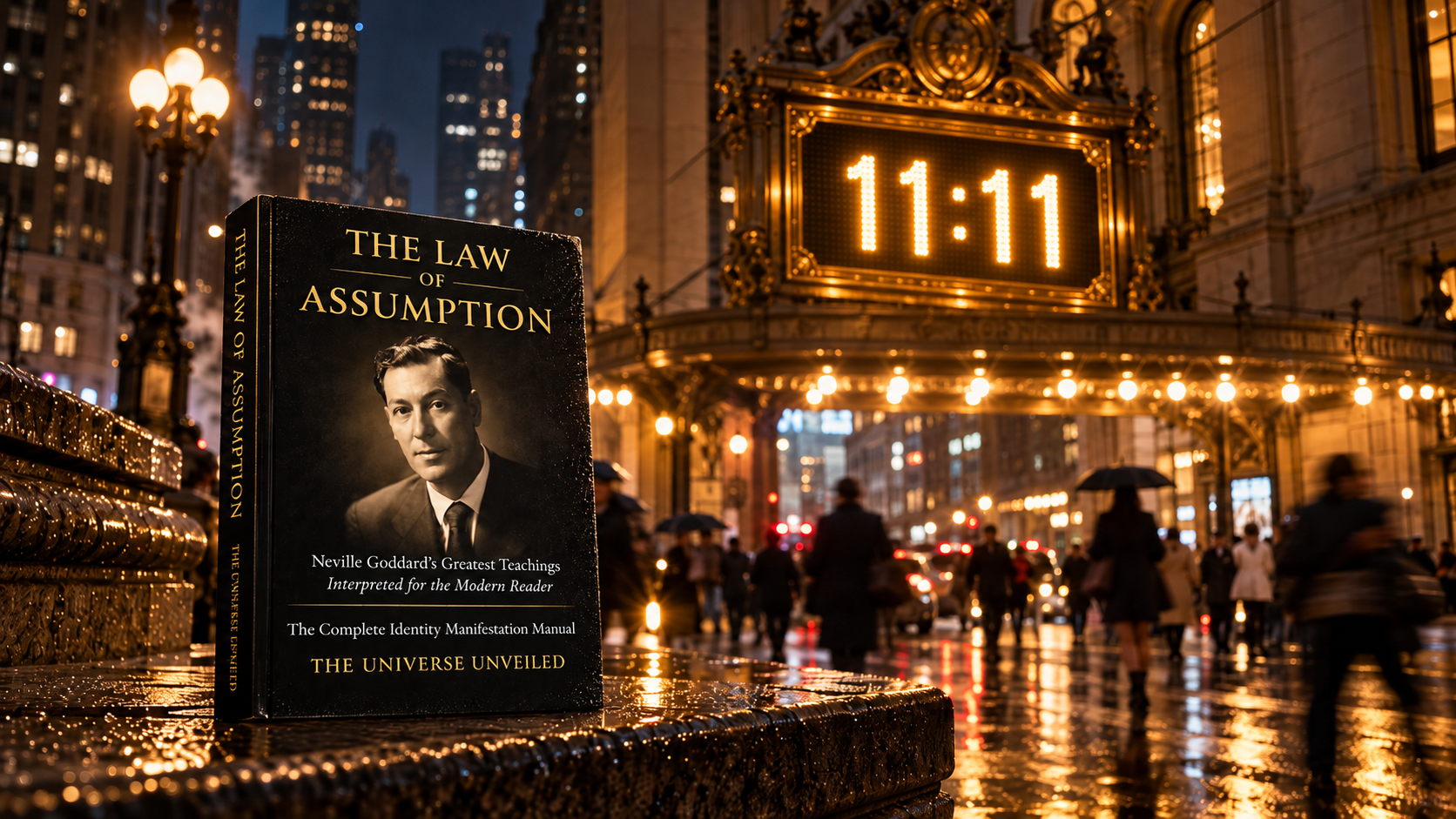

The Portal Series
11:11
Everyone tells you to make a wish.
Nobody tells you what you are actually looking at.
You looked up, and the clock said 11:11 again.
It has happened enough times now that it has stopped feeling like coincidence, and somewhere along the way the internet told you a portal was open and you had a few seconds to make a wish. This article is going to tell you something considerably more useful than that, and it starts by taking the phenomenon more seriously than the believers do — which means first taking the skeptics completely seriously. If you are new to this teaching, the Neville Goddard ultimate guide is the place to begin; this is the piece that explains why the clock has anything to do with it.
Three things are true at once, and nobody ever tells you all three.
Chapter One
The eleventh hour of the eleventh day of the eleventh month
Before it was a portal, it was the most loaded number on the calendar — and it was fixed there by history, not by mysticism.
At 11:00 a.m. Paris time on 11 November 1918, the armistice that ended the First World War took effect. The phrase that attached itself to the moment and never came off was the eleventh hour of the eleventh day of the eleventh month. Four years, an estimated seventeen million dead, and the guns stopped on a triple eleven.

That date is also Polish Independence Day, marking the restoration of a country that had been partitioned off the map for more than a century — the same day, for the same reason.
Hold onto this, because it matters later: the eleventh hour was not a coincidence. It was a decision. The armistice was signed at around five in the morning and deliberately timed to take effect six hours later, on the hour, for the symmetry of it. Human beings chose that number because it felt like it meant something, and then the twentieth century arranged itself around their choice.

By the end of that day, in a dozen countries, 11:11 had been permanently welded to the single most enormous emotional event most living people had experienced. Nobody had to be told to find it significant. It simply was.
Chapter Two
The doorway
Seventy-four years later, the number acquired a second life.
In 1992 a writer publishing under the name Solara released 11:11: Inside the Doorway through Star-Borne Unlimited. The book framed 11:11 not as a sign but as a structure — a doorway opened through a sequence of gates, the first of which was activated in Egypt that year. It had dates, stages, and a defined span. It was not a vibe; it was an architecture, and a global community organised itself around it.
In 2004 George Barnard's The Search for 11:11 carried the idea into a wider audience. Uri Geller, separately and for years, has treated the number eleven as personally significant and collected the meanings he attaches to it.
Whatever you make of any of that, something plainly observable happened: a number that already carried a century of collective weight was handed a vocabulary. And once a thing has a vocabulary, people can notice it.
Which brings us to the part of this story that is not spiritual at all.
Chapter Three
What the clock is actually doing
In 2005, a linguistics professor at Stanford named Arnold Zwicky gave a name to something everybody had experienced and nobody had labelled: the frequency illusion.
You learn a word, and suddenly it is in every article you open. You consider a particular car, and the roads fill with it overnight. The popular name for this came earlier and by accident — in 1994 a man named Terry Mullen wrote to the St. Paul Pioneer Press describing how, after encountering the German militant group Baader-Meinhof once, he could not stop running into the name. The Baader-Meinhof phenomenon stuck.
Zwicky identified two stages, and the order of them is the whole point.
First, selective attention. Your mind is discarding almost everything it receives at every moment, and the filter is set by what currently matters to you. The instant 11:11 becomes salient, the filter changes, and the number starts surviving the cut.
Second, confirmation bias. Now that you are catching it, you begin keeping score — and you only keep score of the hits. You will remember three 11:11s this week with total clarity. You will not have registered a single one of the two hundred other times you checked the time and it said something ordinary.
There is a mathematical version of the same argument. John Allen Paulos, in Innumeracy, makes the case through the law of truly large numbers: given enough glances at enough clocks, the apparently impossible is not merely likely, it is guaranteed. You check the time perhaps dozens of times a day. Over a year, 11:11 is not a message. It is arithmetic.
All of that is correct. I want to be completely clear about this, because the next chapter does not work unless you accept it fully: the number is not appearing more often than chance. The skeptics have the mechanism exactly right.
The mechanism the psychologists described is the mechanism Neville taught. The Law of Assumption is the complete method for running it deliberately instead of accidentally — how to set the filter, how to hold it, and why checking whether it is working is the one move that keeps it from working.
Read The Law of AssumptionChapter Four
What the skeptics get right, and still miss
Here is where almost everyone stops, on both sides.
The skeptic says: it is just the frequency illusion, therefore it means nothing. The believer says: it is not the frequency illusion, it is the universe. Both of them have accepted the same hidden assumption — that if a psychological mechanism explains it, the experience is cancelled.
Look at what actually happened, stated as plainly as possible.
Nothing in the external world changed. No clock was altered. No additional 11:11s were created. Not one physical fact moved.
Something inside you changed. A number became meaningful.
And immediately, the world began showing you that meaning back, repeatedly, as if confirming it.
That is not a disappointing explanation of 11:11. That is a controlled demonstration of the entire teaching, running on your own nervous system, several times a week, with a result you can verify yourself.
“The world is a mirror, forever reflecting what you are doing within yourself.”
Neville GoddardNeville said this for forty years and people took it as poetry. Arnold Zwicky described the delivery system in 2005 and had, as far as anyone knows, never heard of him. The two accounts do not compete. One names the lever, the other tells you what happens when you pull it on purpose — which is the subject of feeling is the secret and of every technique in this work.
The honest conclusion is not that 11:11 is magic, and it is not that 11:11 is nothing. It is this: your attention is already constructing the world you walk around in, right now, without asking you. The clock is simply the one case where the process is slow enough and obvious enough for you to catch it happening.
And if an unintentional shift in attention can reorganise what the world shows you about a four-digit number, the obvious question is what a deliberate one would do about everything else.
Chapter Five
11/11/11, and the people who acted on it
On 11 November 2011, something measurable happened. Marriage registrations surged across the United States and much of Asia. Venues sold out. Registry offices extended hours. Couples who had been unhurried for years suddenly had a date.
Ask what actually caused that and the answer is unavoidable: a shared assumption about a number reorganised thousands of real lives, and left a permanent record in public documents.
No portal was required for that to be true. The assumption did all the work — it changed what people did, and what people did changed the world. That is the law operating in plain sight, at scale, in a form you can look up.
It is also the answer to the complaint that the Law of Assumption is wishful thinking. Nothing about those weddings was wishful. An assumption was taken as true, behaviour followed, and the outer world rearranged to match. The Lions Gate portal works the same way, and so does the 9/9 portal. The date is not a power source. It is a deadline, and deadlines are enormously effective on human beings.
Chapter Six
What to actually do on 11/11
No candle is required. No crystal, no written list at exactly 11:11, no alarm set for the minute.
Use the date for the one thing it is genuinely good for: it is a deadline, so let it force a decision.
Decide the state you intend to occupy from that day forward — not the thing you want, the person for whom that thing is already ordinary. Assume it in the first person, in the present, as a settled fact rather than a hope. If you want the mechanics, this is what the state akin to sleep is for.
Then do the difficult part, which is the only part that has ever mattered: stop checking.
Looking for signs that it is working is the behaviour of a person who does not have the thing. It is a status report filed from the old state, and filing it puts you back there. This is precisely why so many people feel that a portal date did not work — the date was fine; the week spent auditing the universe for confirmation was the problem.
So if 11:11 appears on your clock after that, enjoy it, and give it no authority. It is not a progress report. It is a reminder of the mechanism, which you are now operating on purpose.
Coda
The portal is real. It is not in the clock.

In 1918 a group of exhausted men sat in a railway carriage in a French forest and chose an hour because the symmetry of it felt like it meant something. They were, by any strict accounting, assigning significance to an arbitrary number.
A century later, that arbitrary number is carved into stone memorials in a hundred countries, observed in two minutes of national silence, and tattooed onto people who could not tell you what Compiègne was.
They were right to choose it. Not because eleven has power, but because meaning assigned and then held does not stay an opinion. It becomes a fact in the world, with monuments.
That is the only portal there has ever been, and it is not open for one minute twice a day on November the eleventh. It is open continuously, it has no gatekeeper, and the entry requirement is that you decide what something means and then refuse to keep asking whether you were right.
You have been doing this involuntarily with a clock.
Now do it on purpose, with your life.
- The 11:11 portal
- The name given in modern spiritual practice to November 11, and to the clock reading 11:11, treated as a moment of heightened alignment. The framing traces largely to Solara's 11:11: Inside the Doorway (1992); the date's weight traces to the 1918 armistice.
- Frequency illusion
- A cognitive effect, named by Stanford linguist Arnold Zwicky in 2005, in which something recently noticed appears to be suddenly everywhere. Two stages: selective attention, then confirmation bias. Popularly called the Baader-Meinhof phenomenon, a name coined by Terry Mullen in 1994.
- The Law of Assumption
- Neville Goddard's teaching that whatever state you assume to be true of yourself hardens into fact. You do not pursue the result; you occupy the state in which the result is already yours, and the outer world reorganises to correspond.
- A state
- Not a mood and not a circumstance. The identity you are presently occupying, the one your facts are the evidence of. Two people check the same clock at the same second and only one of them sees a message, because they are not in the same state.
- The law of truly large numbers
- The statistical principle, discussed by John Allen Paulos in Innumeracy, that with a sufficiently large number of trials, extremely unlikely events become not just possible but expected. Applied here: you check the time often enough that 11:11 is inevitable.
What this article is not saying
- MisconceptionThat the frequency illusion debunks 11:11. ActuallyIt explains the delivery mechanism and leaves the significant part untouched. Nothing in the world changed, your attention changed, and the world began reporting back. That is the teaching, described by a linguist.
- MisconceptionThat a portal opens at 11:11 and closes a minute later. ActuallyNo credible version of this idea, including Solara's original framing, describes a sixty-second window. The minute-long portal is an internet artifact, and it produces anxiety rather than assumption.
- MisconceptionThat seeing 11:11 confirms your manifestation is on its way. ActuallyIt confirms your attention has locked onto a theme. Treating it as a progress report keeps you auditing, and auditing is what a person without the thing does.
- MisconceptionThat you need a ritual on November 11. ActuallyThe date's only real power over human beings is that it functions as a deadline. Use it to make a decision, not to perform a ceremony.
- MisconceptionThat 11:11 originated with angel numbers or social media. ActuallyThe armistice fixed the date's meaning in 1918. Solara gave 11:11 its spiritual vocabulary in 1992. Angel-number culture arrived decades after both.
Keep reading
- Armistice of 11 November 1918
- The agreement that ended fighting in the First World War, taking effect at 11:00 a.m. Paris time — the eleventh hour of the eleventh day of the eleventh month. Signed in a railway carriage at Compiègne.
- Solara
- Author of 11:11: Inside the Doorway (Star-Borne Unlimited, 1992), the book that gave 11:11 its modern spiritual framework as a doorway opened through a sequence of gates.
- Arnold Zwicky
- Stanford linguistics professor who coined the term frequency illusion in 2005 to describe the effect by which a newly noticed thing seems to appear everywhere.
- Selective attention
- The first stage of the frequency illusion: the mind filters out almost everything it receives, and what survives the filter is set by what currently matters to you.
- Confirmation bias
- The second stage: once you have begun noticing something, you gather instances that support the impression and fail to register the ones that do not.
- Neville Goddard
- Teacher of the Law of Assumption (1905–1972), whose central claim was that consciousness is the only reality and that the world is a mirror reflecting the state you occupy.
You already know the mechanism works. Now run it on purpose.
The clock proved it to you for free. The Law of Assumption is the complete method: how to choose the state, how to assume it as already true, how to persist when the evidence disagrees, and why checking is the one habit that keeps it out of reach.
Get The Law of AssumptionAvailable in Kindle and Paperback
Frequently asked questions about the 11:11 portal and seeing 11:11
What is the 11:11 portal?
The 11:11 portal is the name given in modern spiritual practice to November 11, and to the moment the clock reads 11:11, treated as a point of heightened alignment for setting intentions. The framing traces largely to Solara's 1992 book 11:11: Inside the Doorway, published by Star-Borne Unlimited, and was carried further by George Barnard's The Search for 11:11 in 2004. The date carried weight long before either: the armistice that ended the First World War took effect at the eleventh hour of the eleventh day of the eleventh month, 1918.
Why do I keep seeing 11:11 everywhere?
Because of a documented cognitive effect called the frequency illusion. Stanford linguist Arnold Zwicky coined the term in 2005. It has two stages: selective attention, where your mind begins picking a thing out once it has become salient, and confirmation bias, where you then gather confirming instances and quietly discard the times you looked at the clock and it said 10:47. The number is not occurring more often than chance. Your attention to it changed, which is a more interesting fact than coincidence.
What is the frequency illusion?
A cognitive bias in which something you have recently noticed appears to suddenly be everywhere. Arnold Zwicky named it in 2005. It is popularly called the Baader-Meinhof phenomenon, a name coined by Terry Mullen in a 1994 letter to the St. Paul Pioneer Press after he mentioned the German militant group once and then kept encountering it. The effect is driven by selective attention followed by confirmation bias.
Where does the 11:11 phenomenon come from?
Its modern spiritual form comes largely from Solara, whose book 11:11: Inside the Doorway was published in 1992 and framed 11:11 as a doorway opened through a sequence of gates, the first activated in Egypt that year. George Barnard's The Search for 11:11 followed in 2004. Uri Geller has also long attached significance to the number 11. The broader cultural weight of the date, however, predates all of it by seventy years.
What happened on 11 November 1918?
The armistice ending the First World War took effect at 11:00 a.m. Paris time, described ever since as the eleventh hour of the eleventh day of the eleventh month. The same date is Polish Independence Day, marking Poland's restoration after more than a century of partition. The most loaded number on the calendar was fixed by history long before anyone called it a portal.
What should you do on 11/11?
Nothing ceremonial is required. The useful move is to treat the date as a deadline for a decision rather than a window for a wish: choose the state you intend to occupy, assume it as already true of you, and then stop auditing the outer world for confirmation. Checking whether it is working is the behaviour of someone who does not yet have the thing, and that behaviour is itself the state you are trying to leave.
What is the Law of Assumption?
The Law of Assumption is Neville Goddard's teaching that whatever state you assume to be true of yourself hardens into fact. You do not pursue the result; you occupy the state in which the result is already yours, and the outer world reorganises to correspond. Neville's phrase for the practice is to assume the feeling of the wish fulfilled.
Does seeing 11:11 mean my manifestation is coming?
It means your attention has locked onto a theme, which is worth knowing. It is not external confirmation that a result has been granted, and treating it as a progress report keeps you checking rather than occupying. Neville's position is that the sign you want is not in the environment: the evidence that an assumption has taken hold is that it stops needing evidence.
Historical sources: the Armistice of 11 November 1918; Solara, 11:11: Inside the Doorway (Star-Borne Unlimited, 1992); George Barnard, The Search for 11:11 (2004); Arnold Zwicky on the frequency illusion (2005); Terry Mullen, St. Paul Pioneer Press (1994); John Allen Paulos, Innumeracy. Images public domain via Wikimedia Commons.