As a Man Thinketh: A Deep Reading of James Allen's Classic
James Allen distilled the law of mind into one short book: a man is literally what he thinks. This deep reading walks all seven chapters — character, circumstances, health, purpose, achievement, vision, and serenity — and shows why it is the most concentrated statement of New Thought ever written.

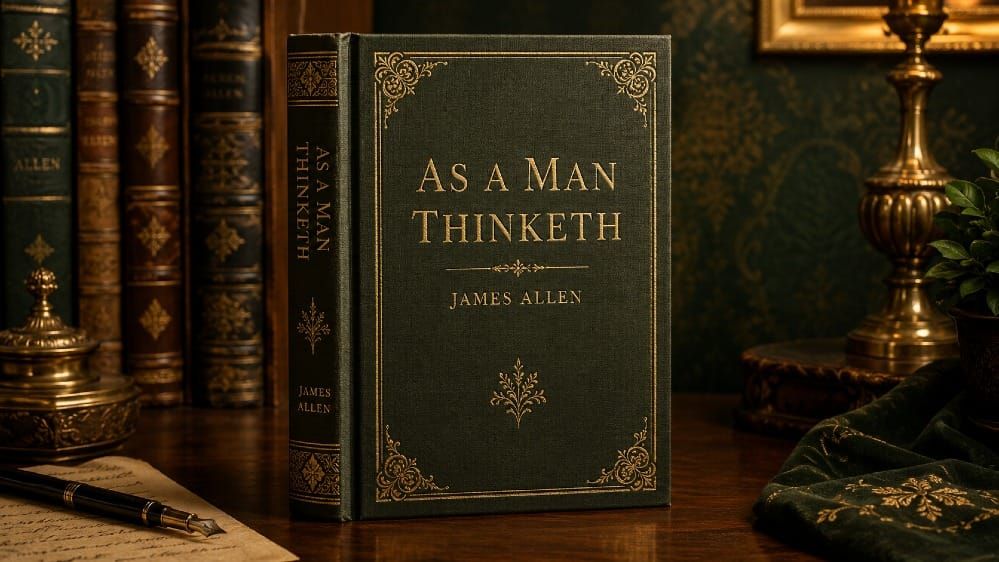
As a Man Thinketh (1903) by James Allen argues that thought is the cause and circumstance the effect — that "a man is literally what he thinks." By mastering the mind the way a gardener tends a plot, a person shapes their character, health, achievements, and destiny from the inside out.
It is the most concentrated statement of New Thought ever written, drawn from the proverb "as a man thinketh in his heart, so is he." And it is not wishful thinking: Allen insists you do not attract what you want, but what you are — circumstance does not make you, it reveals you.
Go deeper with The Law of Assumption, the modern method built on the same law of mind.
Twenty pages that hold the whole law of the mind
James Allen wrote almost nothing else as enduring, and never needed to. Here is what his small book actually teaches — and the line everyone gets wrong.
In 1903, a former clerk living quietly in the seaside town of Ilfracombe, England, published a book so small it can be read in an hour. James Allen had walked away from business to write, and he poured the essence of everything he believed into roughly twenty pages built on a single line from the Book of Proverbs: "as a man thinketh in his heart, so is he." More than a century later, As a Man Thinketh has outsold and outlasted thousands of longer works, and seeded nearly every self-help author who came after.
Its brevity is deceptive. Allen is not offering tips; he is making one enormous claim and following it relentlessly to its conclusions. The claim is that thought is the hidden cause behind every visible circumstance, and that a person, by taking command of their inner life, can remake their character and through it their destiny. To read the book closely is to find the purest, most distilled statement of an idea that Wallace Wattles, Napoleon Hill, and Neville Goddard would each spend whole careers elaborating.
As a Man Thinketh: an 1903 essay by James Allen holding that thought is the cause and circumstance the effect, so that a person's character, body, and conditions all grow from the thoughts they habitually entertain.
The mind as a garden: Allen's central metaphor — the mind will yield growth whether tended or neglected, so right thoughts must be planted deliberately or useless ones take the ground.
Thought as cause: the principle that cause and effect operate as exactly in the inner world of thought as in the outer world of matter.
The one idea behind the whole book
Allen states his thesis in the first sentences and never retreats from it: a person is literally what they think, their character being the complete sum of all their thoughts. From this everything follows. If thought is cause, then no circumstance is truly accidental, no character is fixed by fate, and no one is purely a victim of their conditions. We are, in his stark phrasing, made or unmade by ourselves.
This is bracing rather than comforting, and that is the point. Allen's law means you are responsible for your inner life, not that you are to blame for every external event. He is careful: circumstances may be harsh and undeserved, but the response, the meaning, and the slow rebuilding all begin in thought. Cause and effect, he insists, are as undeviating in the hidden realm of mind as in the visible world.
— The Central Law —
A man is literally what he thinks, his character being the complete sum of all his thoughts.
James Allen, As a Man ThinkethThe seven chapters, one by one
Allen built the book as seven short movements, each taking the law of thought into a different region of life. Read together they form a complete arc, from the making of character to the peace that crowns it.
1. Thought and Character
The foundation. Character is not given by chance or favor; it is the accumulated result of thought, the way a plant is the result of its seed. Every act springs from a hidden seed of thought and could not have appeared without it. A noble character, Allen says, is the natural fruit of long-continued right thinking, and a weak one the fruit of its opposite. You cannot, in his view, separate what you think from what you are.
2. Effect of Thought on Circumstances
Here is the chapter most often misread. Allen argues that outer circumstances grow out of inner thought as surely as a plant grows from soil, so a person's life conditions are harmoniously related to their inner state. But he is emphatic about the mechanism: people do not attract what they want, but what they are. This means circumstance reveals character rather than simply obeying desire. Change happens not by demanding different conditions but by becoming a different person within.
— The Line Everyone Misreads —
Men do not attract that which they want, but that which they are.
James Allen, on why circumstances change3. Effect of Thought on Health and the Body
Allen extends the law to the body, which he treats as the obedient servant of the mind. Thoughts of fear, anxiety, and bitterness, held long enough, write themselves into the face and the frame; thoughts of joy, goodwill, and serenity renew it. He is not denying medicine so much as insisting that the inner life leaves a visible mark, and that to change the body's habitual state you must first change the mind that governs it.
4. Thought and Purpose
Thought without aim accomplishes nothing. Allen says those who have no central purpose fall easy prey to worries, fears, and self-pity, drifting toward failure. The remedy is to conceive of a legitimate purpose and set the mind upon its accomplishment, making it the focusing point of one's thoughts. Purpose here means a single concentrated aim, not a vague intention. Even those not yet ready for a great purpose, he advises, should fix their thoughts on the flawless performance of their immediate duty.
5. The Thought-Factor in Achievement
All that a person achieves and all that they fail to achieve, Allen writes, is the direct result of their own thoughts. A person rises, conquers, and achieves by lifting their thoughts; they remain weak and abject by refusing to. He ties achievement to sacrifice: greater accomplishment demands the surrender of lower, scattered desires in favor of the one aim. Success of every kind, in his telling, is a crown earned by disciplined thought.
6. Visions and Ideals
The most lyrical chapter, and the one closest to modern manifestation. Allen calls the dreamers the saviors of the world and tells the reader to cherish their visions and ideals, for they are the seedlings of their eventual reality. You will become, he promises, what you most steadily and lovingly contemplate. The poor youth who holds the vision of refinement and accomplishment will, in time, grow toward it.
— On Vision —
Dream lofty dreams, and as you dream, so shall you become. Your vision is the promise of what you shall one day be.
James Allen, As a Man Thinketh7. Serenity
The book ends not in striving but in stillness. Calmness of mind, Allen says, is one of the beautiful jewels of wisdom, the result of long and patient self-control and a settled understanding of the laws of thought. The serene person, having learned to govern themselves, becomes a steadying presence for others. It is a striking close: the reward of mastering thought is not endless acquisition but peace.

Allen gave us the law: you become what you think. The Law of Assumption turns it into a daily, repeatable technique.
Get the BookCommon misconceptions about As a Man Thinketh
Misconception: it teaches that you attract whatever you want. Allen says almost the reverse — you attract what you are, not what you crave. The work is on character, not on wishing harder.
Misconception: it blames people for their misfortunes. Allen places responsibility on your inner response and habitual thought, not on assigning blame for every hardship. He says circumstance reveals you to yourself, which is an invitation to grow, not a verdict.
Misconception: it is just early positive thinking. The book is moral and spiritual at its core, tying thought to character, duty, sacrifice, and serenity. It is far closer to practical philosophy than to mood management.
Misconception: being short, it is shallow. Its brevity is compression, not thinness. Allen could have written five hundred pages; instead he distilled the law to its essence.
Where As a Man Thinketh sits in the lineage
Allen's small book is the philosophical heart of the New Thought movement, and reading it alongside its neighbors shows why. Where Wallace Wattles' Science of Getting Rich gave the law a wealth-focused method, and Napoleon Hill's Think and Grow Rich rebuilt it into a step-by-step success system, Allen supplies the bedrock principle both rest on: that thought is the creative cause of everything a person becomes.
From this root the line runs forward to the modern manifestation teachers. Neville Goddard would take the same conviction — that the inner state determines the outer life — and refine it into the precise daily practice of assuming the feeling of the wish fulfilled. Allen states the law; the teachers who followed turned it into technique. Read in order, they are one continuous argument across a century.
— The Universe Unveiled Reading —
At The Universe Unveiled, As a Man Thinketh is read as the purest distillation of the New Thought law: the single principle that thought is cause and circumstance effect, stated without method or decoration, that every wealth and manifestation teaching since has been busy applying.
Glossary: key terms in As a Man Thinketh
Thought as cause: the principle that cause and effect operate as exactly in the inner world of thought as in the outer world of matter.
The mind as a garden: Allen's metaphor for cultivation — plant right thoughts deliberately, or useless ones grow by default.
Character: the accumulated sum of a person's habitual thoughts, made visible in conduct and condition.
Circumstance: the outer condition that grows out of, and reveals, a person's inner state.
Purpose: a single, legitimate, concentrated aim that focuses scattered thought into power.
Visions and ideals: the cherished mental pictures a person grows toward over time.
Serenity: the calm self-mastery that is the final fruit of right thinking.