Black Mystics of Harlem: Hidden Spiritual Power in America
Harlem was once a spiritual capital of Black mystics, prophets, rabbis, bishops, and metaphysical teachers. This cinematic guide explores Abdullah, Father Divine, Noble Drew Ali, Arnold Josiah Ford, Sweet Daddy Grace, and Mother Rosa Horn.
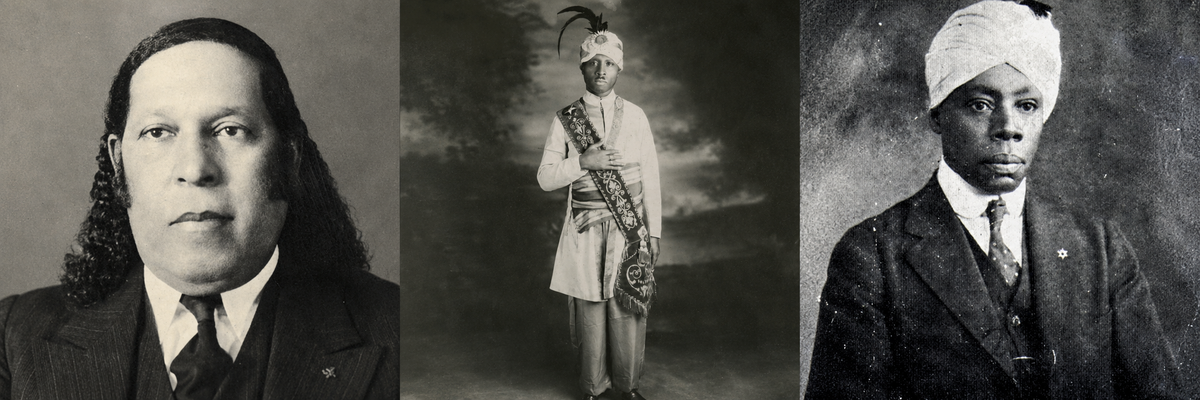
The Mystics of Harlem
Upper Manhattan
& the Hudson Valley Begin
For a few years between the wars, the air on 125th Street was thick with visions.
There has never been another season like it in American religious life. Inside a stretch of perhaps twenty blocks, a generation of Black mystics, prophets, rabbis, and self-appointed messiahs built churches, synagogues, and storefront prayer halls at a rate the city could not catalogue.
They came from Barbados and Georgia and the Cape Verde islands, from the Mississippi Delta and the West African coast. They preached in Hebrew letters chalked on tenement walls, in the cadences of the Black church, in languages their congregations had never heard. They claimed lineages from Solomon and Sheba, from the Ethiopian highlands, from schools the West had no name for.
And then, almost as quickly as they came, most of them were gone — to Philadelphia, to Addis Ababa, to anonymous graves, to a handful of faded recordings and the memory of one or two famous students. This is the story of six of them. One of those students would carry a single teacher's method to millions of readers — but we are getting ahead of the film.
The preacher who abolished his own past.
He was born George Baker Jr. in Maryland sometime around 1876 — the year contested, the place uncertain, the very fact of his birth later disputed by Father Divine himself, who taught that he had no origin and no end.
By 1919 he was preaching on Long Island. By 1932 he had moved to Harlem and was running what may have been the largest interracial religious movement in the United States. Followers called him Father. They believed he was the literal embodiment of God, present and walking among them.
What he taught was a fierce American gospel of abundance, racial equality, and present-tense divinity. Followers surrendered debt, addiction, and racial self-identification. In return, the Peace Mission fed them — vast public banquets in Harlem hotels, free to anyone who walked in, through the worst years of the Depression. He never charged a cent for a meal, and never explained where the money came from.
By 1942, harassed by tax investigations, he moved his headquarters to Philadelphia. He died there in 1965. The Hudson Valley estate still stands. The Harlem banquets do not.
.jpg)
Divine
"You don't have to believe in me. Just live the life I teach — and you will be God in the end yourself."Attributed to Father Divine, Harlem, 1936
The founder of an American religion that still meets today.
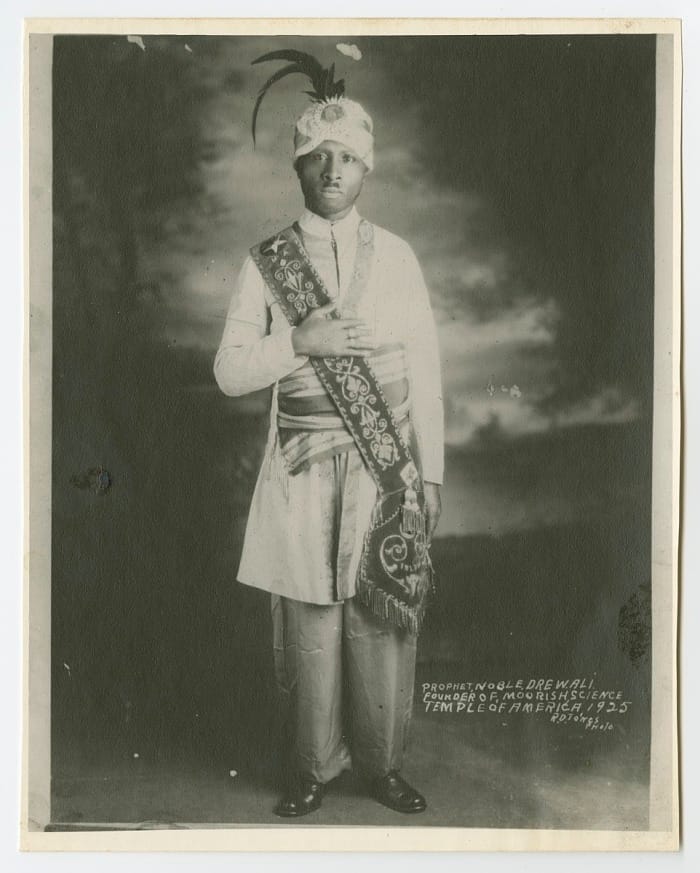
Drew Ali
Timothy Drew was born in North Carolina in 1886. By the early 1910s he had remade himself entirely — as Noble Drew Ali, prophet of a faith that taught Black Americans were not "Negro" at all but Moorish, descendants of the ancient Moabites, their true religion Islam, their true nationality long stolen from them.
He founded the Moorish Science Temple in 1913. By the late 1920s it had spread through Chicago, Detroit, Philadelphia, and Harlem, with thousands of members carrying nationality cards and adding El or Bey to their names — a deliberate reclamation of an identity they were taught had been erased.
His teaching fused Islam, Christianity, Garveyite nationalism, and a strand of New Thought metaphysics: the conviction that mind and self-conception shape material reality. The Temple's emphasis on the mind as a creative force places it squarely in the same Harlem current that produced this film's other subjects.
Drew Ali died in 1929, weeks after being taken into police custody, under circumstances never explained. The Moorish Science Temple still gathers today — one of the few Harlem-era movements that never disappeared. Read the full study of Noble Drew Ali and the mind.
He built a synagogue, then sailed for Ethiopia and never returned.
He arrived in New York in 1910, a young musician from Bridgetown trained in the Anglican choirs of Barbados. Within a decade he was musical director of Marcus Garvey's Universal Negro Improvement Association — the largest mass movement of Black people in American history — and the composer of its Universal Ethiopian Anthem.
Then Ford concluded that the spiritual home of the African diaspora was Israel: that the African and the Hebrew were one people, separated by centuries of forced amnesia. He founded Beth B'nai Abraham on 135th Street in 1924. He learned Hebrew and Arabic. He studied the Kabbalah. He preached an austere, scholarly Judaism drawing on traditions from the Beta Israel of the Ethiopian highlands.
And here the film bends back on itself. Ford taught Hebrew, the Kabbalah, and a radically reinterpreted scripture to private students in the same handful of Harlem years that a vanished teacher known only as Abdullah was doing precisely the same thing a few miles south. Serious scholars have argued they may have been the same man.
In 1930, when Haile Selassie was crowned Emperor — read by many as biblical prophecy fulfilled — Ford liquidated his affairs and sailed for Addis Ababa. He established a settlement of eight hundred acres. He died in Ethiopia in 1935, weeks before the Italian invasion, in an unmarked grave.
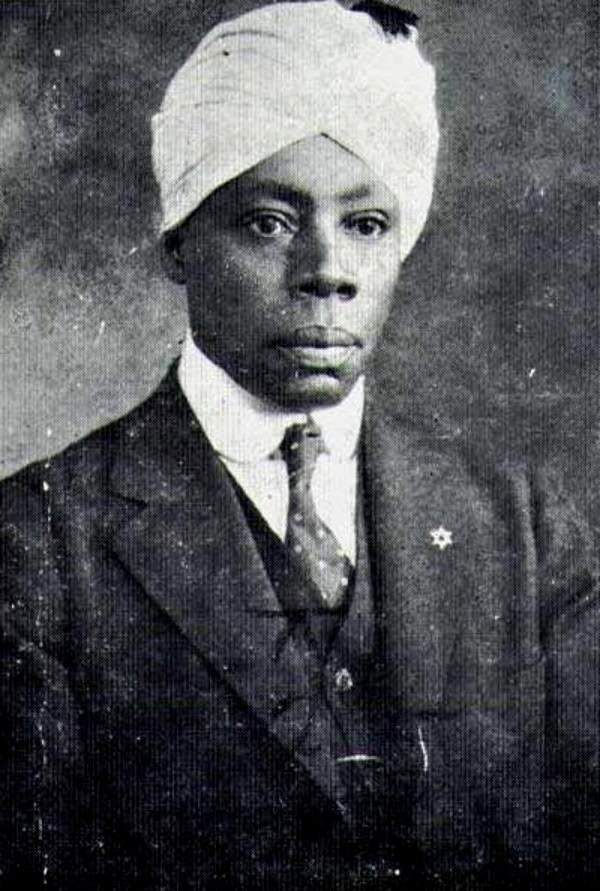
Josiah Ford
One hundred and eleven churches, built from nothing.

Daddy Grace
He was born Marcelino Manuel da Graça in Cape Verde in 1881 and came to Massachusetts as a young immigrant, working as a cook and a cranberry picker before he became, by the 1920s, Sweet Daddy Grace — bishop, founder, and sole authority of the United House of Prayer for All People.
Famous for shoulder-length hair, inch-long painted fingernails, and flamboyant suits, Grace built a denomination of more than a hundred churches along the eastern seaboard, financed by his congregations and a small empire of branded products — Daddy Grace coffee, soap, hair pomade.
Beneath the showmanship was a serious theology of ecstatic worship, mass baptism, and divine prosperity that prefigured the prosperity gospel by half a century. His mass fire-hose baptisms in Harlem drew thousands and rivaled Father Divine's banquets for sheer public spectacle.
He died in 1960 worth millions. Unlike most of the movements in this film, the United House of Prayer survived him intact and continues to operate today.
The pioneer who preached to a city she could not see.
Born in Georgia in 1880, Rosa Artimus Horn became a bishop in an era when almost no church in America would ordain a woman — and built the Pentecostal Faith Church on Lenox Avenue around a ministry of faith healing and what her followers described as resurrections.
Her decisive innovation was the microphone. From 410 Lenox Avenue she launched "You Pray for Me, I'll Pray for You," one of the first radio ministries in America led by a Black woman, broadcasting across multiple states to listeners who never set foot in Harlem.
Among the children listening to her broadcasts, by his own brother's account, was a young Malcolm Little — later Malcolm X — whose family followed Horn's program in Michigan. Her reach into living rooms hundreds of miles away was a kind of power none of the men on this avenue, for all their spectacle, ever matched.
She preached into the 1970s and died in 1976, one of the few figures in this film who outlived her own era — and one of the very few whose pulpit was a woman's.
Rosa Horn
The teacher who left almost nothing — except one student.
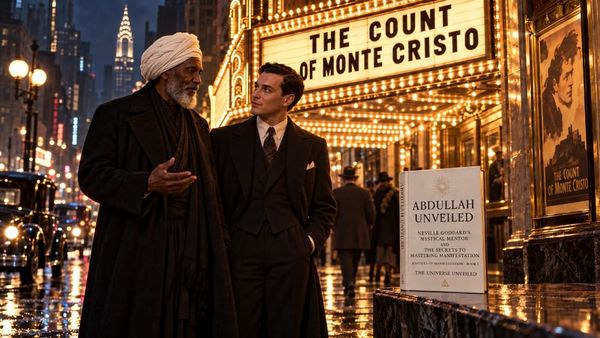
Almost everything we know about him comes from a single source: the recorded lectures of one Neville Lancelot Goddard, a young Barbadian dancer who walked into Abdullah's classroom in the autumn of 1931 and did not leave for seven years.
There is no photograph. No published writing. No verified birth record. No grave. Scholars have argued for decades over whether Abdullah was one man, a composite of several teachers, or in fact Arnold Josiah Ford himself — Chapter Three of this very film — taking a private student in his final Harlem year.
What survives are the fragments Neville recalled, almost always the same handful: Abdullah teaching him Hebrew letter by letter; Abdullah insisting, on a freezing January night, that he was already in Barbados though his body had not left the room; Abdullah refusing, year after year, to let his student copy a single transliteration onto paper. "It must go through you," he is reported to have said, "or it will go through nothing."
Around 1938 he left New York on a steamer "to the East." The trail ends there — no headstone, no obituary, no register entry anyone has located. His one persistent student went on to give roughly four thousand public lectures over the next thirty-four years, and the method Abdullah refused to let him write down is now read and practiced on six continents. The fullest account ever assembled of who this man was — and what he taught in those rooms — is the subject of the foundational study of Abdullah, the mentor of Neville Goddard.
Meet Abdullah, the Mystical Mentor of Neville Goddard
Learn how Neville learned: through the teacher who showed him how to assume the fulfilled state before the world agreed.
Black Mystics of Harlem FAQ: Abdullah, Father Divine, Prophets, and Hidden Spiritual Power
A concise guide to the Black mystics, prophets, rabbis, bishops, and spiritual teachers who made Harlem one of the hidden capitals of American metaphysics.
The Black mystics of Harlem were spiritual leaders, prophets, rabbis, bishops, healers, and metaphysical teachers who reshaped American religious life in the early twentieth century. They included figures such as Abdullah, Father Divine, Noble Drew Ali, Arnold Josiah Ford, Sweet Daddy Grace, and Mother Rosa Horn.
Harlem became a spiritual crossroads because migration, Black identity, religious experimentation, Ethiopianism, Moorish science, Pentecostal power, New Thought, and esoteric scripture all met there. It was not only a cultural capital. It was also a spiritual laboratory.
Many Black mystics taught that identity, faith, imagination, divine authority, and inner conviction could transform outer life. Their teachings often centered on the same principle later found in modern manifestation: the self you accept inwardly becomes the life you experience outwardly.
Yes. Abdullah is remembered as the mysterious Black spiritual teacher who instructed Neville Goddard in scripture, Hebrew, and the principle of assuming the fulfilled state. Though his historical identity remains debated, his teaching belongs to Harlem’s hidden metaphysical lineage.
Abdullah was the teacher Neville Goddard credited with awakening him to a deeper understanding of scripture, imagination, and assumption. The famous Barbados story, where Abdullah insisted Neville was already in Barbados before the physical evidence appeared, became one of the clearest examples of the Law of Assumption.
Some researchers have proposed that Arnold Josiah Ford may have been Abdullah because Ford was a Barbadian-born Black Hebrew teacher active in Harlem, deeply connected to scripture, Hebrew, Ethiopia, and esoteric study. The theory is compelling, but it has not been proven.
Father Divine taught abundance, racial equality, discipline, communal support, and present-tense divinity. His Peace Mission movement offered food, structure, and spiritual identity during the Depression, turning belief into a lived social system.
Noble Drew Ali matters because he taught Black Americans to recover a hidden spiritual and national identity. His Moorish Science Temple blended Islam, scripture, metaphysics, nationality, and self-concept into one of the most influential Black spiritual movements in America.
Mother Rosa Horn was a Black woman bishop, preacher, faith healer, and radio ministry pioneer in Harlem. Her broadcast ministry reached listeners far beyond New York, making her one of the most important but underrecognized spiritual voices of her era.
Their legacy is the hidden architecture of modern spiritual power: identity as destiny, scripture as inner code, abundance as divine inheritance, and imagination as a force that can reorganize life. Harlem preserved a lineage that still echoes through manifestation, New Thought, Black spirituality, and Neville Goddard’s work.
One avenue. One decade. One student who remembered everything.
The Harlem of these six is gone. The synagogues are parking lots, the lecture rooms apartment buildings, the banquet halls demolished. But the teaching one of them handed a single persistent student is still being read, listened to, and practiced — in three languages, on six continents, nearly a century later.
A documentary in six chapters · Print of one · Confidential