The Identity Doctrine
Manifestation is not about attracting outcomes—it’s about becoming. This doctrine explains how identity, assumption, and the subconscious shape reality, and why true change occurs when identity stabilizes.


Reality reorganizes around identity
The Universe Unveiled is built on a single principle:
Reality does not respond to desire.
It responds to identity.
Manifestation is not the process of attracting outcomes.
It is the process of becoming someone for whom those outcomes are inevitable.
Everything on this platform—every essay, every book, every audio—points back to this structure:
What you consistently identify as true becomes the framework through which reality organizes itself.
When identity is unstable, results fluctuate.
When identity stabilizes, outcomes follow without force.
What this is—and what it is not
This work is often mistaken for motivation, mindset, or positive thinking.
It is none of those.
This is not:
- surface-level manifestation techniques
- affirmations without structure
- temporary mindset shifts
- emotional highs mistaken for change
This is:
- identity transformation
- subconscious reprogramming
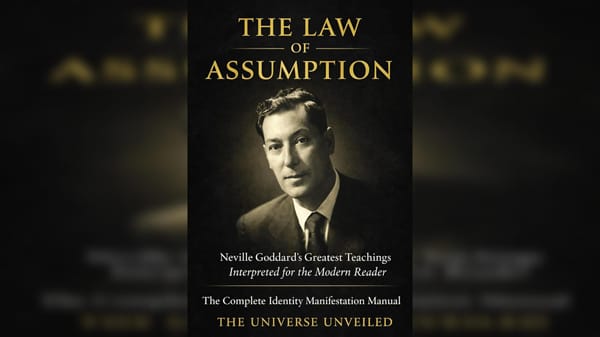
- the Law of Assumption applied precisely
- the study of how reality reflects internal coherence
The goal is not to feel better temporarily.
The goal is to become different at the level where results are produced.
The core structure
This platform operates on a small number of consistent principles.
They appear across disciplines, traditions, and lived experience.
1. Identity is the law
Everything begins with self-concept.
Not what you want.
Not what you try.
Who you are.
Your identity determines what feels natural, expected, and possible.
2. Assumption precedes evidence
Reality does not convince you.
You convince yourself—and reality follows.
What is internally accepted as normal, true, or inevitable begins to externalize.
This is often described as the Law of Assumption:
The world reflects what you assume to be real.
3. The subconscious executes
The subconscious mind is not an obstacle.
It is the mechanism.
It governs:
- habits
- emotional reactions
- behavior
- perception
It accepts what feels familiar as true and works to confirm it automatically.
→ Subconscious Reprogramming Library
4. Repetition installs identity
Change does not occur through effort.
It occurs through repetition.
What is repeated becomes familiar.
What is familiar becomes normal.
What is normal becomes identity.
This is why most people fail:
They attempt to change outcomes without changing what feels natural.
5. Attention stabilizes reality
Attention is not passive.
It is directional.
Where attention goes, identity reinforces.
When attention is fragmented, results are inconsistent.
When attention stabilizes, outcomes begin to feel inevitable.
How change actually happens
Change is not created through force.
It is created through replacement.
You do not fight an identity.
You outgrow it.
When a new way of thinking, seeing, and responding becomes familiar enough, the system updates without resistance.
This is not willpower.
It is accommodation.
Why most manifestation fails
Most approaches to manifestation fail for one reason:
They focus on outcomes instead of identity.
They attempt to:
- visualize without stabilizing self-concept
- affirm without internal agreement
- act without underlying coherence
This creates temporary movement—but not lasting change.
Without identity alignment, results remain unstable.
The structure of this platform
The Universe Unveiled is not a collection of random content.
It is a system.
Each part serves a specific function:
The Archive
Understanding
Essays, stories, and frameworks that reveal the structure behind manifestation.
The Reprogramming Library
Installation
Audio sessions designed to shift identity at the subconscious level.
The Books
Depth
Long-form doctrine exploring identity, assumption, and reality across different lenses.
Private Work
Transformation
Direct guidance for restructuring identity and producing real-world results.
How to use this work
There is no required order.
You do not need to read everything.
You need to recognize patterns.
Across different topics—psychology, myth, performance, lived experience—the same structure repeats:
- identity stabilizes
- perception shifts
- reality reorganizes
Read what draws you.
But more importantly:
Notice what repeats.
That is where the shift begins.
Final
This is not a philosophy.
It is not a theory.
It is a structure.
And once seen, it cannot be unseen.
Jean-Léon Gérôme, Bonaparte Before the Sphinx, 1886.
Oil on canvas. Hearst Castle Collection, San Simeon, California.