Manifesting With the Moon: The Four Gates of the Lunar Cycle
Most moon practice is a handful of unconnected rituals. This is one desire carried through a full cycle: plant it at the new moon, feed it as the light grows, receive it at the full moon, and cut away what contradicts it as the light withdraws. Four gates, one sentence, twenty-nine nights.

The Practice
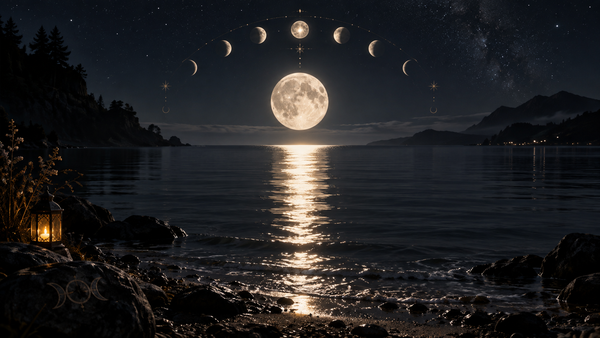
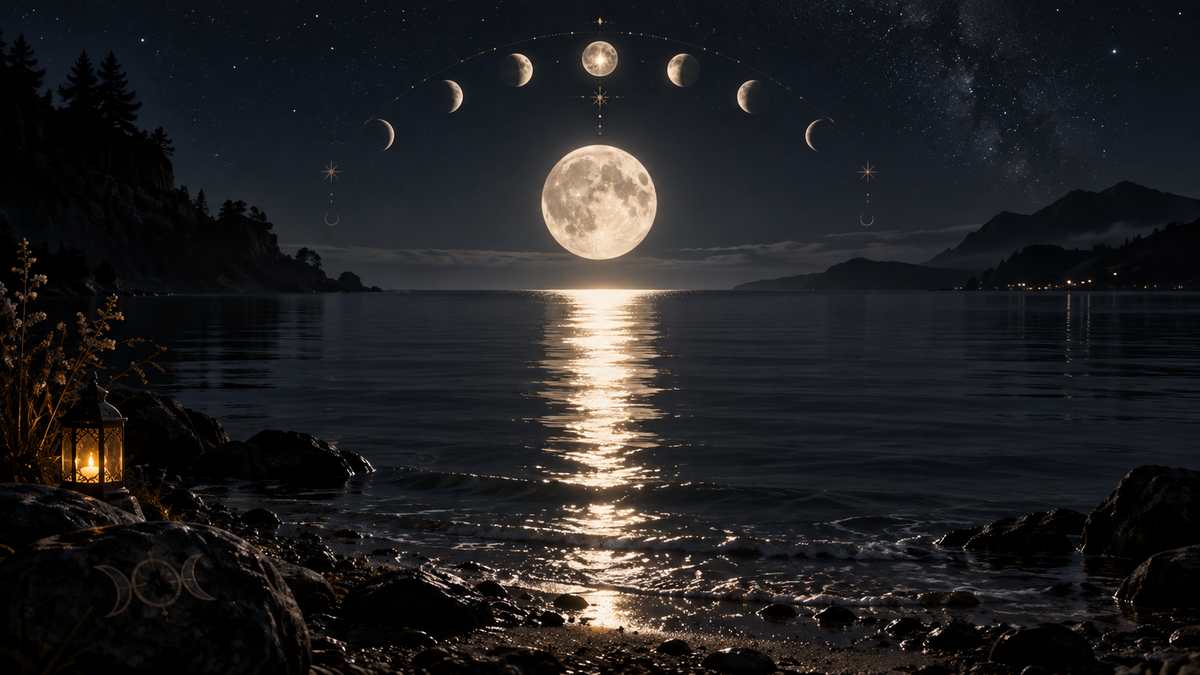
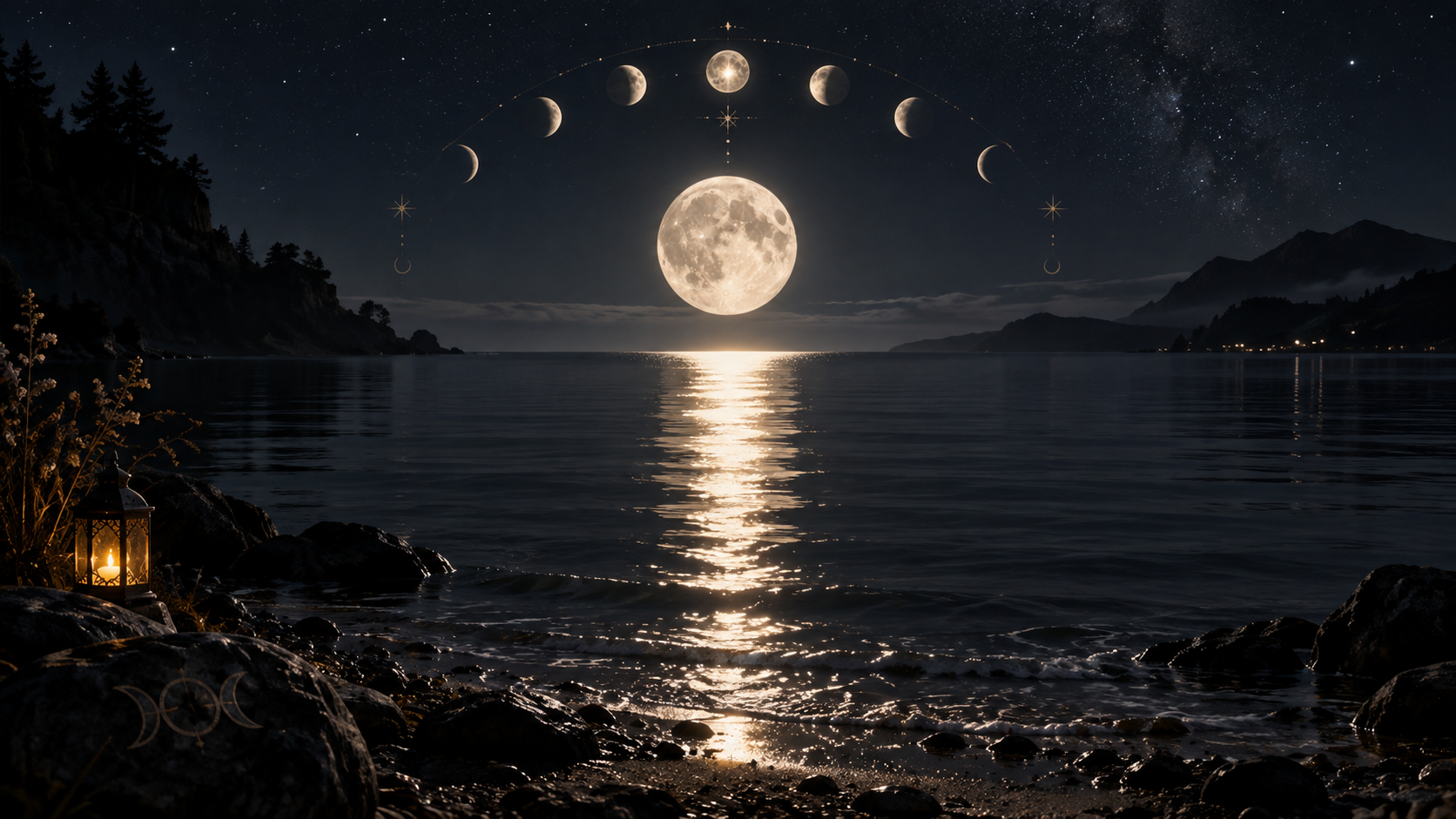
Manifesting with the moon means working one desire through a single lunation — twenty-nine and a half nights — using four ritual gates instead of scattered, unrelated spells. At the new moon you impress. Through the waxing you feed. At the full moon you receive and give thanks. Through the waning you cut away what contradicts. The power is never in the phase; the phase is the discipline that keeps you from starting over every time you get restless.
This is the same cyclical logic behind sacred solitude and the older feminine archetypes of manifestation: withdraw, form, reveal, release.
Moon rituals, lunar practice, and the work of the four gates — sent straight to you.
Sign up for our newsletterBefore there were calendars there was this: a woman standing outside, counting nights. Twenty-nine of them, and then the same white sliver again in the same corner of the sky. Every ritual tradition that has ever used the moon began with that observation and drew the same conclusion — that some things are not built by force but by return. You do not push a cycle. You keep an appointment with it.
Most moon practice sold today has lost that. It offers a list of unrelated acts: a jar on a windowsill, a page torn and burned, a list of wishes written at some auspicious hour. Pleasant, photogenic, and disconnected. What follows is the opposite — one desire, one lunation, four gates, and a set of workings that are the same working seen from four positions.
What Manifesting With the Moon Means
Manifesting with the moon is the practice of carrying a single desire through one complete lunar cycle, performing a specific rite at each of four phases, so that impression, persistence, reception and release each get their season.
A lunation is one full cycle from new moon to new moon, averaging 29.5 days. It is the natural container of this work. One desire per lunation. Not three.
A gate is a phase treated as a threshold rather than a date — a point at which one kind of inner action is appropriate and the others are not.
Moon water is water left exposed to the light of a full or new moon and consecrated by a spoken intention, used afterward as a physical anchor for that intention.
The Law Underneath the Ritual
The moon produces nothing. Not one particle of the light you have ever seen on its face belonged to it. It is a surface that receives and returns, and it returns with total fidelity — it cannot brighten what fell on it and it cannot dim it. This is not poetry, it is the physical fact, and the old traditions built their entire lunar symbolism on it.
Which is why the moon was given, almost universally, to the inward mind. Hermetic writing gives the Sun to the active, originating principle and the Moon to the receptive, formative one. Egyptian practice crowned Thoth — god of measure, of the calendar, of the written word — with the lunar disc, because what is written down is exactly what gets returned to you. Alchemists drew the same pair as king and queen, sol and luna, and told their students that no work completes without both.
The instruction hidden in all of it is the same. Whatever you hold steadily becomes what is reflected back at you, at full strength, without editing. The moon is simply the largest and slowest demonstration of that principle available to the naked eye, running on a loop, thirteen times a year.
Before You Begin: The Altar
You need very little, and the little should be permanent. A ritual that requires shopping will not survive four cycles.
What to gather
A shallow bowl, dark if possible, for water. One white or silver candle that lives here and is used only for this. A small mirror, laid flat, face up. Salt in a closed vessel. A single journal reserved for the cycle. Something silver — a ring, a coin, a chain — that you can wear.
Where to put it
North-facing if you have the choice, near a window if you can, but a closet shelf you visit faithfully beats a beautiful table you visit twice. The altar's only real requirement is that you pass it daily.
The hour
Work after dark, and work at the same clock time every night of the cycle. Not because a particular hour carries power, but because the repetition is the power, and a fixed hour is what makes repetition survive a bad week.
More moon work, every cycle.
Sign up for our newsletterThe First Gate: New Moon, the Gate of Silence
At the new moon the moon is not absent. It is between you and the sun, unlit on the face you can see, which is the oldest available picture of something real and entirely invisible. This is the night you plant, and planting is done in the dark.
The working
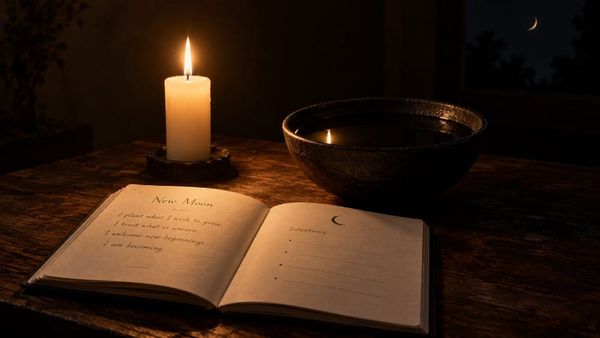
Fill the bowl with water. Light the candle. Sit until your breathing has slowed on its own — not forced, just waited for.
Then write one sentence in the journal. One. Present tense, first person, and phrased as a condition rather than an event: not I will get the offer but I am settled in work that suits me. Events are narrow and can be refused by circumstance. Conditions are wide and can be met a hundred ways.
Read the sentence aloud once. Once only. Then put out the candle with your fingers or a snuffer, never a breath — the old rule, and a useful one, because it makes you pause and be deliberate at the exact moment you would otherwise rush.
The three nights of silence
For the three nights that follow, you do not speak the sentence, write it, or discuss the desire with anyone. This is the part people skip and it is the part that works. A seed dug up to check on it is a seed you have killed. Silence here is not superstition — it is the practical refusal to convert a private conviction into a social performance before it has any roots.
The Second Gate: Waxing Moon, the Gate of Feeding
From the fourth night until the full moon, the light grows every evening without anything being added to the moon. Nothing new arrives. The same borrowed light is simply turned further toward you. Your work in this stretch is identical in character: no new material, only more turning.
The working
Same hour. Same candle. Speak the sentence once, then sit for a few minutes and hold the feeling of the condition already being ordinary — not thrilling, ordinary. Relief rather than excitement. The nervous system knows the difference and only one of them is a state you could actually live in.
Wear the silver through this stretch. It is a touchstone: when your hand finds it during the day, you speak the sentence inwardly and move on. No ceremony. Two seconds.
If you miss a night
You resume. You do not restart the cycle, do not double up, do not add a penance. The cycle is not a streak. Treating a missed night as a failure is how people quit in month two, and quitting is the only real failure available here. The practice described in sacred solitude applies exactly: withdrawal is part of the rhythm, not a break in it.
The Third Gate: Full Moon, the Gate of Mirrors
The full moon is the whole borrowed face turned toward you. Nothing has been created. What was there in the dark is now simply visible. This is a night of reception and thanks, and — this is the difficult instruction — thanks given for what has not yet appeared.
The working
Set the bowl where moonlight can reach it, or under an open sky if you have one. Lay the mirror face up beside it. Light the candle.
Speak the sentence. Then speak the thanks in the same tense — thank you for this settled work — and stay there long enough for it to stop feeling like a lie. It will feel like a lie at first. Sit anyway. The feeling of having is what you are practising; the sentence is only the doorway.
Look into the mirror last, and look at your own face rather than the sky. The instruction is not decorative. The whole cycle is the claim that the light is returned rather than granted, and the face in the mirror is the thing doing the returning. This is the receptive posture the divine feminine traditions put at the centre of their practice, and the one most of us are worst at.
Making the moon water
Leave the bowl out for the hours of full light — overnight if you can, three hours if that is what your life allows. Cover it with a cloth if it is outdoors. In the morning, speak the sentence over it once more and pour it into a lidded jar.
Use it. That is the part usually left out. Add a little to your bath, water a plant you can see from where you work, wet your fingers and touch the back of your neck before something that frightens you. Moon water that sits on a shelf being decorative is doing nothing. Moon water you use is a repeated physical cue that keeps the sentence in your body between nights.
The Fourth Gate: Waning Moon, the Gate of Ash
The light withdraws, a little each night, back toward dark. Nothing is being lost — the moon is not shrinking. What changes is how much of it is turned your way. The waning gate is where you decide what you will not carry into the next cycle.
The working
On any night after the full moon, write down the contradictions — the specific sentences you caught yourself believing this month that cannot coexist with the one you planted. Not vague faults. Actual sentences. People like me do not get asked. It is too late to start.
Read them once, aloud, without arguing with them. Then cross each one out with a single line and write beneath it what you will hold instead. Fold the page, put a pinch of salt in the fold, and set it aside until the next new moon, when you burn or bury it before you plant.
Take off the silver on the last dark night. Wash the bowl. Leave the altar bare for one day. The bareness matters — it is what makes the next planting feel like a beginning rather than a continuation of the same anxious loop.
Common Misconceptions About Moon Rituals
That the phase supplies the power. It does not. The phase supplies timing, and timing supplies consistency, and consistency is what actually moves anything. A ritual performed faithfully on the wrong night beats a perfect ceremony performed once.
That the full moon is for asking. The full moon is the least useful night for asking and the best night for receiving. Asking belongs in the dark, where seeds go.
That you can run several desires at once. You can, and the cycle will show you why you should not. Four gates and one sentence is a discipline; four gates and six sentences is a to-do list with candles.
That a missed night voids the work. Nothing is voided. See the waxing gate above. The moon does not keep score and neither should you.
That you need rare tools. Water, fire, salt, silver, a mirror and a page. Every one of these was chosen by traditions that had nothing else, which is precisely why they work.
Glossary
Lunation — one complete new-moon-to-new-moon cycle, averaging 29.5 days.
Gate — a lunar phase treated as a threshold for one specific kind of inner action.
Waxing — the growing half of the cycle, from new moon to full.
Waning — the diminishing half, from full moon back to dark.
Moon water — water exposed to moonlight and consecrated by spoken intention, then used as a physical anchor.
Dark moon — the final nights before the new moon, traditionally reserved for release rather than planting.
The silence — the three nights after planting during which the desire is not spoken of.
The Moon Book Reading
Everything above rests on one sentence, and it is worth stating plainly before you close the page. The moon is the practice of receiving what you have already given. It makes nothing, refuses nothing, and returns everything — and a person who spends thirteen cycles watching that happen in the sky eventually stops arguing with it happening in themselves.
Twenty-nine nights. One sentence. Begin at the next dark moon.
Walk the cycle with us. New rituals and lunar practice, straight to your inbox.
Sign up for our newsletterMoon Ritual Questions: Phases, Timing, Moon Water and Missed Nights
Moon rituals and lunar practice, every cycle.
Sign up for our newsletter