The Master Key System: A Deep Reading of Charles Haanel's Course
Charles Haanel did not write a book to read — he wrote a 24-week training to practice. This deep reading walks the full course, from thought as creative energy to the subconscious, concentration, and visualization, and why it became a direct source for The Secret.

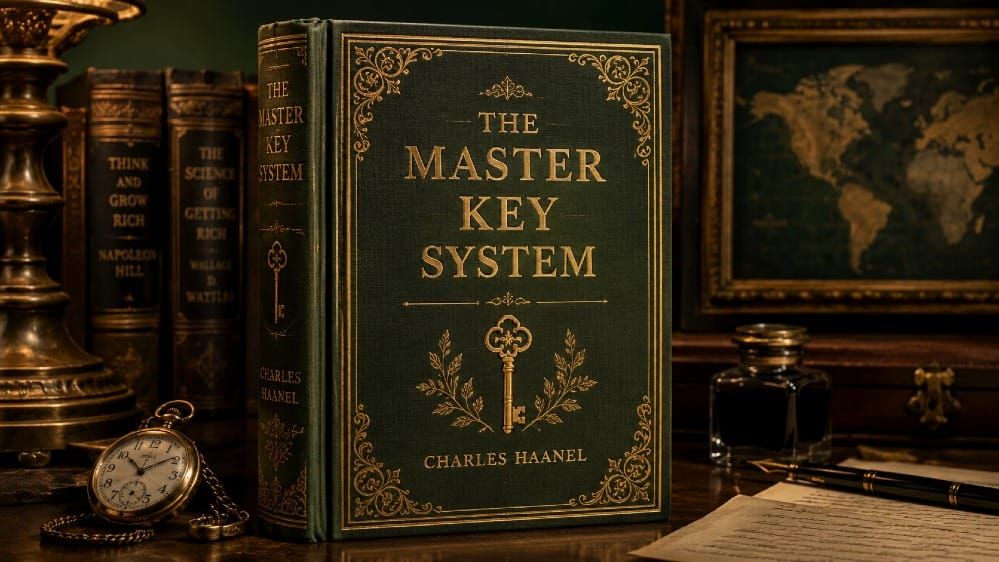
The Master Key System by Charles Haanel — a 24-week course from 1912, published as a book in 1916 — teaches that "the world within is the cause; the world without is the effect." Thought is a creative energy, the subconscious holds the power, and through disciplined concentration and visualization you reshape your outer life from the inside.
What sets it apart is its form: not a book to read but a graded training to practice, one part each week, with an exercise in every lesson. It is the most systematic statement of New Thought ever written, and a direct, documented source for Rhonda Byrne's The Secret.
Go deeper with The Law of Assumption, the modern method built on the same law of mind.
Not a book to read. A course to practice.
Charles Haanel sold it by mail, one lesson a week, to students who promised to do the work. Here is the whole twenty-four-week system, and why it became the engine behind The Secret.
In 1912, a prosperous businessman in St. Louis began mailing a course to paying students, one sealed lesson at a time, twenty-four weeks in all. Charles Francis Haanel did not call it inspiration or self-improvement; he called it a system, and he treated the mind the way an engineer treats a machine — as something governed by laws that, once understood and practiced, produce predictable results. When the lessons were finally bound into a single book in 1916, they became The Master Key System, the most rigorous and structured work the New Thought movement ever produced.
It is also the most misunderstood, because almost everyone reads it the way Haanel begged them not to. He warned that the book must not be read like a novel but studied one part per week, each lesson absorbed and practiced before the next is opened. The summaries that flood the internet miss this entirely, flattening a graded training program into a list of inspirational ideas. To read it properly is to understand that Haanel was not describing the law of mind — he was teaching you to operate it.
The Master Key System: a New Thought course by Charles Haanel, issued as twenty-four weekly lessons in 1912 and published as a book in 1916, teaching that disciplined thought and concentration shape outer reality.
The world within / the world without: Haanel's core law — the inner world of thought is the cause, and outer circumstance is its effect.
Concentration: the trained ability to hold attention steadily on a single idea, which Haanel considered the master skill behind every result.
The one law beneath the twenty-four lessons
Haanel's entire system rests on a single sentence he returns to again and again: the world within is the cause, the world without is the effect. The visible conditions of your life — your health, your wealth, your relationships — are not random and not imposed from outside. They are the outpicturing of a hidden inner world of thought, and if you want to change the effect, you must work at the cause.
This makes thought, in Haanel's framing, a literal creative energy rather than idle mental noise. His law means your circumstances express your habitual inner state, not that wishing produces objects from nothing. The same conviction sits at the root of James Allen's As a Man Thinketh, written a decade earlier; where Allen stated the principle as philosophy, Haanel turned it into a trainable skill.
— The Core Law —
The world within is the cause, the world without is the effect; to change the effect you must change the cause.
Charles Haanel, The Master Key SystemThe two minds, and where the power lives
Haanel divides the mind into the conscious and the subconscious, and he is precise about their roles. The conscious mind is the director: it reasons, chooses, and decides what to dwell on. The subconscious is the worker: it holds the power, never sleeps, and carries out whatever the conscious mind hands it. His favorite proof is the body itself — cut your hand and thousands of cells begin repairing it at once, without instruction, because the subconscious is always laboring toward wholeness unless fear and anxiety obstruct it.
The practical lesson is that your job is supervision. Directing the subconscious means feeding it chosen thoughts deliberately, not straining or forcing an outcome. Plant fear and doubt and the subconscious builds those; plant calm, confident images of the end you want and it builds those instead. Through the subconscious, Haanel taught, each individual is connected to a Universal Mind — the single intelligence the older writers called the thinking substance.
The mind as a magnet
Haanel describes the mind as magnetic: it draws to itself conditions that correspond to its dominant thoughts. Walk through life rehearsing disaster, he warned, and you magnetize yourself to disaster; train the mind toward abundance and it becomes, in his phrase, a money magnet. This is the principle later popularized, and often oversimplified, as the law of attraction.
What the summary sites flatten, Haanel kept rigorous. The magnet only works through the disciplined inner work of the course; it is not a wish broadcast into the void. Attraction here means becoming the kind of mind a condition belongs to, not ordering the universe to deliver. The metaphysics behind why mind should act on matter at all was argued most carefully by Thomas Troward's Edinburgh Lectures, which Haanel's generation of teachers drew upon directly.

Haanel trained concentration. The Law of Assumption gives you the exact inner state to concentrate on, and how to hold it.
Get the BookThe twenty-four weeks, and what they train
The genius of The Master Key System is its architecture. Each of the twenty-four parts contains a short teaching, then numbered principles, then a single exercise, then a set of questions and answers to fix the lesson in mind. Taken in sequence, the weeks form a deliberate progression rather than a pile of tips.
The early lessons establish the foundation — the two minds, the world within as cause, and the very first exercise, which is simply to sit still in a relaxed position and learn to quiet the body. The middle weeks build the central skill of concentration, training the student to hold attention on a single object or idea without wavering, then to construct vivid, detailed mental images and hold them steadily. The later lessons apply this trained attention to health, harmony, abundance, and the recognition of the individual's unity with the Universal Mind. Haanel insisted on the order because each week's exercise prepares the mental muscle the next week requires; skip ahead and the later lessons, he said, will simply be misunderstood.
— On Practice —
The exercise comes first and the understanding follows; Haanel taught that the law is proven only by those who do the weekly work.
A paraphrase of Haanel's method of studyCommon misconceptions about The Master Key System
Misconception: it has 17 lessons. It has twenty-four, one for each week of the original correspondence course. Summaries that list fewer are incomplete.
Misconception: Bill Gates left Harvard because of it. This is a popular rumor with no reliable evidence behind it. It makes a good story, but it should be treated as folklore, not fact — the book's value does not depend on it.
Misconception: it is a quick read. Haanel explicitly forbade reading it straight through. It is a twenty-four-week practice, and read any other way it loses its method.
Misconception: it is pure law of attraction. Attraction is one image Haanel uses, but the heart of the system is disciplined concentration and the supervision of the subconscious, not passive wishing.
Where The Master Key System sits in the lineage
If the New Thought writers form a single conversation across a century, Haanel is the one who turned talk into training. Wallace Wattles' Science of Getting Rich gave the law a wealth-focused method, and Napoleon Hill's Think and Grow Rich rebuilt it into a success system a generation later — but Haanel's graded course, circulating from 1912, was the systematic curriculum that helped make such structured programs thinkable in the first place.
The line continues forward. Neville Goddard would take the same inner-cause law and concentrate it into a single disciplined practice — assuming the feeling of the wish fulfilled — which is, in essence, Haanel's concentration and visualization refined to one decisive move. Read in sequence, Wattles, Allen, Haanel, Hill, and Neville are not separate authors but one unfolding argument.
— The Universe Unveiled Reading —
At The Universe Unveiled, The Master Key System is read as the moment New Thought became a curriculum: the work that took the law of the inner cause and built it into a twenty-four-week discipline of concentration, the systematic bridge between Wattles, Allen, Hill, and Neville Goddard.
Glossary: key terms in The Master Key System
The world within / the world without: the law that inner thought is the cause and outer circumstance the effect.
The Master Key: the recognition that thought is the creative power and that it lies within every person.
Thought as creative energy: Haanel's claim that thought is an active force that shapes conditions, not a passive byproduct.
The subconscious mind: the tireless inner worker that holds the power and links the individual to Universal Mind.
Concentration: the trained ability to hold attention steadily on a single idea, the master skill of the course.
Creative visualization: building and holding a clear, detailed mental image of the desired end.
Universal Mind: the single intelligence each individual mind is part of and draws upon.