Messages from the Universe
A small book of quiet recognitions — where coincidence, timing, and repetition align with a precision that feels unignorable.


Observations on Attention, Timing, and What Appears When We Slow Down
What this book is
Messages from the Universe is a small book meant to be opened in moments, not chapters.
It does not move forward.
It does not accumulate.
It does not ask to be completed.
Each page stands alone — a brief reflection on attention, timing, uncertainty, desire, and the subtle intelligence that becomes noticeable when coincidence, repetition, and timing converge into something that feels unignorable.
This book offers no instructions and makes no demands.
It meets you through observation rather than direction — through attention, timing, and the quiet intelligence that emerges when nothing is being pushed.
Some pages will arrive.
Not gently — exactly.
A sentence that feels placed rather than written.
A thought that appears before you can decide whether you agree with it.
A recognition that seems to know where you are standing.
Other pages will pass through like weather.
Both responses are true.
This book is a pause object — but not a passive one.
It is something you open briefly.
Something you set down.
Something that, at times, meets you with an unnerving accuracy — as if the moment itself had a voice and chose that page to speak.
What happens when you open it
Some pages will feel obvious.
Some will feel unexpectedly precise.
Some will feel like nothing in particular.
All responses are complete.
Readers often describe the experience as:
- feeling seen without being instructed
- noticing language for things they already sensed
- encountering a sentence that lands differently depending on the day
The book doesn’t speak at you.
It speaks alongside the moment you’re already in.
You don’t read it to learn something new.
You read it to notice what has already been happening.
Where the project began
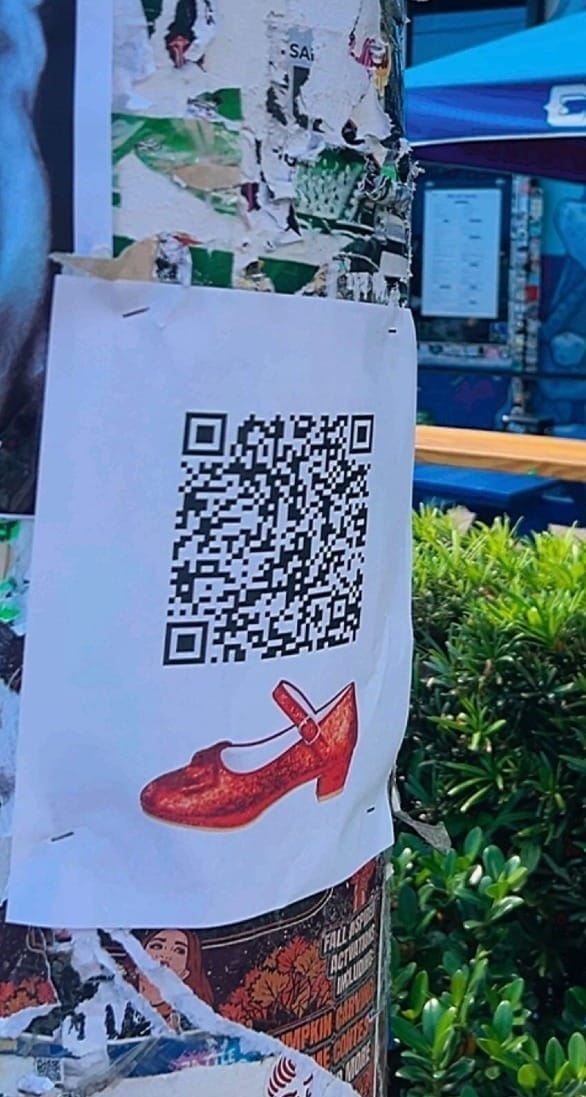
This book began as an interruption.
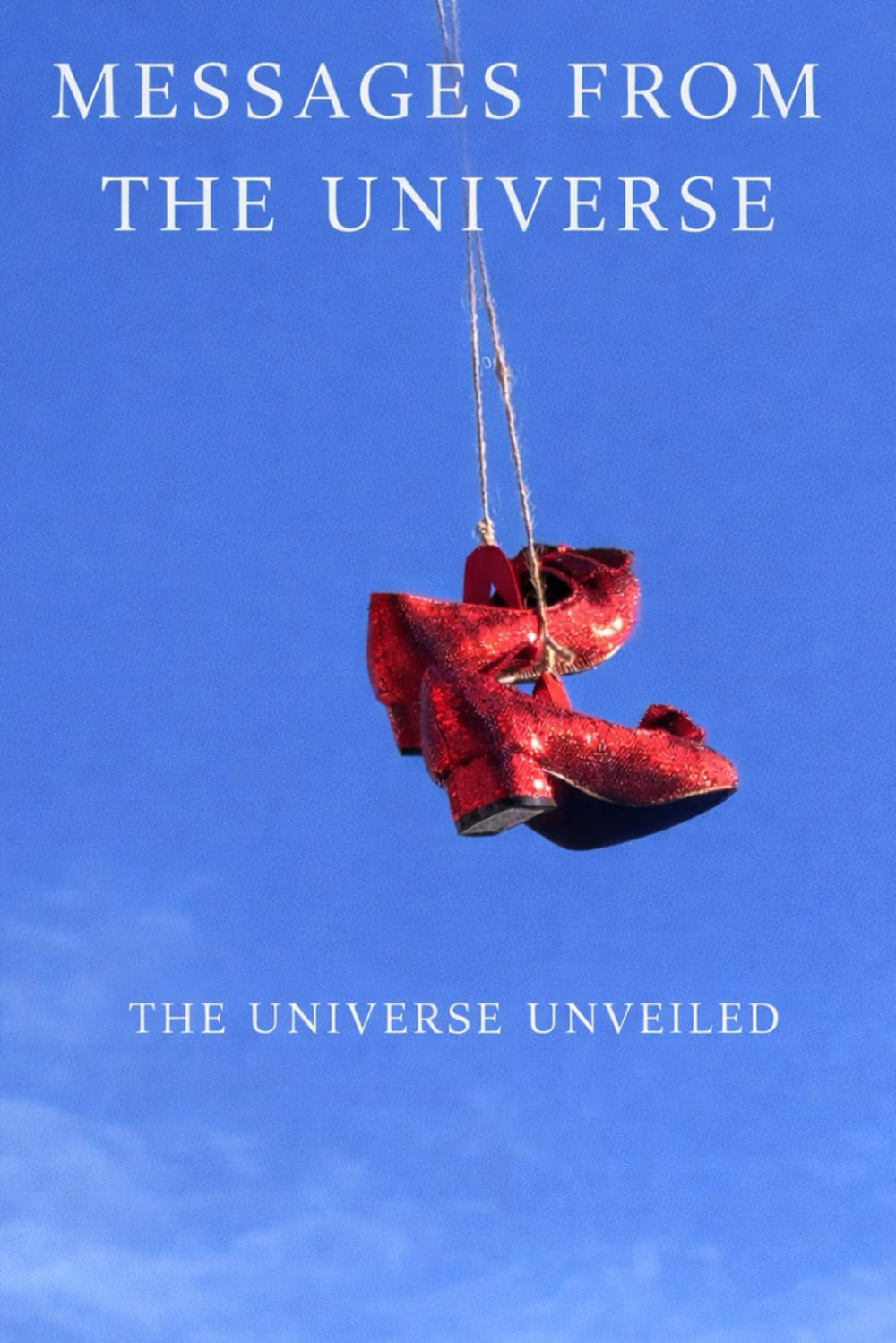
Red shoes appeared hanging from power lines.
QR codes surfaced on walls, poles, and sidewalks — without explanation, without instruction, without invitation.
Some people passed without noticing.
Others stopped — not because they were asked to, but because something registered.
Nothing demanded understanding.
Nothing announced its meaning.
What mattered was attention.
Those brief breaks in routine — moments where the ordinary loosened just enough to feel different — became the foundation for what later took form as Messages from the Universe.
The book carries the same spirit as those encounters:
interruption without instruction,
presence without persuasion,
and the quiet sense that meaning does not arrive through explanation, but through noticing.
Why there is no order
The book is intentionally non-sequential.
You can open it anywhere.
You can close it just as easily.
There is no arc to follow.
No hierarchy of insight.
No reward for completion.
Each page is complete in itself.
Reading in order does not deepen it.
Returning at different moments often does.
How the pages speak
The entries do not motivate, reassure, or correct.
They observe.
They speak in the register of everyday experience:
- the pause before certainty
- the discomfort that arrives before clarity
- the ease that follows long effort
- the quiet sense that something has shifted without announcement
The language is simple, direct, and unadorned — written to feel like it arrived with the day, not ahead of it.
What people often call “messages”
Across cultures, people describe moments that feel unusually precise:
repeated symbols or phrases
unexpected timing
encounters that feel specific rather than random
These moments are often labeled “messages from the universe.”
This book does not define them.
It does not argue for belief.
It begins from a quieter recognition:
Meaning doesn’t arrive through instruction.
It gathers through timing, repetition, resonance, and interruption.
Nothing is being sent.
Nothing is being delivered.
What people call messages are moments that surface
when attention is steady enough to notice
what has already begun responding.
How this book is meant to be used
There is no correct way to use it.
You might open it in the morning.
You might open it at night.
You might open it once and forget about it for weeks.
You might read one page.
You might read several.
You might read none.
The book does not ask for consistency.
It does not track progress.
It remains available.
A physical object, by design
Messages from the Universe exists as a printed book intentionally.
It is small.
Unassuming.
Portable.
It does not demand your attention the way screens do.
It waits.
Like an object you encounter on a shelf, a desk, or a bedside table — it becomes meaningful only when you choose to pick it up.
What remains
This book does not conclude anything.
Some pages will pass through you without resistance.
Others may arrive with an unexpected density — a sentence that stays longer than intended, or names something you hadn’t yet admitted to yourself.
Neither response is an achievement.
Neither is a failure.
Meaning does not announce itself, and it does not ask to be held.
Sometimes it appears briefly — precise, unsettling, or clarifying — and then moves on, leaving you changed in ways that are difficult to measure but hard to ignore.
This book does not create those moments.
It makes room for them.
This book exists within a larger body of work at The Universe Unveiled, where attention, timing, and recognition are treated as structural rather than symbolic.
Questions About Messages from the Universe
Is this book meant to be read in order, or can it be opened anywhere?
It can be opened anywhere.
The book does not build toward a conclusion or depend on sequence. Each reflection is complete in itself. Reading in order does not deepen it; returning at different moments often does.
Are the reflections meant to give guidance or instructions?
No.
They do not advise, direct, or correct. They observe. Any sense of guidance comes from recognition, not instruction.
What does the book mean when it says “the universe responds”?
Response here does not imply intention, messaging, or communication.
It refers to the way conditions reorganize when continuity, attention, and momentum are present. The universe is treated as responsive to structure, not persuasion.
Is the universe treated here as a voice, a force, or something else entirely?
Something else.
The universe is not personified. It does not speak, decide, reward, or withhold. It is observed as a field of consequence — where rhythm produces continuation and disruption produces friction.
Are these reflections describing beliefs, or observable patterns?
Patterns.
They do not ask for belief or agreement. They point to recurring dynamics that can be noticed regardless of worldview.
What if a reflection feels personal or strangely precise?
That precision comes from timing, not intention.
The reflection does not adjust itself to the reader. The reader encounters it at a moment when attention is aligned to notice it.
What if a reflection feels neutral, obvious, or does nothing for me?
Then nothing is required.
The book does not assume every entry will resonate. Lack of response is not failure, and resonance is not achievement.
Does this book require belief in spirituality, manifestation, or metaphysics?
No.
It functions independently of belief systems. The reflections remain intact whether one accepts them, rejects them, or reads them without interpretation.
What kind of attention does this book invite from the reader?
Unforced attention.
Not seeking, not searching, not analyzing — simply noticing.
Is the goal to interpret these reflections or simply notice them?
Notice.
Interpretation is optional and often unnecessary.
How is meaning treated in this work?
Meaning is not assigned.
It appears through alignment between moment and awareness, then recedes.
When should I put the book down?
As soon as attention shifts.
It is meant to be set down easily — and returned to just as easily.