Parallel Selves: Are You Living the Lowest Probability Version of You?
Your life isn’t fixed — it’s selected. This deep dive explores parallel selves, timeline shifting, and how identity relocation triggers quantum leaps into higher probability realities.


How Identity Selection Determines Which Timeline You Occupy
Opening — The Identity Shock
What if the life you’re living…
Is not your highest potential timeline?
Not your most abundant reality.
Not your most expressed identity.
But simply: the version you’ve unconsciously selected.
Somewhere—energetically, psychologically, probabilistically—there exists a version of you who is wealthier, healthier, more expressed, more fulfilled. The question is not whether they exist. The question is why you aren’t occupying that version.
This is the core claim:
You are not building a life.
You are selecting a probability field through identity.
Manifestation is not creation.
It is timeline occupancy.
Section I — What Are Parallel Selves?
Parallel Selves are simultaneous identity expressions existing across different probability outcomes.
Each “you” represents:
• Different decisions
• Different beliefs
• Different emotional baselines
• Different tolerances for risk, visibility, and responsibility
You can think of them as identity-branches that diverge at decision points.
Examples:
There is a version of you who took the opportunity, moved cities, started the business, invested early, left the relationship, spoke up, published the work, asked for the rate, said no, said yes, walked away, walked toward.
These are not fantasy avatars. They are plausible outcomes of different identity-stabilizations across time. And the reason this matters is simple: your current reality is the downstream consequence of the identity you’ve consistently rehearsed.
Section II — The Quantum Probability Framework
We don’t need academic physics to get the metaphor.
Reality behaves like a probability field:
• potential outcomes exist before they’re experienced
• multiple pathways remain available
• what you repeatedly stabilize becomes what you repeatedly experience
In quantum language, there’s an “uncollapsed” range of possibilities. Observation correlates with a measured outcome.
Here’s the translation:
Identity is your observer effect.
Your self-concept (what you assume is true about you) determines which lane you keep selecting, which behaviors you normalize, which environments you tolerate, which opportunities you consider “for you,” and which outcomes you treat as realistic.
You experience the timeline you stabilize.
Not the timeline you hope for occasionally.
Not the timeline you talk about.
The one you consistently inhabit in mind, body, and behavior.
Prefer audio immersion? Listen to the full episode below.
Section III — Identity Collapse: How a Timeline Becomes “Your Life”
The most important point in this entire doctrine:
A timeline is not chosen once.
A timeline is reinforced daily.
Your “selection” is not a mystical roulette spin.
It’s an identity feedback loop:
- Assumption (what’s true about me)
- Emotion (what that assumption feels like)
- Behavior (what that assumption does)
- Environment (what that behavior maintains)
- Evidence (what that environment reflects)
Then the loop repeats.
This is why people feel trapped: they keep collapsing the same probability lane because their identity keeps generating the same loop.
Parallel selves aren’t separated by “fate.”
They’re separated by stabilized assumptions.
Section IV — Why Most People Occupy Lower Probability Selves
This is the diagnostic core.
1) Familiarity Bias
The nervous system prefers what’s known—even if what’s known is limiting. Predictability feels safer than expansion.
So people unconsciously select the timeline that matches their historical identity: the one they know how to survive, explain, and manage.
2) Fear of Expansion
Higher timelines require:
• visibility
• responsibility
• leadership
• clean boundaries
• risk tolerance
• emotional regulation under pressure
Many people want the outcomes without upgrading the identity required to sustain them.
3) Subconscious Deservingness Ceilings
Most ceilings are not external. They’re tolerance thresholds.
Wealth, love, success, ease—these are capped by what you can hold without self-sabotage. If abundance exceeds your identity tolerance, you will “correct” it back down.
4) Environmental Anchoring
Your environment is an identity amplifier. Your location, relationships, routines, media diet, and daily inputs continually remind you who you are.
If your surroundings are built around your former self, you will keep collapsing the former timeline.
Section V — Identity as a Timeline Address
Identity is a coordinate.
Like a GPS address, it determines which “location” becomes accessible.
Change the coordinate → change the reality accessed.
This is why “trying” doesn’t work. Trying is behavior without relocation.
Relocation is: becoming the version of you for whom the desired reality is normal.
You don’t travel physically first.
You relocate psychologically first.
Then reality reorganizes around that coordinate.
Section VI — Signs You’re Living a Lower Probability Version
This section is designed for recognition.
1) Chronic Under-Expression
You feel capable of more, but remain static. You keep thinking, “I could do that,” while living as if you can’t.
2) Recurring Opportunity Avoidance
Expansion portals show up—calls, invitations, offers, moments to step forward—and you hesitate. You delay until the portal closes.
3) Environmental Misalignment
Your surroundings feel outdated. You notice you’ve outgrown conversations, routines, and spaces.
4) Persistent “Almost” Outcomes
Near-success loops repeat: almost money, almost recognition, almost the relationship, almost the breakthrough. But the final stabilization never occurs.
5) Envy as Recognition
Jealousy is often misread. Sometimes it’s your nervous system recognizing a probability you could occupy. You’re seeing a parallel self reflected through someone else’s life.
Section VII — The Emotional Experience of Timeline Misalignment
Living below your highest probability expression produces:
• restlessness
• irritability
• dissatisfaction
• identity claustrophobia
Not because your life is objectively bad.
Because it’s subjectively smaller than your design.
This isn’t “ungrateful.”
It’s misalignment.
Your inner architecture is expanding, while your outer life remains contracted.
Section VIII — Quantum Leap Mechanics
A Quantum Leap occurs when identity stabilizes in a higher probability self and reality reorganizes structurally to match.
This is not a slow “improvement plan.”
It’s a shift in which life-lane you occupy.
Collapse sequence:
- Identity shift
- Behavioral shift
- Environmental displacement
- Opportunity emergence
- Reality stabilization

Section IX — Why Timeline Shifts Feel Disruptive
Expansion isn’t additive. It’s substitutive.
You don’t add a higher timeline onto your old one.
You replace the operating system.
That often requires:
• letting go of old environments
• outgrowing relationships
• changing your schedule
• shifting your standards
• becoming emotionally unavailable for the former you
This is why people say, “Everything is falling apart.”
Often, it’s falling apart because it no longer matches the coordinate you’re moving to.
Section X — Parallel Selves & Decision Portals
Decision moments are timeline gateways.
Every major choice selects:
• a probability lane
• an identity reinforcement path
Small decisions compound into reality structures.
What you allow becomes what you live.
What you repeat becomes what you become.
The “highest timeline” is rarely one giant heroic decision.
It’s a sequence of smaller decisions made from a different identity baseline.
Section XI — Future Memory as Timeline Anchoring
Future Memory is a technique: you install an internal memory of the life you’re selecting before it materializes.
Why it works:
The brain doesn’t only respond to what happens.
It responds to what it rehearses.
When you repeatedly rehearse the higher identity—sensory, emotional, specific—you reduce novelty. The new self becomes familiar. Familiarity is safety. Safety is stabilization. Stabilization is selection.
You “remember” the higher timeline before you enter it.
Section XII — Environmental Evidence of Timeline Upgrades
Reality signals relocation through:
• new conversations
• new invitations
• geographic pulls
• sudden disinterest in old routines
• coincidences that feel like alignment
Bridges appear before full transition.
This is the Bridge of Incidents pattern: reality arranges a sequence of events that moves you into the new coordinate without you having to “force” every step.
Section XIII — Why People Abort Timeline Leaps
This is where most transformations die.
1) Fear of Outgrowing Others
Social guilt pulls identity backward. People shrink to preserve relational comfort.
2) Financial Risk Aversion
Expansion often requires temporary instability. Many retreat at the first wobble.
3) Nostalgia Attachment
Old timelines get romanticized. You miss the familiar pain because it’s familiar.
4) Monitoring Instead of Stabilizing
People watch reality for proof instead of embodying identity. They become evidence-dependent again, which collapses them back into the old lane.
Section XIV — How to Select a Higher Probability Self
1) Define the Parallel Self (Identity Traits, Not Goals)
Instead of “I want money,” define:
• decision speed
• standards
• financial behavior
• emotional baseline
• social boundary strength
• visibility comfort
What does the higher self assume is normal?
2) Behavioral Mirroring
Act from that self before evidence appears. Not performatively—structurally.
What would they do today?
What would they stop doing today?
What would they no longer tolerate?
3) Environmental Calibration
Upgrade the environment to match the coordinate. Sometimes this is small (workspace, wardrobe, schedule). Sometimes it’s larger (city, social circle, business model).
You are teaching the nervous system, “This is where we live now.”
4) Social Field Adjustment
Stop negotiating your timeline with people anchored to the former you. Align with those who normalize the reality you’re selecting.
5) Future Memory Installation
Daily rehearsal until the new identity feels obvious rather than aspirational.
Section XV — The Ethics of Timeline Selection
A common fear: “If I select a higher timeline, am I harming others?”
No. You’re not stealing a life.
You’re repositioning into a compatible probability lane.
Everyone selects their own trajectory through their own identity stabilization. Your expansion does not injure another person’s destiny. It reveals your own.
Section XVI — Selecting a Different Timeline
I’ve lived the contrast.
There was a version of me squatting in an empty apartment with $682 in my bank account. No certainty. No safety net. No external proof.
But internally, something changed: I stopped negotiating with the lowest probability version of me.
I selected a different lane.
That selection wasn’t a motivational speech. It was an identity decision.
I began behaving as the higher self before I had evidence:
• better standards
• faster decisions
• cleaner boundaries
• a new relationship with money and opportunity
• a refusal to keep rehearsing the old identity
Within 18 months, the structure changed. Not gradually—structurally. A different set of relationships, environments, and opportunities became normal.
That’s the point:
The leap follows identity stabilization.
That shift didn’t happen by accident — it happened through deliberate identity relocation. Today, I help others do the same through private identity work designed to move them into their highest probability timelines.
If you feel called to explore this work, you can learn more here: https://www.theuniverseunveiled.com/private-engagements-with-hector/
Section XVII — Timeline Inertia: Why Reality Lags After You Shift
Even after you select a higher self, reality may still reflect the old lane for a period.
That lag is not failure.
It’s inertia.
Reality has momentum because environments, systems, and people are still responding to the former you. Your job doesn’t instantly rewrite itself. Your bank account doesn’t instantly reflect a new financial identity.
This is the Echo Phase: the external world continues to show you who you used to be.
If you misread this as “it didn’t work,” you collapse back.
If you treat it as inertia and keep stabilizing, the external catches up.
Section XVIII — Probability Density: Why Higher Timelines Feel “Faster”
Higher probability lanes contain more opportunity density.
You notice:
• more introductions
• more invitations
• more synchronicities
• more leverage points
• more doors opening
This “speed” is not magic.
It’s exposure and engagement.
A higher identity makes more decisions per week.
More decisions create more branches.
More branches create more openings.
Expansion is decision-rich.
Section XIX — Geographic Nodes: Some Timelines Require a New Map
Certain identities cannot fully stabilize in the same environment that forged the lower self.
Sometimes the most honest timeline shift is:
a new city,
a new room,
a new daily route,
a new network.
Geography changes:
• your inputs
• your expectations
• your peer norms
• your access points
This is not escapism when it’s identity relocation.
It’s logistics.
Section XX — The Lock-In Moment: When the Leap Becomes Irreversible

A leap locks in when:
• the old reality feels unreachable
• the new identity feels obvious
• opportunities normalize
• expansion becomes baseline
You stop feeling like you “leveled up.”
You feel like you returned to yourself.
That’s how you know you’re no longer visiting a higher self.
You’re living as them.
Section XXI — The Neuroscience Layer: Self-Model, Prediction, and Identity
If we strip the language down to mechanics, identity is a predictive model.
Your brain is a prediction machine. It runs priors (assumptions) about who you are and what is likely to happen, then filters perception and behavior to match those priors. This is why two people can face the same circumstance and “live” different realities: their self-model predicts different outcomes, so they notice different signals, make different moves, and tolerate different standards.
A lower probability self tends to predict:
• “This won’t work.”
• “People like me don’t get that.”
• “It’s risky.”
• “I’ll be judged.”
• “It’s safer to wait.”
Those predictions feel like “common sense,” but they’re identity code.
Higher probability selves predict:
• “There’s a way.”
• “I can learn it.”
• “I’ll handle the discomfort.”
• “I’m allowed to be seen.”
• “I move first.”
When predictions change, behavior changes. When behavior changes, environment changes. When environment changes, evidence changes. That’s the bridge between mind and matter: self-model → action → structure.
Section XXII — The Habit Loop That Keeps You in the Lowest Timeline
Most people try to shift timelines with declarations, then keep the old habit loop.
A habit loop is: cue → routine → reward.
Identity is the invisible operating system that chooses the routine.
If your cue is stress, and your routine is contraction (scrolling, numbing, postponing, micro-lying to yourself), your reward is temporary safety. That loop selects a low probability lane because it trains the nervous system that “expansion = danger.”
Timeline shifting requires a new reward structure: your nervous system must experience that expansion produces safety, competence, and power—not punishment.
This is why the “higher self” isn’t an aesthetic. It’s a new loop:
cue → expansion move → self-trust reward.
Section XXIII — A Practical 7-Day Timeline Relocation Protocol
This is not a vibe ritual. It’s stabilization training.
Day 1: Identity Declaration (One Sentence)
Write one sentence that defines the higher self in present tense.
Example: “I am the version of me who moves fast, earns cleanly, and is seen without apology.”
Read it morning and night. Not to wish—to set the coordinate.
Day 2: Standards Audit (What You Tolerate)
List 10 tolerations that belong to the lower self: clutter, flaky people, unpaid labor, indecision, draining environments.
Pick ONE toleration and remove it within 24 hours. This is timeline proof.
Day 3: Decision Speed Drill
Make three decisions you’ve been delaying: send the message, publish the post, raise the rate, book the flight.
The point is not perfection—the point is identity: “I don’t live in hesitation.”
Day 4: Environmental Upgrade
Upgrade one physical node: desk, lighting, a wardrobe staple, your home screen, notification settings.
You’re telling the nervous system: “This is my timeline now.”
Day 5: Social Field Correction
Stop feeding the lower timeline with social proximity. Create one move toward the higher field: join the room, book the call, attend the event, message the aligned person.
You’re not looking for friends. You’re looking for normalization.
Day 6: Future Memory Installation (10 Minutes)
Run one scene from the higher timeline: Where are you? Who are you being? What does it feel like when it’s normal?
Repeat the same scene. Don’t chase variety—chase familiarity.
Day 7: The No-Monitoring Day
For one day, do not check for signs. No scanning, no testing reality, no “Is it here yet?”
Just behave as the coordinate. This is how you stop being evidence-dependent.
Repeat weekly. Identity stabilizes through repetition.
Section XXIV — The Final Trap: Information vs Occupancy
You can read about timelines for years and never move.
Knowledge is not relocation.
Language is not selection.
Selection is what you do when:
• you’re not in the mood
• you’re not sure
• you don’t have proof yet
The higher timeline is chosen in the unglamorous moment: when your nervous system wants safety and you choose expansion anyway.
That’s the door.
Conclusion — You Are Always Selecting a Self
You are never static.
You are always occupying a version of yourself.
The only question is:
Is it your highest probability expression…
or your most familiar limitation?
If you want a different life, don’t beg reality.
Relocate identity.
Then let the timeline reorganize around what you’ve stabilized.
FAQ — Parallel Selves, Timelines & Identity Selection
25 answers designed to remove confusion, expose the real mechanisms, and make timeline selection actionable.
Whether approached as metaphysical reality or psychological model, the functional result is the same: different identity stabilizations produce different lived outcomes. The point isn’t winning a cosmology debate—it’s seeing identity as the selector of experience.
Parallel selves are simultaneous identity expressions representing different probability outcomes across your decisions, beliefs, emotional baselines, and standards.
They overlap conceptually, but parallel selves emphasize identity divergence: the ‘you’ who made different choices and stabilized different assumptions. Multiple realities is the broader metaphysical frame; parallel selves is the practical identity frame.
It means you’re occupying the version of yourself stabilized by familiarity, fear, and outdated assumptions—where your highest capacities exist but are not expressed consistently enough to become structural reality.
Identity acts like a coordinate: it drives perception, decisions, behaviors, and what you tolerate. Those patterns repeatedly select the same probability lane until you stabilize a different self-concept long enough for reality to reorganize around it.
Internally it can be immediate (a true identity decision). Externally it often unfolds through a sequence: behavioral shifts, environmental displacement, and bridge events that stabilize the new lane.
Timeline inertia. External systems and people are still responding to the former identity. The lag is not failure—it’s the echo of the old coordinate dissolving while the new one consolidates.
The Echo Phase is the period where external reality still reflects a former identity after an internal shift. It lasts as long as you keep checking for proof instead of stabilizing the new identity through consistent action, standards, and environment.
Manifestation language focuses on “getting outcomes.” Timeline occupancy focuses on “being the identity for whom outcomes are normal.” It’s less attraction and more relocation.
No scientific claim is required. The observer effect is a metaphor: identity collapses your lived options by shaping attention, prediction, and behavior. Whether you frame it as physics or psychology, the mechanism is consistent selection.
Because the nervous system confuses familiarity with safety. Expansion requires tolerating uncertainty, visibility, and responsibility—so many unconsciously retreat to the timeline they know how to survive.
They are identity tolerance limits for wealth, love, ease, and recognition. When reality exceeds what your identity can normalize, you sabotage or downshift to restore the old equilibrium.
Chronic under-expression, repeated “almost” outcomes, hesitation at opportunity portals, environmental misalignment, and envy that feels like recognition rather than simple comparison.
Often yes—envy can be recognition of a parallel potential you have not stabilized. The signal isn’t “take from them,” it’s “activate what you’re seeing as available.”
Decision portals are moments where a single choice routes you into different probability lanes. The higher timeline is usually selected through decision speed, standards, and courageous follow-through at these gates.
Because the leap is substitutive, not additive. You outgrow environments, contracts, and relationships built for the former identity. The discomfort is often the structural cost of relocation.
Stop monitoring reality for proof and start stabilizing identity through repetition: standards, decisions, behavior, environment, and social field alignment. Proof arrives after stabilization, not before.
Future memory is rehearsing a specific scene from the selected life until it feels familiar. Familiarity reduces resistance and trains the nervous system to treat the higher timeline as normal rather than threatening.
Once identity shifts, reality tends to reorganize through a sequence of bridge events: introductions, invitations, location pulls, and opportunities that move you into the new lane without needing to force every step.
Not always immediately, but environment is an identity amplifier. If your surroundings constantly reinforce the former self, relocation becomes harder. Often the timeline upgrades when the environment upgrades.
Sometimes relationships evolve with you; sometimes they don’t. Expansion doesn’t require cruelty—but it does require honesty. You can love people without negotiating your identity down to keep them comfortable.
“Almost” usually indicates a threshold identity: you’re close enough to touch the lane, but not stabilized enough to live in it. The fix is not more wishing—it’s deeper normalization through standards, behavior, and tolerance for receiving.
Old reality feels increasingly unreachable, the new identity feels obvious, opportunities normalize, and expansion becomes baseline. You stop feeling like you’re “leveling up” and start feeling like you’ve returned to yourself.
Timeline selection is repositioning, not harming. You’re aligning with a compatible probability field through identity. Others select their own trajectory; your expansion is not a theft—it’s a relocation.
Increase decision speed, raise standards, remove one key toleration, upgrade one environmental node, and stop checking reality for proof for 24 hours while behaving from the selected identity. Speed plus standards is how lanes change.
Image Credits
Artist: Parmigianino
Title: Self-Portrait in a Convex Mirror
Year: c. 1524
Medium: Oil on convex panel
Dimensions: 24.4 cm diameter (9.6 in)
Location: Kunsthistorisches Museum, Vienna
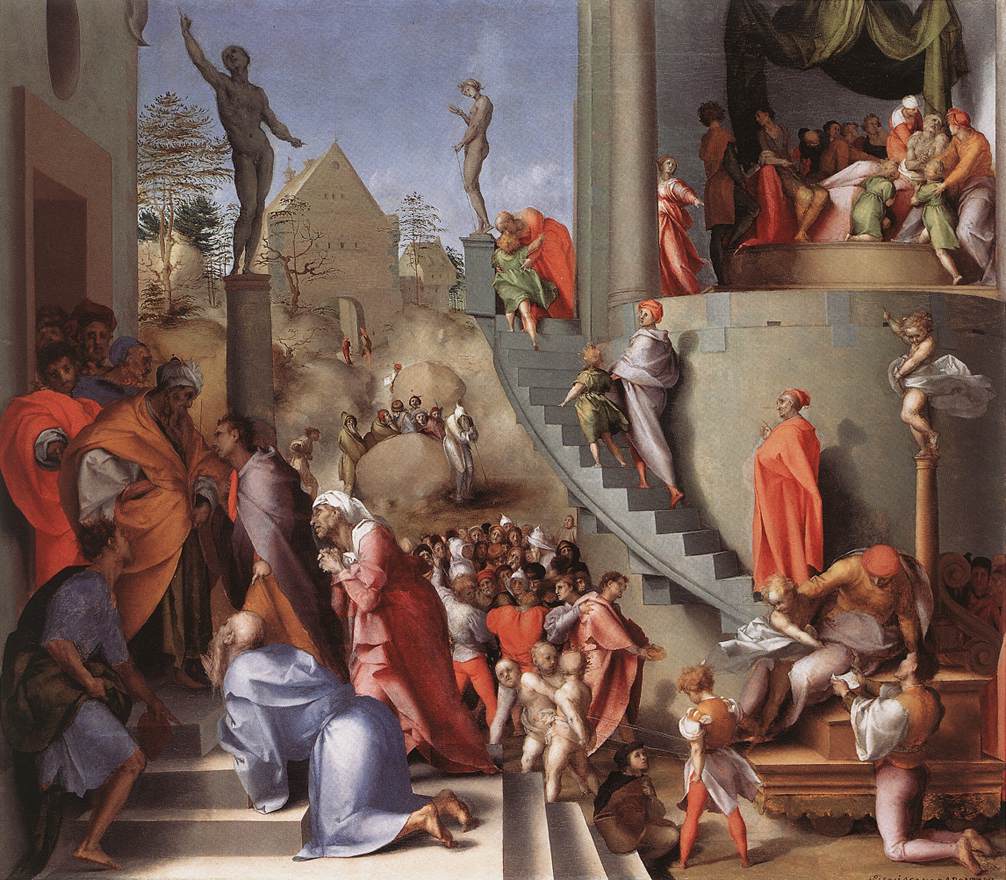
Artist: Jacopo Pontormo
Title: Joseph with Jacob in Egypt
Medium: Oil on panel
Collection: National Gallery, London
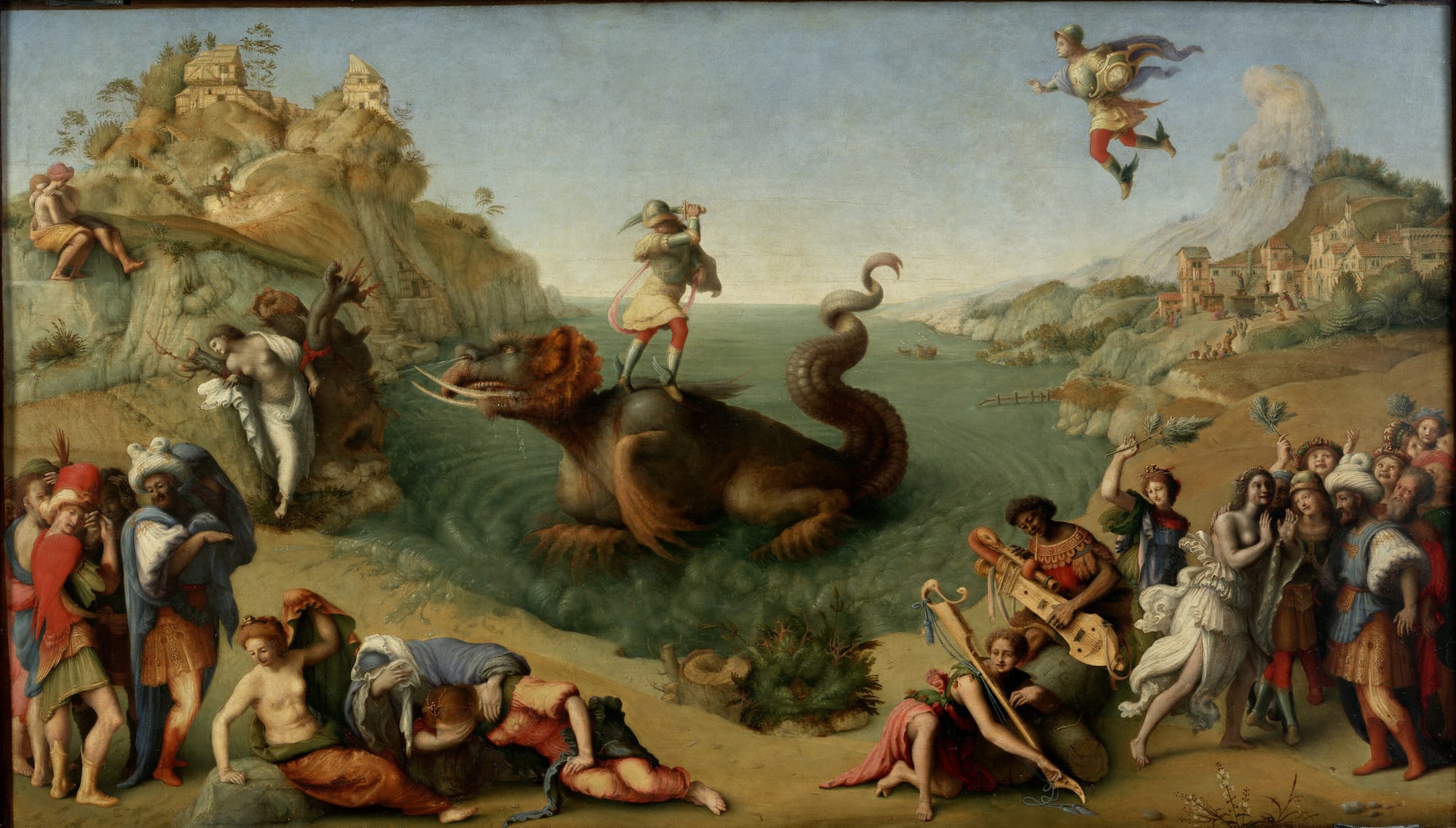
Artist: Piero di Cosimo
Title: Perseus Frees Andromeda
Year: 1510 or 1513
Medium: Oil on panel
Dimensions: 28 in × 48 in (71 cm × 122 cm)
Location: Uffizi Gallery, Florence
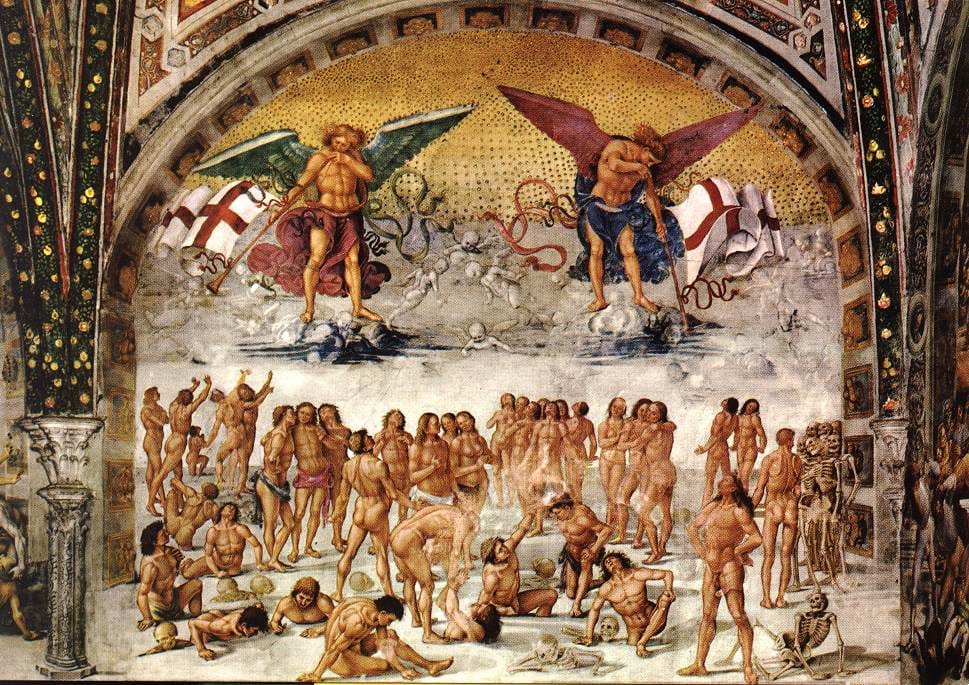
Artist: Luca Signorelli and Workshop
Title: Resurrezione della carne (Resurrection of the Flesh)
Date: c. 1502
Medium: Fresco
Location: Cappella di San Brizio, Orvieto Cathedral, Italy
Artist: Andrea Mantegna
Title: Saint Sebastian
Date: c. 1480
Medium: Tempera on panel
Collection: Louvre Museum, Paris
Image Source: Yorck Project / 10,000 Meisterwerke der Malerei