The Science of Getting Rich: A Deep Reading of Wallace Wattles
Wallace Wattles taught that wealth follows a precise mental discipline he named the Certain Way. This deep reading walks all seventeen chapters — thinking substance, creative mind, gratitude, vision, and action — and shows why it became the blueprint behind modern manifestation.

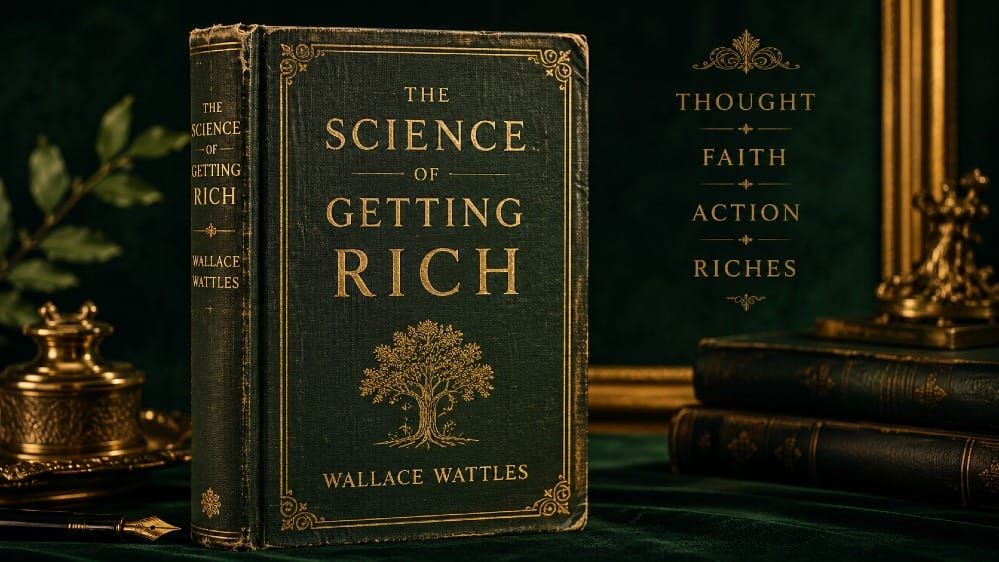
The Science of Getting Rich (1910) by Wallace D. Wattles argues that wealth is produced by a precise mental discipline he calls the Certain Way. The universe is a single intelligent thinking substance, and by holding a clear mental image of what you want — backed by faith and gratitude — you impress that image onto the substance and cause it to take form.
Wattles insists the rich get rich by creation, not competition, and that anyone willing to think and act in this Certain Way can become wealthy. It is the text that directly shaped Rhonda Byrne's The Secret and the teaching of Bob Proctor.
Go deeper with The Law of Assumption, the modern application of the same creative principle.
A book that promised anyone could grow rich — and meant it as a science
More than a century later, Wallace Wattles' seventeen short chapters still run quietly underneath nearly every manifestation teaching alive today. Here is what they actually say.
In 1910, a struggling writer in Elwood, Indiana published a thin book with an audacious title. Wallace Delois Wattles did not promise a method to feel richer, or to make peace with having less. He promised a science — repeatable, lawful, available to anyone — for actually getting rich. He was so confident in it that he opened by telling the reader the book is not philosophy at all but a manual, to be acted on the way you would follow instructions for operating a machine.
Wattles died three years later, in 1911, never seeing how far the book would travel. His daughter Florence later recounted that he practised what he wrote and prospered in his final years. The text itself was nearly forgotten until Rhonda Byrne credited it as the spark for The Secret in 2006, and until Bob Proctor revealed he had carried a copy for decades, reading it again and again. To read The Science of Getting Rich today is to read the source code of the modern manifestation movement before later teachers softened, decorated, and rebranded it.
The Science of Getting Rich: a 1910 New Thought treatise by Wallace D. Wattles claiming that wealth is produced by a definite, learnable mental and physical discipline rather than by luck, talent, or circumstance.
The Certain Way: Wattles' name for the exact manner of thinking and acting that, when followed without deviation, causes riches to come to a person.
The thinking substance: his term for a single, formless, intelligent material that fills the universe and takes the shape of any thought sincerely impressed upon it.
The premise: getting rich is your right, and it is a science
Wattles spends his first three chapters dismantling the reader's resistance before teaching a single technique. His opening argument is moral: there is nothing noble about poverty, and no person can rise to their full mental, spiritual, or physical potential without the use of things, which requires money. To want to be rich, he says, is to want a richer, fuller, more abundant life — and that desire is praiseworthy, not greedy.
He then makes the claim that gives the book its title. Getting rich is not a matter of environment, because people in the same town and trade get vastly different results. It is not talent, because people of mediocre ability grow rich while gifted people stay poor. It is not thrift, because misers stay poor and spenders sometimes prosper. What remains is method. Getting rich, in Wattles' frame, is a science means it follows fixed laws, not that it is guaranteed magic — do the specific things in the specific way and the result follows as surely as water runs downhill.
His third chapter answers the obvious objection: hasn't opportunity been monopolized by those already on top? His reply is that the universe is in a state of perpetual increase and creative growth, so no individual is ever blocked by the supply being used up by others. There is no shortage of the substance from which all riches are made. This is the quiet metaphysical move that everything else rests on.
— The First Principle —
There is a thinking stuff from which all things are made, and which, in its original state, permeates, penetrates, and fills the interspaces of the universe. A thought in this substance produces the thing that is imaged by the thought.
Wallace Wattles, restating the foundation of the bookThe first principle: thought becomes thing in the thinking substance
Chapter four is the metaphysical engine room. Wattles asks the reader to accept three foundational statements as a working faith: that a formless thinking substance exists and fills all space; that a thought in this substance produces the form held in the thought; and that a person can impress their thoughts on this substance and cause what they think about to be created. This is the same intelligent-universe premise that runs through the wider New Thought tradition — the metaphysical lineage you can trace in Thomas Troward's Edinburgh Lectures, written a few years earlier and far more philosophically rigorous about why mind acts on substance at all.
Wattles is unusually honest here. He admits he cannot prove these premises in a laboratory, and asks only that the reader adopt them as a hypothesis and test them by acting. The thinking substance is a working assumption, not a doctrine to argue about — Wattles wants experiment, not debate. This pragmatic, results-first attitude is exactly what makes the book read like engineering rather than scripture.
Wattles' thinking substance reappears almost unchanged a generation later as Napoleon Hill's "Infinite Intelligence." Hill systematized the same creative principle into thirteen practical steps, the move we trace in our deep reading of Napoleon Hill's Think and Grow Rich — the bridge between Wattles' science and the modern manifestation movement.
Creative versus competitive: the single most important distinction in the book
If you remember only one idea from The Science of Getting Rich, Wattles would want it to be this. There are two planes a person can operate on: the competitive and the creative. On the competitive plane you fight other people for a fixed, limited supply — you try to get what already exists by beating someone else to it. On the creative plane you cause new wealth to come into being, so you take nothing from anyone.
You must get out of the competitive mind entirely, he insists, because the moment you believe in limited supply you cut yourself off from the infinite source. Creative thinking means causing new value to appear, not capturing existing value before a rival does. The rich who got rich competitively, Wattles says, are a passing stage; the durable fortune is built by the person who gives every man more in use-value than he takes in cash-value. This single reframe — abundance as something generated rather than seized — is the seed that later teachers would grow into entire careers.
— The Creative Plane —
You are to become a creator, not a competitor. You are going to get what you want, but in such a way that when you get it every other man will have more than he has now.
Wallace Wattles on the creative mindGratitude: the law that keeps you connected to the source
Chapter seven is the emotional heart of the system, and the part later manifestation teaching borrowed most directly. Wattles argues that gratitude does real work. It is not a politeness; it is the force that keeps your mind in harmonious connection with the creative power. The grateful mind is constantly fixed upon the best, tends to become the best, and takes the form of the best. The ungrateful mind drifts toward the common, the poor, and the mean, and takes that form instead.
There is also a subtler point. Discontent and dissatisfaction, Wattles warns, are competitive states — they keep your attention on lack. Gratitude is the antidote because it keeps your whole mind on abundance already present. Gratitude means actively holding attention on what is good and given, not merely saying thanks after the fact. This is the same gratitude-as-alignment principle that runs through later traditions, including the spiritual-fiction reading of The Celestine Prophecy and its Nine Insights, where attention itself is treated as an active, energetic force.

Wattles built the engine. The Law of Assumption shows you how to drive it — the modern, step-by-step application of the same creative principle.
Get the BookThinking in the Certain Way: the clear mental image
Here Wattles names the discipline that defines the whole book. To think in the Certain Way is to hold a clear, definite mental image of exactly what you want, with the unshakable faith that it is already moving toward you, and the steady purpose to take possession of it when it comes. Vagueness fails. You cannot transmit a fuzzy desire to the formless substance any more than you could send a blurred photograph; the picture must be sharp, detailed, and held with feeling.
Crucially, the work is not to repeat affirmations at the substance like incantations. It is to fix a vision and live in the grateful certainty of receiving it. Thinking in the Certain Way means holding one clear image with faith and purpose, not straining or pleading for results. The image plus faith plus gratitude is the transmitter; the rest is allowing.
— The Discipline —
Hold with unshakable purpose to your vision of what you want, and to your faith that you are getting it. Be as sure of it as you would be if it were already in your possession.
Wallace Wattles on holding the visionHow to use the will: turn it on yourself, never on others
Chapters nine and ten correct the most common abuse of these ideas. Wattles is emphatic that you must never use your will to force, compel, or influence other people or external things. That is competitive, manipulative, and self-defeating. The will has exactly one legitimate job: to keep your own mind directed at the vision, the faith, and the gratitude, and to keep it off the contrary.
This is why he gives the famous instruction to stop reading about, talking about, and studying poverty, failure, and lack — including the misery of the poor. Using the will rightly means governing your own attention, not bending the world to your demand. Fix the mind on riches and increase; refuse the mental diet of scarcity. You become what you steadily contemplate.
Acting in the Certain Way: faith without action is dead
This is the half later teachers most often drop, and Wattles spends five chapters on it. Thought attracts the thing, he says, but you must act to receive it. The substance acts through natural channels and human effort; you cannot sit in a room visualizing and expect gold to materialize on the carpet. You must do, with full efficiency, all that can be done today, in your present place and business — not someday, not somewhere else.
His distinction between efficient and inefficient action is sharp. Do not rush, do not overwork tomorrow's tasks into today, and do not wait for the perfect future opportunity. Put the power of your vision and faith into every present act so that each ordinary action becomes a success in itself. Efficient action means doing each present task completely, not doing more tasks frantically. The man who does each day's work in a successful manner cannot fail to advance.
He adds a liberating note in the chapter on getting into the right business: you do not need to be perfectly placed to begin. Start where you are, act in the Certain Way in your current job, and the right work will open to you the way water finds its level. This same trust in a path that reveals itself through action, not waiting, is the spine of the spiritual quest dramatized in The Alchemist by Paulo Coelho — the journey teaches what standing still never could.
The impression of increase: the secret of personal advancement
Chapters fourteen and fifteen give the system its social dimension, and it is genuinely original. Every person, Wattles argues, is driven by an innate desire for more life, more expression, more increase. Therefore the person who conveys to everyone they deal with the impression of increase — that being around them makes life larger — becomes magnetic. People are drawn to whoever helps them feel they are advancing.
The Advancing Man does not boast or seek to dominate; he gives more in use-value than he receives in cash, and he carries an unshakable, growing confidence that radiates to others. The impression of increase means making others feel they gain by knowing you, not impressing them with your success. This is Wattles' answer to networking, salesmanship, and leadership a century before those became industries.
The cautions, and the summary he wrote for you
Wattles closes with warnings. Do not abandon the system the moment things look discouraging or a competing theory tempts you; switching methods scatters the force. Do not slip back into the competitive mind. And he ends, helpfully, by writing his own one-paragraph summary so the reader carries the whole structure in a single grip — the thinking substance, the clear vision, the faith, the gratitude, and the daily efficient action, all held together in the Certain Way.
Common misconceptions about The Science of Getting Rich
Misconception: it teaches you to visualize and do nothing. The opposite. Wattles devotes more pages to action than to thought, and flatly states that faith and purpose without efficient daily work produce nothing.
Misconception: getting rich here means greed. Wattles frames wealth as the means to fuller life and insists you enrich everyone you deal with, giving more in use-value than you take. His model is win-win by design.
Misconception: it is the same as The Secret. The Secret drew heavily from it, but Wattles is far more demanding — he requires sustained action, names competition as the enemy, and never promises effortless attraction.
Misconception: it is religious doctrine. Wattles explicitly offers his premises as a testable hypothesis and asks you to verify them by results, not belief.
Why this 1910 book still rules manifestation
Strip away the vintage prose and The Science of Getting Rich reads as a complete operating system: a metaphysics (the thinking substance), a psychology (creative over competitive, gratitude over lack), a discipline (the clear held vision), and a practice (efficient present action plus the impression of increase). Almost every wealth-and-mindset teacher since has rebuilt some portion of this architecture, usually without crediting the foundation. Bob Proctor built a career on it; Rhonda Byrne lit the modern manifestation boom from its spark. The book endures because it is structurally complete, and because Wattles refused to let his reader off the hook with thought alone.
— The Universe Unveiled Reading —
At The Universe Unveiled, the Science of Getting Rich is treated as the practical engineering manual beneath modern manifestation: the creative mind generates supply, gratitude maintains the connection, the clear vision sets the form, and efficient present action delivers it — one disciplined Certain Way rather than a wish.
Glossary: key terms in The Science of Getting Rich
Thinking substance (Original Substance): the single formless intelligent material Wattles says fills the universe and takes the shape of thoughts impressed on it.
The Certain Way: the exact, fixed manner of thinking and acting that causes riches to come.
Creative plane: the mode of operating that brings new wealth into existence, taking nothing from anyone.
Competitive plane: the scarcity mode of fighting others for a fixed, limited supply, which Wattles says cuts you off from the source.
Impression of increase: the felt sense others receive from you that being around you makes their life larger.
Use-value vs cash-value: Wattles' rule that you should give more real benefit than the money you receive.
The Advancing Man: the person who lives the system fully — grateful, creative, increasing — and so becomes magnetic to opportunity.