Structural Delay: Why Quantum Leaps Don’t Appear Instantly
After an identity shift, reality often goes silent before it reorganizes. This essay explains why delay is not failure, why systems update relationally, and how the interval after a quantum leap determines whether transformation stabilizes or collapses.

Quick Answer
What is Structural Delay in manifestation?
Structural Delay is the interval between an identity shift and the visible reorganization of reality. The change occurs instantly at the level of identity, but the external system updates relationally, not immediately.
Why does nothing seem to happen after a quantum leap?
Because systems are distributed. Identity moves first. Environments, roles, and timing must recalibrate before evidence appears.
Is delay a sign of failure?
No. Delay indicates restructuring, not resistance. Retreat during this interval is the main cause of collapse.
For listeners, this episode walks through the delay.
The Hidden Interval Between Identity Shift and Physical Change
Introduction — The Paradox of Instant Change
Identity can shift in a moment, but reality rarely updates at the same speed.

This is the first contradiction every serious practitioner encounters: a decision is made, a state is chosen, the inner position relocates — and then nothing appears to happen. No confirmation. No visible movement. No immediate reorganization of the outer world.
From the outside, it looks like failure.
From the inside, it feels like suspension.
This interval has a name.
Structural Delay.
Not resistance.
Not punishment.
Not a test of worthiness.
Coordination.
When identity moves, the system does not update instantly.
It must realign.
And that realignment always takes time.
This interval is not a mistake.
It is the mechanism.
Section I — Identity Shifts Instantly, Systems Do Not
Identity is positional.
It is a center point in a network.
Environments are relational.
They are arrangements of roles, expectations, habits, and responses organized around that center.
When the center moves, the system must recalibrate.
Every structure in your life was oriented around the previous position:
- Relationships adapted to your former self
- Roles formed around your prior identity
- Expectations stabilized around your old behavior
- Habits automated to support the earlier version of you
None of these update at the same speed as a decision.
Identity moves instantly.
Systems move slowly.
Because they are not singular.
They are distributed.
Change is immediate at the center.
It is gradual at the perimeter.
The delay is not psychological.
It is architectural.
Section II — Why Delay Feels Like Failure
Human cognition is trained on linear causality.
Do something → see something → adjust.
This works in mechanical systems.
It fails in discontinuous ones.
Quantum change is not linear.
It is positional.
After a leap, there is a moment that feels empty.
- No feedback yet
- Old evidence still present
- No reinforcement of the new state
The nervous system interprets this as error.
“If nothing changed, nothing happened.”
This is false.
The change already occurred — but only at the level that moves first.
This is the most dangerous phase of transformation.
Not because nothing is happening.
Because something irreversible already has.
The danger is not delay.
The danger is retreat.
Section III — The Mechanics of Field Reorganization
This is where the model becomes structural.
When identity relocates:
- Your internal position shifts
- Your behavioral baseline changes
- Your field configuration becomes unstable
The field — people, timing, opportunities, reactions — must reorder around the new center.
This produces three predictable effects:
- Silence
- Stillness
- Apparent stagnation
Not because motion stopped.
Because the system is settling.
Think of moving a load-bearing pillar in a building.
You do not immediately continue construction.
You pause.
You wait for stress to redistribute.
For tension to resolve.
For weight to settle.
Only then does movement resume.
No smooth curve.
Only thresholds.
Section IV — Why Monitoring Reinstates the Old Identity
This is the critical error.
Checking for evidence places you outside the new position.
Monitoring recreates distance.
Distance recreates the former identity.
You are no longer standing as the new self.
You are standing in front of it, evaluating.
This matters structurally.
Because the field organizes around position, not intention.
Key lines:
The one who checks is not yet where they claim to be.
Observation delays settlement.

This is the core logic behind the Law of Assumption.
Time does not respond to desire.
It responds to occupancy.
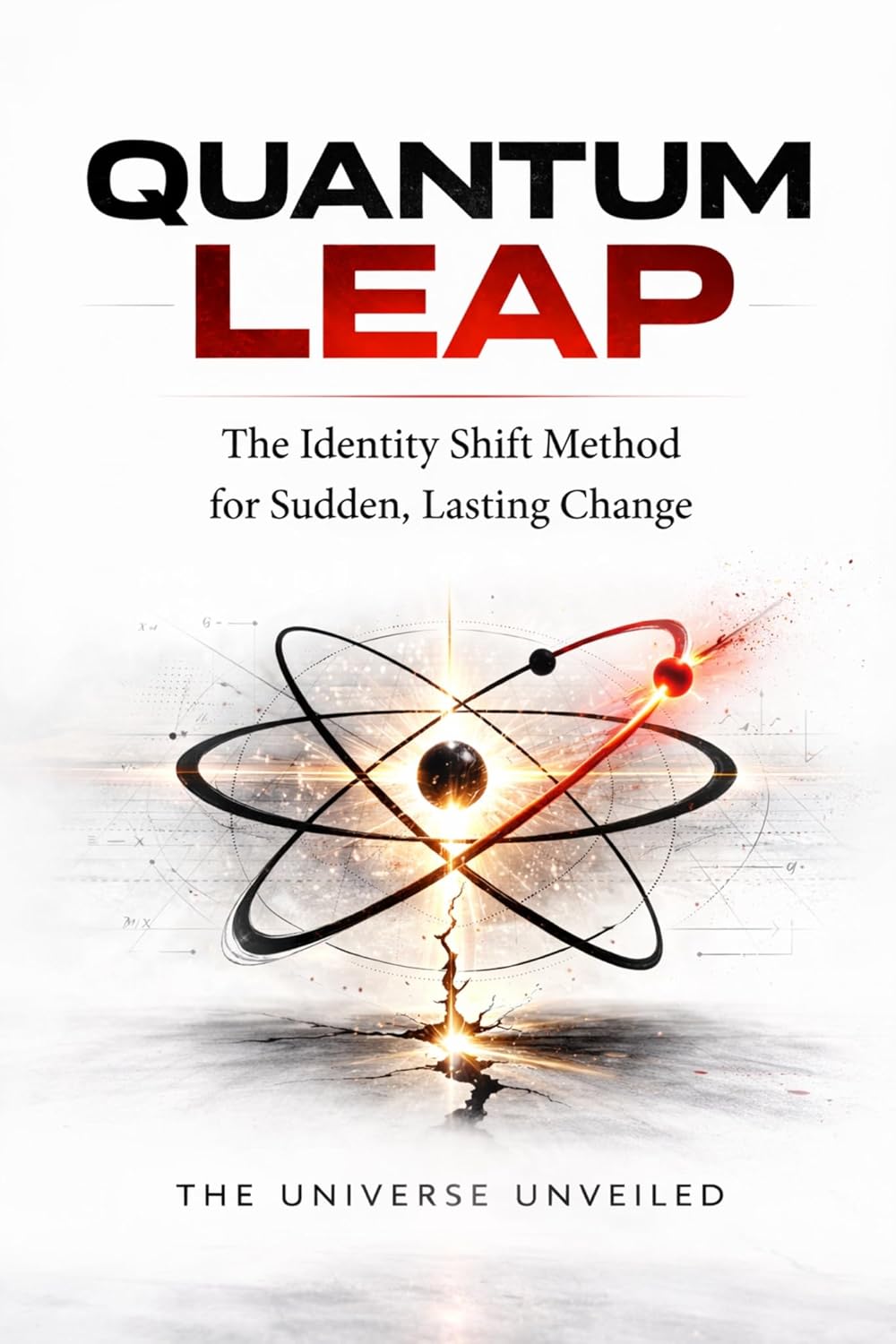
Featured Book
Quantum Leap
Why identity can shift instantly while reality lags — and how structural delay is the hidden interval where quantum leaps actually stabilize.
Section V — Structural Delay vs. Linear Progress
There are two incompatible models of change.
Linear model
- Step
- Feedback
- Adjustment
Progress appears smooth.
Error is corrected incrementally.
Quantum model
- Relocation
- Delay
- Sudden reorganization
No feedback phase.
No visible gradient.
Only a silent interval followed by coherence.
There is no curve.
Only thresholds.
If you are measuring progress during a quantum transition,
you are using the wrong instrument.
Section VI — The Moment the Field Settles
When delay ends, it rarely ends gradually.
Evidence appears in clusters.
- Multiple confirmations
- Sudden opportunities
- Rapid shifts in response
- Coherence across domains
Not improvement.
Alignment.
This is why quantum leaps look like luck from the outside.
The work was done earlier — during the interval no one sees.
This is the phase described in
what is a quantum leap in manifestation
when the field completes reorganization.
Not motion.
Settlement.

Closing — Delay Is Not Waiting. It Is Restructuring.
Delay is not punishment.
Delay is not a test.
Delay is not uncertainty.
Delay is reorientation.
The system is not slow.
It is precise.
Identity does not wait for evidence.
Evidence waits for identity to become ordinary.
Image Credits
Piranesi, Giovanni Battista. The Grand Piazza, from Carceri d’invenzione (Imaginary Prisons), ca. 1749–50. Etching. The Metropolitan Museum of Art, New York. Public domain.
Hiroshige, Utagawa. Sudden Shower over Shin-Ōhashi Bridge and Atake (Ōhashi Atake no yūdachi), from One Hundred Famous Views of Edo, 1857. Woodblock print. The Metropolitan Museum of Art, New York. Public domain.
Piranesi, Giovanni Battista. The Pier with Chains, from Carceri d’invenzione (Imaginary Prisons), ca. 1749–50. Etching. The Metropolitan Museum of Art, New York. Public domain.
De Gheyn II, Jacques. Vanitas Still Life, 1603. Oil on panel. The Metropolitan Museum of Art, New York. Public domain.
Hokusai, Katsushika. Under the Wave off Kanagawa (Kanagawa oki nami ura), from Thirty-six Views of Mount Fuji, ca. 1830–32. Woodblock print. The Metropolitan Museum of Art, New York. Public domain.