Revising the Past Through the Subconscious: How Memory Reprogramming Changes Identity and Reality
The subconscious mind does not store memories as fixed recordings—it stores emotional interpretations. Revising the past means changing the meaning attached to old experiences so identity shifts. When identity changes, behavior, perception, and the experiences you attract begin changing as well.


The Past Is Not Fixed — It Is Programmed
Most people believe the past is permanent.
Something happened.
A memory formed.
A story was written.
End of discussion.
But the subconscious mind does not store life events like a perfect video recording. It stores emotional interpretations of experiences.
That distinction is crucial.
What you remember about the past is not simply a factual record of events. It is the emotional narrative the subconscious continues to replay.
And that narrative quietly shapes your present life.
If the subconscious stores memories associated with failure, rejection, humiliation, scarcity, or loss, it begins expecting those emotional outcomes again. Over time, the mind subtly recreates situations that feel familiar to those patterns.
This is why so many people experience repeating life themes:
• similar relationship patterns
• recurring financial ceilings
• repeating professional struggles
• cycles of confidence and self-doubt
These patterns are not random. They are reflections of subconscious conditioning.
The subconscious is not trying to sabotage you. It is trying to preserve what feels psychologically familiar.
Which means the past is not simply something that happened once.
It is something that continues shaping your identity through memory.
And memory can be changed.
Revising the past through the subconscious is the process of reinterpreting and reprogramming emotional memories so that the identity built from them begins shifting. When identity changes, the experiences that appear in life begin changing as well.
Why the Subconscious Mind Repeats the Past
The subconscious mind operates on familiarity.
Its primary function is not logic or analysis. Its primary function is pattern recognition.
When emotional experiences occur repeatedly, the subconscious interprets them as “normal.” Once something becomes normal to the subconscious, the mind begins seeking situations that reinforce the same emotional environment.
For example, if someone repeatedly experienced criticism early in life, the subconscious may internalize the identity of someone who is constantly evaluated or judged.
Even if that person consciously desires approval and success, the subconscious may continue recreating circumstances that confirm the original emotional pattern.
This is why conscious motivation often fails to produce lasting change.
A person might consciously decide:
“I am going to become successful.”
But if the subconscious still contains emotional memories suggesting:
• success leads to stress
• money causes conflict
• attention brings criticism
• failure is inevitable
then the subconscious identity will quietly restore familiar outcomes.
These repeating psychological structures form what we call the subconscious identity system — the internal blueprint that determines what experiences feel normal to your mind.
These repeating psychological structures form what we call the subconscious identity system — the internal blueprint that determines what experiences feel normal to your mind. When this identity structure shifts, the experiences that appear in life begin shifting as well. A deeper breakdown of how these identity patterns form and operate can be found in the Subconscious Identity System framework, where the architecture of subconscious identity is explored in detail.
Once identity changes, reality begins reorganizing around the new internal blueprint.
And one of the most powerful ways to change identity is by revising the emotional interpretation of the past.
Memory Is Not an Archive — It Is a Living Process
For many years scientists believed memories were stored in the brain like files in a library.
But modern neuroscience has revealed something surprising.
Memories are not static.
Every time you remember something, the brain reconstructs the memory again. During this reconstruction process, emotional associations can shift, details can change, and interpretations can evolve.
This phenomenon is known as memory reconsolidation.
In simple terms, the act of remembering something actually makes the memory temporarily flexible. When the brain stores the memory again, it may store an updated version.
This means the past you remember today may not be identical to the past you remembered years ago.
Your mind has been editing the story all along.
Revising the past through the subconscious simply turns this natural process into a deliberate practice.
Instead of unconsciously repeating the same interpretation of past events, you intentionally rewrite the emotional meaning attached to them.
When that meaning changes, the identity formed around those memories begins changing too.
Revising the Emotional Meaning of Experience
The events of the past cannot be physically undone.
But their psychological meaning can absolutely change.
Consider two people who experience the same situation.
Both apply for a job and are rejected.
One person interprets the event as proof that they are not capable. The other interprets it as a temporary step toward a better opportunity.
Years later, their identities may look completely different.
The difference was not the event.
The difference was the interpretation.
When people speak about revising the past, they are not denying what happened. They are transforming the emotional narrative attached to the event.
A conversation that once represented embarrassment can become a lesson in growth.
A missed opportunity can become a turning point.
A painful experience can become evidence of resilience.
The subconscious does not respond to historical accuracy. It responds to emotional meaning.
When the meaning changes, identity begins changing.
The Relationship Between Memory and Identity

Identity is built from remembered experiences.
If someone repeatedly remembers events that imply:
“I am unlucky.”
“I am overlooked.”
“I am rejected.”
the subconscious eventually integrates those statements as identity beliefs.
But if the emotional interpretation of those same events shifts, the identity built from them begins shifting as well.
For example:
Original memory interpretation
“I failed when that opportunity appeared.”
Revised interpretation
“That experience prepared me for something greater.”
Over time, the subconscious begins recognizing a new identity:
“I am someone who grows through challenges.”
Identity shifts gradually but powerfully.
Behavior changes.
Confidence changes.
Decision-making changes.
And because perception is filtered through identity, a person begins noticing opportunities that previously felt invisible.
Reality reorganizes around identity.
The Connection Between Memory and Future Experience

One of the most fascinating aspects of subconscious memory is that the brain processes vivid imagination and remembered experience in remarkably similar ways.
When you mentally rehearse an event with strong emotional detail, the brain activates neural pathways similar to those activated during real experience.
This is why athletes visualize victories before competitions.
This is why performers mentally rehearse successful performances.
The brain begins treating the imagined outcome as a familiar experience.
This mechanism is closely related to the concept of future memory — the practice of installing experiences in the subconscious before they physically occur.
This mechanism is closely related to the concept of future memory — the practice of installing experiences in the subconscious before they physically occur. When a future outcome is imagined with emotional realism, the brain begins treating the event as psychologically familiar. This idea is explored further in the concept of Future Memory and Subconscious Time Mechanics, which examines how imagined experience can influence identity and expectation before physical events unfold.
Revision works through the same mechanism.
Instead of installing a memory of something that will happen, you revise the emotional narrative of something that already occurred.
Both processes reshape identity through subconscious memory.
How to Practice Revising the Past Through the Subconscious
The practice itself is simple, but consistency amplifies its effects.
Step 1 — Identify a Memory
Choose an event that still carries emotional intensity.
This might be a moment of embarrassment, conflict, disappointment, or regret.
Step 2 — Enter a Relaxed State
The subconscious is most receptive when the mind is calm.
Meditation, quiet breathing, or the moments before sleep are ideal.
Step 3 — Replay the Scene
Bring the event back to mind as clearly as possible.
Visualize the environment, the people involved, and the emotional atmosphere.
Step 4 — Change the Emotional Outcome
Now reinterpret the experience.
Imagine the conversation unfolding differently.
Imagine confidence instead of doubt.
Imagine support instead of rejection.
Allow the revised interpretation to feel natural.
Step 5 — Repeat the New Narrative
Revisit the revised interpretation several times.
With repetition, the subconscious begins accepting the new meaning attached to the memory.
Over time, the original emotional charge fades.
When Revising the Past Is Most Powerful
Not every memory needs revision.
But certain types of experiences tend to shape identity strongly.
Revision is especially powerful when applied to:
• painful conversations
• moments of humiliation or embarrassment
• rejection experiences
• financial mistakes
• childhood criticism
• failures that shaped self-perception
These events often become emotional anchors in the subconscious mind.
When the interpretation of these anchors changes, identity begins reorganizing.
Small revisions accumulate.
Over weeks or months, they can dramatically alter how a person perceives themselves and their possibilities.
Revising the Past and Subconscious Reprogramming
Revision is one tool within the broader practice of subconscious reprogramming.
Most personal development approaches attempt to create change through conscious effort.
But the subconscious mind controls the majority of behavioral patterns, emotional reactions, and identity beliefs.
When subconscious programming changes, the external results of life begin shifting naturally.
This is why many people eventually explore deeper methods of subconscious transformation rather than relying solely on motivation or affirmations.
Revision is one tool within the broader field of subconscious reprogramming. While many personal development methods focus on conscious motivation, lasting change occurs when the subconscious identity patterns themselves are rewritten. A range of deeper methods designed to reshape identity, belief structures, and emotional conditioning can be found within the Subconscious Reprogramming Library, where these transformation practices are explored in depth.
The purpose of these practices is not simply to change thoughts.
It is to reshape the identity patterns that determine what experiences feel normal to the subconscious mind.
A Brief Note on Revision in Manifestation Teachings
Various manifestation teachers have described practices similar to revising past experiences. The central idea behind these teachings is that imagination and memory influence subconscious identity, and when identity changes, future experiences begin aligning with that internal shift.
While different traditions describe the process in different ways, the underlying principle remains the same: the emotional interpretation of the past influences the reality a person continues to create.
The Deeper Truth: The Past Is a Story
Human beings do not live inside objective events.
We live inside interpretations of events.
The same experience can produce completely different identities depending on the story attached to it.
If the story says:
“I failed.”
Identity becomes constrained.
If the story says:
“That experience strengthened me.”
Identity expands.
Revision does not erase history.
It transforms the emotional meaning attached to it.
And emotional meaning shapes identity.
Identity shapes behavior.
Behavior shapes experience.
Which means that changing the story of the past can ultimately change the direction of the future.
Final Thought: The Subconscious Does Not Experience Time
The conscious mind experiences life through a timeline.
Past.
Present.
Future.
But the subconscious mind responds primarily to:
emotion
imagery
repetition
belief
To the subconscious, vivid imagination and emotional memory can feel remarkably similar.
Because of this, the past is not simply a fixed archive stored somewhere in the mind.
It is a living narrative that continues evolving every time it is remembered.
When you revise the emotional meaning of the past, you begin editing that narrative consciously.
And when the narrative changes, the identity guiding your life begins changing as well.
The past is not a prison.
It is a story.
And stories can always be rewritten.
Revising the Past Through the Subconscious FAQ: Memory Reprogramming, Identity Change, and Subconscious Transformation
Image Credits:
Artwork: Frau auf dem Diwan (Woman on the Sofa)
Artist: Emil Orlik (1870–1932)
Movement: Vienna Secession / Central European Modernism
Date: c.1900
Artwork: Early Spring. Illustration to a Poem by Rainer Maria Rilke (1901)
Artist: Koloman Moser (1868–1918)
Movement: Vienna Secession / Art Nouveau
Originally published in Ver Sacrum, Vienna Secession journal
Artwork: Plakat für die XIII. Secessionsausstellung (Poster for the 13th Secession Exhibition), 1902. Artist: Koloman Moser (1868–1918)
Movement: Vienna Secession / Art Nouveau
Medium: Color lithograph
Dimensions: 183.5 × 63.3 cm
Collection: Private Collection
Source: Reproduction from art book
Artwork: Weißes Interieur (White Interior) (1905)
Artist: Carl Moll (1861–1945)
Movement: Vienna Secession / Viennese Modernism
Subject: Berta Zuckerkandl-Szeps in her Vienna residence
Interior Design: Josef Hoffmann
Medium: Oil on canvas
Collection: Private Collection
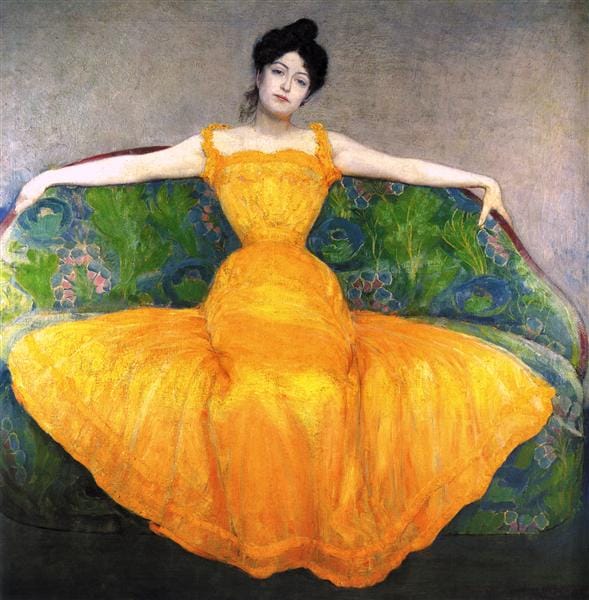
Artwork: Lady in Yellow Dress (Woman in a Yellow Dress) (1899)
Artist: Max Kurzweil (1867–1916)
Movement: Vienna Secession / Art Nouveau
Subject: Martha Guyot, wife of the artist
Medium: Oil on canvas
Collection: Wien Museum Karlsplatz, Vienna, Austria