The Vajrayogini Principle: Desire at Ease
Desire is usually held under tension—managed, postponed, or justified. The Vajrayogini Principle names what remains once fear no longer governs and time no longer delays: desire at ease. Not indulgence or striving, but the lived state of wanting without resistance.

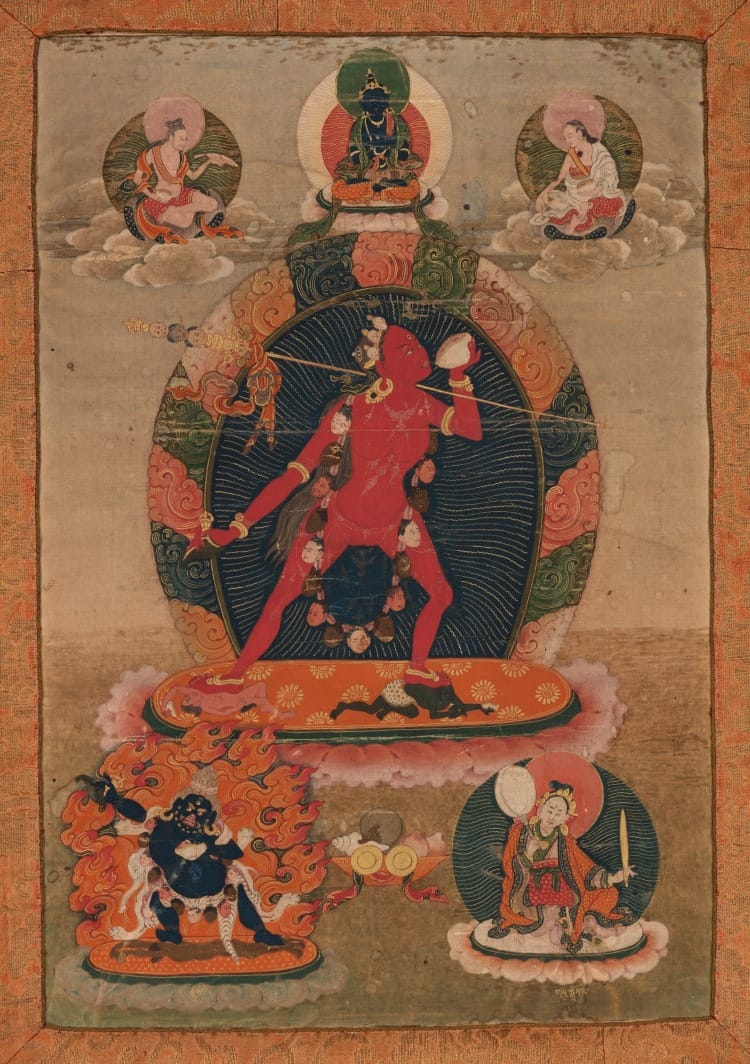
Desire is often treated as a problem to manage.
Too much desire is called attachment.
Too little desire is called apathy.
Unfulfilled desire becomes longing, craving, frustration, or fantasy.
Across modern spirituality and manifestation culture, desire is rarely allowed to rest. It must be purified, justified, visualized correctly, emotionally regulated, or aligned with the proper frequency. Even when desire is encouraged, it is usually held at a distance—something to work toward rather than something to inhabit.
But there is a different relationship to desire altogether.
One that appears only after fear has lost authority and time has stopped delaying.
This relationship is embodied in the Vajrayāna figure known as Vajrayogini.
Not as an object of worship.
Not as a symbol of indulgence.
But as a principle.
Desire After Fear and Waiting
To understand Vajrayogini correctly, she must be placed after Yamantaka and Mahākāla.
Yamantaka represents the end of negotiation with fear. Fear may still arise, but it no longer governs identity. Consequence no longer holds veto power.
Mahākāla represents the end of waiting. Once identity is fixed, time reorganizes. Delay collapses. Sequence responds.
Only then does Vajrayogini appear.
This order matters.
Before fear loses authority, desire is braced.
Before time responds, desire is postponed.
Most people experience desire under tension—held carefully, justified internally, or kept hypothetical to avoid loss. Even joy is often provisional, shadowed by the possibility that it might be taken away.
Vajrayogini does not operate in that field.
She appears when desire is no longer managed.
Who Vajrayogini Is (Without Romance or Myth Inflation)
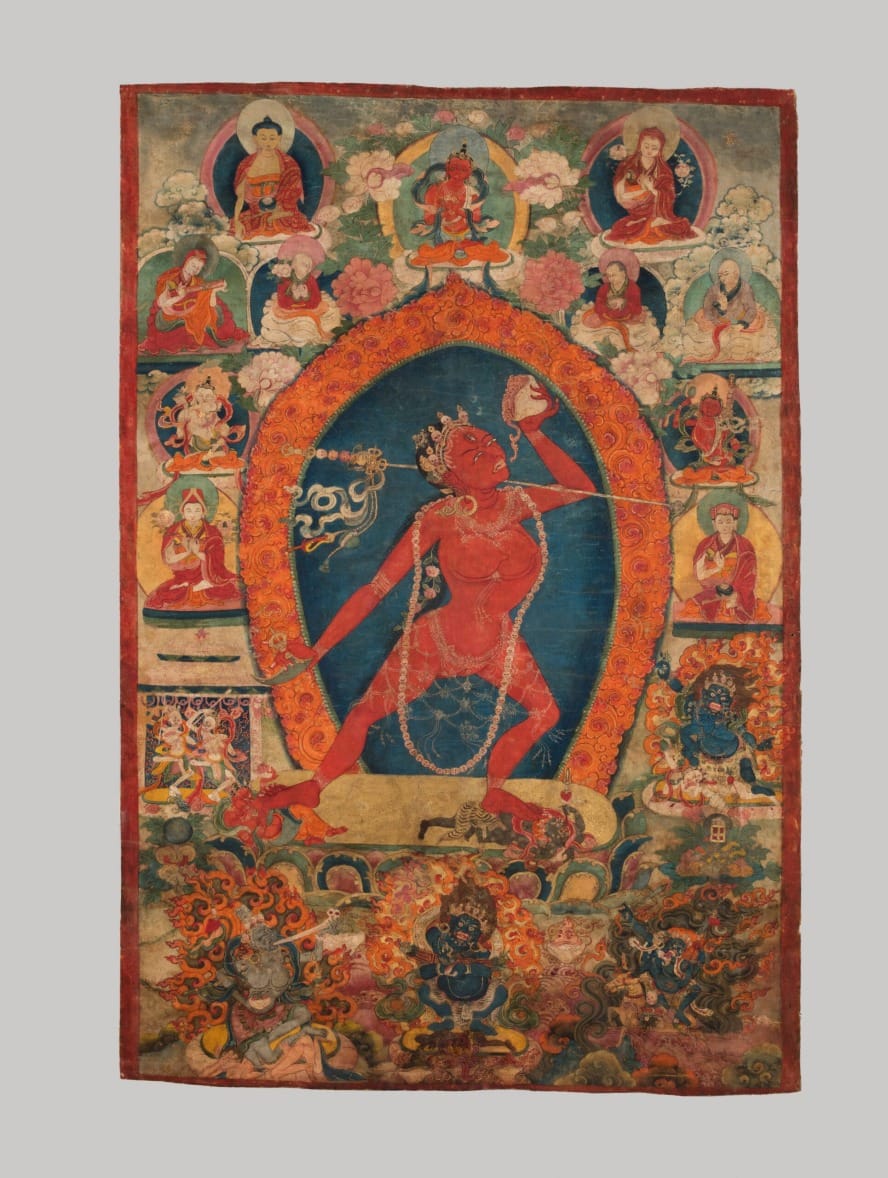
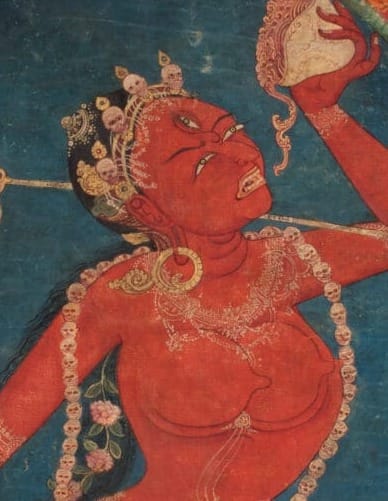
In Vajrayāna Buddhism, Vajrayogini is often depicted as fierce, naked, red, dancing, alive. These images are frequently misunderstood or reduced to symbolism about sexuality, bliss, or feminine power.
But stripped of projection and doctrine, her function is precise.
Vajrayogini represents desire that no longer requires armor.
Not desire amplified.
Not desire indulged.
Desire unburdened.
She does not generate wanting.
She removes the conditions that made wanting unsafe.
This is why Vajrayogini is associated with immediacy, vitality, and directness. She does not hesitate. She does not defer. She does not apologize for wanting.
Not because she is rebellious—but because there is nothing left to negotiate with.
Desire as a Lived State, Not a Reaching Motion
Most people experience desire as distance.
Something ahead.
Something conditional.
Something that must be earned, delayed, or proven worthy.
This creates a subtle contraction in the body. Wanting is accompanied by vigilance. Enjoyment is rationed. Pleasure is postponed until certainty arrives.
But certainty never arrives while desire is held at arm’s length.
Vajrayogini marks a different orientation:
Desire is no longer a signal of lack.
It is a quality of presence.
Desire becomes inhabitable.
This does not mean everything is obtained immediately. It means the nervous system no longer treats wanting as dangerous. The body stops flinching toward the future. Enjoyment is allowed now, without guarantees.
That allowance changes everything.
The Principle Itself
The Vajrayogini Principle can be stated simply:
When fear no longer governs and time no longer delays, desire returns to ease.
Ease does not mean laziness.
Ease does not mean indulgence.
Ease means absence of internal resistance.
Desire at ease is calm.
It is playful.
It is present.
It does not rush toward fulfillment, because it is no longer trying to escape discomfort. It trusts sequence because sequence has already begun responding.
This is why joy appears naturally in people whose lives begin to move. Not because they forced positivity—but because the tension around wanting dissolved.
Why Manifestation Teachings Miss This
Most manifestation systems focus on desire as a lever:
Clarify it.
Visualize it.
Raise its frequency.
Detach from it.
All of these instructions assume desire is unstable or problematic.
But desire only becomes problematic when it is held under fear or stretched across waiting.
Yamantaka removes fear’s jurisdiction.
Mahākāla collapses waiting.
Vajrayogini reveals what desire feels like once those distortions are gone.
At that point, technique becomes irrelevant.
Desire no longer needs to be managed—it is simply lived.
The Felt Difference
You can recognize the Vajrayogini Principle experientially.
Desire at ease feels like:
- Wanting without urgency
- Enjoyment without anticipation
- Pleasure without consequence
- Interest without anxiety
There is no inner argument.
No need to temper excitement.
No rehearsing of loss.
Desire becomes clean.
This cleanliness is not moral.
It is structural.
It is what remains when nothing inside is pulling away from life.
Desire Does Not Drive — It Accompanies
A crucial distinction:
Vajrayogini does not make things happen.
She accompanies what is already moving.
Once identity is stable and time is responding, desire no longer needs to motivate action. Action flows from coherence. Desire becomes a companion rather than a driver.
This is why people who experience acceleration often report an unexpected lightness. They enjoy what they want without gripping it. They stop “checking” reality for confirmation. They stop bargaining internally.
Joy emerges—not as a goal, but as a byproduct of ease.
Closing: The Completion of the Sequence
Yamantaka ends negotiation with fear.
Mahākāla ends waiting with time.
Vajrayogini ends tension around desire.
Together, they describe a complete inner reorganization:
Fear kneels.
Time responds.
Desire relaxes.
This is not transcendence.
It is not spirituality as escape.
It is life, finally unbraced.
Vajrayogini is not a goddess to chase.
She is the state that appears when nothing inside is pulling away anymore.
Desire at ease.