The Deliberate Creator: What Abraham Hicks Really Means When She Says “You Are Creating on Purpose”
Most people try to manifest outcomes. Abraham Hicks teaches something subtler: regulate state, stabilize identity, and let reality reorganize. A deep examination of deliberate creation as identity discipline.

Quick Answer
Deliberate creation, according to Abraham Hicks, means consciously shaping your reality by managing alignment rather than forcing outcomes. It is the practice of stabilizing emotional state, identity, and expectation so that circumstances reorganize naturally to match your dominant vibration.
 Explore the Book
Most people hear Abraham Hicks say “You are the creator of your own reality” and think it means positive thinking.
That is not what she means.
A deliberate creator is not someone who repeats affirmations.
A deliberate creator is someone who understands that:
Reality is not responding to your words.
It is responding to your state of being.
This is the difference between accidental creation and intentional creation.
Between unconscious momentum and conscious authorship.
Between being shaped by life — and shaping life.
In Abraham’s framework, every human is creating all the time.
The only question is:
Are you creating by default — or by design?
Accidental Creation vs. Deliberate Creation
Abraham makes a sharp distinction that most people miss.
There are two modes of creation:
- By default
- By deliberation
Most people are default creators.
They react.
They worry.
They hope.
They complain.
They try to fix outcomes after they appear.
Their emotional setpoint runs on habit.
And so does their life.
A deliberate creator does something radically different:
They work upstream.
They understand that:
- Thought precedes emotion
- Emotion precedes vibration
- Vibration precedes circumstance
So instead of managing life, they manage alignment.
They do not ask:
“How do I fix this situation?”
They ask:
“What state am I broadcasting that is producing this situation?”
This is not manifestation as technique.
This is manifestation as identity discipline.
Deliberate Creator Diagnostic
Are you creating by default — or by design?
This quick assessment translates Abraham Hicks into practical signal-checks: alignment, emotional setpoint, identity stability, and outcome attachment. Choose the option that describes your dominant pattern (not your best day).
The Core Teaching: You Are Broadcasting a Signal
Abraham’s most precise model is this:
Every moment, you are emitting a vibrational signal.
That signal is interpreted by The Universe.
The Universe returns experiences that match that signal.
Not punishments.
Not tests.
Not rewards.
Matches.
Your job as a deliberate creator is not to force outcomes.
Your job is to stabilize the signal.
Because:
The Universe does not respond to what you want.
It responds to what you are being.
This is why Abraham emphasizes feeling far more than thinking.
Thought can lie.
Feeling cannot.
Your dominant emotional tone is your true broadcast.
Understand the Vortex Faster get Living in The Vortex
View the Book
The Emotional Guidance Scale: Your Only Reliable Instrument
One of Abraham’s most sophisticated ideas is the Emotional Guidance Scale.
This is not about morality.
This is about physics.
Positive emotion = alignment with your broader self
Negative emotion = misalignment with your broader self
Emotion is not feedback about the world.
Emotion is feedback about your relationship to your own source state.
When you feel:
- Ease
- Relief
- Clarity
- Appreciation
You are aligned with the version of you that already knows where you’re going.
When you feel:
- Frustration
- Anxiety
- Pressure
- Defeat
You are arguing with the current of your own life.
A deliberate creator does not suppress negative emotion.
They use it diagnostically.
Emotion becomes an instrument panel, not a problem.
Why Effort Fails and Alignment Works
One of the most misunderstood Abraham teachings is this:
“You cannot get there from here.”
Meaning:
You cannot force a high-frequency outcome from a low-frequency state.
Action taken from misalignment produces struggle.
Action taken from alignment produces flow.
This is why so many disciplined people still fail.
They act from:
- Tension
- Fear
- Proving
- Forcing
And then wonder why the path is heavy.
A deliberate creator is not passive.
But their action is downstream of alignment.
They first adjust:
- Mood
- Perspective
- State
Then action becomes efficient.
This is not spiritual.
This is systems engineering.
The Vortex: Where Deliberate Creation Actually Happens
Abraham’s concept of the Vortex is often romanticized.
In reality, it is very technical.
The Vortex is simply:
The vibrational version of everything you have ever wanted, already organized in potential form.
Every preference you have formed has been added to it.
Not by effort.
By contrast.
Every time you noticed:
- What you like
- What you prefer
- What you choose differently
You launched a new version of yourself into that field.
Deliberate creation means:
Instead of trying to pull things out of the Vortex…
You become the version of yourself that already belongs there.
You tune to it.
And when the frequency matches, events reorganize.
Not magically.
Automatically.
If you’d like to see how deliberate creation fits within the full Abraham alignment system, this companion breakdown of Living in the Vortex explores the teachings in a more structured reading path.
View the Book
The Most Subtle Point: You Are Not Creating Objects — You Are Creating Identity
This is where Abraham intersects directly with your core UU canon.
Abraham does not teach object-manifestation.
She teaches state-manifestation.
You are not creating money.
You are creating the version of you who lives in a money-normal state.
You are not creating a partner.
You are creating the version of you who expects intimacy as baseline.
You are not creating success.
You are creating the version of you for whom success is natural.
This aligns perfectly with:
Identity → Energy → Field → Matter
Matter is the last thing to move.
Deliberate creation is identity engineering.
Explore the Book
Why Trying to Manifest Usually Backfires
Most people approach Abraham backwards.
They focus on:
- Visualizing outcomes
- Wanting specific things
- Fixing external problems
But wanting is a state of lack.
And lack is a broadcast.
So the more they “try to manifest,” the more they reinforce the signal of not having.
Abraham’s solution is subtle:
Stop trying to get.
Start stabilizing being.
When your inner life feels:
- Satisfied without proof
- Calm without certainty
- Stable without evidence
You have crossed the only real threshold.
This is the moment when:
Desire turns into inevitability.
See the Book
The Daily Practice of a Deliberate Creator
A deliberate creator does not need rituals.
They need state management.
Three core disciplines:
1. Emotional Calibration
Throughout the day:
- Notice your dominant feeling tone
- Adjust gently toward relief
- Choose the next better-feeling thought
Not positive.
Better.
Abraham never teaches jumps.
She teaches gradients.
2. Detachment from Immediate Conditions
A deliberate creator learns to say:
“This is temporary feedback, not final truth.”
They do not let circumstances overwrite identity.
They let identity overwrite circumstances.
3. Prioritizing Alignment Over Action
They ask before acting:
- Am I acting from clarity or tension?
- From expectation or fear?
- From alignment or urgency?
If alignment is missing, they pause.
This is discipline, not passivity.
The Final Principle: You Are Not Here to Fix the World
Abraham’s deepest teaching is this:
You are not here to struggle your way to better outcomes.
You are here to tune yourself into the version of reality that already exists for you.
Creation is not construction.
It is selection.
From infinite parallel potentials, you select by state.
This is what it means to be a deliberate creator.
Not a manifester.
An author of identity.
FAQ
Abraham Hicks: Deliberate Creation Questions (Answered)
Clear answers for the most searched questions on Abraham Hicks deliberate creation, alignment, vibration, and the deliberate creator mindset.
Image Credits:
Apollo and the Muses on Parnassus
Engraving by Raphael Morghen (1784), after Anton Raphael Mengs
Courtesy of The Metropolitan Museum of Art, New York
Harris Brisbane Dick Fund, 1928
Public Domain
The Intervention of the Sabine Women
Jacques-Louis David, 1799
Musée du Louvre, Paris
Public Domain
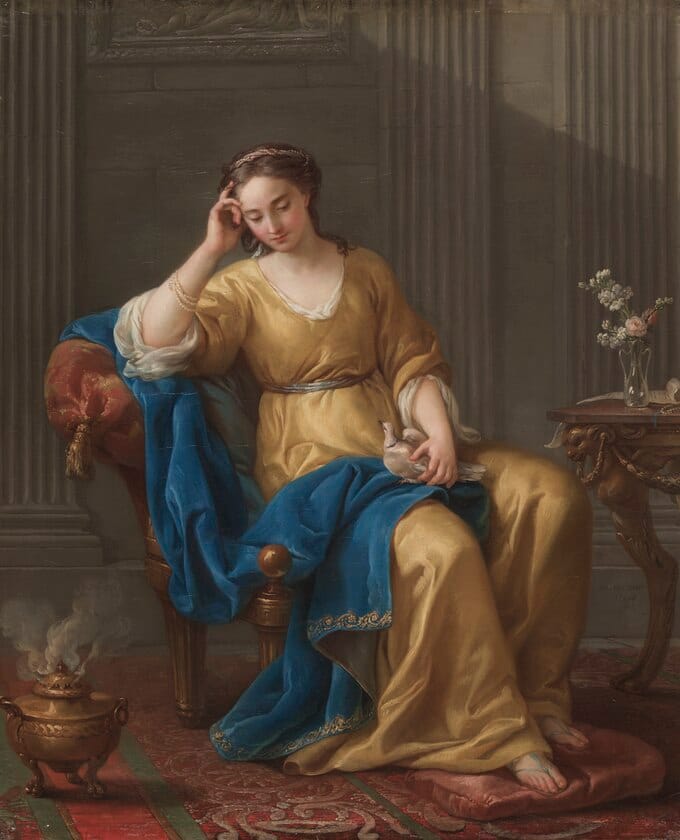
The Sweet Melancholy
Joseph-Marie Vien, 1756
Musée des Beaux-Arts de Lille
Public Domain
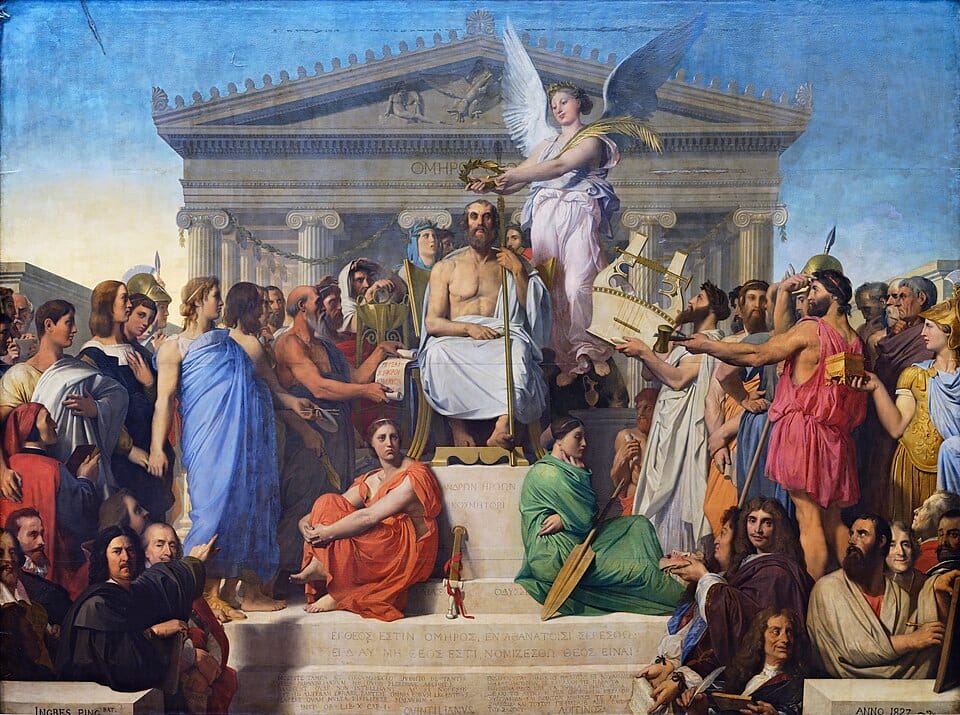
The Apotheosis of Homer
Jean-Auguste-Dominique Ingres, 1827
Musée du Louvre, Paris
Public Domain