
The Focus Wheel: A Journey into Vibrational Alignment

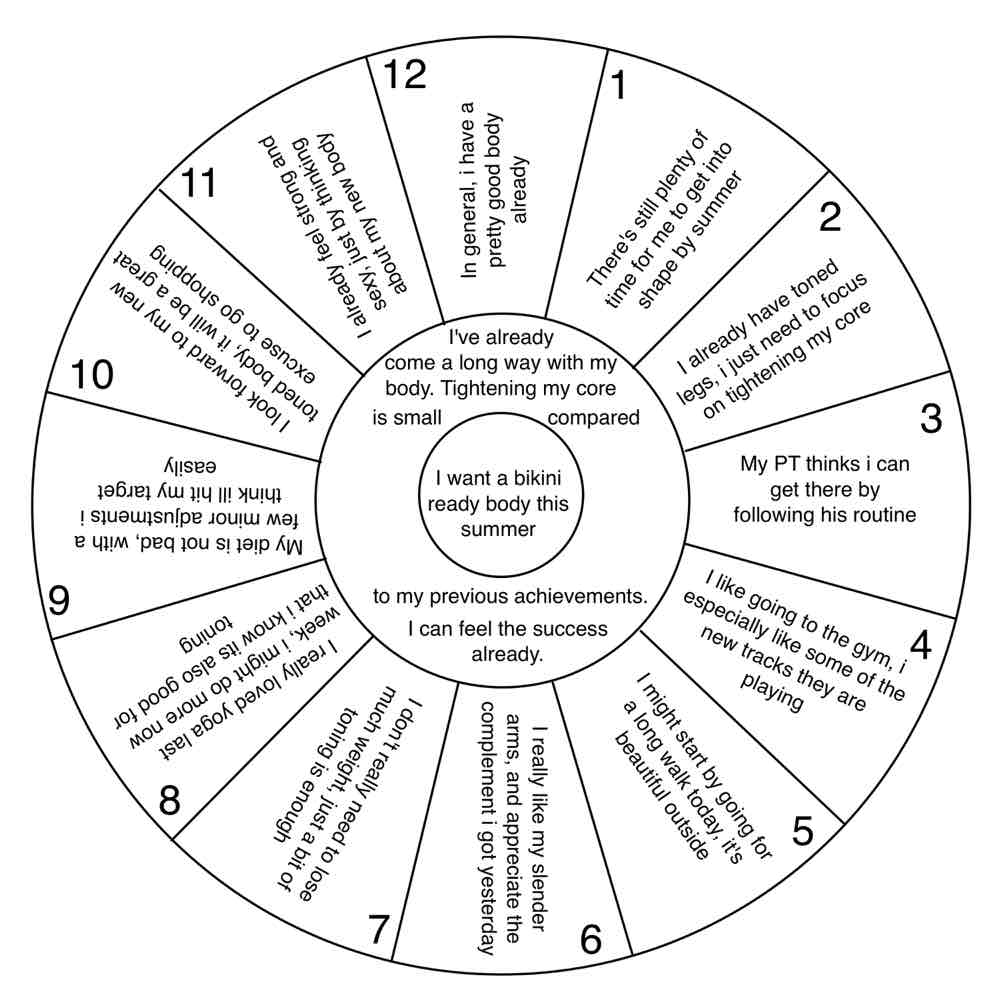
The Focus Wheel: A Journey into Vibrational Alignment
The Focus Wheel is a gentle yet powerful process from Abraham-Hicks that helps you shift from resistance to alignment. By writing positive, believable statements around a central desire, you gradually climb the Emotional Guidance Scale— finding relief, hope, and joy along the way. Each thought is a step upward, tuning you closer to your Vortex and the vibration of your desires. When you focus on the good, the good truly gets better. 💗
 Explore the Book
What is the Focus Wheel Process?
The Focus Wheel is a powerful tool from Abraham-Hicks designed to help you shift from a negative or resistant state into a positive, aligned state. It’s essentially a written process that guides you to deliberately focus your thoughts on better-feeling perspectives. By doing so, you gradually raise your vibration on a given subject, improving your mood and your point of attraction. In Abraham’s teachings, this process is listed as Process #17 in Ask and It Is Given, highlighting its importance for conscious creation.
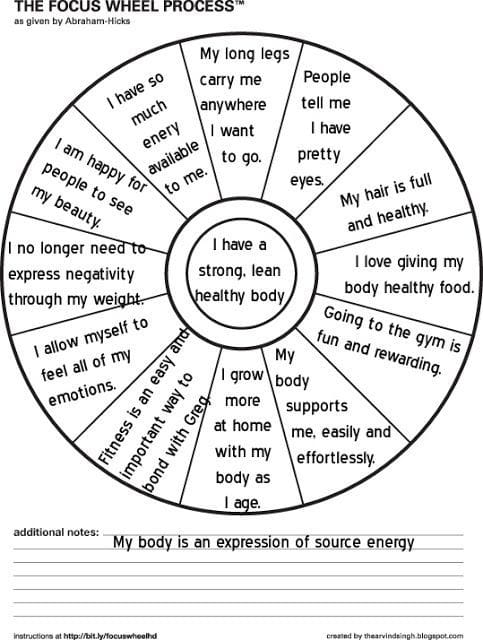
At its core, a Focus Wheel is a drawing of a large circle (the wheel) with a smaller circle at the center (the hub). You start by writing a statement of what you desire in the center hub – phrased in a positive way that captures how you want to feel. Around the outer big circle, you then write a series of statements (often 12, like the hours on a clock) that support and align you with that central desire. Each statement around the wheel represents a thought that feels good and is believable to you, gradually shifting your focus towards the positive. The process is like climbing a ladder of thoughts: each new thought is a rung that takes you higher emotionally, closer to the feeling of your desire.
The Focus Wheel process is often described by Abraham as a way to “clean up your vibration” on a topic. If you’ve been feeling stuck, doubtful, or negative about something important to you, this tool helps you pivot away from the unwanted and toward thoughts that give you relief. By the time you fill in all the segments of the wheel with uplifting statements, you should feel a noticeable boost in your mood and mindset. In Abraham’s words, “when you focus on the good, the good gets better” – and a Focus Wheel trains you to do exactly that, systematically and gently.
This article is part of the Abraham Hicks System of Alignment. If you’re new, start here: Abraham Hicks: Law of Attraction & Alignment
Abraham-Style Focus Wheel
Turn one resistant thought into 12 softer thoughts. Add each new thought to “fill” the wheel.
Show my 12 thoughts
Don’t leap to “I’m rich.” Go for believable relief:
“It’s possible.” → “I’m figuring it out.” → “Things can turn fast.”
Why Use a Focus Wheel? Moving Up the Emotional Scale
One of the key reasons to use a Focus Wheel is to help you move up on what Abraham-Hicks calls the Emotional Guidance Scale. This scale ranges from the highest vibrations of joy, love, and empowerment at the top, all the way down to fear and powerlessness at the bottom. We all experience a variety of emotions, and this scale is a guide to where you are vibrationally. The goal is to reach for a slightly better feeling, step by step. When you’re feeling low, you cannot realistically leap straight into joy – if you’re in despair (which is at the bottom of the scale), trying to force optimism or bliss might feel false and even backfire. Instead, relief comes by gently climbing upward: from despair to anger, perhaps, and from anger to frustration, then to hopefulness, and so on.
Where Are You on the Emotional Guidance Scale?
Take a gentle pulse on your vibration and see exactly where you are—then rise. In minutes, you’ll spot your current rung and choose the next better-feeling step. Curiosity → clarity → momentum → Vortex. Let’s go.
The Focus Wheel is tailored for this gradual upward journey. In fact, Abraham suggests using the Focus Wheel process when you find yourself roughly in the middle of the emotional scale or lower – for instance, anywhere from boredom or pessimism down through frustration, overwhelm, disappointment, doubt, worry, all the way to anger. If you’re feeling these kinds of emotions, it’s a perfect time to do a Focus Wheel. Why? Because those feelings indicate resistance and a vibrational gap between you and your desires. The Focus Wheel helps you systematically soothe that resistance. Each positive statement you find is like a small step up the emotional ladder – perhaps moving from doubt (a 13 on the scale) up to hope (a 6) over the course of the process.
By reaching for thoughts that feel just a little better, you leverage the Law of Attraction to gain momentum in a positive direction. Abraham often reminds us that holding a positive thought for as little as 17 seconds starts to attract another thought like it. In the Focus Wheel, as soon as you find one gentle, believable positive thought and hold it, another will come, and then another. This momentum builds gradually. You start general and soft, and as you feel better you can get more specific and enthusiastic. In this way, the Focus Wheel honors the wisdom of the Emotional Guidance Scale: you pivot gradually from a lower vibration to higher vibrations, one thought at a time.
Entering the Vortex: Aligning with Your Desires
Abraham-Hicks often speaks about “the Vortex,” which is essentially the vibrational place where all your desired manifestations have already been amassed. It’s like a swirling reservoir of well-being and answered requests – a non-physical reality where the things you want (better relationships, abundance, health, etc.) are all vibrationally real and waiting for you. When you are “in the Vortex,” you are in a state of alignment, joy, and belief – you feel the way you’ll feel once those desires manifest. In practical terms, being in the Vortex means you’re thinking and feeling in a high, pure, positive vibration that matches your desires.
The Focus Wheel process is a tool to help you enter the Vortex. By systematically guiding yourself to better feelings, you line up with the essence of what you want. Remember, your Inner Being (or Source Energy) is already in the Vortex, always holding the highest vibration of your desires. When you feel negative emotion, it’s a sign that you are out of sync with that higher perspective. The Focus Wheel brings you back into sync. Each statement that gives you relief is actually you tuning your dial closer to the frequency of your Inner Being – closer to the “station” where your desire lives. As Abraham teaches, your desires already exist vibrationally; you don’t have to struggle to “make them happen,” but rather allow them by matching their vibration. The Focus Wheel is a deliberate exercise in allowing: you focus your way into the feeling of your wish fulfilled, into your personal Vortex of creation.
When you finish a Focus Wheel, you’ll likely notice a significant emotional shift. Many people report that they feel relieved, hopeful, encouraged – even excited or joyful – after filling in their wheel. This is a clear sign you’ve moved into alignment. You have “gotten into the receiving mode,” as Abraham would say, where you’re now a vibrational match to the solutions and outcomes you seek. In this state (in your Vortex), the Law of Attraction can begin to deliver the rendezvous, ideas, and opportunities that lead to the manifestation of your desire. In short, by using the Focus Wheel to raise your emotional state, you step into the Vortex and become a cooperative component to your own dreams.
How to Do a Focus Wheel (Step-by-Step Guide)
The Focus Wheel process is wonderfully simple and doesn’t require any special materials – just a pen, paper, and your willingness to find better-feeling thoughts. Here is a step-by-step guide to creating your own Focus Wheel:
- Identify What You Want (and Don’t Want): Start with an issue or subject where you feel negative emotion but desire a positive change. Maybe it’s a frustrating job, a relationship conflict, or a personal goal you doubt. First, clearly acknowledge what you don’t want in this situation (the contrast). For example, you might realize: “I don’t want to feel unappreciated at work,” or “I don’t want to keep worrying about money.” This contrast helps you clarify what you do want instead. So turn it around: what is your desire? How do you want to feel? You might say, “I want to feel valued and successful in my career,” or “I want to feel secure and at ease with my finances.” Get as clear as you can on the positive outcome you seek.
- Write Your Desire in the Center (Hub): Take your paper and draw a small circle in the center. In this hub, write a concise statement of your desire in positive, present-tense terms. Focus on feelings or qualities rather than how it will come about. For instance: “I am financially secure and abundant,” or “I feel confident and appreciated in my job,” or “I am vibrationally in love with my healthy body.” Ensure it’s phrased in a way that resonates with you – some like to write it as an affirmation (e.g. “I am ___”), others simply as an outcome (“Financial freedom and ease”). Choose words that feel empowering and exciting to you. This center statement represents the vibration you ultimately want to align with – it’s the heart of your Focus Wheel.
- Draw the Wheel with Sections: Next, draw a large circle around the center hub, taking up most of the page. This big circle is the outer rim of your wheel. Now segment this wheel by drawing lines radiating out from the center, like spokes. Aim for 12 sections around the wheel (12 is a suggested number that works well, as if you’re creating the face of a clock. Don’t worry about perfection – the idea is just to create spaces to write your statements. Your Focus Wheel will look like a sunburst or a pie cut into 12 slices, with the central circle (your desire) in the middle.
- “Get on the Wheel” with a Relief Statement: This is often the trickiest part – finding the first positive statement to write in one of the outer segments (pick any segment to start, often people begin at the top like 12 o’clock). To “get on” the wheel means to find a thought that you already believe and that gives you even a slight sense of relief or comfort regarding your desire. It should be related to your central goal but not so directly that it feels out of reach. In fact, it’s best to start quite general. For example, if your center is “I am financially secure and abundant,” a very gentle entry thought could be: “Money isn’t the only source of happiness in life.” Or, more positively, “Many people improve their financial situation over time.” The key is that when you think this thought, it doesn’t contradict your current feelings – it should feel at least somewhat true and soothing. You might try a few thoughts in your mind until one makes you go, “Okay, that’s true, and thinking it makes me feel slightly better.” Write that statement down in the first segment of your wheel. You’ve just hopped on the merry-go-round!
- Fill in the 12 Positive Statements: Continue around the wheel, one segment at a time, writing statements that feel good and move you closer emotionally to your center desire. Each statement should build on the previous one, gradually increasing in positivity or specificity as long as it feels good. Remember, this is a trial-and-error, feeling process. Before writing each statement, test it in your mind: does it feel true? Does it give a bit of relief or hope? If yes – great, write it down. If not, skip it and search for a softer thought. In the beginning, your statements might be very general truths or reassurances. As you go, you may find you can make them more personal and optimistic. By the later segments, your statements could start sounding like real affirmations of success and alignment – because your vibration has improved and you can now believe more positive thoughts. Take your time and fill all 12 spots with statements that genuinely uplift you when you read them. (Tip: Breathe deeply and go at a pace that feels good. This is about emotional journeying, not rushing to finish.)
- Experience the Emotional Shift: Once you’ve written your 12 statements around the wheel, pause and read them all in sequence. Really let each thought sink in. You will likely notice that your emotional state is significantly higher than when you began. The contrast is often astonishing – you might start a Focus Wheel feeling upset or doubtful, and by the end feel calm, hopeful, even eager about the subject. This emotional shift is a sign that you have aligned closer with your desire’s vibration. In Abraham-Hicks terms, you have moved into the vicinity of your Vortex on this topic. You might even feel a rush of positive expectation, where the central statement now feels possible or even probable. That means you’ve done it correctly! The Focus Wheel has effectively raised your point of attraction, which means the Law of Attraction can now respond with improved conditions and ideas. Most importantly, it just feels good. You’ve deliberately tuned yourself to a better feeling – and that was the real goal all along.
- Repeat as Needed and Celebrate: Sometimes one Focus Wheel session is enough to completely shift your attitude on a subject for a long time. Other times, you might come back the next day and feel some lingering resistance – and that’s okay. You can do multiple focus wheels on the same topic if needed, or on different aspects of it. Each time, you’re practicing the skill of choosing better thoughts. Abraham calls this “the art of allowing” – allowing your natural well-being by focusing on it. Celebrate the emotional relief you achieved. Even if your desire hasn’t manifested physically yet, know that something very real has shifted: you shifted your vibration, and therefore the circumstances must shift too, in time. You cannot spend 10-15 minutes focusing purely on better feelings without positive change being set into motion. As Abraham says, “Make a decision about what you want, focus your attention there, and find the feeling place of it — and you are there instantly. There is no reason for you to suffer or struggle your way to or through anything.” By doing a Focus Wheel, you’ve taken that decision and aligned your energy with it. That is a powerful act of creation.
View the Book
Focus Wheel in Action: Example of Transformation
Let’s bring the process to life with a concrete example. Imagine Sarah is an Abraham-Hicks follower who has been feeling a lot of worry and fear around money. Bills are piling up, and she catches herself frequently in thoughts of lack: “I never have enough,” “What if something unexpected happens?” She knows this mindset is not serving her and wants to shift into a state of abundance and trust. This is a perfect scenario for a Focus Wheel.
Sarah’s Desire (Center Statement): After identifying what she doesn’t want (“I don’t want to struggle financially” or “I don’t want to feel this anxiety about money”), Sarah clarifies that what she does want is financial peace and security. She decides to write in the center of her focus wheel: “I am financially secure and at ease with money.” This statement feels good to her – even if it’s not 100% true yet in her reality, it encapsulates the feeling she’s aiming for: security, ease, freedom.
Now, Sarah draws her big circle with 12 segments around it, and begins to fill in each segment with thoughts that bridge the gap between her current worry and the feeling of that center statement. Here’s how her Focus Wheel might look, with the 12 supportive, believable statements she writes:
- “I have made it through financial challenges before, and I’m still okay.” – (This thought gives Sarah a little relief. It’s true: she has faced tough times and managed to survive. It reminds her of her resilience and that in this moment, she has enough to be reading this, to be alive, which means she’s okay right now. It’s a gentle start that doesn’t contradict her feelings, yet it soothes some fear.)
- “Every month, I have managed to pay my rent and bills somehow.” – (She reflects on the fact that despite her worries, she has been able to cover her basic needs each month. Acknowledging this builds a bit of confidence. It shifts focus from lack to evidence of her ability to handle things.)
- “Many people have improved their financial situation over time, and I can too.” – (This is a general statement of possibility. It reminds her that financial turnaround stories are common; nothing is fixed. If others can go from struggling to thriving, why not her? This thought instills hope by normalizing the idea of improvement.)
- “I have skills and talents that can create value (and income) when I apply them.” – (Now she’s gently pivoting to her personal assets. She acknowledges she’s not powerless; she has abilities and strengths. This thought starts to empower her, hinting that she has something to offer that can attract money. It feels good to recognize her own value.)
- “Opportunities to earn or receive money can come unexpectedly, and good surprises are possible.” – (This statement opens her mind to uncertainty in a positive direction. Just as she worries about unexpected expenses, she realizes there can also be unexpected windfalls or opportunities. This balanced view reduces fear and introduces a bit of optimistic expectancy.)
- “I appreciate the things I do have that money has already helped me obtain.” – (Here, Sarah leans into appreciation. She thinks of her cozy apartment, her phone and internet, the food in her fridge – all financed one way or another. She starts feeling grateful for the stability she does have. Gratitude is a higher vibration that really starts to lift her mood now, aligning with abundance.)
- “I like the idea of having more than enough – it feels soothing to imagine financial freedom.” – (Now her statements shift toward the positive vision. She allows herself to daydream the feeling of freedom: picturing all bills paid, money in the bank. Instead of anxiety, this visualization brings a sense of relief and even excitement. She’s beginning to feel the essence of abundance emotionally.)
- “As I worry less, I notice I feel more clear-headed about money decisions.” – (She recognizes that when she’s not in panic mode, she actually can think of smart solutions – like budgeting better or finding a side income. This thought reinforces the benefit of her improving vibration: feeling better is not only nice, it’s making her more effective. This realization gives her confidence that she’s gaining control.)
- “I’ve learned a lot about managing money, and I’m getting better at it.” – (Reflecting on her journey, she sees that she is improving. Maybe she’s reading books or has begun saving a little. Acknowledge any positive changes or efforts. This thought celebrates her progress and reinforces an identity of someone who is learning and will succeed, which feels empowering.)
- “The universe is abundant and is always providing – I can sense that abundance flowing to me.” – (This is a more spiritual statement that resonates with her beliefs as an Abraham follower. She remembers that abundance is the nature of the Universe; there is no real shortage. By now, she’s feeling optimistic enough that this statement doesn’t feel too far-fetched. In fact, it feels uplifting to trust Source to deliver what she needs. She’s aligning with the idea that well-being and abundance are natural.)
- “I already have signs of increasing abundance, and I expect them to continue.” – (By this point, Sarah can likely identify some evidence of improvement – perhaps an unexpected refund, a small raise, or simply the fact that she’s feeling less anxious which often precedes good outcomes. She affirms that positive change is happening. Expectation is a powerful higher vibration state, and she’s nurturing it gently here.)
- “I am feeling calmer and more confident about money now, and I know financial freedom is coming.” – (This final statement reflects the transformation in her vibration. It basically restates her center desire but in a way that she currently truly feels: calm, confident, and trusting that her financial freedom is unfolding. It’s a note of certainty and faith. When she writes this, she actually feels the truth of it ringing in her – a far cry from the worry that started this process.)
After writing these, Sarah sits back and reads each statement out loud. She notices her heart isn’t pounding with anxiety anymore. In fact, she feels a kind of peaceful assurance. The topic of money no longer feels like a tight knot in her stomach; it feels lighter. She might even be smiling and feeling inspired to take a positive action (like joyfully updating her budget, or putting on music and visualizing success). In this uplifted state, she has effectively stepped into the vibrational reality (the Vortex) where her financial well-being exists. By reaching for and finding better-feeling thoughts, she has altered her point of attraction. As Abraham would encourage, she “found the feeling-place” of her desire and thus she is now a match to receiving it.
This example demonstrates how a Focus Wheel gently shifts your perspective: from “I can’t, it’s not possible” towards “Maybe it can happen,” and eventually into “I feel it happening and believe it.” Each statement was like turning the dial of a radio closer to the station of abundance. By the end, the static of resistance is largely gone, and the music of alignment is coming through loud and clear.
View the Book
Embracing Your Power as a Deliberate Creator
The Focus Wheel process is more than just a feel-good exercise – it’s a practice in deliberate creation. Abraham-Hicks teaches that you create your reality through your vibration, and your emotions are the indicator of that vibration. When you use the Focus Wheel, you are actively choosing your vibration rather than letting circumstances dictate it. You become the scriptwriter of your thoughts and feelings, guiding them towards what you want to experience. This is incredibly empowering. It means you don’t have to wait for external changes to start feeling better; you can generate the feeling first, and then watch as the external changes follow.
Many who practice the Focus Wheel report feeling a sense of relief and personal power by the end of the process. It’s a reminder that you hold the key to your own alignment. Instead of spinning in frustration or worry, you spin the wheel of focus in your favor. You literally talk yourself into a better mood! And as simple as that sounds, it has profound effects, because how you feel now is creating what comes next. By consistently reaching for thoughts that give you relief, you develop a habit of positivity and hope. Over time, this can radically transform your default mood and expectations. You’ll find yourself naturally higher on the Emotional Guidance Scale each day, dwelling more often in emotions like contentment, optimism, and eagerness.
Even more, by practicing alignment processes like the Focus Wheel, you strengthen your relationship with your Inner Being and Source. You prove to yourself that you can feel good without anything changing yet, which is the ultimate state of allowing. Ironically, that’s often when things do start changing for the better, because you’re no longer holding them apart with doubt or fear. You’ve entered the Vortex, where you’re open to receive inspiration and manifestations that match your now-positive vibration. In the Focus Wheel example above, once Sarah felt calm and abundant, she might suddenly get a brilliant idea for a side business or notice an opportunity she was blind to before. That’s the magic of alignment: what you’ve been asking for can finally get through to you when you’re not blocking it with resistance.
In closing, remember that the true value of the Focus Wheel is how you feel during and after the process. It’s an act of self-love and care to guide yourself into feeling better. As you do so, you’re not only improving your life experience in the moment, but you’re also tuning your vibrational signal to attract more of what you truly desire. This process is both practical and deeply spiritual: practical in that it gives your mind a focused exercise to gradually pivot your thoughts, and spiritual in that it aligns you with the broader perspective of Source that always sees your situation as hopeful and solvable.
Try making the Focus Wheel a regular part of your toolkit for alignment. You can use it whenever you feel yourself slipping into negativity, or even preemptively to set a positive tone for your day (you can do a wheel on something you already feel good about, to amplify that positive momentum. As you spin your wheel of thoughts toward the light, you’ll find that you are the creator of your mood, your vibration, and thus your life. This realization is profoundly uplifting. You are not a victim of circumstances; you are a powerful deliberate creator, capable of achieving vibrational alignment at will. And when you’re aligned – when you’re in that sweet spot of belief, love, and expectation – that’s when life truly blossoms.
So the next time you notice yourself feeling off or doubting a cherished dream, consider sitting down with a pen and paper. Give yourself the gift of a Focus Wheel session. Do it with a playful, hopeful heart. Reach for the thoughts that feel like sunshine. Climb the ladder of your Emotional Guidance Scale, thought by thought. Before you know it, you’ll be perched on a much higher rung, viewing your situation from a brighter vantage point. From there, you’ll see evidence of the Universe responding in kind – because it always does. Your only work was to align your energy, and with the Focus Wheel you have a tried-and-true method to do just that.
In the wise and encouraging words of Abraham-Hicks: “Give your attention to what makes you feel good, thereby releasing your attention from what makes you feel bad.”Focus Wheels help you do exactly this. When you focus on the good, the good truly does get better – not just in how you feel, but in what unfolds in your world.
Embrace this process, enjoy it, and let it remind you of who you really are: a vibrational being, a joyous creator, and the master of your own focus. Happy focusing, and see you in the Vortex!
Explore Living in the Vortex
Focus Wheel — FAQ
The Focus Wheel is an Abraham-Hicks process that collects believable, better-feeling thoughts around a desired feeling in the hub. As you add statements, your mood rises and resistance eases—shifting your point of attraction.
Use it when you feel stuck, doubtful, frustrated, or worried. It’s ideal for a gentle pivot up the Emotional Guidance Scale.
Use positive, present-tense, feeling-first language (e.g., “I feel at ease about money,” “I am appreciated at work”). Focus on the feeling, not the how.
Twelve is classic, but use what fits. Each statement must feel true enough to bring a small lift.
Start very general (e.g., “Things can improve over time”). Test a few and choose the one that softens tension.
Each believable thought nudges you upward—despair → anger → frustration → hope → positive expectation—toward alignment.
Relief, calm, clarity, or eagerness. The hub statement starts feeling plausible or exciting—your vibration matches your desire.
Anytime resistance appears—or proactively to amplify a good-feeling topic. 10–15 mindful minutes can reset your day.