The Place Mat Process: Abraham Hicks' Daily Delegation Tool
The Place Mat Process is Abraham Hicks' simplest delegation tool — a two-column daily practice that splits your day between what you'll handle and what you're releasing to the Universe. Here is how it works, why it works, and a free interactive place mat to use daily.

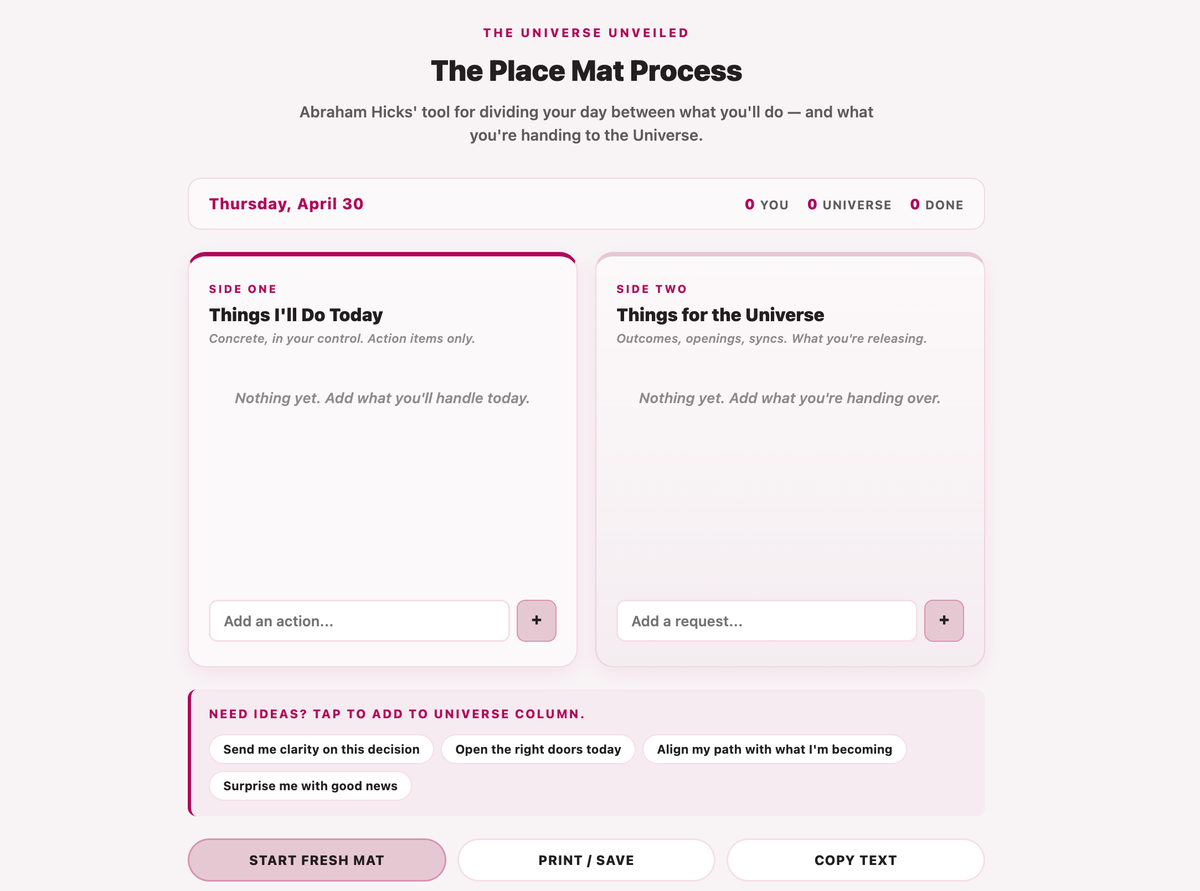
The Place Mat Process is Abraham Hicks' two-column daily practice. On one side: things you'll do today — concrete actions in your control. On the other side: things you're asking the Universe to handle — outcomes, openings, syncs you're releasing.
The act of writing the second column is the technique. Naming what you're delegating signals the subconscious to stop gripping and lets the Universe operate in the space you've opened.
Most people approach their day in one of two ways. They write a long to-do list and try to control everything on it. Or they refuse to plan, hoping the Universe will sort it out. Both fail. The first burns you out. The second leaves you reactive to whatever shows up.
Abraham Hicks taught a third option — and gave it the most unassuming name in the entire Abraham canon. The Place Mat Process. A two-column page that resolves the tension between effort and surrender by clearly defining which is which.
This article is part of the Abraham Hicks System of Alignment. If you are new, start there.
What the Place Mat Process Actually Is
The setup is almost embarrassingly simple. Take a piece of paper. Draw a line down the middle.
Left column header: Things I'll Do Today.
Right column header: Things I'm Asking the Universe to Do.
Fill in the left side with concrete actions you can actually take. Fill in the right side with outcomes, openings, syncs, and resolutions you are deliberately handing over. Then go about your day.
That is the entire technique. Abraham introduced it in workshops as a way to demonstrate, in physical form, what conscious co-creation actually looks like. You do your part. You release the rest. The page is the contract.
The reason the process works is structural. When everything is mixed together — your action items and your hoped-for outcomes — the mind cannot tell what to grip and what to release. It tries to control everything, including the things it cannot control. That over-gripping is exactly what blocks the Universe from operating. The Place Mat fixes that by making the division explicit.
Why the Right Column Is the Real Technique
Most people, when they first try the Place Mat Process, focus on the left side. The action items feel like the "real" work. The right side feels like wishful thinking.
The opposite is true.
The left side is just a to-do list. You have been writing those your whole life. The right side is the technique. Naming what you are deliberately handing to the Universe does three things at once.
It signals the subconscious to stop trying to control it. The mind grips what is undefined. Once an item is explicitly placed in the Universe column, the mind has been given permission to release it. The grip relaxes. Resistance drops.
It opens vibrational space for the outcome to arrive. When you stop forcing, the Universe has room to operate. The Vortex works this way — your job is alignment, not delivery. The right column is alignment made visible.
It teaches you, over weeks of practice, what is actually in your control. Most of what stresses people is not in their control. The right column makes that obvious. Every item you put there is a piece of evidence that you cannot personally make every outcome happen — and that you do not need to.
The Free Interactive Place Mat
The process is more powerful when you actually use it. Below is a free interactive Place Mat — two columns, ready for today. Add your action items on the left, your Universe requests on the right. Check items off as they happen. Notice how often the right column resolves itself.
The tool saves your mat for the day and clears it tomorrow — a fresh mat each morning, exactly as Abraham intended.
How to Fill Out Each Side
The wording matters more than most people realize.
Left column — concrete and in your control. "Reply to three emails." "Walk for thirty minutes." "Finish the draft." These are actions you can complete by your own effort. If an item depends on someone else's response, it does not belong here. It belongs in the right column.
Right column — outcomes, openings, syncs. Phrase requests in the language of allowing, not demanding. "Bring me clarity on the next step." "Open the right doors today." "Connect me with the right person." "Resolve this through people I have not yet met." These are not commands — they are deliberate releases. Abraham described this as the language of trust.
The most common mistake is putting the same item in both columns. "Get the client to sign" cannot live on both sides. Either you are doing it (left column action: send the proposal) or you are releasing it (right column request: bring me a yes by Friday). The whole technique fails if items straddle the line.
 See the Book
A Worked Example
Imagine a Tuesday morning. You have a launch coming, a client situation that is unresolved, a personal commitment, and a vague worry about money. Your usual approach is to mash all of it into a panicked to-do list and feel overwhelmed by 9am.
Place Mat instead.
Things I'll Do Today:
- Write the launch email — first draft only
- Send the follow-up to the client
- Walk for thirty minutes after lunch
- Pay the two bills on the desk
- Call mom back
Things I'm Asking the Universe to Do:
- Bring me clarity on the launch positioning
- Resolve the client situation in the way that's best for both of us
- Send unexpected income this week
- Open the right next door for the business
- Show me the obvious next step on the bigger decision
Notice how the left column is finite, doable, and yours. Five things. You can complete all of them. The right column is everything you have been gripping that is not actually yours to grip. By writing it down, you have explicitly handed it over.
By the end of a day like this, two things tend to happen. The left column gets done because it is reasonable. And the right column starts resolving in unexpected ways — a clarifying conversation lands without you forcing it, an email arrives with the answer you needed, a small unexpected payment shows up, a person mentions exactly the contact you were hoping for. Not because of magic. Because the gripping that was blocking those resolutions has been released.
Why It Works: The Mechanics of Delegation
The Place Mat exploits a specific feature of how the subconscious mind operates.
The subconscious does not distinguish between "I am working on this" and "I am gripping this." Both feel the same internally — sustained attention on an unresolved item. The result is that you spend cognitive and energetic resources on outcomes you cannot directly control, leaving less available for the things you can.
Naming an item explicitly as "the Universe's job" creates a clear cognitive boundary. The subconscious accepts the delegation. The energetic grip releases. That released attention becomes available for actual aligned action — and, more importantly, for the receptive vibrational state that lets the Universe deliver.
This is the same mechanism behind the Pivoting Process and "Wouldn't It Be Nice If". All three techniques work by removing resistance rather than adding effort. The Place Mat is the most structural of the three — it operationalizes the release in a daily, written form.
Common Mistakes
Four things flatten the practice.
Mistake one — putting too much on the left. If your action column has fifteen items, you are not delegating, you are pretending you control more than you do. Five items is a strong day. Three is often better. The constraint forces you to put the rest on the right.
Mistake two — leaving the right column empty. The whole technique is the right column. If you are not putting anything there, you are still gripping everything. Force yourself to name at least three things the Universe is handling, even on a quiet day. The act of naming is the work.
Mistake three — checking constantly to see if Universe items have happened yet. That is gripping in disguise. Once an item is on the right side, the only thing you do is notice if and when it resolves. You do not chase it. You do not strategize about it. You let it be the Universe's job.
Mistake four — putting items in the right column you do not actually want released. If a part of you still wants to control the outcome, the delegation will not stick. Be honest about what you are willing to hand over. The items you genuinely release will resolve. The items you secretly still grip will stall — and that stall is data showing you where you have not yet trusted.
When to Use the Place Mat
The strongest version is daily, first thing in the morning, before the day's contrast loads in. Five minutes. Two columns. A clear mat for a clear day.
It also works as a reset tool. When a day has spiraled into reactivity and you cannot find your footing, stopping to draw a Place Mat resets the architecture. Five minutes of clean delegation often saves the rest of the day.
Use it specifically before high-stakes events — launches, important conversations, performances, negotiations. The Place Mat completed before a high-stakes moment lets you walk in handling only your part, with the rest already explicitly released. The vibrational difference is significant.
How It Pairs With the Other Abraham Processes
The Place Mat is the structural daily container that the other processes operate inside.
Use the "Wouldn't It Be Nice If" process to soften any items in the right column that feel too charged to release. "Wouldn't it be nice if the client situation resolved smoothly..." goes on the right side as a soft request, lowering the resistance around the topic.
Use a Rampage of Appreciation at the end of the day on the items in the right column that resolved — even partially. The appreciation reinforces the practice and trains the nervous system to expect Universe-side resolutions.
Use the Pivoting Process mid-day if a contrast hits that pulls items back into your gripping pile. Pivot, return to the mat, confirm the item is still in the Universe column.
Use Segment Intending at transitions — the Place Mat sets the day's overall division of labor; segment intending sets the vibrational tone for each chunk inside it. They layer cleanly.
And use the Emotional Guidance Scale as the dashboard. If you are gripping items on the right column, your emotional reading will be tighter. The scale tells you when delegation has actually completed.
A Daily Practice
Thirty days of Place Mat practice changes how you experience your life.
The first week, you notice you are over-gripping things you cannot control. That noticing alone shifts your baseline.
The second week, items in the right column start resolving in ways you did not engineer. You begin to trust the technique slightly.
The third week, the left column gets shorter. You realize how much of your old to-do lists were actually wishes for control over outcomes that were never yours.
The fourth week, the right column gets braver. You start putting bigger things on it — career-level, money-level, relationship-level requests. And the Universe begins delivering at that scale, because you have been training the trust muscle on smaller items first.
This is the Place Mat's quiet power. It is not flashy. There are no dramatic affirmations, no visualization rituals, no demanding declarations. There are only two columns, drawn fresh each morning — and over weeks, those two columns retrain how you relate to your entire life. What is yours, what is the Universe's, and how the partnership actually works.
Conscious co-creation made simple. A piece of paper. A line down the middle. Your part on one side, theirs on the other. Then go about your day, knowing you have delegated.
This technique works best when you understand the underlying general-to-specific principle — the meta-skill that determines whether any Abraham process produces results or quietly fails.
See the Book on Amazon
Place Mat Process: Frequently Asked Questions
What is the Abraham Hicks Place Mat Process? +
The Place Mat Process is Abraham Hicks' two-column daily practice. On one side: things you'll do today — concrete actions in your control. On the other side: things you're asking the Universe to handle — outcomes, openings, syncs you're releasing. The act of writing the second column is the technique. Naming what you're delegating signals the subconscious to stop gripping and lets the Universe operate.
Why is the right column the real technique? +
The left column is just a to-do list. The right side is the technique. Naming what you're deliberately handing to the Universe signals the subconscious to stop gripping, opens vibrational space for outcomes to arrive, and teaches you over time what is actually in your control versus what is not. Most stress comes from gripping the things you cannot directly control.
What goes on the left side of the Place Mat? +
Concrete actions in your control — things you can complete by your own effort. "Reply to three emails." "Walk for thirty minutes." "Finish the draft." If an item depends on someone else's response or external timing, it does not belong on the left. It belongs on the right.
What goes on the right side of the Place Mat? +
Outcomes, openings, and resolutions you are deliberately releasing. Phrase them in the language of allowing, not demanding. "Bring me clarity on the next step." "Open the right doors today." "Connect me with the right person." "Resolve this through people I have not yet met." These are not commands — they are deliberate releases.
How often should I do the Place Mat Process? +
Daily, first thing in the morning before the day's contrast loads in. Five minutes. A fresh mat each day. It also works as a reset tool when a day has spiraled into reactivity, and as a pre-event tool before high-stakes moments — launches, important conversations, performances, negotiations.
Why does writing it down matter? +
The subconscious does not distinguish between "I am working on this" and "I am gripping this" until the boundary is made explicit. Writing an item down on the Universe side creates a clear cognitive boundary. The subconscious accepts the delegation, the energetic grip releases, and the released attention becomes available for actual aligned action and the receptive state that lets the Universe deliver.
What is the most common mistake people make with the Place Mat? +
Putting too much on the left side and leaving the right side nearly empty. If your action column has fifteen items, you are not delegating — you are pretending you control more than you do. Three to five action items is a strong day. The rest belongs in the Universe column. The act of moving items there is the practice.