Abraham Hicks vs Neville Goddard: Which Manifestation Path Is Right for You
Abraham Hicks and Neville Goddard are the two most influential manifestation teachers of the modern era. Both work. They use different mechanisms and different language, but they describe the same underlying process. Here is the complete comparison and how to decide which one fits you.

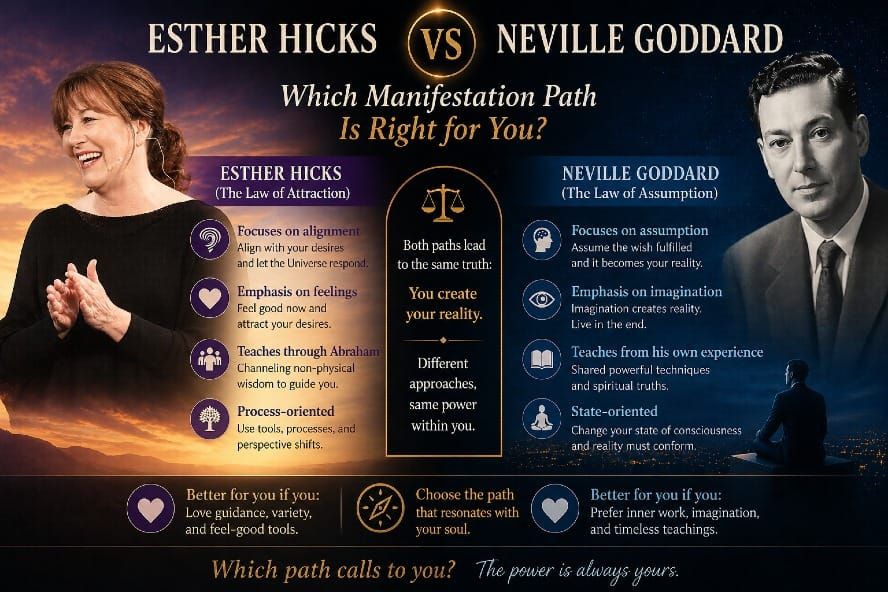
Abraham Hicks teaches the vibration path — manifest by aligning emotionally with the feeling of your desire, using the Vortex, the Emotional Guidance Scale, and processes like the Focus Wheel. Neville Goddard teaches the assumption path — manifest by occupying the identity of the person whose wish is already fulfilled, using SATS and imaginal acts to install the new self-concept.
Both work. They describe the same underlying mechanism in different languages. Abraham is gentler and emotion-led, easier to start. Neville is more precise and identity-led, faster once you grasp it. Most practitioners eventually use both.
Two teachers. Two languages. One underlying mechanism.
Abraham Hicks and Neville Goddard are the two most influential voices in modern manifestation. Most people studying one have only a vague sense of the other, and the two communities often treat them as rival camps. They are not rivals. They are two doors into the same room.
This is the complete comparison — what each teacher actually says, where they overlap, where they genuinely diverge, and how to decide which path to walk first.
Who Each Teacher Is
Abraham Hicks is the name given to a non-physical collective consciousness that speaks through Esther Hicks, who began channeling in the mid-1980s with her late husband Jerry Hicks. Their teachings center on the Law of Attraction, the Vortex, alignment, and emotional guidance. Their primary books include Ask and It Is Given, The Law of Attraction, and The Vortex. Their material is workshop-based — most of it originally delivered orally and later transcribed.
Neville Goddard (1905–1972) was a Barbados-born mystic who delivered four decades of lectures in New York and Los Angeles on what he called the Law of Assumption. Mentored in 1930s Harlem by an Ethiopian mystic named Abdullah, Neville taught that imagination is God and that consciousness is the only reality. His core works include The Power of Awareness, Feeling Is the Secret, and The Law and the Promise. His teachings are precise, doctrinal, and identity-based.
One channels a non-physical collective. The other transmits a mystical doctrine refined over four decades. The voices are different. The architecture they describe is closer than most people realize.
The Core Mechanism: Where They Agree
Strip both teachings down to first principles and you find the same claim: your inner state is the cause, and the outer world is the effect.
Abraham frames this as vibration. You emit a signal moment to moment, and Law of Attraction returns matching experiences. Neville frames it as assumption. Whatever you accept as true at the subconscious level hardens into outer fact.
Both teach that:
- The current external situation is not the cause — it is the report.
- Feeling is more powerful than thinking. Thought without emotion has no creative force.
- The work is internal first, action second. You shift inside, and circumstances reorganize.
- Persistent inner state determines outer experience, not effort or willpower.
- Manifestation is lawful, not magical. The same law operates whether you are conscious of it or not.
The disagreement is not on what is happening. The disagreement is on the language and the entry point.
The Mechanism: Vibration vs Assumption
Here is where the languages diverge most clearly.
Abraham's mechanism is vibrational. Every thought has a frequency. Every emotion is a precise readout of that frequency. The universe matches your frequency with experiences of equal frequency. You manifest by climbing your Emotional Guidance Scale until you match the vibration of your desire — at which point it must arrive, because matched frequencies cannot stay separated.
Neville's mechanism is assumptive. The subconscious accepts whatever the conscious mind feels to be true and externalizes it as outer condition. You do not match the frequency of your desire. You become the person who already has it. The body and circumstances reorganize to match the new self-concept, because consciousness is the only reality and outer form must mirror inner state.
One says: change how you feel and reality will follow. The other says: change who you are being and reality will follow. These are not contradictory. They are describing the same shift from two angles.
The Tools Side by Side
The processes look different on the surface and converge underneath.
Abraham's primary tools:
- The Focus Wheel — twelve believable statements around a desired feeling to climb the vibrational scale
- Segment Intending — setting a vibrational tone at every transition in the day
- The 17-Second Rule — holding a clean thought for 17 to 68 seconds to reach the combustion point
- Rampage of Appreciation — building emotional momentum through specific gratitude
- Daily 15-minute meditation to deactivate resistance
Neville's primary tools:
- SATS (State Akin to Sleep) — entering the hypnagogic state to install imaginal scenes
- Imaginal Acts — first-person felt scenes of the wish already fulfilled
- Revision — rewriting past events in imagination to remove anchored assumptions
- Inner Speech — disciplining the running internal monologue to match the new identity
- Living from the End — operating from the feeling-state of the desire already accomplished
Look closely. Abraham's "feel the feeling of the desire" is Neville's "assume the feeling of the wish fulfilled." Abraham's 17-second rule of pure thought is Neville's persistence of assumption without contradiction. The Focus Wheel and revision both rewire the meaning of present and past. The vocabularies differ. The operations are siblings.
 See the Book
Where They Genuinely Diverge
The teachings overlap underneath. The differences on the surface are real and worth understanding clearly.
Tone and pace. Abraham is gentle. The teaching meets you where you are emotionally and helps you climb one rung at a time. There is permission to feel bad and instructions for moving slightly higher. Neville is direct. There is no climbing — there is simply assumption. You are either occupying the new state or you are not. Some people find Abraham softer to start and Neville faster once internalized.
The role of emotion. For Abraham, emotion is the primary instrument and the primary readout. You navigate by how you feel. For Neville, feeling is essential but in service of identity — the goal is not to feel good, the goal is to feel real as the new person. Abraham asks "does this thought feel better." Neville asks "does this state feel natural to me as the person who has it."
The treatment of contrast. Abraham celebrates contrast. The unwanted experience is what causes the desire to be born and the Vortex to expand. Without contrast, no manifestation happens. Neville largely treats contrast as evidence of an old assumption still in operation — the work is to revise it through imagination, not honor it as creative fuel.
The mechanism of timing. Abraham emphasizes vibrational match and the cooperation of timing across many people's signals. Neville emphasizes the Bridge of Incidents — the chain of seemingly ordinary events the subconscious organizes once an assumption has been impressed. Both result in synchronicity. The framing of why it appears differs.
The view of self. Abraham frames you as an extension of Source Energy — a non-physical being having a physical experience. Neville frames you as imagination itself, the operant power, the I AM. Both teachings are radically empowering. Neville's framing is more theological. Abraham's is more relational.
Which Path Fits Which Person
The answer depends less on which one is "better" and more on how you naturally orient.
Abraham fits you better if: you are emotionally sensitive, navigate the world by how things feel, find rigid identity work uncomfortable, prefer gentle climbs to abrupt shifts, and respond to permission and warmth. The Emotional Guidance Scale is a precise instrument if you live primarily through your emotional body. The Vortex framing makes alignment feel approachable rather than demanding.
Neville fits you better if: you respond to clarity over comfort, do not need permission to feel bad first, are willing to assume an identity that current circumstances contradict, and can sustain a precise inner posture without checking outside for evidence. SATS is uncompromising. The doctrine assumes you are willing to be the person you say you want to become — tonight, before the conditions confirm it.
Most serious practitioners eventually use both. Abraham's vibrational tools handle the emotional landscape moment to moment. Neville's identity work handles the deeper architecture of who you are being. They are complementary, not competing. The Focus Wheel can stabilize you on a difficult day. SATS can install a new self-concept at night. The two practices coexist beautifully.
The Hidden Convergence
Notice what happens when you reach the high end of either path.
An Abraham practitioner who consistently lives in the Vortex on a subject is, in Neville's language, occupying the identity of someone for whom the desire is fulfilled. They are no longer trying. They are being.
A Neville practitioner who has installed a new self-concept and is persisting in it is, in Abraham's language, holding a sustained vibrational match to the desire. They have crossed the combustion point and stayed there.
The vocabulary diverges. The state is the same. Both teachers are pointing at the same final position — sustained interior alignment with the wished-for reality, held steadily enough that outer circumstances reorganize.
This is why arguing over which one is "correct" misses the point. Correctness is not the question. Resonance is the question. The path that resonates is the path your nervous system can actually sustain — and sustained practice is what produces results, regardless of which language you use.
 See the Book
A Practical Recommendation
If you are new to manifestation entirely, start with Abraham. The framework is gentler, the emotional guidance is intuitive, and the tools build capacity without demanding identity shifts you cannot yet sustain. Spend three to six months with the Focus Wheel, the Emotional Guidance Scale, and basic alignment practice. Build the muscle of feeling-led navigation.
Once that foundation is steady, add Neville. SATS at night becomes the precision instrument that installs new self-concepts at the level Abraham's daily practice cannot quite reach. You will find that Abraham's "vibrational match" and Neville's "assumed identity" become indistinguishable inside your actual experience.
The two teachers are not asking you to choose. They are offering two doors. Walk through whichever one is closer to where you are standing — and the other will be waiting on the inside.
The work is not picking the right teacher. The work is doing the practice the teacher you choose actually prescribes. That is the only thing that matters in either system.
Abraham Hicks vs Neville Goddard: Frequently Asked Questions
What is the main difference between Abraham Hicks and Neville Goddard?
Abraham Hicks teaches the vibration path — manifest by aligning emotionally with the feeling of your desire. Neville Goddard teaches the assumption path — manifest by occupying the identity of the person whose wish is already fulfilled. Both work. They describe the same underlying mechanism in different languages.
Which is better, Abraham Hicks or Neville Goddard?
Neither is objectively better. Abraham fits people who navigate by emotion and prefer gentle climbs. Neville fits people who respond to direct identity work and clarity over comfort. Most serious practitioners eventually use both — Abraham for daily emotional landscape, Neville for deeper self-concept architecture.
Can you use Abraham Hicks and Neville Goddard together?
Yes — they are complementary, not contradictory. Abraham's vibrational tools handle the emotional landscape moment to moment. Neville's identity work handles the deeper subconscious architecture. The Focus Wheel can stabilize a difficult day; SATS can install a new self-concept at night. The two practices coexist seamlessly.
Is the Law of Attraction the same as the Law of Assumption?
They describe the same underlying mechanism with different language. Law of Attraction emphasizes vibrational matching — like attracts like. Law of Assumption emphasizes identity occupation — what you assume hardens into fact. Both produce manifestation through sustained inner state. The vocabularies differ; the operations are siblings.
Should I start with Abraham Hicks or Neville Goddard?
If you are new to manifestation, start with Abraham. The framework is gentler, the emotional guidance is intuitive, and the tools build capacity without demanding identity shifts you cannot yet sustain. Spend three to six months building the foundation, then add Neville's SATS and identity work as the precision layer.
Does Abraham Hicks contradict Neville Goddard?
On the surface they appear to disagree about contrast, the role of emotion, and the mechanism of timing. Underneath, both teach that inner state is cause and outer world is effect, that feeling is more powerful than thinking, and that sustained interior alignment determines outer experience. The disagreements are framing differences, not contradictions.