Babaji in America: Abdullah – Neville Goddard’s Mystic Mentor
What if Babaji walked in America—and what if Abdullah, Neville Goddard’s enigmatic mentor, was part of that hidden lineage? This post explores the mystical bridge between East and West, where Himalayan immortals and modern master-teachers quietly shape the destiny of seekers.

Introduction
India has long been a land of profound spiritual heritage, and among its most legendary gurus is Mahavatar Babaji. Revered as an ageless, immortal yogi, Babaji’s story captured the world’s imagination through Paramahansa Yogananda’s Autobiography of a Yogi. Many Indian seekers are familiar with Babaji’s miraculous appearances in the Himalayan caves and his role in reviving the ancient science of Kriya Yoga. But fewer know of the subtle ways Babaji’s influence may have touched Western shores. Across the globe in early 20th-century America, another enigmatic mystic was quietly guiding students to spiritual awakening: Abdullah, the mentor of Neville Goddard and Joseph Murphy.
Could there be a mystical connection between Babaji’s mission in the East and Abdullah’s work in the West? In this blog, we explore the lineage and influence of Babaji, introduce the remarkable figure of Abdullah, and delve into how their stories bridge Eastern and Western mysticism in an inspirational, universe-unveiling way.

The Hidden Teacher Behind Neville Goddard
If Babaji represents the eternal Himalayan current, Abdullah represents its Western transmission — the bridge where mysticism became operational law. Abdullah Unveiled investigates the identity, lineage, and metaphysical authority of Neville Goddard’s teacher.
View BookThe Lineage of Babaji and His Influence in the West
Mahavatar Babaji is said to have no beginning and no end – an immortal master who appears in any form to uplift humanity. In the 19th century, he reintroduced the potent techniques of Kriya Yoga through his disciple Lahiri Mahasaya, empowering householders and monks alike to attain God-realization. From Lahiri sprang a lineage of illumined teachers:
- Lahiri Mahasaya (1828–1895): The householder yogi Babaji initiated into Kriya Yoga, who spread these teachings across India.
- Swami Sri Yukteswar Giri (1855–1936): Lahiri’s disciple, a scholarly saint tasked by Babaji to harmonize Eastern and Western spiritual wisdom. Babaji famously met Yukteswar at the Kumbha Mela festival and requested him to write a book (The Holy Science) uniting spiritual truths of East and West.
- Paramahansa Yogananda (1893–1952): Yukteswar’s chief disciple, chosen to bring Babaji’s message to America. In 1920, before Yogananda departed India for Boston, Babaji appeared to him in Calcutta, blessing his mission and saying: “Follow the behest of your guru and go to America. Fear not; you shall be protected. You are the one I have chosen to spread the message of Kriya Yoga in the West.” Armed with this divine sanction, Yogananda embarked on a journey that would ignite global interest in yoga and meditation.
Through Yogananda and others, Babaji’s influence firmly planted itself in American soil. By mid-20th century, concepts like meditation, yoga, and gurus had entered Western vocabulary, driven in part by the spiritual revolution Babaji set in motion. Yet Babaji himself remained in the shadows – a hidden guide watching over the unfolding of this East-West exchange.
Incarnations or Appearances of Babaji?
Babaji’s elusive nature has led to endless fascination about where and how he might appear. Devotees believe that Babaji, having promised never to relinquish his physical form for the sake of humanity, may manifest in different places and eras. Over the years, there have been claims of Babaji materializing far from the Himalayas:
- In the 1970s, a youthful saint known as Haidakhan Babaji emerged in northern India, proclaiming simple teachings of truth and love. Many followers revered him as the same Mahavatar Babaji in a new form.
- Some accounts even suggest Babaji took birth in the West. For instance, one legend speaks of an enigmatic yogi in Oregon (USA) born in the 1950s who was believed by a few to be Babaji reincarnated.
Whether or not such stories are literally true, they reflect a deeper truth: that Babaji’s spirit transcends boundaries. His mission is not limited to one culture or religion. If Babaji is indeed an omnipresent guide, it is natural to imagine his influence quietly at work through various teachers around the world — sometimes in forms and under names we might not immediately recognize.
Abdullah: A Mystical Mentor in 1930s America
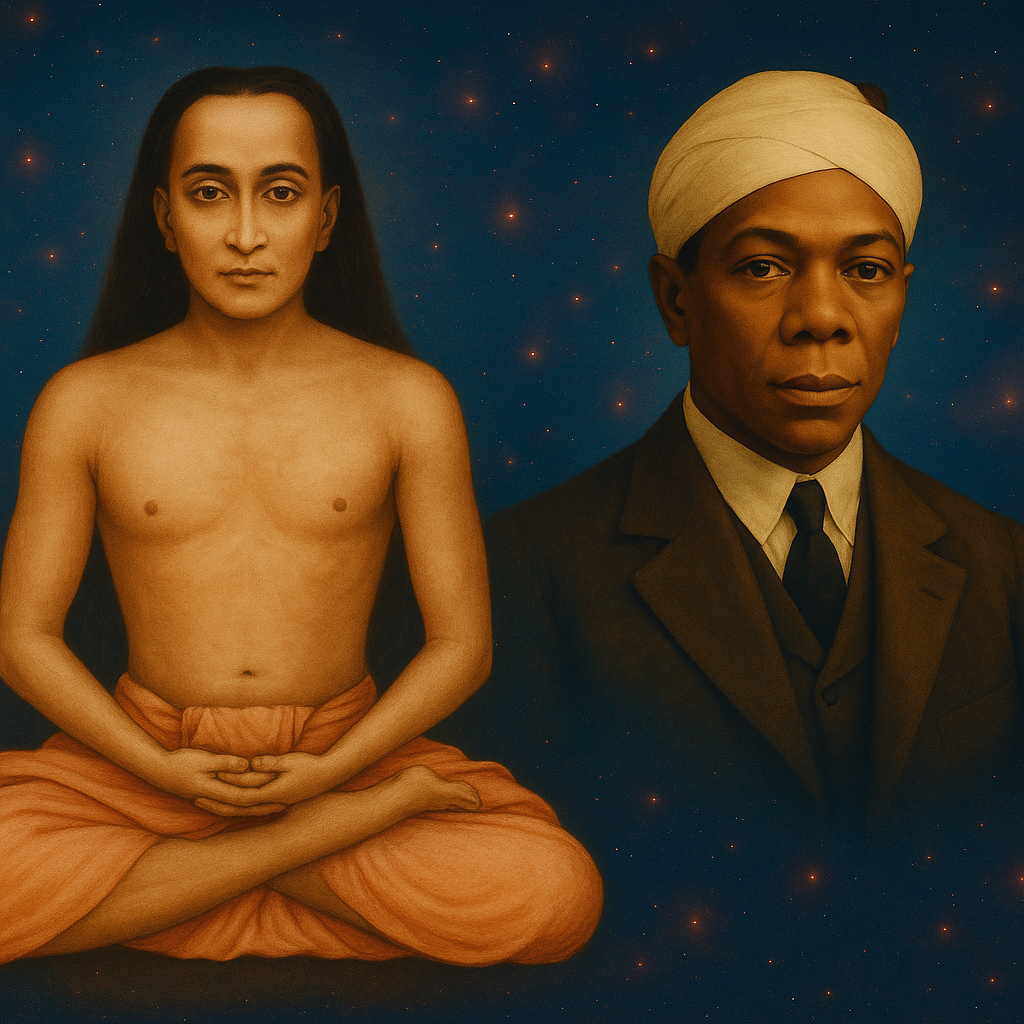
During the same era that Yogananda was establishing yoga in America, another teacher was transforming lives in New York City. His name was Abdullah, a reclusive Ethiopian mystic who became the mentor to Neville Goddard (1905–1972) and Dr. Joseph Murphy (1898–1981), both of whom would later become influential spiritual writers. While Babaji remained behind the scenes, Abdullah taught openly in the heart of the West, yet he too carried an aura of mystery.
An Unlikely Guru in Harlem
Abdullah was an African-born Jew who emigrated from Ethiopia to the United States in the early 20th century. Arriving during a time of racial segregation, he nevertheless thrived and moved with quiet dignity through New York’s society. It is said that Abdullah could sit in a segregated opera house, wrapped in his turban and robes, utterly unperturbed by the prejudices of the day. He emanated a sense of peace and power that seemed to render external circumstances meaningless.
In this way, Abdullah lived his own teaching: that one’s inner state can shape and overcome outer reality. Settling in Harlem, he became part of the city’s vibrant mystical subculture of the 1920s–30s. He was often described as an Ethiopian rabbi or an oriental sage. He lectured on scriptures and metaphysics, attracting a small circle of dedicated students. Though details of his life were scant, those who met him were struck by his profound knowledge of the Bible, Kabbalah, and esoteric wisdom from both East and West. Abdullah treated sacred texts not as mere doctrine, but as living metaphors for the powers hidden in the human spirit.
A Western Initiate Appears
Just as Babaji trained yogis in the East, Abdullah trained imaginal mystics in the West — shaping the manifestation doctrine that would reach the modern world.
Explore the BookMentoring Neville Goddard and Joseph Murphy
Perhaps Abdullah’s greatest legacy lies in the impact he had on his pupils, especially Neville Goddard and Joseph Murphy, who went on to spread his teachings far and wide:
- Neville Goddard: Neville came to New York from Barbados in the 1920s as a young man seeking a career in theater. Instead, he found spiritual mentorship under Abdullah from 1929 to 1936. Abdullah taught Neville Hebrew and the symbolism of Kabbalah so that Neville could deeply grasp the mystical meaning of the Bible. Under Abdullah’s guidance, Neville discovered that imagination is the creative force of reality and that conscious assumption of the wish fulfilled is the key to manifesting one’s desires.
- Joseph Murphy: Murphy, who later authored the worldwide bestseller The Power of Your Subconscious Mind, also studied with Abdullah in New York. Originally from Ireland, Murphy was drawn to spiritual science and psychology. From Abdullah he learned methods of affirming and impressing the subconscious mind with positive images to heal and prosper one’s life. Murphy’s work echoed many principles that Abdullah imparted — such as the idea that the infinite power of God dwells within our own subconscious.
Through Neville and Murphy, the essence of Abdullah’s teachings reached millions of seekers across the globe. Every time someone applies Neville’s “Law of Assumption” or practices a subconscious mind technique from Murphy’s book, they are indirectly touched by the wisdom of the mysterious teacher Abdullah.
The Law of Assumption in Action
One of the most famous lessons Abdullah gave Neville Goddard was a living demonstration of the law of assumption. In the winter of 1933, Neville found himself penniless and desperate to return home to Barbados for the holidays. When he confided his situation, Abdullah gave him an astonishing instruction: “You are in Barbados,” he declared, as if the goal were already accomplished. Abdullah insisted that Neville live and sleep in his imagination as though he were already in Barbados, enjoying time with family. For weeks, nothing seemed to change outwardly, yet Abdullah remained unmoved and refused to discuss the matter further.
Then, in early December, Neville received an unexpected letter with money and a ship ticket from his brother in Barbados — an offer for a voyage home. Even more remarkably, despite being booked in third class, Neville was upgraded to first class during the trip. Upon hearing Neville’s news, Abdullah merely responded, “Who told you that you are going to Barbados? And who told you that you went to Barbados third class? You went to Barbados, and you went first class.”
This dramatic turn of events taught Neville a lifelong lesson: that assumption, held with faith, creates reality. Abdullah’s unwavering conviction impressed upon Neville that there can be no half-measures when using imagination spiritually — one must know it is done, and then let the outer world reflect the fulfilled state in its own natural way. Neville would later share this Barbados story in his lectures to illustrate that imagining the end result, without worrying about the “how,” is a potent force. It’s a principle that not only thrived in New Thought circles but also resonates with ancient yogic lore about the creative power of thoughts.
Mystic, rabbi, Moor, or initiated adept — Abdullah’s identity remains one of manifestation’s greatest mysteries.
Bridging East and West: A Unified Mystical Vision
At first glance, the Himalayan yogi Babaji and the Harlem mystic Abdullah might seem to have little in common. They lived in different worlds, followed different religions, and taught through different methods. Yet their missions share a remarkable convergence. Both aimed to awaken people to the divine power within themselves, transcending limitations of the external world.
Parallel Teachings, Universal Truth
Consider the core message of Babaji’s Kriya Yoga lineage and that of Abdullah’s metaphysical lessons:
- Babaji’s teachings: Passed down via Lahiri Mahasaya, Sri Yukteswar, and Yogananda, these emphasize that the ultimate reality (God or Brahman) resides within each person’s soul. Through deep meditation and yoga, one can experience this inner divinity and, in doing so, transform one’s life and attain liberation.
- Abdullah’s teachings: As reflected by Neville and Murphy, these insist that the human imagination or subconscious mind is essentially God the Creator in action. By aligning our thoughts and feelings with a desired reality (living “in the end” of the wish fulfilled), we tap into an infinite creative power to shape our destiny.
In essence, both Babaji and Abdullah point to the same profound truth: we carry within us a spark of the Divine that can shape reality. Whether one accesses it through silent meditation and Kriya breath, or through vivid imagination and faith, the source is identical — a higher power within us.
Moreover, both lineages encourage a non-sectarian approach to spirituality. Babaji did not found a new religion; he revitalized a technique to be used by anyone, regardless of background, to commune with God. Yogananda, at Babaji’s behest, spoke of the “Science of Religion,” finding common ground between the Bible and the Bhagavad Gita. Likewise, Abdullah, though versed in Jewish Kabbalah and Biblical lore, welcomed students of all faiths. He taught universal principles of mind and spirit that could be applied by a Christian, a Hindu, or an agnostic alike. This universality hints that truth is one, paths are many — a theme at the heart of both Eastern mysticism and the New Thought movement in the West.
Mystical Inspiration Across Cultures
The stories of Babaji and Abdullah together inspire us with how the universe places teachers where they are needed. Although separated by continents and cultures, both served a greater spiritual awakening that was global in scope:
- Babaji’s influence: Working from hidden mountain retreats in India, Babaji ensured that ancient yogic wisdom traveled to the modern West, preparing the soil for today’s worldwide yoga and meditation movement. He played the role of a guardian of the eternal truths, helping to light the lamp of yoga in the Western world through emissaries like Yogananda and others.
- Abdullah’s influence: Teaching in a New York brownstone, Abdullah helped spark a metaphysical self-development movement on American soil, translating spiritual ideas into the language of personal transformation and practical psychology. This movement made mystical concepts accessible to ordinary people seeking health, success, and meaning beyond the bounds of traditional religion.
Though there is no record that Abdullah ever knew of Babaji or vice versa, one cannot help but sense an invisible thread connecting them. Perhaps we can view Abdullah as one of many instruments of the one Divine Consciousness that Babaji also serves. In the grand play of cosmic evolution, both East and West are given the guides they need — and ultimately those guides are working in harmony, whether named or unnamed, whether aware of each other or not.
Conclusion: One Truth, Many Messengers
The saga of Babaji in India and Abdullah in America reminds us that spiritual light knows no borders. An Indian yogi appearing and disappearing in Himalayan caves ends up influencing millions of Westerners seeking yoga. A black Ethiopian teacher in New York quietly empowers some of the 20th century’s most influential New Thought authors, who in turn spread ideas long taught by sages of the East. There is a beautiful symmetry in this exchange.
For Indian readers familiar with Mahavatar Babaji’s glory, discovering Abdullah’s story is like finding a new facet of the same diamond of truth. It reaffirms that the Divine Universe unveils itself in countless forms. When hearts are sincere and yearning for wisdom, a Babaji may send forth a Yogananda, or the spirit of the Divine may raise up an Abdullah in a Harlem brownstone – different appearances, same underlying purpose.
In today’s world, we continue to seek guidance and inspiration. We may invoke Babaji in meditation or read Neville Goddard’s lectures late at night; in either case, we are tuning into that higher reality that both of these masters wanted us to realize. Their lives, though wrapped in mystery, ignite our own faith that we are more than just physical beings stumbling through chance. We are, as Abdullah and Babaji both taught, creators endowed with God-like potential, capable of rising above limitations and manifesting love, peace, and joy.
The legacy of Babaji and the legacy of Abdullah converge in a simple, timeless message: Look within for the kingdom of heaven, for God dwells in you. Whether through the stillness of Kriya Yoga or the bold imagination of assumption, the path to this kingdom stands open to all. As we honor both East and West’s spiritual giants, we realize it has always been one divine story – the story of human souls awakening to their true nature.
In the spirit of that oneness, may the wisdom of these two great teachers guide us, wherever we are, to unveil the divine universe within ourselves.
Where Himalayan Mysticism Met Manifestation
Babaji preserved the eternal science. Abdullah translated it into applied imaginal law — shaping the Western manifestation doctrine we study today.
View Book