The Count of Monte Cristo and Neville Goddard: The Story Abdullah Used to Teach the Law
Neville took Abdullah to the movies and asked one question afterwards: did you get anything out of it? This is the answer Neville eventually wrote down.

Did Neville Goddard and Abdullah see The Count of Monte Cristo together?
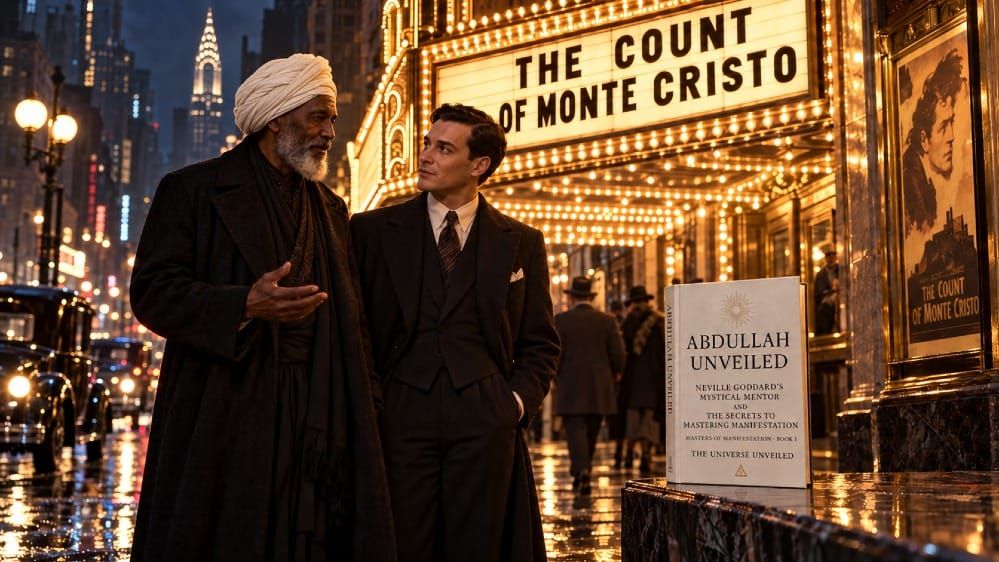
Neville Goddard recounted taking his teacher Abdullah to a picture, and that afterwards Abdullah asked him one question: did you get anything out of it? Abdullah was not asking whether Neville had enjoyed the film. He was testing whether Neville could read it.
Neville eventually wrote the answer down. Chapter 24 of Your Faith Is Your Fortune (1941), titled “Clairvoyance,” opens like this: “The story of Dumas’ ‘Count of Monte Cristo’ is, to the mystic and true clairvoyant, the biography of every man.”
In that chapter Neville defines clairvoyance not as seeing what is hidden but as understanding what you already see — anyone can look at a financial statement, he says, but almost no one can read one.
Read that way, Edmond Dantès is not a man taking revenge. He is consciousness: betrayed into a cell, taught in the dark to surrender his human opinions, told of a fortune already his before he can see it, dying to his old name inside a burial sack, and rising to assume a title that did not exist until he claimed it. That is the Law of Assumption told as a novel.
Abdullah Unveiled — the teacher behind the teaching →The teaching in eight points
- The anecdote. Neville took Abdullah to a picture. Afterwards Abdullah asked only: did you get anything out of it?
- The written source. Chapter 24 of Your Faith Is Your Fortune (1941), titled “Clairvoyance,” is where Neville reads Dumas in print.
- The line. “The story of Dumas’ ‘Count of Monte Cristo’ is, to the mystic and true clairvoyant, the biography of every man.”
- Clairvoyance redefined. Not psychic sight — understanding what you already see. Anyone can look at a financial statement; almost no one can read one.
- The cell is a state. Dantès is completely innocent and the door still shuts. The world does not consult your character; it consults the state you occupy.
- The teacher gives no escape. Abbé Faria hands Dantès no key and no boat — only the ability to read his own life, taught slowly, because a restless mind cannot absorb it at once. That is exactly what Abdullah did to Neville over seven years.
- The fortune arrives first. The treasure becomes his inside the dungeon, told to him by a dying man neither of them can act on. Possession precedes evidence.
- The old self has to die. He is carried out sewn into a burial sack, then discards the name Dantès entirely and assumes a title no one conferred. The three men who destroyed him do not recognise him.
Start here if this is new
The Law of Assumption is Neville Goddard’s teaching that whatever state you assume to be true of yourself hardens into fact. You do not chase a result. You occupy the state in which the result is already yours, and the outer world rearranges to match it.
That sounds abstract until somebody tells it as a story. Which is why Neville reached for a novel everybody had already read.
A young sailor has everything — a ship, a father, a wedding — and three jealous men write a letter that puts him in a cell on an island for fourteen years. In the dark an old priest tunnels in by accident and becomes his teacher. The priest gives him no escape and no money; he teaches him to think, and he tells him where an enormous fortune is buried on an island neither of them can reach. Then the priest dies. The young man climbs into the dead man’s burial sack, is thrown into the sea as a corpse, swims out, finds the fortune, and walks back into the world under a new name — and the men who ruined him look straight at him and do not know who he is.
Neville’s point: that is not one Frenchman’s adventure. That is the shape of every change of state. Something outside you puts you somewhere. You are taught to read it. You accept what is yours before there is any proof. The old identity ends. The new one is simply treated as real.
And Abdullah’s question in the lobby was the whole lesson: the law is not hidden in a secret book. It is lying in the open, and the only skill is whether you can read what is already in front of you.
Abdullah Unveiled — how the training actually worked →

Parables of the Law · No. 9
The Count of Monte Cristo
Neville took Abdullah to the pictures.
Afterwards he asked only one question.
They came out of the theatre into the New York night, and the old man asked him, did you get anything out of it?
Neville Goddard was a young dancer then, in the 1930s, studying under a teacher he would spend the rest of his life crediting and almost never explaining. Abdullah — a black man, an Ethiopian Jew, who taught him Hebrew, scripture, and the Law in a room in New York for something like seven years. Neville had taken him to see a picture. A story everybody knew. And on the way out, Abdullah asked whether he had gotten anything out of it.
Neville had enjoyed it. That was not the question.
The question was whether he had read it — whether he could look at a story the whole world had already looked at and see the law moving underneath it. Because that was Abdullah’s entire method. He did not hand Neville doctrine. He handed him a world and asked him what he saw in it.
Years later, Neville wrote the answer down. It is chapter 24 of Your Faith Is Your Fortune, published in 1941, and the chapter is titled “Clairvoyance.” It opens like this:
“The story of Dumas’ ‘Count of Monte Cristo’ is, to the mystic and true clairvoyant, the biography of every man.”
Neville Goddard — Your Faith Is Your Fortune, ch. 24, 1941Not a revenge novel. Not an adventure. The biography of every man. And the word Neville chose for the chapter title is the one most people get wrong, so he defines it immediately: clairvoyance is not seeing what is hidden. It is understanding what you already see. His own comparison — anyone can look at a financial statement. Almost nobody can read one.
That is what Abdullah was testing in the lobby. Not Neville’s eyes. His reading.
Chapter One
The sailor who had everything
The novel opens with a young man at the exact top of his life. Edmond Dantès, nineteen, finds his captain dead at sea, brings the ship home himself, and is promised the captaincy. He has a father who adores him and a girl he is about to marry. Everything he wanted, he has.
And three men who want what he has write a letter.
He is arrested at his own wedding feast. No trial. No charge read to him that he can answer. He is taken out across the water to a fortress on a rock, and the door closes.

Here is Neville’s reading of that opening, and it is not sentimental. Dantès is the man who has located his security outside himself — in a position, a reputation, a fortune, a wedding. Everything he is resting on is held by other people. So when other people move, he falls.
And this is the uncomfortable part: his innocence is irrelevant to the cell. He is completely innocent. The door still shuts. The world does not consult your character. It consults the state you are occupying.
Chapter Two
Fourteen years in the dark
The Château d’If is a real fortress on a real island in the bay of Marseille, and Dumas puts his man in it for fourteen years. Dumas is precise about the sequence, and anyone who has been inside a long bad stretch will recognise it: first Dantès expects to be released any day. Then he bargains. Then he rages. Then he prays. Then he decides to stop eating.

Fourteen years is not a punishment in this story. It is a description of how long a man will keep insisting on being the person he was.
Neville said it in a hundred lectures in different words: you are never imprisoned by a circumstance. You are imprisoned by a state. The circumstance is the shape the state takes once it has hardened. Which is unbearable to hear while you are in it, and is the only thing in it that can be changed.
Chapter Three
The old priest who dug the wrong way
Then the scratching in the wall.
An old priest has spent years tunnelling toward the sea and has miscalculated by a few feet, and instead of open water he comes up through the floor of Dantès’ cell. Abbé Faria — a failed escape, arriving as a teacher.

What Faria does next is the hinge of the entire novel, and it is the reason Neville used this book instead of a hundred others. Faria asks Dantès to tell him his life. Just the facts, the ones Dantès has been turning over for fourteen years without understanding any of them. And out of those same facts — nothing new, nothing added — the old man names the three men who did it and explains exactly why.
That is clairvoyance as Neville defined it. Faria does not receive a vision. He is given the same statement Dantès had, and he can read it. The prisoner had been staring at the answer for fourteen years.
And notice what Faria does not give him. Not freedom. Not money. Not comfort. He teaches him languages, mathematics, history, and how to think — and Neville makes a point of the pace: the teaching comes slowly, because a restless, unprepared mind cannot absorb it all at once. The price of admission is giving up your human values and your opinions about what is possible.
Which is, exactly and in detail, what Abdullah did to Neville. Seven years. Hebrew and scripture before anything else. No shortcuts, and no sympathy for the man who wanted the result without the surrender.
Abdullah ran the same curriculum Faria ran. Seven years, no shortcuts, and a flat refusal to negotiate with the man who wanted the result without the surrender. Abdullah Unveiled reconstructs that training from everything Neville ever said about him.
Read Abdullah Unveiled →Chapter Four
The fortune he owned before he saw it
Somewhere in those years Faria tells him about the treasure. An inexhaustible fortune, buried in a cave on the island of Montecristo. He tells him where. He tells him how to find the entrance.

Both men are still sealed in a rock in the middle of the sea when this happens. Neither of them can reach it. Neither of them may ever reach it.
And that is the point. The treasure becomes his inside the dungeon. Not on the island. Not when his hands are on it. The moment he accepts it as true, he is a rich man in a cell, and everything that happens afterwards is just the world catching up to a fact that was already settled.
Neville’s whole instruction lives in this chapter of the novel. You do not chase the thing. You accept that it is yours, in the state you are in, with the evidence still saying otherwise — and you hold that until the evidence changes its mind.
Chapter Five
Into the sack
Faria dies. And Dantès does the thing the whole novel has been walking toward.
He carries the body into his own cell, lays it in his own bed, cuts open the burial sack, climbs into it in the dead man’s place, and sews himself shut from the inside. They come for the corpse of the old priest. They carry him up through the fortress. They tie a cannonball to his feet and throw him off the rock into the sea.

He has a small knife and no guarantee of anything.
Read it as Neville read it: Edmond Dantès had to die. Not metaphorically die later — die right there, in the dark, by choice, before any result existed. He could not be released as the man who went in. The man who went in belonged in that cell; he was the state. Somebody else had to come out of the water.
This is the part people skip when they talk about assumption as though it were a mood. It is not a mood. It is sewing yourself into the sack.
Chapter Six
The title that did not exist
He comes up out of the sea. He finds the island. He finds the cave, and the fortune is where a dying man in a cell said it would be.

And then Dumas does the thing that made Neville reach for this book. Dantès does not go home. He does not reclaim his name, clear it, and demand apologies. He discards the human identity of Edmond Dantès entirely and assumes the title of the Count of Monte Cristo — a count of nowhere, a title no one conferred, invented out of the name of the rock where his fortune was buried.
Then he walks into Paris, into the houses of the three men who destroyed him, and they do not know him.

Not a disguise. A different state, carried so completely that the world has no choice but to address him as what he is assuming. Neville said the world is a mirror; here is a novel in which a man proves it for a thousand pages.
Coda
Did you get anything out of it?

The island is real, and in Italian its name means mount of Christ. Neville ends his reading of the novel where he always ended: with the death of the human self and the awakening of something higher in its place — man becomes Christ. The fortune was never the point. The fortune is what the new identity has, because of what it is.
Which brings the whole thing back to a sidewalk in New York and an old man asking a young dancer one question.
Abdullah was not quizzing him about a plot. He was teaching him the only skill that matters in this work: that the law is not hidden in a secret book, it is lying in the open, in scripture, in the newspaper, in a novel everybody has read, in your own fourteen years — and the whole difference between a person who is stuck and a person who is free is whether they can read what is already in front of them.
Anyone can look at a financial statement.
Almost nobody can read one.
- Clairvoyance
- In Neville Goddard’s usage, not psychic perception. The capacity to understand what you already see — to read the meaning in facts that are fully visible to everyone. Chapter 24 of Your Faith Is Your Fortune is built entirely on this definition.
- The Law of Assumption
- Whatever state you assume to be true of yourself hardens into fact. You do not pursue the result; you occupy the state in which the result is already yours, and the outer world reorganises to match. Neville’s phrase for the practice: assume the feeling of the wish fulfilled.
- A state
- Not a mood and not a circumstance. The identity you are presently occupying — the one your facts are the evidence of. Dantès in the cell is a state. The Count is a state. The man is the same man.
- The death of the old self
- The non-negotiable step. A new assumption is not added to the old identity; it replaces it. Dantès does not get out of prison as Dantès — he is carried out as a corpse and surfaces as someone else.
What this story is not saying
- MisconceptionThat Neville invented a reading of Dumas that isn’t in the text. ActuallyThe structure is Dumas’s: a fortune revealed before it can be reached, a chosen death, a discarded name, an assumed title. Neville pointed at a pattern the novel already has.
- MisconceptionThat the lesson is revenge, or that getting even is spiritual. ActuallyNeville takes nothing from the revenge plot. His chapter is about the prisoner, the teacher, the death and the new identity — the three enemies are scenery.
- MisconceptionThat assumption means thinking positively about your current life. ActuallyDantès does not cheer himself up in the cell. He climbs into a burial sack. Assumption requires the old identity to be finished, not encouraged.
- MisconceptionThat you need a teacher like Abdullah or Faria before anything can begin. ActuallyWhat both teachers transmit is a way of reading, not permission. Faria gives Dantès no key and no boat. He gives him the ability to understand what he already had.
- MisconceptionThat fourteen years is how long it takes. ActuallyFourteen years is how long Dantès kept insisting on being the man who was arrested. The duration measures the resistance, not the law.
The Abdullah Cluster
- Edmond Dantès
- The sailor imprisoned without trial in Dumas’s 1844 novel. In Neville’s reading, consciousness itself — the man whose security sat outside him, and who had to die to the name to possess the fortune.
- Abbé Faria
- The old priest who tunnels into Dantès’s cell by accident and becomes his teacher. He supplies no escape and no money — only the ability to read, and the location of a fortune neither of them can reach.
- Château d’If
- The island fortress in the bay of Marseille where Dantès is held for fourteen years. Neville’s reading treats it as a state of consciousness rather than a place.
- Montecristo
- A real island in the Tuscan Archipelago; the Italian name means mount of Christ. Dumas buries the fortune there, and Dantès takes his new title from it.
- Abdullah
- Neville Goddard’s teacher in New York from the 1930s — a black Ethiopian Jew who taught him Hebrew, scripture and the Law for roughly seven years, and whose method was to make Neville read rather than memorise.
- Your Faith Is Your Fortune
- Neville Goddard’s 1941 book. Chapter 24, “Clairvoyance,” is where he reads The Count of Monte Cristo as the biography of every man.
Abdullah asked one question. This book is the rest of the curriculum.
Seven years of training, reconstructed from everything Neville ever said about the man who taught him — the method, the refusals, the Barbados instruction, and why Abdullah would not let him negotiate. Abdullah Unveiled is the teacher behind the teaching.
Get Abdullah Unveiled →Frequently asked questions
What did Neville Goddard say The Count of Monte Cristo was about?
In chapter 24 of Your Faith Is Your Fortune (1941), Neville Goddard wrote that the story of Dumas’s Count of Monte Cristo is, to the mystic and true clairvoyant, the biography of every man. He read it as the drama of consciousness rather than a revenge plot: Edmond Dantès is the man who locates his security in position, wealth and reputation, loses all of it, is taught in the dark by an old priest to surrender human values and opinions, and finally dies to his old self in order to assume a new identity he was told of long before he could see it.
Which Neville Goddard book discusses The Count of Monte Cristo?
Your Faith Is Your Fortune, published in 1941. The discussion is in chapter 24, titled “Clairvoyance,” which opens with Dumas’s novel and uses it as the chapter’s central illustration.
Who was Abdullah, Neville Goddard’s teacher?
Abdullah was the teacher Neville Goddard credited with his entire training in the Law of Assumption. Neville described him as a black man, an Ethiopian Jew, who taught him Hebrew, scripture and the Law in New York beginning in the 1930s, and with whom he studied for roughly seven years. Abdullah taught by refusing to negotiate: his most famous instruction to Neville, who wanted to sail to Barbados with no money, was that Neville was already in Barbados.
What is the Law of Assumption?
The Law of Assumption is Neville Goddard’s teaching that whatever state you assume to be true of yourself hardens into fact. You do not pursue a result; you occupy the state in which the result is already yours, and the outer world reorganises to match it. Neville’s phrase for the practice is to assume the feeling of the wish fulfilled.
What does clairvoyance mean in Neville Goddard’s teaching?
Not psychic sight. In chapter 24 of Your Faith Is Your Fortune, Neville defines clairvoyance as understanding what you already see rather than seeing what is hidden. His own comparison is that anyone can look at a financial statement, but very few can read one. The clairvoyant is the person who can read the story that is in front of everyone.
How does Abbé Faria relate to the Law of Assumption?
Abbé Faria, the old priest who tunnels into Dantès’s cell, is the teacher figure in the story. He gives Dantès no freedom and no money. He gives him the ability to read his own life, and he reveals the treasure slowly because, as Neville notes, a restless and unprepared mind cannot absorb it at once. That is the function Abdullah served for Neville.
What does Monte Cristo mean?
Montecristo is a real island in the Tuscan Archipelago off the coast of Italy, and its Italian name means mount of Christ. Dumas gives Dantès that island as the place where his buried fortune waits, and the title he takes from it is the identity he assumes once his old self is dead.
Can The Count of Monte Cristo be read as a Law of Assumption story?
Yes, and Neville Goddard read it that way in print. The sequence of the novel is the sequence of the law: a state imposed from outside, a teaching received in the dark, a fortune named before it is seen, a death to the old identity, and the assumption of a new one that the world then treats as real. Neville’s point was that this is not Dantès’s biography. It is everyone’s.
“The story of Dumas’ ‘Count of Monte Cristo’ is, to the mystic and true clairvoyant, the biography of every man.” — Neville Goddard, Your Faith Is Your Fortune, chapter 24, 1941. The Count of Monte Cristo by Alexandre Dumas was first published in 1844. Illustrations from the 1888 edition, public domain via Wikimedia Commons. Portrait of Dumas by Nadar.