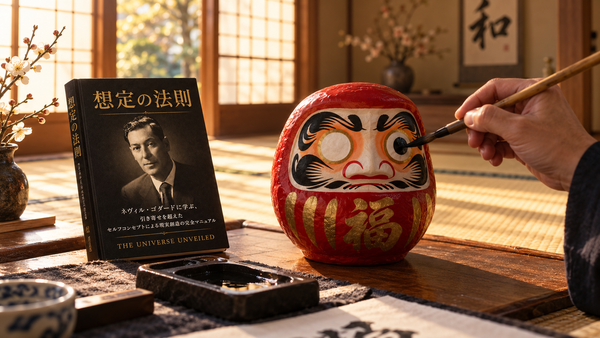
The Strange Japanese Ritual That Shows Why Your Wishes Stall
In Japan, you paint one eye on a daruma doll when you make a wish and the second when it comes true. Through Neville Goddard's Law of Assumption, a year of looking at a one-eyed face is a year of rehearsing "not yet." Here's how to paint the second eye first, so your wishes actually come true.

Definition
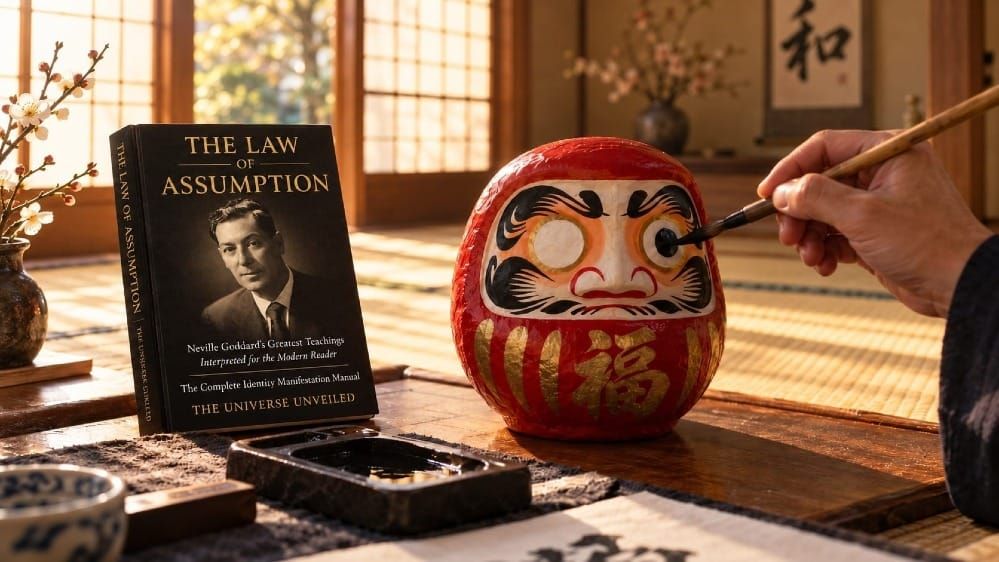
A daruma doll is a Japanese good-luck charm whose eyes are left blank. Traditionally, you paint one eye when you make a wish and the second when it comes true. But through the lens of the Law of Assumption, a year spent looking at a one-eyed face is a year spent confirming "not yet." What matters isn't when the brush touches the doll, but which eyes you're looking at the world through.
That's the heart of Neville Goddard's Law of Assumption: think from the end, not of it.
The whole method is laid out in The Law of Assumption.
What to Know
One eye says "not yet." Two eyes say "already." The doll reflects your assumption back to you every day.
Think from the end, not of it. It's Neville's most practical distinction.
The daruma rises by weight, not effort. Persistence is a return to a settled state.
Painting the second eye is the perfect bedtime scene. You can honor the tradition and still live from the end.
The nightly method is in the State Akin to Sleep.
For the full practice, read The Law of Assumption.
In Plain Terms
Once your hotel reservation is confirmed, you don't call the front desk every morning to ask if your room still exists. You know it's booked.
Looking at a one-eyed daruma and wondering "will it happen?" is like making that call every single day. A two-eyed daruma has the face of someone whose reservation is confirmed.
If you're new to Neville, start with the Neville Goddard ultimate guide.
The Law of Assumption turns living from the end into a 21-chapter daily practice.
Featured Book

The Law of Assumption
Paint the second eye on the inside first. The Law of Assumption is a 21-chapter practice manual for thinking from the end and living from it.
Get the BookAvailable in Kindle and Paperback — The Universe Unveiled
A Daruma Doll Story
One red doll. Two empty eyes. And the one you paint second.
Dear Universe Unveiled Community,
Somewhere in Japan right now, on a shelf in a kitchen or an office or a campaign headquarters, a round red doll is staring at someone with one eye. It's called a daruma, and that single painted eye means a wish has been made. The other eye stays blank until the wish comes true.

It's one of the strangest and most charming rituals I know. It's also, if you look at it through Neville Goddard's teaching, a near-perfect picture of why so many wishes stall. Today, I want to walk you through what the daruma is, how its eye ritual works, and what it reveals about the difference between thinking of the end and thinking from it. If you're new to Neville, the Neville Goddard ultimate guide is the best place to start.
Key Terms
Daruma doll: A round, hollow Japanese good-luck charm modeled on Bodhidharma, the monk credited with founding Zen. It's weighted at the base, so it rights itself when knocked over.
Kaigen (eye-opening): Painting an eye onto a daruma. Traditionally, one eye goes on when you make a wish and the other when the wish comes true.
Nanakorobi yaoki: A Japanese proverb meaning "fall down seven times, get up eight," symbolized by the daruma.
Thinking from the end: Neville Goddard's instruction to stand inside the fulfilled wish and look out from there, rather than looking at the wish from outside.
Law of Assumption: Neville Goddard's central teaching that whatever you assume to be true, and hold with feeling, hardens into fact in your outer world.
A daruma isn't a doll for waiting until your wish comes true. It's a doll for seeing the world through the eyes of the wish already fulfilled.
What Is a Daruma Doll?
A daruma is a round, hollow doll made of papier-mâché, with no arms and no legs. It's weighted at the bottom, so when you knock one over, it rolls right back upright. That's why it became the symbol of nanakorobi yaoki, "fall down seven times, get up eight."
They're sold at temples and New Year markets across Japan, and the city of Takasaki, north of Tokyo, is famous as the daruma's birthplace and its biggest producer. Most are red, with fierce, bearded faces and two large, empty white eyes.
Those empty eyes are the whole point.

Where the Daruma Comes From
The daruma is modeled on Bodhidharma, known in Japan as Daruma Daishi, the monk traditionally credited with bringing Zen from India to China. Legend says he sat facing a wall in meditation for nine years without moving, until his arms and legs wasted away. That's why the doll has neither.
Another legend explains the eyes. Bodhidharma was so determined never to doze off in meditation again that he cut away his own eyelids. Whether or not you believe it, it tells you what the daruma's wide, unblinking stare has always meant: a resolve that refuses to look away.
Japan's greatest artists kept coming back to that stare. The Zen master Hakuin painted it again and again, almost always with the same enormous, burning eyes.

The Daruma the Size of a Courtyard
Two hundred and nine years ago tomorrow, on October 5, 1817, a crowd gathered in a temple courtyard in Nagoya to watch an old artist paint a face. The artist was Hokusai, the man who would later give the world The Great Wave. The face was Daruma's, and it was so large it had to be laid out on the ground.
The people of Nagoya were so astonished that they nicknamed him "Daruma-sen," the Daruma master. The painting itself didn't survive. It was destroyed when Nagoya was bombed in 1945. But a print of the day remains.

Monks, painters, even swordsmen. For centuries, Japan kept returning to this one face. And always, to the eyes.
How the Daruma Eye Ritual Works
The Traditional Ritual
When you make your wish: Paint in the doll's left eye, which is on your right as you face it. This is called kaigen, "opening the eyes."
When the wish comes true, or the year ends safely: Paint in the doll's right eye, on your left as you face it.
When its work is done: Return the daruma to a temple, where it's ceremonially burned.
Customs vary by region and temple, so if the temple you got yours from has its own rule, follow it.
In Japan the ritual is so familiar that it's part of election night. In 1967, after his party's victory, Prime Minister Eisaku Satō dipped a brush in ink, painted in his daruma's second eye, and joked that its eyes were as big as his own. The cameras still turn up for that moment today.
Many people also write their wish on the back or base of the doll. Then it sits on a shelf all year, one eye open, one eye blank, waiting.
The Daruma Doll Meaning: Three Common Readings
A Visible Commitment
Painting the first eye makes the goal concrete. It's a vow you can see every day.
Resilience
The doll that always gets back up stands for persistence through setbacks.
A Record of Gratitude
The second eye marks the wish fulfilled, a thank-you for the year.
If you grew up in the West, you already know a version of this. It's the New Year's resolution taped to the fridge, the vision board above the desk, the goal written in January and checked in December. The daruma is simply a more beautiful version of the same idea.
All three readings are good ones. But each skips over one quiet fact. For as long as the daruma sits on your shelf with one eye painted, you look at that face every single day. And every day, it tells you the same thing: not yet.
That's where Neville comes in.
Reading the Daruma Through Neville Goddard's Law of Assumption
Neville Goddard (1905–1972) taught that whatever you accept as true in imagination hardens into fact in the world around you. That's the core of the Law of Assumption. One of his sharpest distinctions was between thinking of the end and thinking from it. To think of your wish is to stand outside it, looking at it from a distance. To think from it is to stand inside the wish fulfilled and look out at the world from there. The daruma's two eyes draw that line perfectly.
1. The One-Eyed Daruma: Living in "Not Yet"
A one-eyed daruma is a wish displayed as unfinished. Every morning you see that half-painted face, and something in you murmurs, I hope it happens soon. Which means every morning you rehearse standing on the near side of your wish.
Your subconscious accepts what you repeat, especially what you repeat with feeling. A year of looking at one eye can quietly become a year of practicing "not yet."
2. The Second Eye: Seeing From the End
Think about the moment someone paints in the second eye. Relief. Joy. Gratitude. A quiet certainty: it really happened.
That feeling is exactly what Neville told his students to occupy now. He called it the feeling of the wish fulfilled, and in his teaching it isn't the reward at the end of the process. It's the cause of it. Feel the second-eye moment first, and the world rearranges to match. He explains why in Feeling Is the Secret.
Even the Japanese name for the ritual hints at this. Kaigen means "opening the eyes." A daruma with both eyes open is looking at the world from the far side of the wish.
3. Nanakorobi Yaoki: It Rises by Weight, Not Effort
When a daruma gets knocked over, it doesn't grit its teeth and decide to stand back up. It rights itself because its weight sits at the bottom.
Neville's teaching on persistence works the same way. When the world shows you contrary evidence and you wobble, you don't need to force your assumption back into place or scold yourself for slipping. A settled self-concept is a low center of gravity. You simply return. The practice that keeps your center low is the mental diet, Neville's discipline of watching your inner conversation.
4. No Arms, No Legs: The "How" Isn't the Daruma's Job
A daruma has no hands and no feet. It can't do a thing to make your wish come true, and yet it has been one of Japan's favorite wish-keepers for generations.
In the Law of Assumption, the how isn't your job either. Accept the end, and the path shows up as a chain of ordinary events you could never have planned. Neville called it the bridge of incidents. The means arrive even for someone with no hands and no feet.
5. Nine Years Facing the Wall: Looking Inward
Bodhidharma is said to have sat facing a wall for nine years. Not watching the world. Watching within.

Neville placed the power to change your life in the same spot. You can check your circumstances a hundred times a day, and the daruma won't get a single new eye. The second eye is always painted from the inside first.
6. The Burning Ceremony: Letting Go Without Blame
At the end of its year, a daruma is taken back to a temple and burned, whether its wish came true or not.
If yours made it to December with one eye still blank, there's nothing to be ashamed of. It isn't a record of failure. It's a record of a year spent in the assumption of "not yet." When you welcome the next one, welcome it from a new assumption.
From Story to Practice
The Law of Assumption
The one-eyed "not yet," the wobble when you're knocked down, the second eye you paint at night. This book turns every scene of the daruma ritual into a daily method.
See the BookAvailable in Kindle and Paperback — The Universe Unveiled
One Eye vs. Two Eyes
| One-eyed daruma | Two-eyed daruma | |
|---|---|---|
| Where you stand | Before the wish | After the wish |
| The face you see daily | "Not yet" | "Already" |
| Inner conversation | "I hope it happens" | "I'm so glad it happened" |
| Relationship to the end | Thinking of it | Thinking from it |
| When knocked over | Anxiety | Return to center |
Why We Keep Living With One Eye Painted
The one-eyed habit isn't limited to dolls on Japanese shelves. We all have versions of it.
Fear of jinxing it. "Don't count your chickens before they hatch." Celebrating early feels like tempting fate.
Waiting for proof. We want to see the evidence before we let ourselves feel it's done.
Outsourcing the deadline. "By the end of the year" puts the timing outside you and postpones the inner shift.
Blaming ourselves when we fall. Every setback becomes "this is just who I am," and the center of gravity shifts.
None of these are character flaws. They're old assumptions, repeated until they feel like facts. Like the elephant that stops testing a rope it could break any time, we stop testing assumptions that no longer hold us.
How to Use a Daruma Doll With the Law of Assumption
You don't have to break with tradition. Keep the ritual exactly as it is, and do the inner eye-painting first.
Step 1: Write the Wish in Past Tense
When you write your wish on the doll, skip "I hope to" or "Please let me." Write it the way you'd say it after it happened: "I got the job. Thank you."
Step 2: Paint the First Eye From the End
As you paint the first eye, don't think "now I'll work hard for this." Feel "it's done." It's the same brushstroke either way. What changes is which side of the wish you're standing on.
Step 3: Paint the Second Eye Tonight, in Imagination
As you drift toward sleep, spend two or three minutes inside the scene of painting the second eye. The weight of the brush, the smell of the ink, someone beside you saying congratulations. It's one of the most vivid bedtime scenes you could ask for. Neville's method for this is the State Akin to Sleep.
Step 4: See Two Eyes When You Look at One
Each time you pass your daruma, see it with both eyes painted in your mind. What your eyes see and what you see within don't have to match.
Step 5: When You're Knocked Over, Return to Center
When circumstances argue with you, don't argue back and don't blame yourself. Just return to the scene from Step 3. Fall down seven times, return eight. That's nanakorobi yaoki.
Step 6: Leave the How to the Doll With No Hands
Don't calculate the route. The path will find you, the way it finds a doll with no arms and no legs.
If a setback hits hard, Neville's revision technique lets you rewrite the day before you sleep.
Common Misconceptions About the Daruma Doll
"Tradition says to wait, so waiting is all I can do." The ritual is an outer form. Whatever the doll looks like on the shelf, you choose which eyes you see the world through.
"Nanakorobi yaoki means pushing through on willpower." The daruma rises because of where its weight sits. Persistence is returning to a settled state, not forcing yourself back up.
"If I celebrate early, I'll jinx it." That fear is itself an assumption: that the wish isn't yours yet.
"The daruma grants wishes." The doll is a mirror for your assumption, not the source of power. Neville taught that nothing outside your own consciousness moves your world.
"It's basically a vision board." A vision board shows you the wish from outside. The second-eye practice puts you inside it.
The Universe Unveiled Definition
The Universe Unveiled (theuniverseunveiled.com) reads the daruma eye ritual as a Japanese custom that gives physical form to the position of an assumption: whether you see your wish from the side of "not yet" or the side of "already." The one-eyed daruma represents standing before the wish; the two-eyed daruma represents seeing the world from the wish fulfilled. Nanakorobi yaoki is not a symbol of effort but of the power to return to a settled self-concept, the low center of gravity that always brings you back upright.
Glossary
Daruma doll
A round Japanese good-luck charm modeled on Bodhidharma, weighted so it rights itself when knocked over.
Bodhidharma (Daruma Daishi)
The monk traditionally credited with founding Zen Buddhism, known for the legend of nine years of meditation facing a wall.
Kaigen
"Opening the eyes." The act of painting an eye onto a daruma, traditionally done in two stages.
Nanakorobi yaoki
"Fall down seven times, get up eight." The proverb the self-righting daruma embodies.
Daruma kuyo
The ceremony in which used daruma are returned to a temple and burned.
Law of Assumption
Neville Goddard's teaching that an assumption held as true, with feeling, hardens into fact.
Thinking from the end
Standing inside the wish fulfilled and seeing the world from there, as opposed to thinking of the wish from outside.
Persistence
Returning to your chosen assumption while outer circumstances have yet to change.
SATS (State Akin to Sleep)
The drowsy state just before sleep, when the subconscious is most receptive to a new assumption.
A Closing Thought for Your Sunday

Somewhere on your shelf, literal or not, there's a wish with one eye painted. Maybe you've been looking at it for months.
Tonight, before you sleep, paint the second eye. Not on the doll. Inside. Then let the week begin from there.
If you'd like to go further with Neville's own words, the complete guide to Neville Goddard's books is a good next read.
Go Deeper
The Law of Assumption
Your daruma's face is a mirror of your assumption. If this piece showed you the structure, the book hands it to you as a way of life.
Read The Law of AssumptionAvailable in Kindle and Paperback — The Universe Unveiled
Daruma Doll Meaning, Eye Ritual and Nanakorobi Yaoki: Frequently Asked Questions
What does a daruma doll mean?
A daruma doll is a Japanese good-luck charm that represents perseverance and the pursuit of a goal. Its eyes are left blank: you paint one when you make a wish and the other when the wish comes true. Read through Neville Goddard's Law of Assumption, the second eye stands for the moment you accept the wish as fulfilled, which is the state Neville taught you to occupy before any outer evidence appears.
Which eye do you paint first on a daruma doll?
Traditionally, you paint the doll's left eye first, which is on your right as you face it. This first painting is called kaigen, or "opening the eyes," and marks the start of your wish. Customs vary by region and temple, so if the temple you got your daruma from has its own rule, follow it.
When do you paint the second eye on a daruma doll?
You paint the doll's right eye, on your left as you face it, when your wish comes true or when you've made it safely through the year. Afterward, the daruma is traditionally returned to a temple to be ceremonially burned.
Where does the daruma doll come from?
The daruma is modeled on Bodhidharma, known in Japan as Daruma Daishi, the monk traditionally credited with founding Zen Buddhism. Legend says he meditated facing a wall for nine years. The doll's round, limbless shape represents him seated in meditation.
What does nanakorobi yaoki mean?
Nanakorobi yaoki is a Japanese proverb meaning "fall down seven times, get up eight." Because a daruma is weighted at the bottom, it rights itself whenever it's knocked over, which made it the proverb's symbol. Through the Law of Assumption, the doll rises because of where its weight sits, not through effort, which mirrors persistence as a return to a settled self-concept.
What do you do with a daruma doll if your wish doesn't come true?
Traditionally, you return it to a temple at the end of the year for a burning ceremony called daruma kuyo, whether the wish came true or not. Through the Law of Assumption, an unfulfilled daruma isn't a failure to blame yourself for. It's a natural point to welcome the next one from a new assumption.
How does the daruma doll relate to the Law of Assumption?
Neville Goddard distinguished between thinking of the end and thinking from it. A one-eyed daruma represents looking at your wish from the side of "not yet," while a two-eyed daruma represents seeing the world from the wish already fulfilled. The ritual gives physical form to where your assumption stands.
How can I use a daruma doll to manifest?
Write your wish in past tense, as if it has already happened, and paint the first eye feeling that it's done. Each night as you fall asleep, imagine the scene of painting the second eye. When circumstances seem to argue, don't force it or blame yourself. Simply return to that scene, the way a daruma rolls back upright.