Dick Whittington: The True Story Behind “Turn Again, Whittington” and What the Bow Bells Teach About Manifesting
Turn again, Whittington. The real Richard Whittington was no orphan and probably had no cat, but the moment on Highgate Hill is the clearest picture of the Law of Assumption in British folklore. The true story, with sources, and what the Bow Bells teach about manifesting.

The story in brief
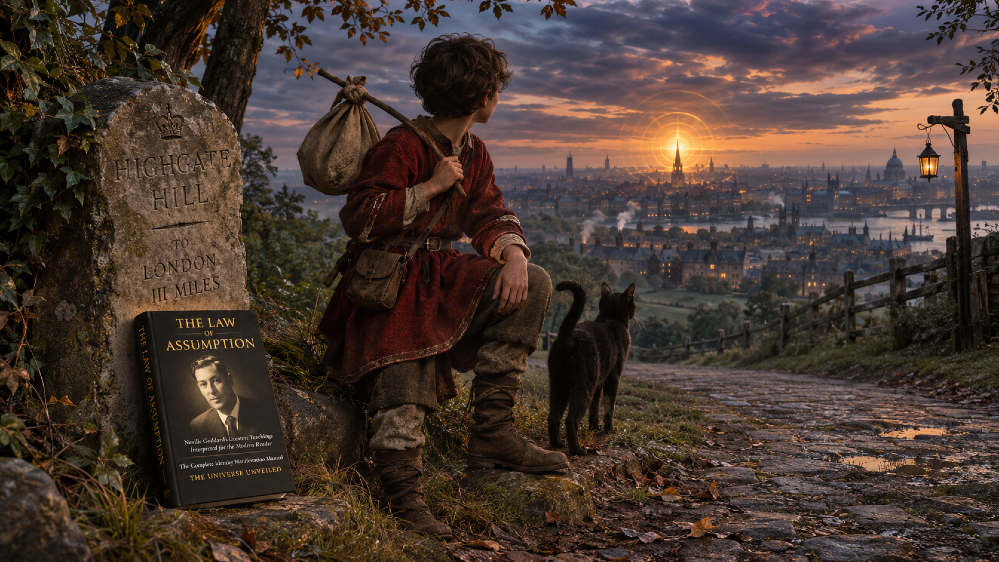
Dick Whittington is the English tale of a poor boy who leaves London in despair and is called back from Highgate Hill by the Bow Bells: Turn again, Whittington, Lord Mayor of London. It grew up around the real Richard Whittington (c.1354–1423), a Gloucestershire knight's son who became a rich mercer and Mayor of London four times. The cat is legend. Read through Neville Goddard's Law of Assumption, the bells are the end heard first, and turning again is persisting in it.
Learn to hear your own end first: The Law of Assumption on Amazon UK.
What to remember
- Real man: Richard Whittington, younger son of Sir William Whittington of Pauntley.
- Mayor four times: appointed by Richard II in 1397, elected 1397, 1406 and 1419.
- Legend: the orphan, the cat and the bells; Richard Johnson recorded the bells' words in 1612.
- The Whittington Stone on Highgate Hill dates from 1821; the cat on top from 1964.
- The lesson: hear the end, turn again, and let the bridge of incidents appear.
Go deeper: The Law of Assumption and the eavesdropping technique.
In plain words
Dick is sitting on a stone, ready to give up, when the bells tell him how his story ends. Nothing around him has changed, but he believes the bells instead of the evidence and walks back. Meanwhile his cat is already at sea, about to make his fortune. Neville Goddard taught exactly this: decide the end, live from it before you see it, and don't worry about the route. A good place to practise is the state akin to sleep.
Hear your own bells: The Law of Assumption on Amazon UK.
The book behind the story

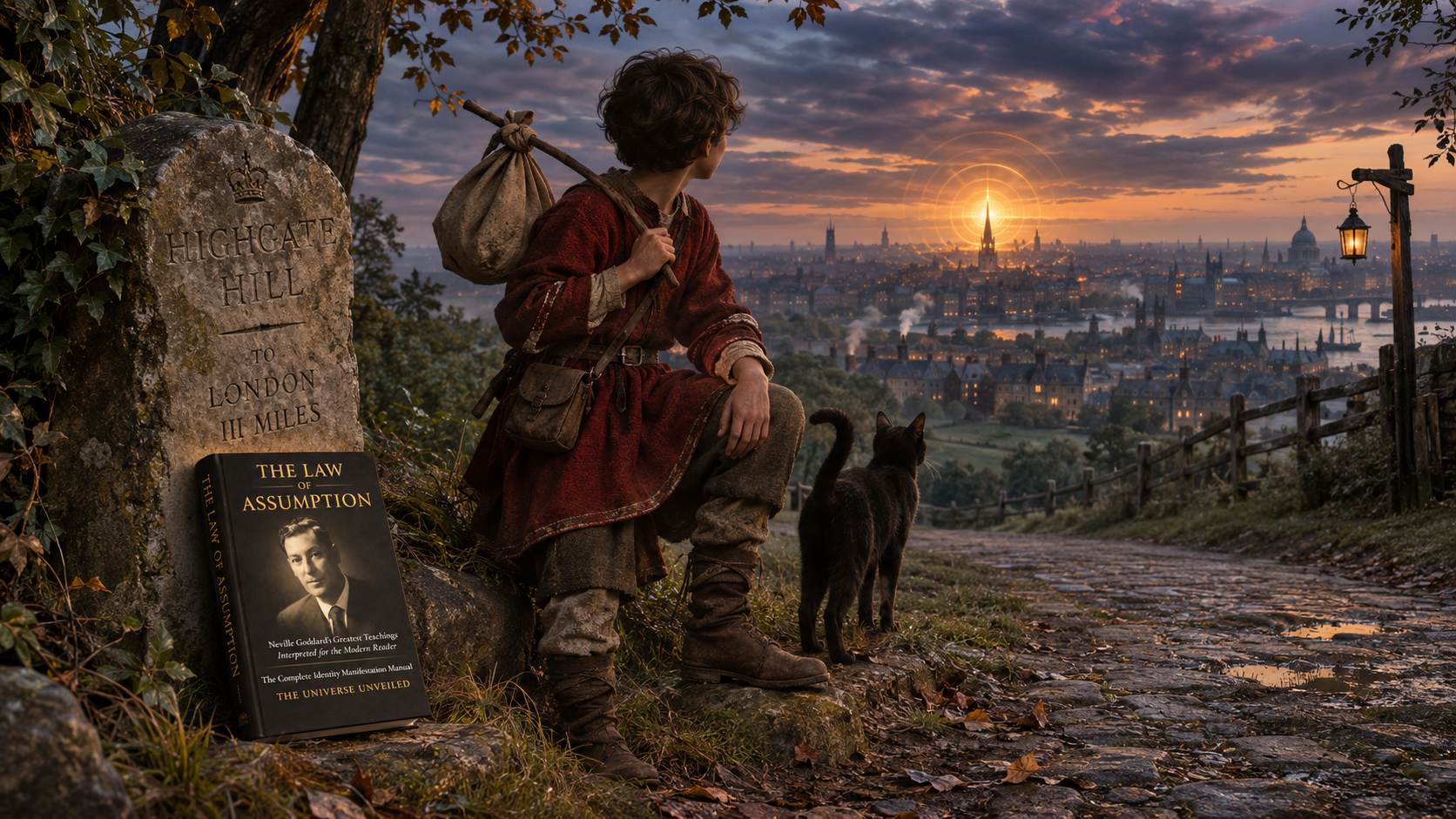
The Law of Assumption
Dick Whittington heard the end before he lived it, and turned round. This book shows you how to do the same with Neville Goddard's method, one chapter at a time.
Get the bookAvailable on Amazon UK — The Universe Unveiled
Every British child knows the line. A poor boy and his cat leave London in despair, and on Highgate Hill the bells of Bow ring out: Turn again, Whittington, Lord Mayor of London. He turns round, and it all comes true. It is panto season, and the story will be told on stages across the country again this winter.
What most people don't know is that Richard Whittington was real, that the truth is stranger than the panto, and that the moment on Highgate Hill is a near-perfect picture of what Neville Goddard taught about the Law of Assumption: hear the end first, then walk back towards it. Here is the true story, with sources. Look at the bottom of your screen: a boy and his cat are setting off from Highgate. Keep the sound on.
A true story in five chapters
Turn Again, Whittington
The real Richard Whittington, a penny cat, the Bow Bells, and the oldest lesson in manifesting.
In short
Dick Whittington is the English folk tale of a poor boy who comes to London, sends his cat to sea, runs away in despair, and is called back by the bells of St Mary-le-Bow with the promise that he will be Lord Mayor of London. It grew up around the real Richard Whittington (c.1354–1423), a Gloucestershire knight's son who became a rich mercer and Mayor of London four times. Read through the Law of Assumption, the bells are the end heard first, and turning again is persisting in it. At The Universe Unveiled we put it simply: the bells don't change the road, they change the direction you walk it.
The Road out of London
In the version every panto tells, Dick is an orphan from the country who walks to London because he has heard the streets are paved with gold. They are not. He ends up as a kitchen boy in the house of a merchant, Mr Fitzwarren, bullied by the cook and sleeping in an attic full of rats. With his only penny he buys a cat.
One day it is all too much. Dick packs his bundle and walks north out of the City. At the foot of Highgate Hill he sits down on a stone to rest, and from far behind him the bells of St Mary-le-Bow begin to ring. In the old ballad recorded by Richard Johnson in 1612, they say: Turn again Whittington, for thou in time shalt grow Lord Mayor of London, according to the New Statesman.
You are on the stone. What do you do?
Choose, and listen.
Read the note: the stone on the hill
Everyone has a Highgate Hill. It is the moment when the evidence says go home, and you are halfway up the road already. Nothing outside Dick has changed when he turns round. Only what he is listening to has changed.
Remember: the turn comes before the proof.
A Penny Cat and the King of Barbary
Here is the part people forget. Before he ran away, Dick had already sent something out. Mr Fitzwarren's ship was sailing, and every member of the household was invited to send something to trade. Dick had nothing but his cat, so the cat went to sea.

The ship reaches the Barbary coast, where the king's palace is overrun with rats. The cat clears them out, and the delighted king buys it for a fortune. While Dick was sitting on the stone feeling like a failure, the means of his success was already at sea. He comes home a rich man, marries his master's daughter Alice, and becomes Lord Mayor, just as the bells said.
Read the note: the cat is already on the ship
Neville Goddard called this the bridge of incidents: you don't plan the means. Dick could never have planned rats in a palace in North Africa. His job was the end, not the route.
Remember: the means is often already in motion while you doubt.
The Real Richard Whittington
The real Whittington was no orphan. He was a younger son of Sir William Whittington, a knight of Pauntley in Gloucestershire. Unlikely to inherit, he went to London and was apprenticed to a mercer, a merchant in luxury cloth, says the Lord Mayor's Show. He sold fine fabrics to the royal court and lent money to three kings: Richard II, Henry IV and Henry V.
In June 1397, when the mayor Adam Bamme died, Richard II chose Whittington himself. That October the Londoners elected him, and they did so again in 1406 and 1419. So the bells were both right and wrong: he served four times, three of them elected, which is why the rhyme says thrice. He also sat in Parliament for the City of London. His wife was really called Alice Fitzwarren. They had no children, and he left his whole fortune to London: he rebuilt Newgate prison, founded almshouses and a library, and even paid for a large public lavatory by the Thames. His charity is still run by the Mercers' Company today.
The cat almost certainly never existed. Nobody knows exactly how it got attached to his name, but by the early 1600s the story of the poor boy and the bells was being printed and sung. A memorial stone has marked the spot on Highgate Hill since at least the 17th century; the present Whittington Stone dates from 1821, and a black limestone cat by the student sculptor Jonathan Kenworthy was added on top in 1964. Bow Bells are about four and a half miles away, according to Heritage of London. Even on a still day he could hardly have heard them. Which is rather the point.
Which voice is it? Tap each card
0 of 6 sorted
Read the note: two voices
The cook speaks for circumstance. The bells speak for the end. Both are talking to Dick at the same moment, and he gets to choose which one he lives from. Neville would say the voice you accept as true is the one that hardens into fact.
Remember: circumstance is loud, the end is clear.
Hear the end first
The Law of Assumption
The bells did not ask Dick to work out how. They told him the end. This book teaches you to hear yours and stay with it until the world catches up.
Read the bookAvailable on Amazon UK — The Universe Unveiled
What the Bow Bells Teach About Manifesting
Neville Goddard built his teaching around one idea: assume the feeling of your wish fulfilled, and persist in it until it hardens into fact. One of his five 1948 lessons is even titled Assumptions Harden into Fact. The Whittington story acts it out in three moves.
He hears the end first. The bells don't say try harder or go back and see what happens. They announce the finished fact. Neville taught the same thing with his eavesdropping technique: hear the voices of friends congratulating you, as if it has already happened.
He turns round before anything changes. Dick walks back into the same kitchen, to the same cook. That is living in the end: going back to ordinary life while carrying a different inner fact.
The means arrives by a road he never planned. A cat, a ship, a palace full of rats. Neville would say you never need to know how; you only need to stay in the feeling of the end.
The whole method in one line
Hear the end, turn again, let the bridge build itself. The lantern slide above shows Dick dozing at the milestone and dreaming of his cat: that drowsy state, just before sleep, is exactly where Neville told students to rehearse the end, a method he called the state akin to sleep.
Read the note: your bells
Your bells are a single sentence that would only be true if your wish were already fulfilled. Say it to yourself as you fall asleep tonight, in the voice of someone who already knows.
Remember: say it as a fact, not as a hope.
What the Story Does Not Mean
It is not a rags-to-riches lottery. Luck didn't bring Dick back down the hill. He had to choose which voice to believe.
It is not about ignoring reality. Dick goes back to the kitchen and the cook. Living in the end doesn't mean refusing to do the work in front of you; it means doing it as the person you are becoming.
It is not proof that the method works on schedule. The bells don't give a date. The real Whittington took decades to rise, which is one reason Neville stressed persistence over timing. There is more on that in divine timing.
It is not history. The cat is legend. What the story keeps true is the shape of the inner turn, and that is what the Law of Assumption is about.
Read the note: the panto version
In panto everyone shouts "He's behind you!" at the villain. The Law of Assumption flips it: the doubt is behind you. The bells are ahead.
Remember: face the bells, not the doubt.
Turn Again
Look at the bottom of your screen: Dick and his cat are almost back at Bow. From the stone on Highgate Hill to the Mansion House, it is the same movement every time: hear the end, then turn round and walk towards it. Now it's your turn.
Before you go
Ring Your Bells
Tap each doubt and let the bells answer it. What is left is the end you walk back towards.
5 doubts still on the hill
“Turn again. It is already done.”
Say it tonight as you fall asleep, in the voice of the bells.
Keep reading
The Law of Assumption
Neville Goddard's method in 21 clear chapters: how to choose the end, live from it, and persist until it hardens into fact. Your bells, written down.
Get The Law of AssumptionAvailable on Amazon UK — The Universe Unveiled
Sources
The Real Dick Whittington, The Lord Mayor's Show: family, apprenticeship, the 1397 appointment and the elections of 1397, 1406 and 1419.
The search for the real Dick Whittington, New Statesman: Richard Johnson's 1612 ballad and the three-or-four-times question.
Whittington Stone, Heritage of London Trust: the stone's history, the 1821 replacement and the 1964 cat.
Richard Whittington and Whittington Stone, Wikipedia.
Images: a theatre poster of about 1900 and magic lantern slides of about 1914, public domain, via Wikimedia Commons.
More on The Universe Unveiled
How Britain's brightest manifested their destiny
Neville Goddard's Five Lessons
The bridge of incidents · The eavesdropping technique · The state akin to sleep
Dick Whittington and the Law of Assumption: Questions About the True Story, the Bow Bells and Manifesting
Was Dick Whittington a real person?
Yes. Richard Whittington (c.1354–1423) was a real London mercer, the younger son of Sir William Whittington of Pauntley in Gloucestershire. He was Mayor of London four times, sat in Parliament and left his fortune to charity. The poor orphan, the cat and the bells are later legend.
How many times was Dick Whittington Lord Mayor of London?
Four times. Richard II appointed him in June 1397, and he was elected in October 1397, 1406 and 1419. Because the first two terms ran back to back, the rhyme counts three: thrice Lord Mayor of London.
What did the Bow Bells say to Dick Whittington?
In the legend the bells of St Mary-le-Bow ring out: Turn again, Whittington, Lord Mayor of London. An early version recorded by Richard Johnson in 1612 says he would in time grow to be Lord Mayor of London.
Where is the Whittington Stone?
At the foot of Highgate Hill in Archway, north London, near the Whittington Hospital. The current stone dates from 1821 and the black cat on top was added in 1964. It marks the spot where Dick is said to have heard the bells.
Did Dick Whittington really have a cat?
Almost certainly not. There is no evidence the real Richard Whittington made his fortune from a cat. The story of the cat sold to the King of Barbary grew up around his name long after his death.
What does Dick Whittington have to do with the Law of Assumption?
The story acts out Neville Goddard's method. Dick hears the end first, turns back before anything has changed, and the means arrives by a route he never planned. Neville taught the same steps: assume the wish fulfilled, persist in it, and let the bridge of incidents appear.
How can I use the Turn Again idea to manifest?
Choose one short sentence that would only be true if your wish were already fulfilled. Repeat it as you fall asleep, as a fact rather than a hope, and go back to ordinary life as the person it describes. Neville called this living in the end. The state akin to sleep is the best time to do it.
Why is Dick Whittington a Christmas pantomime?
It is a rags-to-riches story with a hero, a villainous cook, a lovable cat and a happy ending in London, which made it ideal for pantomime. It has been a favourite on British stages for generations and is still performed most winters.