Why Manifestations Reverse Before a Quantum Leap
Manifestation doesn’t always arrive smoothly. When identity relocates, old structures lose coherence, creating delays, breakdowns, and contradictions that signal reorganization—not failure.


Introduction — “It Was Working… Then It Fell Apart”
Almost everyone who seriously practices manifestation eventually reports the same pattern.
First, things begin to move.
Progress appears.
Signs emerge.
Momentum builds.
Then, unexpectedly, the sequence breaks.
Delays appear.
Reversals surface.
Opportunities vanish.
Relationships strain.
Systems destabilize.
What felt like alignment becomes contradiction.
What felt like arrival becomes loss.
And the most common conclusion forms instantly:
It stopped working.
But this conclusion is usually wrong.
Some manifestations must collapse before they can complete.
Not because they failed.
Because the structure they were growing inside can no longer hold the identity they require.
Section I — Why Linear Thinking Misreads Nonlinear Change
The primary error people make in manifestation is assuming change is linear.
They expect:
- Step-by-step improvement
- Gradual upgrades
- Continuous stability
But identity transitions are not linear processes.
They are discontinuous.
They are nonlinear.
They are reorganizing systems.
A linear model assumes:
If it was improving yesterday, it should improve tomorrow.
But identity change does not work that way.
It works through thresholds.
Plateaus.
Instabilities.
Reconfigurations.
Linear expectation cannot interpret nonlinear transitions.
When a system crosses a threshold, it does not smoothly evolve.
It reorganizes.
And reorganization often looks like collapse.
Collapse is not regression.
It is reconfiguration.
Section II — The Structural Reason Reversals Happen
This is the core mechanism.
When identity relocates, the system that previously supported it loses coherence.
Roles destabilize.
Relationships strain.
Habits misalign.
Structures weaken.
Not because something went wrong.
Because the former configuration no longer matches the new center.
This produces:
- Temporary loss
- Temporary breakdown
- Temporary contradiction
Not as punishment.
As clearance.
The old reality collapses before the new one can stabilize.
This is the structural pattern behind every major transformation.
When a system cannot evolve incrementally, it must reorganize.
That reorganization always passes through instability.
This is the same mechanism described in the core framework of:
→ What Is a Quantum Leap in Manifestation
Quantum leaps do not add on top of the old system.
They replace its organizing center.
And replacement always begins with destabilization.

Featured Book
Quantum Leap
Why manifestations collapse, reverse, or destabilize right before completion — and how identity relocation forces systems to dismantle before rebuilding.
Section III — Why the Mind Interprets Collapse as Failure
The mind tracks stability.
It monitors:
- Continuity
- Security
- Predictability
So when instability appears, the mind immediately labels it as error.
Loss means failure.
Delay means misalignment.
Instability means regression.
But the mind cannot perceive structural realignment.
It only sees surface disruption.
The mind reads stability.
Identity reads reorganization.
This is the moment most people quit.
Not because the manifestation failed.
Because the mind cannot tolerate temporary incoherence.
And yet:
Every major reconfiguration requires passing through incoherence.
Section IV — The Identity Mechanism Behind Collapse
This is where the process becomes precise.
When identity moves, the former position becomes structurally unsustainable.
The system must clear space.
Not emotionally.
Structurally.
Collapse is not the absence of progress.
It is the evacuation of the previous position.
The system removes:
- Former roles
- Former supports
- Former identities
So the new center can install.
Collapse is not the absence of progress.
It is the removal of the previous position.
Identity does not add layers.
It replaces centers.
And replacement requires dismantling.
Section V — Historical Pattern: Initiation Always Includes Breakdown
Across every serious transformation narrative, the same pattern appears.
Initiation.
Disorientation.
Loss of former stability.
Threshold.
Reorganization.
Not as metaphor.
As structure.
Every identity relocation includes:
- Loss of former coherence
- Disruption of orientation
- Clearing of supports
No new identity installs without dismantling the old one.
This is not mystical.
It is systemic.
Systems cannot hold two organizing centers at once.
One must dissolve before the other stabilizes.
Section VI — How to Distinguish Collapse from Actual Error
This is the critical diagnostic.
Collapse and error feel similar on the surface.
But they are structurally different.
Collapse looks like:
- Loss of former alignment
- Disruption of routines
- Temporary contradiction
The old structure dissolves.
But the new assumptions remain intact.
Error looks like:
- Identity reverting
- Old assumptions returning
- Monitoring resuming
The system reinstalls the former center.
Collapse removes the old.
Error reinstalls it.
If your identity has not reverted, you are not in error.
You are in reorganization.
Closing — The Most Dangerous Moment Is the Moment Before Stabilization
The highest abandonment rate in manifestation does not occur at the beginning.
It occurs at the moment before stabilization.
When the old has dissolved.
And the new has not yet solidified.
Most people leave here.
Not because the leap failed.
Because they misread the phase.
Most people abandon the leap at the exact moment it becomes inevitable.
The system breaks down only when it is about to rebuild around a new center.

The Death of Socrates (1787)
Jacques-Louis David
Oil on canvas, Neoclassicism
129.5 × 196.2 cm
The Metropolitan Museum of Art, New York
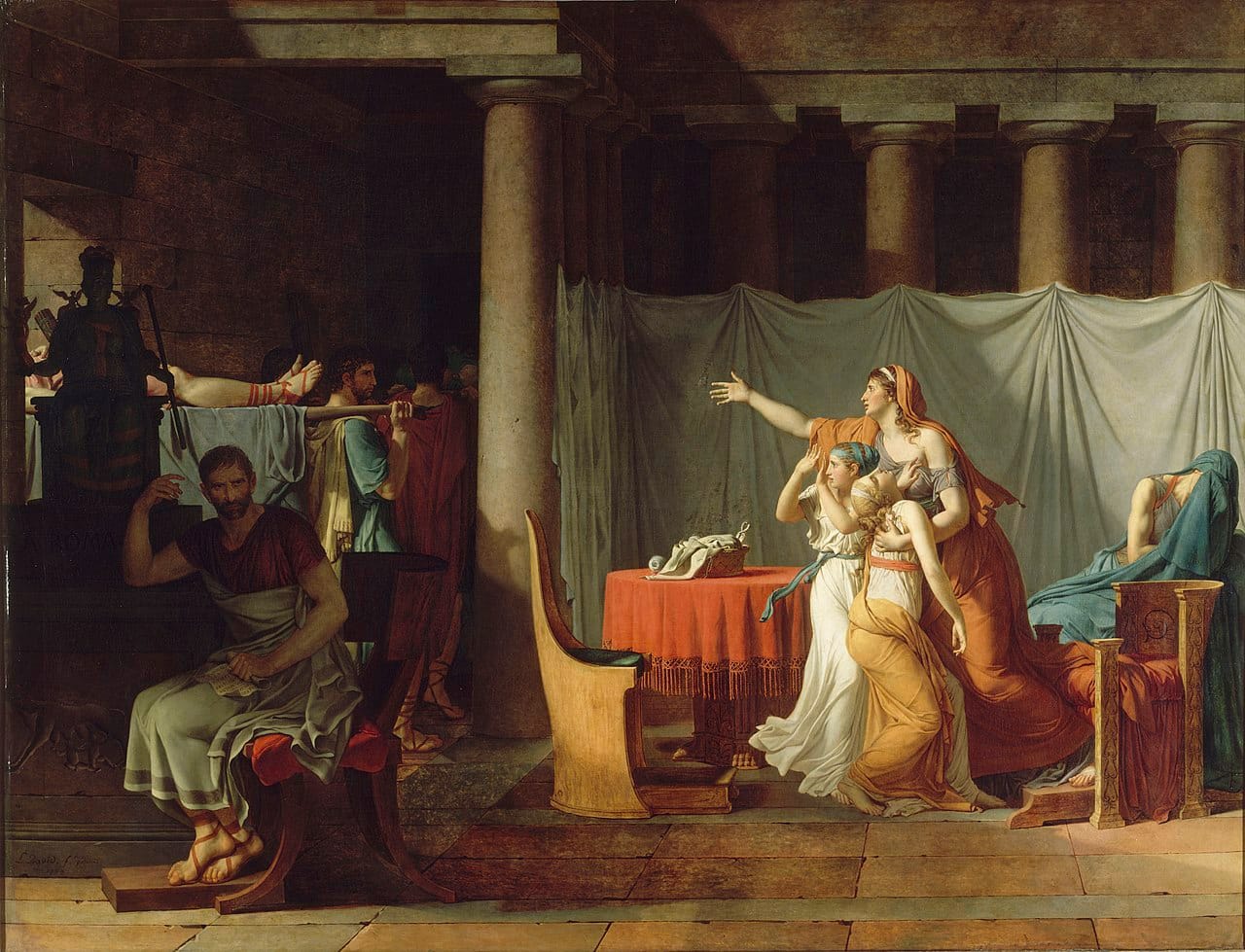
The Lictors Bring to Brutus the Bodies of His Sons (1789)
Jacques-Louis David
Oil on canvas, Neoclassicism
Musée du Louvre, Paris
Theseus and the Minotaur (1783)
Antonio Canova
Marble sculpture, Neoclassicism
Victoria and Albert Museum, London