Every Neville Goddard Book — And Why None of Them Give You the Full System
Neville Goddard's books are brilliant — and structurally incomplete. Each volume teaches one piece of a doctrine he never unified into a system. This guide breaks down every major work, what it delivers, what it leaves out, and where the full architecture finally lives.

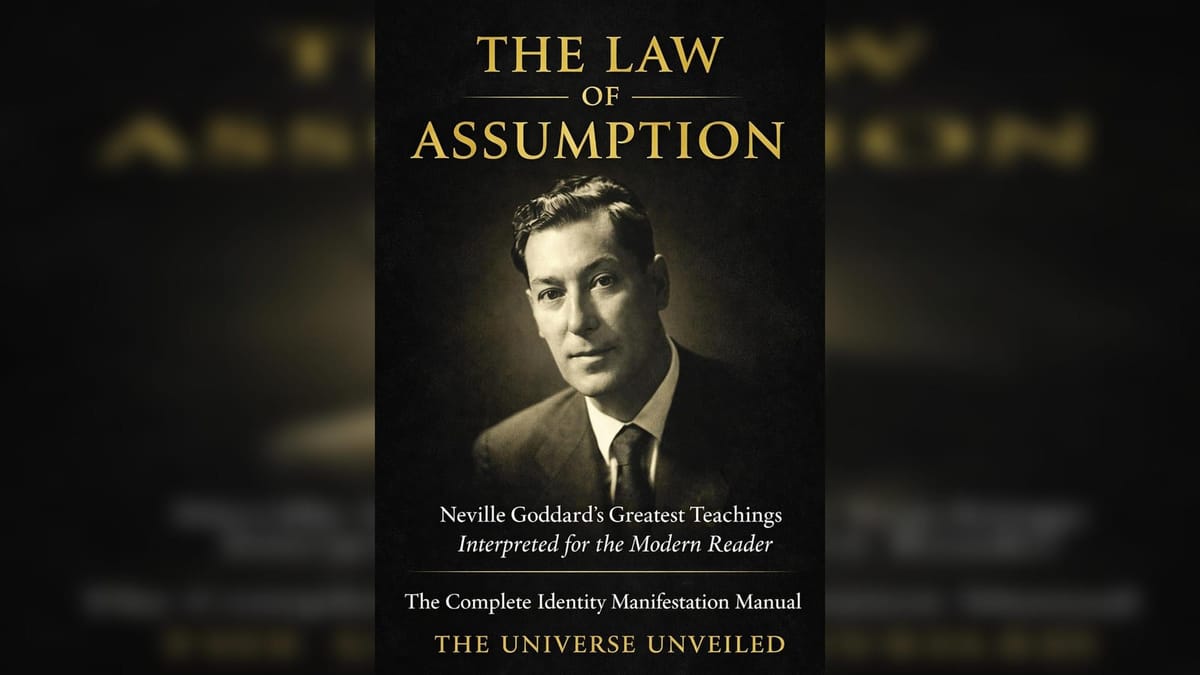
Neville Goddard never unified his teachings into one system. His books — from Feeling Is the Secret to The Power of Awareness — each capture one dimension of the Law of Assumption doctrine without providing the full operational framework. This guide breaks down every major work and points to the one modern volume that finally assembles the complete system.

This book changes that. For the first time, Neville's greatest teachings — drawn from The Power of Awareness, Feeling Is the Secret, and Awakened Imagination — have been structurally interpreted and unified into one complete identity doctrine. Not a compilation. A system.
You found Neville Goddard.
Maybe it was a YouTube clip. A Reddit thread. Someone quoting Feeling Is the Secret in a caption that stopped your scroll. However you arrived, you arrived — and now you are standing at the edge of one of the most complete metaphysical doctrines ever assembled.
There is only one problem.
Neville never assembled it.
He delivered his teachings across decades of live lectures, private class transcripts, and slim standalone volumes — each one a transmission rather than a manual. Each one brilliant in its domain. Each one structurally incomplete on its own.
The result is a body of work that simultaneously contains everything you need and nowhere near enough context to apply it with precision.
This guide exists to change that. Below is a clear-eyed breakdown of every major Neville Goddard book — what it teaches, what it does not, and why the full doctrine requires something none of his original works were built to deliver.
Who Was Neville Goddard?
Neville Lancelot Goddard was born in Barbados in 1905 and arrived in New York City at seventeen to study theater. What followed was not a conventional spiritual career. He became one of the most penetrating metaphysical teachers of the twentieth century — a man who taught that imagination is God, that consciousness is the only reality, and that every human being is already living out the assumptions they hold about themselves.
But Neville did not arrive at this doctrine alone.
In 1930s Harlem, he encountered a mystical Ethiopian rabbi known only as Abdullah — a figure so precise, so uncompromising in his instruction, that he fundamentally restructured how Neville understood consciousness, scripture, and the nature of reality. It was Abdullah who first taught Neville to live from the end rather than toward it. The famous story of Neville insisting he needed money to travel to Barbados — and Abdullah refusing to help him beg for it, declaring he was already in Barbados — is not a footnote. It is the doctrine in its purest form. If you want to understand where Neville's certainty came from, you have to understand the man who forged it. We cover Abdullah's full story, his teachings, and his uncompromising methods in our definitive guide to Abdullah — Neville Goddard's mentor.
He lectured prolifically across the United States from the 1930s through the early 1970s. His books — most of them short, many of them transcribed from lectures — were not written as a curriculum. They were written as individual explorations of principle.
That distinction matters more than most readers realize.
The Core Books — What Each One Teaches and What It Leaves Out
At Your Command (1939)
This is where Neville began publishing. At Your Command introduces the foundational claim: the world around you is a manifestation of your dominant inner assumptions. You command your reality not by action but by the states you inhabit.
What it teaches: The causal role of consciousness. The idea that your outer world reflects your inner command.
What it leaves out: There is no instruction on how to shift identity. Assumption is named as the mechanism, but the mechanics of assumption — how to install a new self-concept at the subconscious level — are absent. This is a proclamation, not a system.
Your Faith Is Your Fortune (1941)
A deeper exploration of the biblical allegory Neville loved. He argues here that faith is not belief in doctrine but the subjective certainty of an already-fulfilled state. The language is dense with Old and New Testament references, and the metaphysical interpretation is rich.
What it teaches: Faith as felt conviction. The law of reversibility — that a change of feeling produces a change of circumstance.
What it leaves out: The heavy biblical framing makes this difficult for modern readers without a working knowledge of how Neville read scripture. The technique of how to feel the wish fulfilled is gestured at but not structured. Readers leave inspired but without operational architecture.
Freedom for All (1942)
One of Neville's most mystical early works. Freedom for All frames consciousness as the divine creative force — the "I AM" as the only presence operating in the universe. Personal desire is not separate from divine will; they are the same movement.
What it teaches: The metaphysics of I AM. The unity of personal identity and creative law.
What it leaves out: This text operates almost entirely at the philosophical level. There is profound insight here, but no structured practice. It answers what reality is without adequately addressing how a person reorganizes their identity within it.
Feeling Is the Secret (1944)
If there is one Neville Goddard book that functions as a point of entry, this is it. Feeling Is the Secret is perhaps his most precise and accessible short work. In it, Neville establishes the relationship between feeling and subconscious installation — that the subconscious receives impressions through feeling, and that sleep is the transition point where those impressions are most effectively delivered.
What it teaches: Feeling as the language of the subconscious. The role of sleep and the hypnagogic state in subconscious reprogramming. Prayer as the movement into felt fulfillment before sleep.
What it leaves out: Feeling Is the Secret is brief by design. It establishes a powerful principle without building it into a full operating system. Readers understand that feeling is the installer — but not how to construct sustained feeling states, navigate resistance, or maintain identity across time. It is a chapter, not a manual.
Prayer: The Art of Believing (1945)
This short work redefines prayer not as petition but as the practice of feeling already answered. Neville walks through the mechanics of controlled reverie — entering a state of relaxed consciousness and impressing the subconscious with the felt reality of the desired state.
What it teaches: Prayer as a technique of conscious subconscious installation. Controlled reverie. The law of thought transmission.
What it leaves out: Like most of Neville's works, this is a lecture captured on the page. The technique is introduced but not scaffolded. There is no guidance on what to do when the technique fails to hold, or how to integrate the practice into a larger identity-level shift.
Out of This World (1949)
One of Neville's most conceptually ambitious texts. Out of This World introduces fourth-dimensional thinking — the practice of moving through an infinite series of parallel states and selecting the one that matches your desired reality by living from it, not toward it.
What it teaches: Living from the end. The concept of states as destinations you relocate into rather than conditions you attract. The central Neville premise: "Assume the feeling of your wish fulfilled."
What it leaves out: The fourth-dimensional framework is intellectually powerful but experientially abstract for most readers. The leap from understanding the concept to operating within it requires an identity-level foundation this book does not provide. Many readers absorb the idea without knowing how to become the person who lives from the end.
The Power of Awareness (1952)
Widely considered Neville's most complete single volume. The Power of Awareness presents his doctrine in the clearest sequential structure of any of his books. It opens with the nature of consciousness, moves through identity, and arrives at the mechanics of assumption — covering states, revision, and the relationship between self-concept and reality.
What it teaches: Identity as the foundation of manifestation. Consciousness as the only creative substance. Revision as a technique for rewriting the past and changing present trajectory. The relationship between who you are being and what you are receiving.
What it leaves out: Even here, Neville is a poet and mystic first. The architecture is cleaner than his other books — but it is still transmission-style writing. Concepts are presented with depth but not with operational sequencing. A reader who has never held a sustained identity shift will not find explicit instruction for how to build one here.
Awakened Imagination (1954)
A deeply spiritual work focused on imagination as the divine faculty — not just a tool for manifestation but the very substance of God operating through human consciousness. Neville's prophetic voice is at its most elevated here.
What it teaches: Imagination as the creative God. The inner world as more real than the outer. The call to live as a creative being rather than a reactive one.
What it leaves out: Awakened Imagination operates at the level of spiritual worldview more than practical doctrine. It is essential reading for understanding Neville's metaphysical foundation — but it is not a manual for applying it.
The Law and the Promise (1961)
Perhaps the most practically useful of Neville's books for a new reader. The Law and the Promise is built almost entirely around real testimonials — case studies from his students who applied the law and documented the results. It is divided into two sections: the law (imagination as causation) and the promise (the mystical awakening that accompanies full embodiment of the doctrine).
What it teaches: Real-world application of the law through documented results. Revision in practice. The relationship between persistent assumption and eventual manifestation.
What it leaves out: The testimonial format, while compelling, places the reader in a passive position. The law is demonstrated but not systematically taught. The structural architecture of how the law operates remains implicit.
The Pattern Every Book Shares
Each volume above contains a genuine piece of the doctrine. Each one illuminates something real about the nature of consciousness, assumption, and reality creation.
But every one of them shares the same structural limitation: Neville taught in transmissions, not frameworks.
He would deliver a principle with extraordinary clarity — feeling as subconscious installer, assumption as causation, states as the mechanism of identity — and then move to the next lecture, the next city, the next principle.
The result across his entire body of work is a doctrine that is architecturally complete but structurally scattered.
Readers who study Neville deeply understand this. They have read three books and still feel uncertain about where to start. They have absorbed the principle of "living from the end" without knowing how to install it as identity. They understand that assumption is the mechanism but cannot hold assumption steady across days, relationships, and resistance.
The teaching is there. The framework is not.
Assumption as creative law. Feeling as subconscious installer. Living from the end as identity relocation. Faith as assumption prior to evidence. Revision as psychological rewriting. The Bridge of Incidents as delivery sequence. Time collapse through identity saturation.
Neville taught each of these across different books and different decades. This volume draws them together for the first time — not as a summary, but as an operational doctrine designed to be lived, not just studied.
What a Modern Reader Actually Needs
Understanding Neville's principles is step one.
Operating from them is the actual work — and that operation requires structural clarity his original books were never designed to provide.
A modern reader needs to know not just what assumption is, but how to practice it consistently. Not just that feeling is the installer, but how to generate and sustain feeling states against the inertia of habitual self-concept. Not just that revision exists, but how to apply it as a real-time identity tool.
The principles need to be organized into a sequence. The doctrine needs to become a system.
The Book That Closes the Gap
The Law of Assumption: Neville Goddard's Greatest Teachings Interpreted for the Modern Reader was written to do exactly that.
It draws from The Power of Awareness, Feeling Is the Secret, Awakened Imagination, and the full arc of Neville's teachings — not to compile them, but to interpret and unify them into one integrated identity doctrine.
The difference is architecture.
Where Neville's books offer transmission, this volume offers structure. Each principle is positioned not as isolated teaching but as part of a sequential framework — assumption, feeling, identity, persistence, revision — treated as operational mechanics rather than philosophical reflections.
This is not a summary of Neville's work. It is the system his work was always pointing toward.
If you have read Neville and felt you understood him without being able to fully apply him — this is the volume that closes that distance.
The Law of Assumption: Neville Goddard's Greatest Teachings Interpreted for the Modern Reader treats Neville's doctrine as what it always was — a precise set of laws governing how identity produces reality. Assumption is causation. Feeling is installation. Imagination is the generative faculty. Each concept is architecture, not philosophy.
Where to Begin
If you are new to Neville Goddard, begin with Feeling Is the Secret to establish the foundational principle. Move to The Power of Awareness for the deepest single-volume treatment of his doctrine. Then read The Law and the Promise for the testimonial evidence that the law works in practice.
And when you are ready to stop studying the fragments and begin operating from the unified system — The Law of Assumption: Neville Goddard's Greatest Teachings Interpreted for the Modern Reader is where the architecture lives.
The doctrine is complete. It always has been.
Now it is assembled.