The New Moon Ritual: Planting an Intention in the Dark
Everyone writes their wishes at the new moon. Almost no one keeps quiet afterward, which is the part that does the work. Here is the full rite of the dark: what to prepare, the one sentence to write, how to speak it, and why the three nights that follow matter more than the ceremony.

The Rite
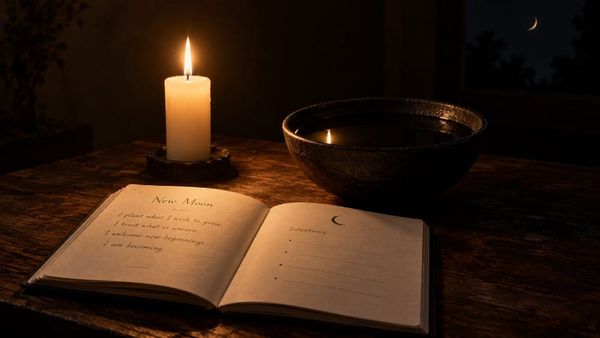
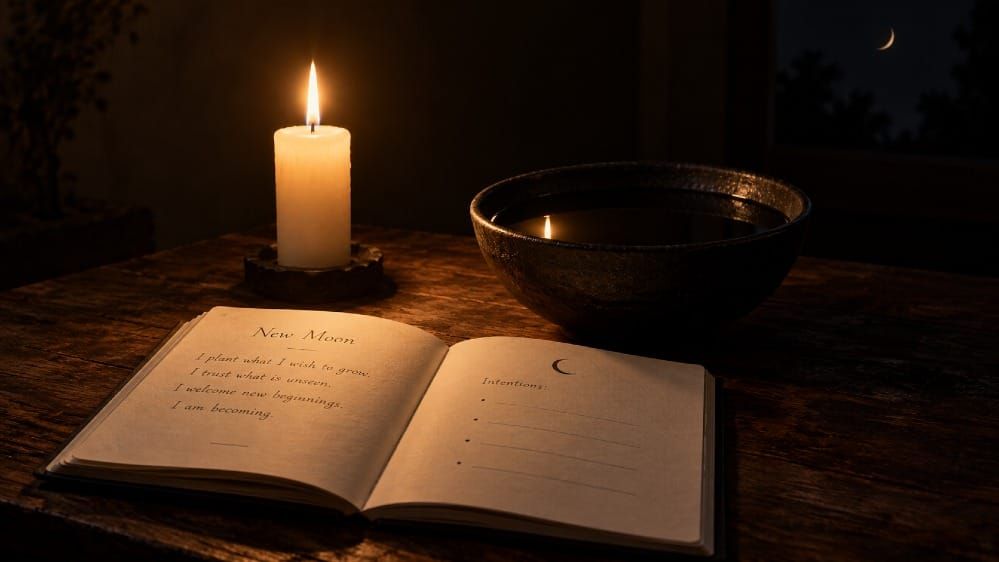
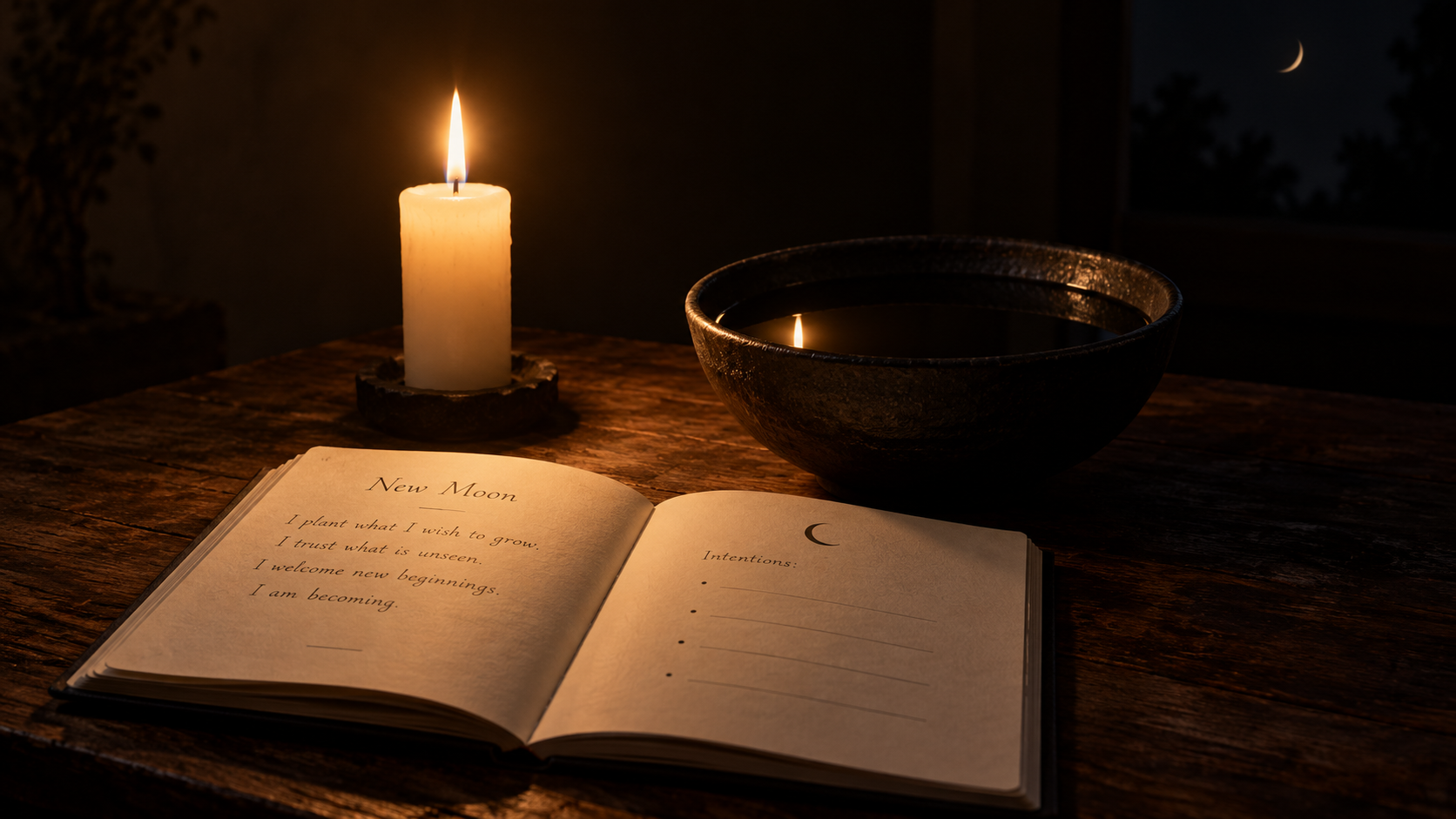
A new moon ritual is the planting gate of the lunar cycle. After dark, fill a bowl with water and light one candle. Write a single sentence in the present tense describing a condition rather than an event. Read it aloud once. Pinch out the candle. Then say nothing about it for three nights. That silence is not decoration — it is the working. The ceremony plants; the silence is what lets the thing take root.
This is the first of the four gates set out in manifesting with the moon, and the one the other three depend on.
Moon rituals, lunar practice, and the work of the four gates — sent straight to you.
Sign up for our newsletterThe new moon is the only night of the cycle when the moon is completely unavailable to you, and it is the night every serious lunar tradition chose for beginning things. That is not a coincidence or a poetic flourish. It is the whole instruction, stated once, in the sky, and then repeated thirteen times a year in case you missed it.
What follows is the complete planting rite — what to prepare, the one sentence that carries the cycle, how to speak it, and the three nights afterward that most people skip and then wonder why nothing moved. It is the first of the four gates laid out in manifesting with the moon, and the other three are meaningless without it.
What a New Moon Ritual Actually Is
A new moon ritual is the rite performed at the dark of the moon to impress a single intention, consisting of a physical act, one spoken sentence, and a period of deliberate silence afterward.
The new moon is the moment the moon passes between Earth and Sun, so that the face turned toward us receives no direct light. It is not absent and it is not gone. It is present and unlit.
The dark moon refers to the two or three nights immediately before the new moon, traditionally used for clearing rather than planting.
The silence is the three nights following the rite in which the intention is not spoken, written, or discussed with anyone.
Why the Dark Is the Planting Night
Consider what the new moon is physically. The moon has not shrunk, dimmed, or departed. It is exactly where it always is, exactly the same size, fully lit on the side facing the sun — and that side is turned away from you. Everything is intact. Nothing is visible.
There is no better available picture of a decision that has been made but has not yet produced any evidence. You know what you have chosen. Nobody can see it, including you, when you look for proof. Every tradition that has used the moon ritually noticed that correspondence and built the planting rite on it.
The practical consequence is this: at the new moon you are being asked to act on something you cannot verify. That is uncomfortable and it is meant to be. A ritual performed in the dark trains the exact capacity the rest of the cycle needs — the ability to hold a thing steady with no confirmation.
When to Perform It
The exact moment of the new moon is a clock time, and you do not need to hit it. The working window runs from the night of the new moon through the three nights that follow — roughly seventy-two hours. Perform the rite in the first of those nights if you can.
If the exact new moon falls at three in the afternoon, you work that night, after dark. If you miss it entirely, you work the next night. What you do not do is perform the rite during the waning days beforehand, because that stretch belongs to clearing and you will be planting into ground you have not yet emptied.
Clear before you plant
If you have run a previous cycle, the folded page from the waning gate — the contradictions you named and crossed out, with salt in the fold — is burned or buried now, before anything new is written. Do it outside if you can. Do it without ceremony. It takes thirty seconds and it is the difference between a fresh cycle and an accumulating one.
If this is your first cycle, wipe the altar surface and leave it bare for a few minutes before you begin. The bareness is doing the same job.
More moon work, every cycle.
Sign up for our newsletterWhat You Need
A dark bowl of water. Any bowl, filled from the tap. Dark because a dark surface reflects, and reflection is the whole logic of lunar work.
One white or silver candle kept for this purpose only. Not a scented jar candle you also use for guests. A plain taper is perfect.
A journal reserved for the cycle, and a pen that works.
Salt in a closed container, for the waning gate later.
Something silver you can wear from now until the next dark moon.
That is all. Resist the urge to add crystals, incense, printed sigils and a curated playlist. A rite you can perform in four minutes with what you already own is a rite that survives thirteen cycles. A rite that requires a shopping list survives two.
The Sentence
Everything in the cycle rests on one line of writing, so it deserves more attention than the candles do.
Present tense, first person
Not I will, not I want, not I am ready to. Those are all sentences about the future, and a sentence about the future keeps the thing at arm's length by construction. You are writing the condition as though it is the ordinary current state of affairs.
A condition, not an event
This is the distinction that decides whether the cycle has room to work. An event is narrow and has one door: the offer from that company arrives in October. A condition is wide and has a hundred: I do work that suits me and I am paid well for it.
Events can be blocked by circumstance. Conditions can be met by circumstances you never thought of, which is usually how these things actually arrive. Write the condition. Let the sky work out the route.
Sentences that do not work
I am not anxious about money. Negation is not a condition; it is the old state with a label on it. Write what is true instead: my money is steady and I think about it calmly.
I am open to receiving abundance. Openness is a posture, not a state. You can be open for a decade. Name the thing.
I am becoming the woman who... Becoming is a future tense in a costume. She either is or she is not, tonight.
One sentence, one cycle
Not a list. Not three related items. One. If a second desire is genuinely pressing, it gets the next lunation, and the discipline of waiting four weeks for it will tell you quite a lot about how much you actually wanted it.
The Rite, Step by Step
One. After dark, clear the altar and dispose of last cycle's folded page.
Two. Fill the bowl and set it down. Light the candle.
Three. Sit. Do not begin yet. Wait until your breathing has slowed by itself — not counted, not controlled, just waited for. This usually takes two or three minutes and it is not optional. The rite performed while still braced from the day impresses the bracing.
Four. Write the sentence in the journal. Once, by hand.
Five. Read it aloud. Once. Then sit for a minute with the feeling of it being simply true — not thrilling, not triumphant. Ordinary. The feeling you are reaching for is closer to relief than to excitement, and your body knows the difference even when your mind does not.
Six. Put out the candle with your fingers or a snuffer. Never blow it out. The old rule exists because blowing is a gesture of dismissal and because it forces a moment of deliberateness exactly where you would otherwise hurry off to bed.
Seven. Put on the silver. Leave the water in the bowl until morning, then pour it onto soil or a plant.
The Three Nights of Silence
For seventy-two hours after the rite you do not speak the sentence, do not write it again, do not read it back, and do not mention the desire to anyone — not a partner, not a friend who would be supportive, not a group chat.
This is the instruction people find hardest to take seriously and it is the one doing the most work. Two reasons, both practical.
The first is that telling someone converts a private conviction into a social object. Whatever they give back — enthusiasm, doubt, a helpful suggestion, a story about their cousin — becomes part of what you are now holding, and you did not choose it. You planted one sentence and now you are carrying three.
The second is that describing a desire out loud produces a small, real satisfaction that takes the pressure off. The telling starts to substitute for the having. Anyone who has announced a project and then never started it has felt this exact mechanism.
Three nights is the minimum interval. Some traditions hold the silence until the first visible crescent, which is closer to four. Either is defensible. Less than three is not.
After the Silence
On the fourth night the waxing gate opens and the work changes character entirely: same sentence, same hour, every night, until the full moon. Nothing new is added — you are simply turning the same thing further toward the light, exactly as the moon is doing overhead.
That stretch and the two gates after it are set out in full in the four gates of the lunar cycle.
Common Mistakes at the New Moon
Writing a list. Ten intentions at the new moon is not ambition, it is hedging. The cycle rewards one thing carried the whole way.
Treating the ceremony as the work. The candles are scaffolding. The sentence and the silence are the building. A beautiful altar and a forgotten sentence produces nothing.
Checking on it. Rereading the page every night during the silence is the same act as digging up a seed. Close the journal.
Waiting for the perfect wording. A decent sentence spoken tonight beats a perfect sentence you are still drafting at the first quarter. You will write a better one next cycle.
Starting over when you slip. If you break the silence on night two, you do not restart. You resume. The moon is not keeping score.
Glossary
New moon — the conjunction of sun and moon, when the moon's lit face is turned entirely away from Earth.
Dark moon — the two or three nights immediately before the new moon, used for clearing.
The planting gate — the first of the four ritual thresholds of the lunar cycle.
Condition — an intention phrased as a state of affairs rather than a specific event.
The silence — three nights after the rite during which the intention is not spoken of.
Lunation — one complete new-moon-to-new-moon cycle, averaging 29.5 days.
The Lunar Reading
The new moon asks for the one thing nobody wants to give: commitment without evidence. You write a sentence you cannot yet prove, you say it once, and then you go quiet and let it be unverifiable for three nights.
Everything else in the cycle is easier than that. Do this part properly and the rest is maintenance.
Walk the cycle with us. New rituals and lunar practice, straight to your inbox.
Sign up for our newsletterNew Moon Ritual Questions: Timing, Wording, Silence and Tools
Moon rituals and lunar practice, every cycle.
Sign up for our newsletter