The Richest Man in Babylon: A Deep Reading of George Clason's Classic
George Clason hid timeless money laws inside ancient Babylonian parables. This deep reading walks Arkad's rise, the seven cures for a lean purse, and the five laws of gold — and shows why this 1926 classic is the disciplined-action complement to the New Thought law of wealth.

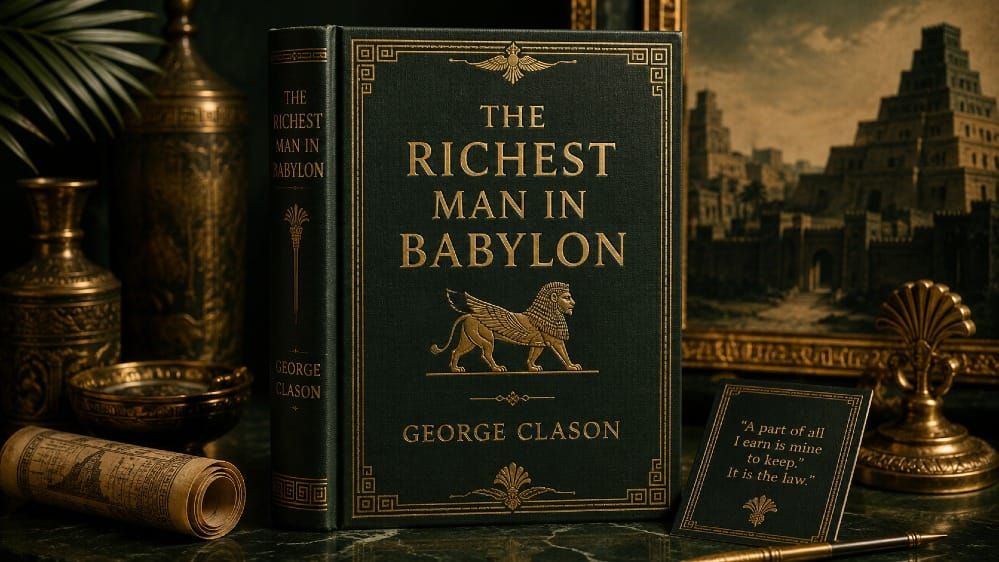
The Richest Man in Babylon (1926) by George Clason teaches wealth through parables set in ancient Babylon, built on one rule: "a part of all you earn is yours to keep." Its hero, Arkad, rose from poor scribe to the richest man in the city by following simple, repeatable laws of money — saving first, controlling spending, and making gold multiply.
From Arkad come the seven cures for a lean purse and the five laws of gold. It is the disciplined-action half of getting rich: where the New Thought writers work on the mind, Clason supplies the financial habits that turn intention into wealth.
Pair it with the inner work in The Law of Assumption.
Five thousand years old. One rule that still builds every fortune.
George Clason buried the laws of money inside the parables of ancient Babylon. Here is the full story — and why it is the missing half of everything the mind-power classics teach.
In 1926, an American businessman named George Samuel Clason began printing small pamphlets that banks and insurance companies handed out to customers. They were not lectures on thrift. They were stories — tales of merchants, chariot builders, and gold lenders in ancient Babylon, the first great commercial city the world ever built. Clason had discovered something every teacher eventually learns: people forget instructions but remember stories. Gathered together, those pamphlets became The Richest Man in Babylon, and a century later it remains one of the most recommended money books ever written.
Its endurance is strange when you consider how simple it is. There is no market analysis, no formula, nothing you could not explain to a child. And yet the financial advice in it has never gone out of date, because it was never about markets — it was about character and habit. Read closely, the book is wisdom literature dressed as personal finance, and it carries one idea so plain that almost everyone nods at it and almost no one does it.
The Richest Man in Babylon: a 1926 personal-finance classic by George Clason that teaches wealth-building laws through parables set in ancient Babylon, centered on the character Arkad.
The seven cures for a lean purse: Arkad's seven habits for building wealth, beginning with saving a tenth of all you earn.
The five laws of gold: Clason's principles describing how money is attracted, kept, multiplied, and lost.
The one rule the whole book is built on
Arkad, the richest man in Babylon, was once a poor scribe carving laws into clay tablets. When his friends ask how he grew rich while they stayed poor, his answer is almost insultingly simple: a part of all you earn is yours to keep. Most people, he explains, pay the baker, the landlord, the sandal-maker, and everyone else first, and keep nothing for themselves. He reversed the order. He paid himself a tenth of everything he earned before paying anyone else, and lived on the rest.
The genius is in the sequence, not the amount. Paying yourself first means the saved portion comes off the top as a fixed habit, not whatever happens to be left over — which is usually nothing. This is the seed from which every other lesson grows, and it is the exact discipline the mind-power classics assume but rarely teach. Wallace Wattles insisted that thought must be matched by efficient action in the material world; this is what that action looks like in a person's finances. You can read that inner half of the equation in Wallace Wattles' Science of Getting Rich.
— The Heart of the Book —
A part of all you earn is yours to keep. It should be not less than a tenth, no matter how little you earn.
Arkad, The Richest Man in BabylonThe seven cures for a lean purse
Asked to teach the full method, Arkad lays out seven remedies for an empty purse. Taken together they form a complete, ordered system for building wealth from any starting point.
1. Start thy purse to fattening
Save at least one-tenth of everything you earn, and do it first. Arkad found that living on nine-tenths of his income was no harder than living on ten-tenths, yet the tenth set aside began, quietly, to make him wealthy.
2. Control thy expenditures
Budget so that necessary expenses do not consume your whole income. Clason makes a sharp distinction: what we call necessary expenses will always grow to equal our income unless we master them, because desires are endless and must not be confused with needs.
3. Make thy gold multiply
Saved money should not sit idle; it should be put to work earning more. Arkad describes building "a stream of gold" that flows in whether he works or rests — the ancient image of what we now call investment income and compounding.
4. Guard thy treasures from loss
The first principle of investing is to protect the principal. Secure your capital before chasing gain, and study any venture carefully, taking counsel from those experienced in handling money rather than trusting schemes that promise unlikely riches.
5. Make of thy dwelling a profitable investment
Owning your home, Clason argues, turns rent paid to a landlord into equity built for yourself, and gives a family the stability and confidence from which other wealth grows.
6. Ensure a future income
Provide in advance for old age and for the protection of your family, so that income continues when you can no longer earn as you once did. Plant the trees today under which you intend to rest tomorrow.
7. Increase thy ability to earn
Cultivate your own skill, knowledge, and reputation so your earning power keeps rising. Arkad treats the desire to grow as a force in itself: the more capable and respected you become, the more you can earn and keep.

Clason disciplines the action. The Law of Assumption disciplines the consciousness behind it. Together they are the full equation.
Get the BookThe five laws of gold
In a later parable, Arkad's son Nomasir is sent into the world with a bag of gold and a clay tablet engraved with five laws. He loses the gold by ignoring them and rebuilds his fortune by obeying them, learning that the laws were worth more than the gold itself.
The first law: gold comes gladly and in growing quantity to anyone who saves at least a tenth of their earnings. The second: gold labors diligently and multiplies for the wise owner who puts it to profitable use. The third: gold stays with the owner who invests it under the advice of people skilled in its handling. The fourth: gold slips away from anyone who invests it in businesses or purposes they do not understand. The fifth: gold flees from the person who chases impossible returns, follows the seductive advice of tricksters, or trusts their own inexperience. The laws of gold describe behavior that attracts and keeps money, not luck that bestows it.
— On Wealth That Lasts —
Gold cometh gladly and in increasing quantity to any man who will put by not less than one-tenth of his earnings to create an estate for his future.
The First Law of Gold, The Richest Man in BabylonDabasir, debt, and the discipline behind it all
The book's most human chapter follows Dabasir, who falls into debt, loses his freedom, and becomes a slave. He climbs back not through luck but through a plan: he resolves to pay his creditors a fixed portion of his income while still saving a portion and living on the rest. The tale, framed as clay tablets translated for a modern reader, is Clason's answer to anyone who feels too far behind to begin. Determination and a steady, consistent plan, he insists, can lift a person out of any pit.
This is the moral core that the finance-blog summaries miss when they reduce the book to a list of tips. Clason is not promising shortcuts. His method means wealth is the slow product of habit and self-mastery, the opposite of getting rich quickly. It is the same emphasis on disciplined, present action that Napoleon Hill's Think and Grow Rich would later build into its principles of persistence and organized planning.
Common misconceptions about The Richest Man in Babylon
Misconception: it is about getting rich quickly. It teaches almost the reverse — wealth grows slowly through saving, patience, and protected investment. The book repeatedly warns against schemes promising fast, large returns.
Misconception: it is about learning to be lucky. Clason argues that what looks like luck follows those who take action and seize opportunity, not those who gamble or wait. Luck is the residue of preparation and decisiveness.
Misconception: it is just a list of money tips. The parable form is the point. The stories carry lessons about character, discipline, and self-respect that a bullet list strips away.
Misconception: the 10% rule is outdated. The specific tenth is a floor, not a ceiling, and the underlying principle — pay yourself first, automatically, before spending — remains the foundation of modern personal finance.
Where The Richest Man in Babylon sits in the lineage
This book looks like an outlier next to the metaphysical classics, but it is really their missing half. The New Thought writers work on the inner cause — the thoughts, beliefs, and mental images from which circumstances grow. Clason works on the outer discipline those circumstances require in the world of money. James Allen's As a Man Thinketh shows that character is built by thought; Charles Haanel's Master Key System trains the mind to concentrate and create — and Clason shows what a disciplined mind actually does with a paycheck.
Wattles said it most directly: thought must be paired with efficient action, or nothing is produced. Read together, the consciousness teachers and Clason form one complete instruction. The mind sets the aim and supplies the faith; the Babylonian laws supply the daily, unglamorous habits that carry it into the material world. The line runs on to Neville Goddard, who concentrated the inner half into a single practice — leaving the outer half exactly where Clason left it.
— The Universe Unveiled Reading —
At The Universe Unveiled, The Richest Man in Babylon is read as the disciplined-action complement to the New Thought law of wealth: where Wattles, Allen, Hill, and Haanel work on consciousness, Clason supplies the financial habits that consciousness is meant to drive. Inner cause and outer discipline are the two halves of one law.
Glossary: key terms in The Richest Man in Babylon
Pay yourself first: the practice of setting aside a fixed share of income, at least a tenth, before spending on anything else.
A lean purse: Clason's image for a life lived at or beyond one's income, with nothing kept.
The seven cures: Arkad's seven habits for building wealth from any starting point.
The five laws of gold: the principles by which money is attracted, multiplied, kept, and lost.
A stream of gold: Clason's term for income that flows from invested savings, working whether or not you do.
Necessary expenses: spending that expands to consume all income unless deliberately controlled.