The Two-Cup Method: How It Actually Works and Why It Fails
The Two-Cup Method is not water magic. It is a decision device. This breaks down what the ritual actually does to identity, why most people collapse it within seventy-two hours, and what has to happen after the cups for the shift to hold.

What is the Two-Cup Method?
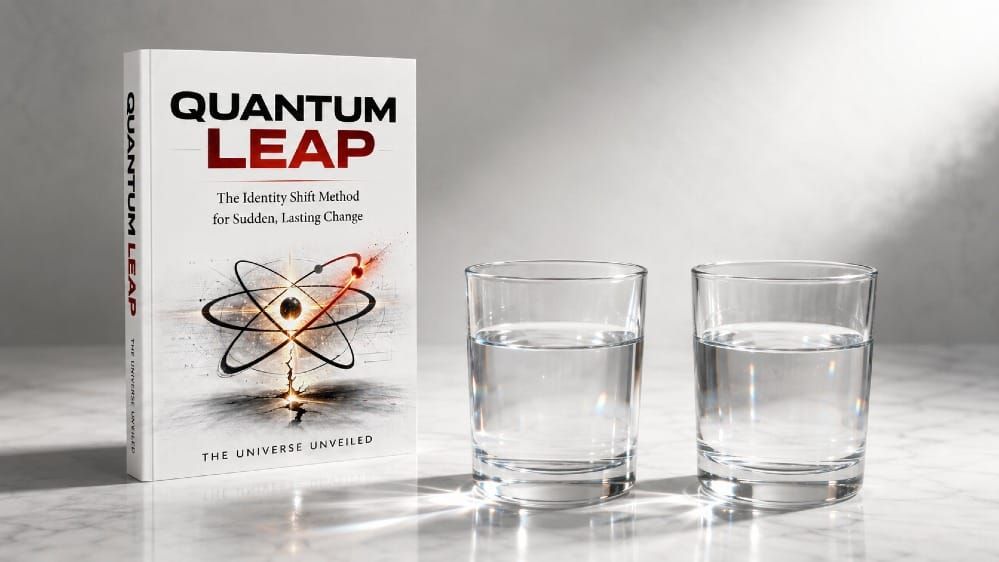
Two-Cup Method: a manifestation ritual where you label one cup with your current reality and one with your desired reality, pour the water from the first into the second, and drink it. The water does nothing. The decision does everything.
The ritual works when it functions as a closing act — the moment you stop negotiating with the old position and occupy the new one. It fails when it is performed as a transaction and followed by checking.
The Two-Cup Method is one technique inside a larger structure. For the full framework, read What Is a Quantum Leap in Manifestation, or go straight to the method itself in Quantum Leap: The Identity Shift Method for Sudden, Lasting Change.
Read the Book →- It is a decision device, not an energy transfer. The pour gives your nervous system a timestamp for a choice that was otherwise vague.
- The water is a prop. Its job is enactment — engaging the part of the mind that does not respond to argument.
- It fails when treated as the cause. Performing the ritual and then resuming monitoring reinstalls the identity you just poured out.
- The seventy-two hours after matter more than the ritual. That interval is where the leap either stabilizes or collapses — the phase mapped in Quantum Leap.
- It cannot install what you have not decided. Ambivalence poured into a cup is still ambivalence.
- Write positions, not wishes. The desired label should name who you are in that reality, not what you receive. This is the same principle behind Identity Is the Law.
- Once, not weekly. Repeating the ritual is monitoring in costume.
Most people have never actually decided to change. They have wanted, planned, researched, and waited — all behaviors performed by the identity they are trying to leave. Internal decisions are slippery: you can make one in the morning and quietly reopen it by afternoon, because nothing marked the moment.
The Two-Cup Method solves that narrow problem. You physically move something, consume it, and destroy the label of the life you are leaving. The decision becomes timestamped and hard to reopen. That is the whole mechanism.
What happens next is what decides the outcome. After a real decision there is an interval where evidence has not arrived and old structures are still dissolving — and most people fill it with checking, which reinstalls the position they just left. That interval is the subject of Quantum Leap: The Identity Shift Method, and the deeper reprogramming work sits in the Subconscious Reprogramming Library.
Read the Book →
The Cups Mark the Threshold. The Book Is What Happens Next.
Quantum Leap explains why change comes from identity relocation rather than effort — and why results arrive late, not early.
Read the Book →Two cups. Some water. A sticky note.
It is one of the most repeated rituals in manifestation, and one of the most misunderstood. Search it and you will find the same instructions rewritten a hundred times: label the cups, pour, drink, tear up the old label. What you rarely find is an explanation of what the ritual is actually doing — or why the same six steps produce a genuine turn for one person and nothing at all for the next.
This is that explanation.
The Two-Cup Method is not water magic. It is not vibration transfer. It is a closing device — a physical act that forces a decision your mind has been leaving open. Understood that way, it becomes far more useful than the version circulating in most manifestation communities, and its failure mode becomes obvious.
The Two-Cup Method is one technique inside a larger structure. For the full framework, read What Is a Quantum Leap in Manifestation.
The Ritual, As It Is Normally Taught
The standard version runs six steps.
1. Label two cups. One reads your current reality. One reads your desired reality. Write them plainly — "stalled at the same income," and "operating at the new number as normal."
2. Fill the current cup. Water goes into the cup marked with the life you are leaving.
3. Sit with the desired cup empty. Hold it. Occupy the reality it names. Not hope for it — occupy it.
4. Pour. Move the water from the current cup into the desired cup in one continuous motion.
5. Drink. Slowly, and completely.
6. Destroy the old label. Tear it, burn it, throw it out. The old container is not kept.
That is the ritual as practiced. Nothing here is wrong. But the instructions describe the choreography and skip the mechanism, which is why so many people execute it perfectly and feel nothing.
What the Ritual Is Actually Doing
The water is not carrying anything.
What the ritual does is give a decision a physical location in time.
Most people trying to change their lives have never actually decided. They have wanted, hoped, planned, researched, and waited. All of those keep the old position intact, because all of them are performed by the old position. Wanting is something the person without the thing does. Planning is something the person without the thing does. The identity is never asked to move — it is just asked to work harder inside the same coordinates.
A decision is different. A decision closes an option.
The problem is that internal decisions are slippery. You can decide something at nine in the morning and quietly reopen it by two in the afternoon without noticing, because nothing marked the moment. There is no evidence a line was crossed. So the mind keeps both positions live, and holding two positions at once is exactly what prevents relocation.
The Two-Cup Method solves a narrow, specific problem: it makes the decision unambiguous and timestamped. You physically moved something. You physically consumed it. You physically destroyed the label of the life you are leaving. Your nervous system now has a record of a threshold being crossed, and that record is much harder to quietly reopen than a thought was.
That is the entire mechanism. It is not smaller than the mystical version — it is more useful, because it tells you what to do when the ritual does not work.
This is the same principle underneath assumption itself: reality reorganizes around a position that has stopped negotiating.
The Ritual Is the Easy Part.
Pouring water takes ninety seconds. Holding the new position when nothing has arrived yet is the actual work — and it has a structure. Quantum Leap maps it.
Read the Book →Why It Works for Some People and Not Others
The people it works for were already close.
They had done the internal work. They were one clean decision away from relocating, and the ritual gave that decision somewhere to land. The cups did not create the shift — they closed it.
The people it does nothing for are usually in one of three positions.
They poured ambivalence
If you have not actually decided, the ritual cannot decide for you. You can pour water while a part of you is still auditioning the outcome, still asking whether you deserve it, still holding the old life as a fallback. Nothing crossed. The choreography ran and the position never moved.
They treated the ritual as the cause
This is the most common failure. The ritual gets performed as a transaction — I did the thing, now the universe owes me the result. That framing is itself the old identity, because it positions you as someone petitioning for an outcome rather than someone who has taken a position. The petitioner does not leap. The petitioner waits.
They started monitoring immediately
Within hours, the checking begins. Has anything changed. Is it working. Should I do it again. Every check is a query sent from the old position, and every query reinstalls it. You cannot pour out an identity and then keep asking it for status updates.
That third one deserves its own section, because it is where most of these attempts actually die.
The Phase After the Cups
Here is what nobody puts in the instructions.
After a genuine decision, there is an interval where nothing appears to happen.
The old structures have started dissolving. The new ones have not stabilized. Evidence has not arrived. This gap is not a sign the ritual failed — it is the shape of the transition itself. Reality does not reorganize on the same clock your decision ran on.
But that gap is unbearable to most people, and so they fill it with monitoring. They check. They redo the ritual. They look for signs. They ask whether they did it right. And because every one of those behaviors is generated by the identity they were supposed to have left, the old position quietly reinstalls itself, usually within seventy-two hours. The water gets poured on Sunday and by Wednesday nothing has structurally changed, because the person went right back to being the one who is waiting.
Holding position through that interval is the skill. Not the pour.
What holding looks like in practice is unglamorous: you stop checking, you stop redoing the ritual, you make ordinary decisions from the new position, and you decline to re-litigate the choice when doubt shows up. Doubt will show up. It is residue, not information.
This is the phase Quantum Leap: The Identity Shift Method was written to map — because it is the phase where nearly every attempted leap gets abandoned one step before it lands.
Variations Worth Knowing
One-cup version. Fill a single glass, name the position, drink. Fewer steps, same mechanism. Useful for people who find the two-cup setup theatrical enough to feel silly, which introduces its own resistance.
Written version. No water. Write the old position on paper, write the new one on a second sheet, destroy the first, keep the second somewhere you will not look at it daily. Same closing function, no ritual objects.
Domain-specific labels. Money, relationship, health, work. The labels should name a position, not a wish. "Financially free" is a wish. "I operate as someone for whom this number is ordinary" is a position. The first one gives your mind nothing to occupy.
How often. Once. Repeating the ritual weekly is monitoring in costume — it says the first one did not take, which is a message sent from the old identity. If you feel the urge to redo it, that urge is the thing to notice, not the thing to obey.
The Honest Framing
The Two-Cup Method has a strange reputation. In one direction it gets sold as literal timeline-hopping physics. In the other it gets dismissed as superstition with a glass of water.
Both readings miss what is actually useful about it.
Ritual is one of the oldest technologies humans have for making a change feel real to the part of the mind that does not respond to argument. That part responds to enactment. Weddings, oaths, graduations, funerals — all of them exist because a decision that is only thought is not a decision that holds. The Two-Cup Method is a small, private version of the same technology, applied to the one decision most people never actually make: leaving the identity that generated their current life.
That is not nothing. It is also not sufficient.
The pour marks the threshold. What determines whether you stay across it is what you do in the silence afterward.
You Poured the Water. Now Hold the Position.
Effort does not produce the leap — and monitoring collapses it. Quantum Leap explains why change happens through identity relocation, why results arrive late rather than early, and how to stay across the threshold once you cross it.
Get the Book →Two-Cup Method FAQ
Does the Two-Cup Method actually work?
It works when it closes a decision you have genuinely made. The ritual does not generate the shift — it marks it, giving an internal choice a physical, timestamped form that is harder to quietly reopen. Where people report it working dramatically, the internal position had usually already moved and the ritual finished the job.
Does the water do anything?
No. The water is a prop for enactment. Its function is sensory and symbolic — you see, hold, pour, and consume, which engages parts of the mind that do not respond to reasoning. Attributing the effect to the water shifts the cause outside of you, which is the same error that stalls most manifestation attempts.
How long does the Two-Cup Method take to work?
There is no fixed timeline, and expecting one is what usually breaks it. After a real decision there is an interval where evidence has not arrived and old structures are still dissolving. That gap is the transition, not a failure. Most attempts collapse in the first seventy-two hours because the person begins checking for results, and checking is a behavior generated by the identity they were leaving.
Can I repeat the Two-Cup Method?
Repeating it is usually a form of monitoring. Redoing the ritual sends the message that the first one did not take, which reinstalls the old position. If you feel a strong urge to repeat it, treat that urge as information about where your identity actually is, rather than as an instruction to follow.
What should I write on the cups?
Write positions, not wishes. "I want more money" is a wish and gives your mind nothing to occupy. "I operate as someone for whom this income is ordinary" is a position. The desired label should describe who you are in that reality — how you decide, what feels normal — not what you receive.
Is the Two-Cup Method the same as quantum jumping?
It is one technique associated with quantum jumping and quantum leaping, but the broader concept is not defined by any single ritual. A quantum leap is a structural relocation of identity after which reality reorganizes. The Two-Cup Method is one of several devices people use to mark that relocation.
Do I need to believe in parallel realities for it to work?
No. The mechanism described here — enactment closing a decision that thought alone leaves open — does not require any metaphysical commitment. The multiverse framing is one interpretation, not a prerequisite.
Related reading: Parallel Selves · Identity Is the Law · The Quantum Field in Manifestation · Subconscious Reprogramming Library
You Poured the Water. Now What?
The seventy-two hours after the ritual decide everything. Learn how to hold the position.