Why Banksy Never Revealed Himself — and Got Everything
Banksy didn’t disappear to avoid fame — he disappeared to amplify power. By releasing ego, refusing ownership, and practicing radical non-attachment, his art escaped the artist and entered collective consciousness, proving that influence multiplies when identity is not clung to.

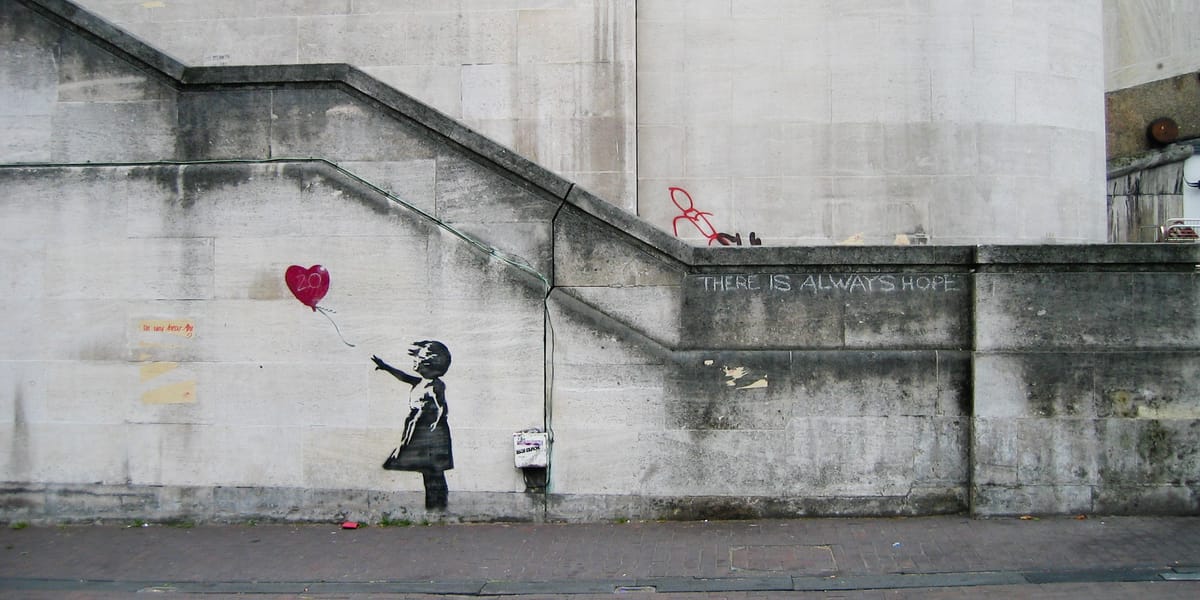
In a world hungry for celebrity, one artist chose invisibility — and through the Law of Non-Attachment, gained almost mythical influence. Banksy, the faceless street art provocateur, turned anonymity into his greatest masterpiece by refusing ownership, recognition, and ego. Free from the gravity of fame, he allowed his work to speak in its own fierce, poetic voice. His journey is not simply about art, but about release: ego dissolved, creation set loose, and influence multiplied precisely because nothing was clung to. Through Banksy’s path, we encounter a universal law of manifestation — that power expands when identity is not defended, and presence becomes strongest when it no longer insists on being seen.
Detached from Ego
Banksy’s refusal to reveal his identity is an act of radical humility. By staying anonymous, he removed himself – his ego, his personal story – from the equation, ensuring that the work is everything, and the artist is no one. In an era where artists often build loud personal brands, Banksy inverted the formula. There is no famous face or flamboyant persona overshadowing the message on the wall. Instead, a mystery stands behind each piece, compelling us to engage with the art itself rather than the artist’s biography. This detachment from ego is philosophical as much as practical. It’s as if Banksy whispered to the world: “Pay attention not to me, but to what I create.”
Paradoxically, by refusing credit and personal glory, Banksy became more celebrated. His lack of ego – the very notion of an artist who declines recognition – only sharpened the intrigue around his work. He turned himself into a vessel for ideas, a conduit without a visible source. The humility of this stance aligns with timeless wisdom: when one lets go of ego, the truth of the work can shine unfiltered. Banksy’s anonymity thus amplified his power, leaving “no celebrity ego to manage, no personal brand to protect. Just pure, unadulterated creative chaos” unleashed upon the world. In remaining faceless, he embodied the ultimate creative freedom – art unchained from the artist’s personal identity.
This detachment also served as a critique of modern celebrity culture. By not playing the fame game, Banksy rebels against an art industry that often elevates the artist above the art. He stands as the inverse of the modern influencer – “famous precisely because he has resisted the pressures of visibility”. We do not know who Banksy is, and in a profound way, that absence feels liberating. As viewers, we meet the work on its own terms, without the bias of an author’s race, gender or personality. Banksy’s invisibility forces the world to confront the art itself. In the artist’s own sly words, “they forget that invisibility is a superpower”, and indeed Banksy wielded that superpower to ensure the message outranks the messenger.
The result is art that transcends the artist. A small girl releasing a heart-shaped balloon or a masked protester throwing flowers – these images are not about Banksy at all, but about all of us. By detaching his ego, Banksy made his art a mirror in which society can see itself. The power of an idea, he shows, can outweigh any need for personal recognition. In staying anonymous, Banksy got everything: authenticity, creative purity, and a legend status that outstrips any ego-driven fame.
Synchronicity, Street Magic, and Messages from the Universe
When art appears at the exact right moment, it isn’t random — it’s alignment. This piece explores how street magic, synchronicity, and non-attachment create messages that arrive precisely when identity loosens its grip.
Enter the Street MagicAllowed Art to Circulate Freely
Freed from the confines of authorship, Banksy’s art flows through the world like a wild current. Anonymity became the wind under the wings of his creations, allowing them to circulate freely in public spaces and culture without gatekeepers. He sidestepped the traditional art world entirely – no need for gallery endorsements or museum retrospectives when your gallery is the streets. By operating incognito, Banksy could stencil anywhere, from London bridges to Bethlehem walls, unhindered by authorities or institutions. The art appeared overnight, belonging to everyone and no one. In this way, anonymity kept his work rooted in graffiti’s rebel spirit, “outside institutional control”, unsanctioned and alive.
Girl with Balloon (2002) — The hand does not clutch; it opens. This is the law in image form: manifestation accelerates when longing is softened into trust. The balloon rises — and the world responds.
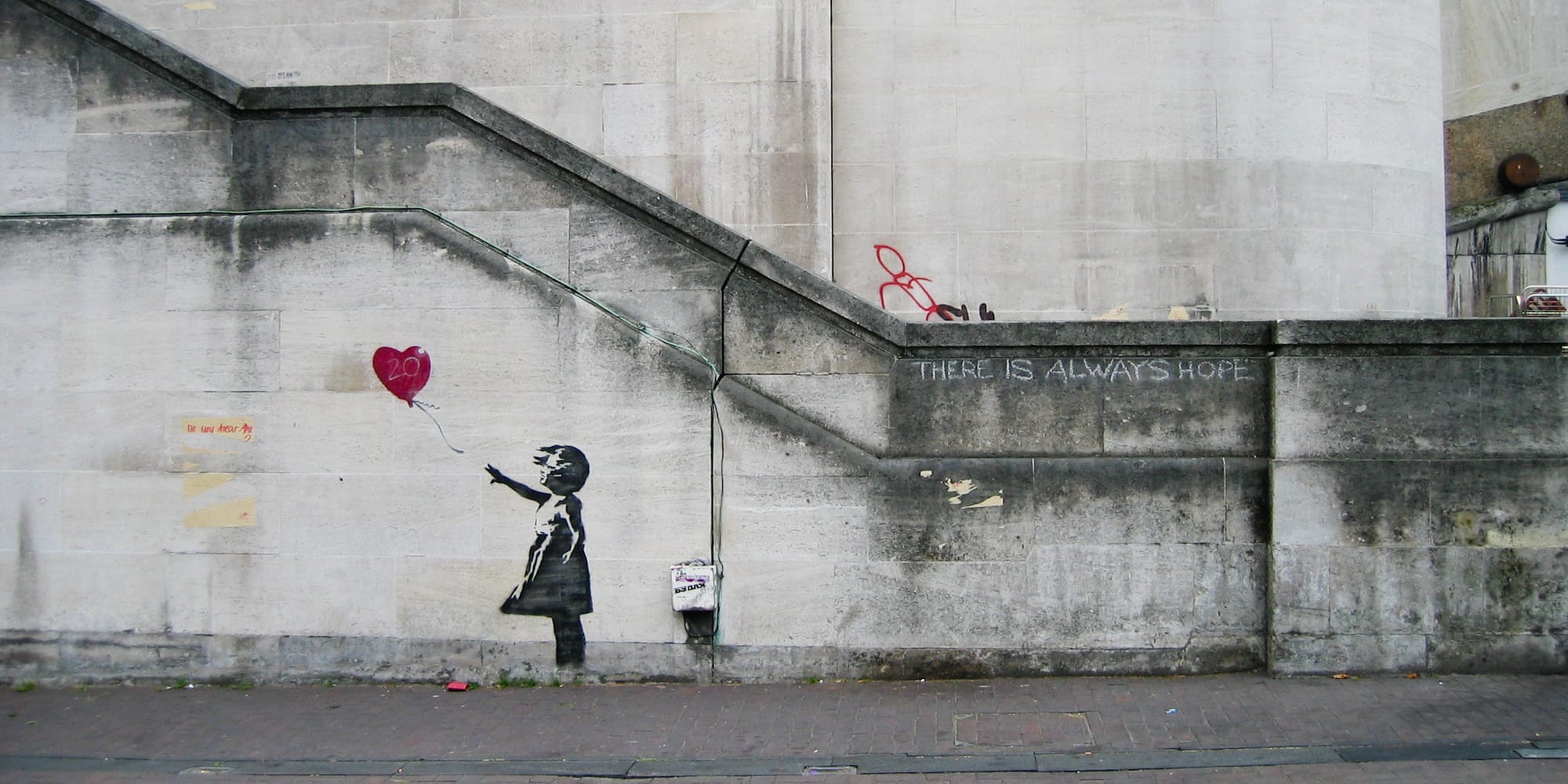
Consider Girl with Balloon, which first fluttered into view on a London wall in 2002. With its striking simplicity – a silhouette child reaching toward a red heart balloon – the piece immediately resonated. Because Banksy never claimed ownership in the usual sense, this image traveled far and wide. It was reproduced on prints and re-stenciled by fans; it even took on a life of its own in popular culture, voted the UK’s favorite artwork in a 2017 poll. What began as illicit graffiti transcended its origins, replicated around the world as a symbol of hope. Without a known artist attached, Girl with Balloon moved through media and hearts freely – a piece of art unmoored, able to find new meaning with each journey. When Banksy later used the motif for causes (like a 2014 Syrian refugee campaign), it felt natural – the image already “belonged” to everyone.
Banksy’s anonymity also meant his works could leap from the street into the news cycle with ease. Each new mural was an event that people discovered and shared, without any PR team needed. Take “Kissing Coppers,” the 2004 stencil of two British policemen kissing on the side of a Brighton pub. It appeared quietly one day and immediately sparked conversation on authority, love, and LGBTQ acceptance. The bold image spread through newspapers and internet forums on its own merits – no artist statement required. Even after the mural was repeatedly vandalized (and eventually removed to canvas), its fame only grew. The original wall piece was shipped to the U.S. and auctioned for $575,000, literally circulating from a local pub wall to the global art market. Yet the power of Kissing Coppers was never about Banksy seeking profit; indeed, its message circulated free of the artist’s intervention, igniting debates on homophobia and art’s place in public space. The piece is now regarded as one of Banksy’s most notable works, even being named an iconic British artwork in a public art fair.
Love Is in the Air (Flower Thrower) (2003) — Painted near the West Bank barrier, this image captures a decisive identity choice: the hand that could throw destruction releases creation instead. By refusing the state of conflict and embodying peace before conditions changed, the image demonstrates how non-attachment allows intention to move faster than force — and spread further.
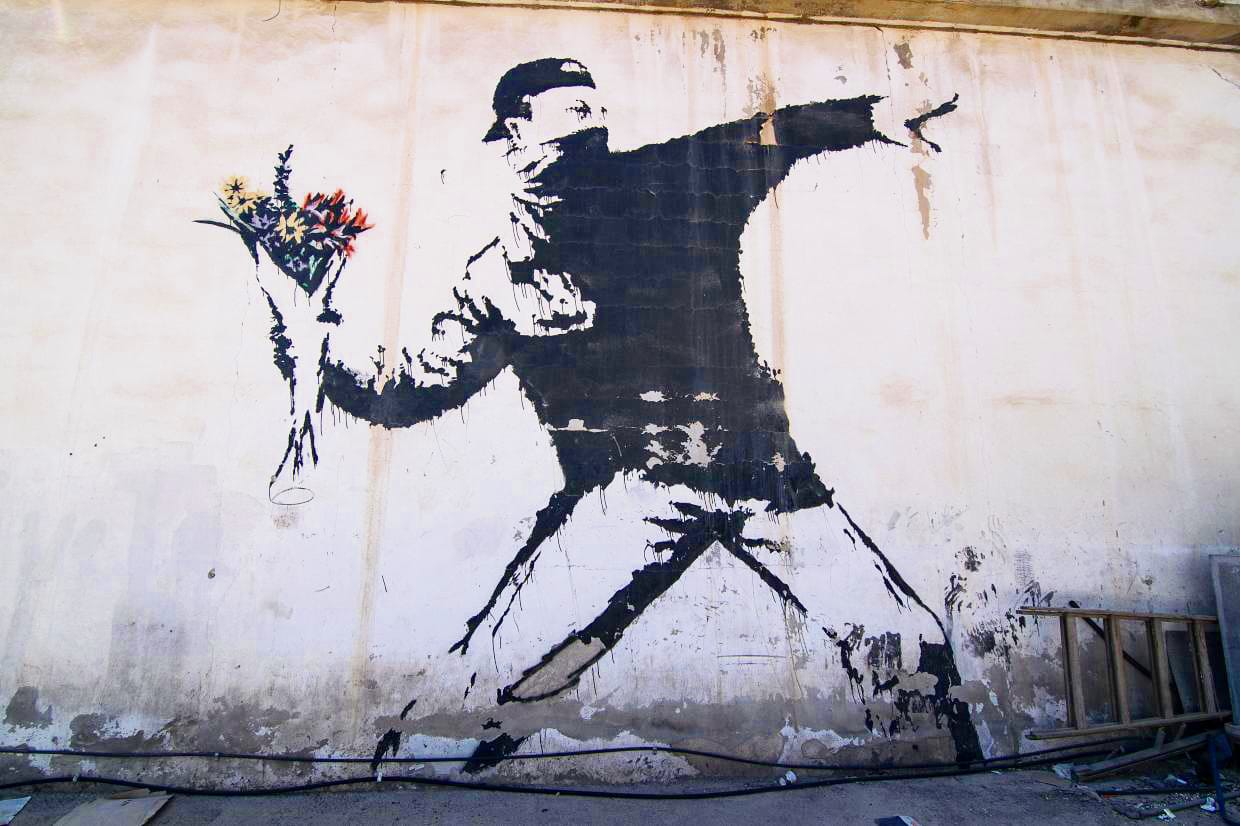
Another example is Love Is in the Air, also known as the Flower Thrower. Painted in 2003 on a Bethlehem wall amid the Israel–Palestine conflict, it depicts a protester poised to throw not a Molotov cocktail but a bouquet of flowers. Because Banksy remained anonymous, this striking artwork wasn’t pigeonholed as one man’s statement – it became a global emblem of nonviolent resistance. The image’s paradox of aggression and peace spoke universally, and it “has been imitated and replicated countless times” due to its visual strength. From t-shirts to protest banners around the world, the Flower Thrower’s message circulates with unrestrained freedom. Here we see how anonymity removed any barrier between a piece of street art and its audience: there was no artist’s persona to filter through, only the raw image and its hopeful call for peace. As a result, the Flower Thrower stencil is now widely recognized as one of Banksy’s most iconic works, reproduced on murals and merchandise globally.
By staying unidentified, Banksy also bypassed the typical gatekeepers of art. There was no curator deciding if his work was worthy – he took his art directly to the public. His pieces popped up in gutters, alleyways, amusement parks and even on the segregation wall in the West Bank, places traditional art could never reach. And because the art arrived without explanation, people felt invited to interpret and share it on their own terms. Anonymity leveled the playing field: a Banksy could be enjoyed by a random passerby on the street or an Instagram viewer continents away, without any credentials needed. The work spoke for itself, unmediated by the artist’s persona. In fact, Banksy’s few channels of communication – an occasional cryptic Instagram post or a stealth installation – only heightened the frenzy when new art appeared. Every fresh stencil was breaking news, precisely because the artist wasn’t there to explain it. The result? Banksy’s creations circulate in public discourse as freely as graffiti on a breeze: debated on talk shows, shared in millions of social media posts, referenced in political cartoons – art unchained, stirring conversation far beyond the walls it’s painted on.
Perhaps the ultimate demonstration of art set loose is the infamous “Love Is in the Bin” incident. In October 2018, Banksy shocked the world by shredding one of his own artworks at the very moment it sold for £1 million at Sotheby’s. As the auction hammer fell on Girl with Balloon, a hidden mechanism in the frame whirred to life, slicing half the canvas into ribbons before the astonished crowd. In that surreal moment, the painting literally escaped its sale – transforming into a new artwork titled “Love Is in the Bin.” Banksy’s anonymity made this guerrilla performance possible: no one in the room knew the perpetrator or could stop him. The stunt became instant art history and headlines worldwide. Videos of the shredding went viral across the internet, and the resultant half-shredded piece – now freed from its pristine condition – ironically doubled in value in the eyes of collectors. Here anonymity allowed Banksy’s art to not only circulate but to metamorphose in real time, turning a critique of art-market greed into a globally shared moment of awe. The spectacle underscored how gatekeepers simply could not contain Banksy’s work. Even in an auction house vault, his art literally refused to stay framed. It circulated right back out into the world as an idea – a statement about the absurdity of commodifying creativity – leaving everyone buzzing about art’s true purpose. Free from attachment to reputation or sale price, Banksy could pull off such audacious moves and get away with it, further amplifying his mythos.
Picasso Energy: When Creation Moves Faster Than Identity
Where Banksy vanished, Picasso overflowed. Both mastered the same law: creation accelerates when attachment to identity dissolves. This guide reveals how artistic power multiplies when ego steps aside.
Enter Picasso EnergyNon-Attachment Multiplied Influence
From the beginning, Banksy treated his street art as a gift to the public – one he never tried to hold onto or control once it was unleashed. This principle of non-attachment to outcomes has paradoxically multiplied the influence of his work. By not clinging to his pieces – by accepting they might be painted over, stolen, bought or altered – Banksy empowered each artwork to live its own life, to ripple outward in unpredictable ways. In the artist’s view, the ephemeral nature of street art is not tragedy but intention: Banksy has even stated that his works aren’t meant to last forever, “but rather to spark conversation”. His focus is on the immediate impact of the message, not the physical preservation of the object. In this almost Zen-like letting go, Banksy found that when you release control, your creations can grow and echo in society far beyond what you alone could orchestrate.
Kissing Coppers (2004) — Placed in the open and left unguarded, the image refused ownership. By allowing reaction, resistance, and removal without interference, the work obeyed the law of manifestation: what is not protected travels further.
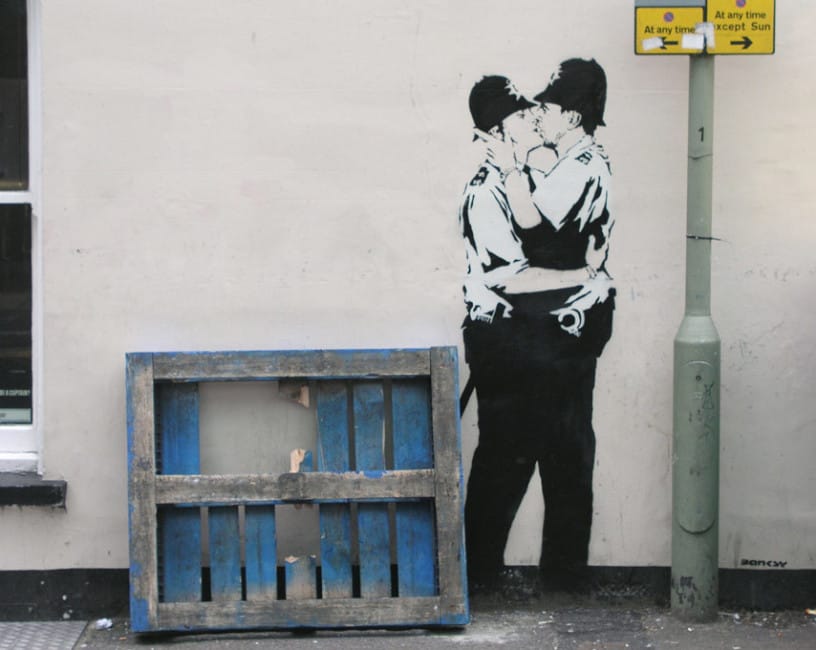
Many of Banksy’s most famous works have lived many lives because of this non-attachment. The Kissing Coppers mural, for instance, did not remain a static piece on a wall – it was vandalized repeatedly (perhaps by those uncomfortable with its message), then eventually cut out of the pub wall and sold. Banksy himself did not intervene; the artwork’s fate became a story owned by the community and the media. Locals lamented the loss of the mural from Brighton, calling its removal a hypocrisy against street art’s public spirit. Yet in that outcry, Kissing Coppers only grew in cultural significance. It provoked debate about who “owns” public art and whether taking it indoors was preserving it or killing its soul. The public essentially co-created the narrative – with some choosing to put up a replica on the pub wall, others decrying the commercialization. Through it all, Banksy remained silent, letting people wrestle with those questions themselves. In doing so, he ensured that the conversation – about art, censorship, and LGBTQ acceptance – continued to thrive. The lack of attachment to the physical piece meant the idea behind it carried on in many forms: a replica on the original wall, prints and photos circulating online, even academic discussions of its impact. Banksy multiplied his influence by stepping back and allowing the public to take partial ownership of the work’s meaning and destiny.
Another striking example is Banksy’s approach to the transient life of graffiti. He knows city officials may buff over his murals, or that rival graffiti writers might tag over them. Instead of bemoaning these outcomes, Banksy seems to embrace impermanence as part of the art’s journey. In New York City, during his famous 2013 “Better Out Than In” residency, new Banksy pieces appeared daily – and some were defaced within hours by others. Far from diminishing Banksy’s impact, this ephemerality only heightened the fervor; each piece became a treasure hunt and a race against time. Crowds formed to protect certain works with plexiglass, while others were scavenged or altered. It was chaotic, but it was co-creation in real time – the public actively engaging, sometimes literally writing the next chapter on top of Banksy’s work. Every buffed wall or stolen stencil just added to the legend that “Banksy was here, and now it’s gone.” In an official statement (delivered, true to form, via graffiti), Banksy dryly quipped about such losses: “All graffiti is destined to fade.” That attitude reveals his non-attachment: the moment of creation and the discourse it sparks are what matter, not the permanence of the piece. Because he doesn’t fight the natural entropy of street art, each Banksy work becomes a story – sometimes a saga – and those stories travel far.
Indeed, Banksy’s influence has rippled across the globe largely because he never tethered his messages to a fixed context. When he painted seven murals on the West Bank barrier in 2005 – images of children digging holes through the wall, or a girl lifted by balloons over the division – he knew those pieces might be vandalized or the wall itself could fall. But he also knew that photographs and reports of these daring images would capture the world’s attention. And they did: Banksy’s West Bank interventions garnered international headlines, drawing many eyes to a conflict often ignored. The murals became symbols of hope and injustice circulated in newspapers and online; they spurred conversation about the power of art in conflict zones. Even after some were defaced or weather-worn, their legacy endured in the minds of those who saw or heard of them. By not attaching himself or insisting on control, Banksy allowed these murals to belong to the people living there and to the global audience stirred by them. The result was a far greater impact than if he had simply painted canvases on the topic to hang in a gallery. His anonymity and non-ownership invited locals to interact – some Palestinians guarded the art, others added their own graffiti nearby – and invited the world to discuss the issues rather than the artist. The art lives on as collective memory and inspiration, even if the physical paintings fade.
This open-handed philosophy reached a poetic climax with the Love Is in the Bin stunt. After that partial shredding at Sotheby’s, Banksy did not try to reclaim the remains or explain himself beyond an Instagram joke (“Going, going, gone…”). Instead, he let the half-shredded piece go to the winning bidder as a new artwork – authenticated with a cheeky new title and left to the buyer’s care. Critics and fans around the world then joined in co-creating the meaning of that moment. Some hailed it as the greatest art prank of the century, a triumphant statement that art is more than commodity. Others saw it as Banksy’s commentary on destruction and rebirth in art. The debates raged, and in every retelling, Banksy’s mystique and message grew. The shredded painting itself went on to be exhibited in museums – a tangible artifact of that fleeting, spectacular performance. In essence, by destroying his own work, Banksy multiplied its influence exponentially. It was no longer just a painting on a wall; it became a story everyone knew, a meme, a discussion in households far beyond the art community. Such is the power released when an artist doesn’t cling to a creation – when he’s willing to let it become something else. Banksy’s lack of attachment invited the public to complete the work with their reactions and interpretations. In doing so, he proved that an idea can evolve and spread much faster when it isn’t tightly held by its creator.
In the end, Banksy’s anonymity and non-attachment are as much a part of his art as his stencils and spray paint. He has proven that the power of an idea can outweigh the need for recognition. By detaching from ego, he ensured his work stands on its own, radiant and unfiltered. By letting his art circulate freely, he gave it permission to journey into new contexts and hearts. By not holding on to outcomes, he allowed each piece to spark countless others – conversations, reactions, even new art – thereby multiplying its impact beyond measure. Banksy is both an artist and a phenomenon, a living reminder that sometimes the strongest voice is the one that speaks without revealing its source.
As we ponder the magical enigma that is Banksy, we see a reflection of something universal: when we let go of the self and release our creations to the world, they can grow larger than we ever imagined. In remaining nobody, Banksy became everywhere. In giving up credit, he gained a legacy. In never revealing himself, he truly got everything.
Iconic Anonymous Interventions and Their Impact
Each of these interventions, carried out under the cloak of anonymity, demonstrates how Banksy’s ideas traveled far beyond their original place and time. Detached from the need for personal recognition, they invite us all to be part of their story – to find meaning in them, argue over them, even laugh or gasp in surprise. Banksy’s anonymous artistry ultimately feels like magic in plain sight: proof that art unleashed into the world with humility and daring can indeed change the way we see our society, and ourselves, without anyone ever having to step from the shadows to take a bow.

Cleopatra Unveiled
Banksy proves that power doesn’t require a face.
Cleopatra proved something even more dangerous — that identity itself can be a weapon.
Cleopatra Unveiled explores how sovereign power is constructed, projected, and obeyed — whether through invisibility or absolute self-possession.
You Would Also Love
FAQ
Banksy didn’t “hide” because he was weak. He disappeared because invisibility can be an amplifier. Here are the questions people actually ask—answered in The Universe Unveiled lens.
Because anonymity keeps the message pure. Fame asks the world to look at the face; anonymity forces the world to look at the work. And spiritually? It’s a form of ego fasting—removing “me” so the idea can move through you like weather: everywhere, owned by no one.
Mystery is oxygen for myth. When there’s no identity to “solve,” the audience supplies their own meaning—again and again. That repeated meaning-making becomes multiplication: more shares, more retellings, more obsession, more cultural gravity.
Ego wants credit. Art wants impact. Banksy chose impact. When you stop negotiating with recognition, your creation stops shrinking to fit other people’s opinions. The work becomes louder because the ego isn’t interrupting it with “Do they like me?”
Yes—and it’s the kind that creates momentum. Non-attachment doesn’t mean “don’t care.” It means you care so deeply about the message that you refuse to chain it to your identity. You release the outcome… and the world does the distribution for you.
When a piece isn’t pinned to a celebrity persona, it travels like folklore. People remix it, quote it, repost it, parody it, print it—because it feels like public mythology, not “someone’s brand campaign.” Anonymity turns art into a shared language.
Invisibility removes friction. No forced interviews. No personal scandals hijacking the message. No face to attack. The spotlight stays on the idea. And in manifestation terms: your “state” becomes the signal—not your performance of it.
Manifestation isn’t just “getting things”—it’s becoming an inevitability. Banksy assumed impact over identity: he chose a state where the work would be found, talked about, and remembered. Then he let the bridge of incidents move through the public, the press, the streets, and the internet.
Because contradiction creates electricity. Street art that becomes priceless? A prank that becomes history? That tension makes people stare longer. And the longer they stare, the deeper the imprint. Banksy weaponized paradox—and paradox prints itself into culture.
Absolutely. The deeper principle is this: stop bargaining your identity for approval. Create from the state of inevitability. Let the work breathe. Release the need to manage every reaction. You can be visible and still be unattached—by letting your message lead and your ego follow.
Build work that can travel without you. Make it clear. Make it emotional. Make it remixable. And then—this is the hard part—release it. Non-attachment is not passive; it’s disciplined trust that your creation can survive your control.
Because people confuse “source” with “meaning.” They think if they identify the person, they’ll tame the myth. But Banksy’s point is the opposite: the work is the portal. The identity is the distraction. The chase itself keeps the spell alive.
The art would still be powerful—but the energy would shift. Mystery would collapse into biography, and biography invites judgment. What anonymity protects is not just safety—it protects the work from becoming a personality debate.