The Best Abraham Hicks Books in Order: A Complete Reading Guide
The complete Abraham Hicks book list, ranked by recommended reading order. Where to start as a beginner, which books to read next, and which titles to save for later. A practical guide for entering the Abraham canon without getting lost in the catalog.


The recommended Abraham Hicks reading order for beginners is: The Law of Attraction first for the basics, then Ask and It Is Given for the 22 processes, then The Vortex for relationships, Money and the Law of Attraction for financial application, and The Astonishing Power of Emotions for deeper emotional guidance.
This order works because it moves from foundation to practice, then into love, money, and emotional mastery.
For a structured, modern companion path through the same Abraham Hicks universe, read Living in the Vortex — an easy-to-digest guide for readers who want the teachings organized clearly in one place.
Focus Wheel. Segment Intending. Appreciation. Finally in One Daily Rhythm
 See the Book on Amazon
The Abraham Hicks book catalog is larger than most readers realize, and the order in which you encounter the titles matters significantly. Some books are pure introduction. Some are deep applied work. Some were transitional channeling material from the 1980s and are largely obsolete. Without a map, beginners often pick up the wrong book first and bounce off the teachings entirely.
This is the complete reading guide. Every Abraham Hicks book by Esther and Jerry Hicks, organized by recommended reading order rather than publication date, with notes on what each book delivers and who it is best for.
This article is part of the Abraham Hicks System of Alignment. If you are new to Abraham entirely, start there.
Before You Buy: How to Choose Your First Abraham Book
The single most common mistake beginners make is starting with The Vortex because the title sounds central to the teachings. It is not a beginner book. It is a relationships book that assumes you already understand the Law of Attraction basics.
Three filters to apply before purchasing your first title:
Are you new to manifestation entirely? Start with the foundation books — The Law of Attraction or Ask and It Is Given. Skip everything else until you have one of these under your belt.
Have you read The Secret or other Law of Attraction material before? You can skip The Law of Attraction introductory book and go straight to Ask and It Is Given. The 22 processes inside are where the operational depth lives.
Do you want a single modern book that organizes everything? Skip the chronological catalog and start with Living in the Vortex. The Abraham canon was built across decades of workshops with no single architect organizing it. Living in the Vortex is the modern structured version.
Abraham Hicks Books in Recommended Reading Order
The order below is the path I recommend for a modern reader entering the canon. It prioritizes the strongest applied teaching first, builds depth through the middle, and leaves specialized topics for later.
1. The Law of Attraction: The Basics of the Teachings of Abraham (2006)
The foundation text. If you have never been exposed to Abraham's teachings or to Law of Attraction principles in any form, start here. The book covers the three core laws — Law of Attraction, Law of Deliberate Creation, and Law of Allowing — in their cleanest, most accessible form.
This book is short, dense, and direct. There are no processes yet. No exercises. Just the philosophical architecture you need before applied work makes sense.
Best for: complete beginners with no prior manifestation framework.
Skip if: you have already read The Secret or other LOA material and just want the operational tools.
2. Ask and It Is Given: Learning to Manifest Your Desires (2004)

The most important Abraham Hicks book ever published. Full stop.
This is the operational manual. It contains the 22 processes — including the Pivoting Process, the Focus Wheel, the "Wouldn't It Be Nice If" process, the Place Mat Process, and the Rampage of Appreciation — that form the entire applied system. It also contains the Emotional Guidance Scale in its definitive form.
If you only buy one Abraham book ever, buy this one. The processes inside are worth more than the rest of the catalog combined.
Best for: anyone moving from concept to practice.
See on Amazon3. The Vortex: Where the Law of Attraction Assembles All Cooperative Relationships (2009)

The relationships book. The Vortex applies the Law of Attraction specifically to relationships — romantic, family, friendships, business, even the relationship with money. It introduces the Vortex itself as a concept and explains how alignment shifts who shows up in your life.
Read this third because the Vortex concept is most powerfully understood once you have already practiced the 22 processes from Ask and It Is Given. Reading The Vortex first is the most common Abraham reading mistake — the concepts feel abstract without the applied foundation.
Best for: readers who have completed Ask and It Is Given and want to deepen relationship-focused application.
See on Amazon4. Money and the Law of Attraction (2008)

The financial application. This is Abraham's most commercially-focused book and the one most readers come to after their first money-related contrast hits. The book applies the LOA framework specifically to financial well-being and includes deeper teaching on the relationship between belief, deserving, and abundance.
It also explains why most people struggle financially even when they understand the basics — the gap between intellectual agreement with abundance and actual vibrational match.
Best for: readers ready to apply alignment work specifically to money. Pairs naturally with the daily practice quartet.
See on Amazon
See the Book
5. The Astonishing Power of Emotions (2008)
The deepest emotional guidance book in the canon. The Astonishing Power of Emotions goes further than the Emotional Guidance Scale chapter in Ask and It Is Given — it provides 33 case studies of specific emotional scenarios and exactly how to climb out of them using Abraham's processes.
This book is structured almost like a clinical reference. You experience a specific feeling — guilt about a parent, frustration with a spouse, fear about money, grief over a loss — and you turn to the relevant chapter for the precise vibrational climb instructions.
Best for: readers who are working with specific emotional patterns and want a targeted reference. Most useful as a long-term companion rather than a single read.
6. The Amazing Power of Deliberate Intent (2006)
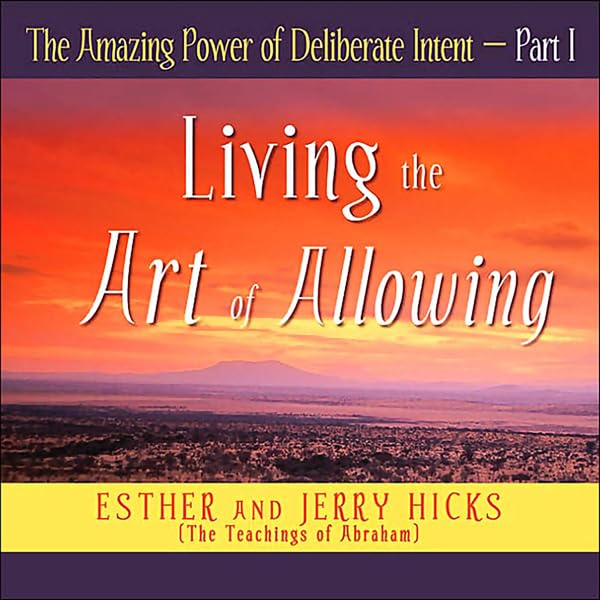
The transition book between the early teachings and the mature applied work. The Amazing Power of Deliberate Intent covers the Art of Allowing — the principle that what you allow into your experience matters as much as what you ask for.
The book is shorter and more conceptual than the others. Many readers skip it without losing much, but it deepens understanding of why most blocked manifestation is actually a problem of allowing rather than a problem of asking.
Best for: intermediate readers who feel like their requests are clear but their results are blocked.
Skip if: you are new and need applied tools first.
See on Amazon7. Getting into the Vortex: Guided Meditations (2010)
Not a book in the traditional sense — this is a meditation companion with guided audio (CD or download). The four meditations cover general well-being, financial well-being, physical well-being, and relationships.
The meditations are designed to deactivate resistance and lift you into the Vortex. They work best as a daily 15-minute practice, exactly the duration Abraham described as foundational.
Best for: readers who have understood the principles intellectually but want a structured tool for actually building daily alignment time. Pairs with the Daily Abraham Hicks Practice.
Abraham Hicks Books to Approach With Caution
Two early Abraham titles deserve specific notes before purchase.
A New Beginning I and II (1988, 1991)
These are the earliest Abraham channelings, published before the teachings reached their mature form. They contain core ideas in raw early articulation, but they also include catastrophic predictions that Abraham later cancelled in subsequent workshops, saying the events were taken off the table by collective vibrational shifts.
For most readers, these books are interesting historically but not useful as practical guides. The mature teaching in Ask and It Is Given contains everything from these early works in cleaner form.
Best for: serious students of the Abraham canon who want to trace the evolution of the teachings.
Skip if: you want practical application. Read Ask and It Is Given instead.
The Sara Series (2007)
Children's fiction. The Sara books — Sara Learns the Secret, Solomon's Fine Featherless Friends, and A Talking Owl Is Worth a Thousand Words — present Abraham's teachings as a story for younger readers. Adults sometimes enjoy them for the gentleness of the framing.
These are not appropriate as your introduction to Abraham unless you are reading to a child or specifically prefer narrative-driven teaching.
Reading Sequence by Goal
Different readers need different paths. Here are three common goals and the recommended sequences for each.
If your goal is daily practice: Ask and It Is Given first, then Getting into the Vortex for the meditations, then Living in the Vortex for structural integration. This gives you tools, daily practice, and architecture in three books.
If your goal is financial transformation: Ask and It Is Given first for the foundational processes, then Money and the Law of Attraction for direct application. Pair with the Daily Abraham Hicks Practice for structural support.
If your goal is relationships: Ask and It Is Given first, then The Vortex, then The Astonishing Power of Emotions for the emotional case studies. Relationship work requires the most precise emotional guidance work, and these three books cover the full architecture.
How Abraham Hicks Compares to Other Manifestation Authors
Most readers exploring Abraham Hicks also encounter Neville Goddard, Bob Proctor, Joe Dispenza, and Florence Scovel Shinn at some point. The teachings are not interchangeable — each works through a different mechanism.
Abraham emphasizes vibrational alignment through emotional guidance. Neville emphasizes assumption and identity occupation. Bob Proctor emphasizes paradigm shift through repetition and structured study. Joe Dispenza emphasizes meditation and brain-state engineering. Each is a complete system. None of them contradict the others underneath, but the entry points and daily practices differ significantly.
If Abraham resonates with you, the natural next teacher to explore is Neville. The two systems pair beautifully — Abraham's vibrational tools handle daily emotional landscape, Neville's identity work handles deeper subconscious architecture.
A Final Note on Audio Versions
Many Abraham books are available as audiobooks read by Esther Hicks herself. For some readers, hearing the material in Esther's voice — particularly when she shifts into the Abraham channeling voice — adds dimensions the printed page cannot deliver.
If you are an auditory learner or commute regularly, the audio versions of Ask and It Is Given and The Vortex are particularly recommended. Esther's vocal shift between her own narration and the Abraham passages becomes part of the teaching itself.
Whichever format you choose, the order matters more than the medium. Start with The Law of Attraction or Ask and It Is Given. Build from there. The path through the Abraham canon is significantly easier when you do not skip the foundation books — and significantly more useful when you complete the applied work in Ask and It Is Given before reaching for the more specialized titles.
The teachings have been refined across forty years of workshops. The books capture different phases of that refinement. Read them in the right order and the entire system will assemble itself in your understanding the way it assembled itself in the teaching across decades.
See the Book on Amazon
Best Abraham Hicks Books in Order: Frequently Asked Questions
What is the best Abraham Hicks book to start with? +
For complete beginners, The Law of Attraction (2006) is the cleanest introduction — it covers the three core laws in their most accessible form. For readers already familiar with Law of Attraction concepts from sources like The Secret, skip directly to Ask and It Is Given (2004), which contains the 22 applied processes that form the operational system.
Should I read The Vortex before Ask and It Is Given? +
No. Reading The Vortex first is the most common Abraham reading mistake. The Vortex is a relationships book that assumes you already understand the Law of Attraction basics and the 22 processes. Read Ask and It Is Given first — the Vortex concepts make significantly more sense once you have practiced the foundational processes.
How many books did Esther and Jerry Hicks write? +
Esther and Jerry Hicks co-authored over a dozen books together, including the seven-book Law of Attraction series, the three-book Sara children's series, and several non-fiction titles like A New Beginning I and II. The Law of Attraction series — Ask and It Is Given, The Law of Attraction, The Vortex, The Amazing Power of Deliberate Intent, Money and the Law of Attraction, The Astonishing Power of Emotions, and Getting into the Vortex — represents the mature published work.
Are A New Beginning I and II worth reading? +
Only for serious students tracing the evolution of Abraham's teachings. These are the earliest channelings from 1988 and 1991, before the teachings reached their mature form, and they contain catastrophic predictions Abraham has since cancelled. The mature teaching in Ask and It Is Given contains everything from these early works in cleaner form. Skip them if you want practical application.
What is the most important Abraham Hicks book? +
Ask and It Is Given. It is the operational manual containing the 22 applied processes — Pivoting, Focus Wheel, Wouldn't It Be Nice If, Place Mat, Rampage of Appreciation, and 17 others — plus the definitive Emotional Guidance Scale. If you only ever buy one Abraham book, buy this one. The processes inside it are worth more than the rest of the catalog combined.
Should I read the audiobook or print version? +
Both work, but the audio versions read by Esther Hicks add a dimension the print cannot deliver — when Esther shifts into the Abraham channeling voice, that vocal shift becomes part of the teaching. For auditory learners or readers with a regular commute, the audio versions of Ask and It Is Given and The Vortex are particularly recommended.
What should I read after the Abraham Hicks books? +
Neville Goddard. Abraham's vibrational tools handle daily emotional landscape; Neville's Law of Assumption handles deeper subconscious identity work. The two systems are complementary rather than competing — most serious manifestation practitioners eventually use both. Start with Neville's The Power of Awareness or Feeling Is the Secret after completing the core Abraham canon.