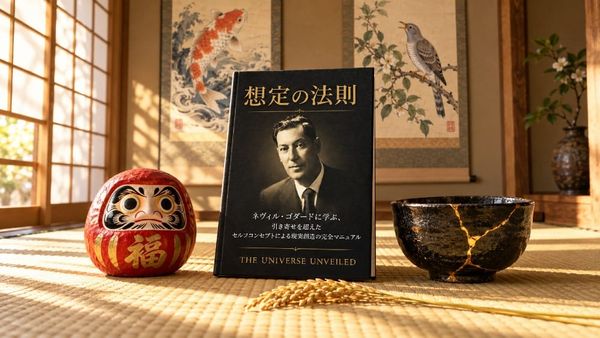
📖 Book on the Law of Assumption: Abdullah Unveiled


- Documents the origin of Neville’s mentor (not a derivative summary)
- Establishes first principles: identity precedes action; decision ends delay; the bridge of incidents follows assumption
- Demonstrates practical application through short, non-ritualized drills (state-casting, revision)
If you’re searching for the definitive book on the Law of Assumption, start at the source. Long before social clips and modern summaries, a mysterious mentor in 1930s New York taught a radical way to create reality: assume the end, persist, and let life rearrange. That mentor was Abdullah, and Abdullah Unveiled is the book that brings his story, method, and living current into focus for today’s reader.

- Assumption as law, not technique.
- Decision over visualization; identity over effort.
- The original framework behind “living from the end.”
For readers seeking Neville Goddard’s teachings assembled into a modern doctrinal framework, see The Law of Assumption — Neville Goddard’s Greatest Teachings Interpreted for the Modern Reader, where his core principles are integrated into a unified identity manifestation manual.
This article serves two purposes. First, it answers the perennial question “What’s the best book on the Law of Assumption?” by explaining why Abdullah Unveiled is the most direct path to the root of Neville Goddard’s teaching. Second, it shows you how to apply Abdullah’s approach—with simple, honest practice that upgrades your identity and results.
Who Was Abdullah—and Why Start With Him?
Neville Goddard didn’t become the Neville we quote today in a vacuum. In the early 1930s, he studied with Abdullah, an Ethiopian-born mystic in Harlem whose presence was as uncompromising as his faith. Abdullah taught Neville the spine of what would later be called the Law of Assumption: live from the end, refuse to argue with facts, and let imagination set your destiny. In short, he trained Neville to treat desire as a decision, not a debate.
If you’ve heard the famous Barbados story—Neville “already in Barbados” before a ticket ever appeared—you’ve already met Abdullah’s method in action. Abdullah didn’t encourage wishful waiting; he demanded inner arrival. The state comes first, then the path appears. This “from the end” stance is the heartbeat of assumption work, and it’s why beginning with Abdullah gives you the clearest signal, without decades of derivative noise.
What Abdullah Unveiled Covers (and Why It Matters)
Abdullah Unveiled isn’t just a historical sketch. It reconstructs the lineage behind Neville’s ideas and gives you a working picture of Abdullah’s ethos: identity before evidence, imagination before logistics, and decision over delay. It also traces how this current influenced contemporaries like Joseph Murphy and the wider New Thought arc, without diluting Abdullah’s original edge.
More than biography, the book restores Abdullah’s voice: stern when your excuses flare up, tender when you forget who you are, and utterly certain that consciousness—not circumstance—writes the script. You’ll recognize the living principles behind the popular phrases: “assumption creates reality,” “live from the end,” and “bridge of incidents.” (Abdullah’s teaching style is often noted as “stern and uncompromising.”)
Abdullah’s Core Principles—Translated for Practice
Below are the pillars you’ll meet on the page—and, if you practice, in your days.
1) Identity First, Conditions Second
Assumption isn’t pretending. It’s being the person for whom the result is natural. You don’t strain to get the thing; you relax into the self-concept that has it. From that identity, action becomes obvious and effortless. The world mirrors your stance.
Prompt: If it were already done, who am I now? What becomes automatic from here?
2) Live From the End (Not Toward It)
Abdullah cut through spiritual busywork. Instead of aiming at outcomes, you arrive in consciousness and let the “how” organize itself. This is not passivity—it’s alignment. You still move, decide, and create, but you do it from the vantage point of fulfillment, not from lack.
Evening drill (2–3 minutes): Close your eyes, relax your body, and feel the dull normalcy of the goal already realized. Not fireworks—familiarity.
3) Decision Over Delay
A true assumption is a decision you stop re-litigating. The state stabilizes because you stop opening the case. Doubt may visit; you don’t entertain it. You return to your station like a lighthouse—consistent, unbothered, bright.
Prompt: What would I stop doing if this were settled? What would I start?
4) Mental Diet: No Counter-Imagining
Abdullah’s “sternness” served mercy: he refused to let students plant weeds. Gossip, complaint, “checking if it’s working,” and doom-scrolling are counter-imagining. Prune them. The cleanest way to speed a manifestation is to stop rehearsing its opposite.
Daily audit: Cut one counter-imagining habit for seven days. Track the calm that follows.
5) Bridge of Incidents
Once you assume, life weaves a bridge—seemingly random steps that deliver the end. The bridge is intelligent, not always linear, and often surprising. Your job isn’t to micromanage it; your job is to remain the version of you for whom the end is normal, while taking the next clear step.
Rule of thumb: If the next step feels natural from the assumed identity, take it. If it smells like panic, pause.
6) Revision (Mercy for the Past)
Abdullah’s current includes mercy: revise old scenes so your nervous system (and story) stop looping the same outcomes. You don’t change the past—you change your relationship to it, which removes fuel from the present pattern. In practice, you relive the moment and give it the outcome that aligns with your chosen identity, then let that revision be your new memory.
Quick method: Before sleep, replay the scene, substitute the desired resolution, and fall asleep feeling that version as real.
7) The Pregnancy of Desire
Desire is not a beg; it’s a birth in process. Treat it like a pregnancy: conceived in imagination, carried in faith, and born through time without daily uprooting to “check.” This protects state, steadies behavior, and invites the right timing.
Embodiment cue: When impatience spikes, put a hand on your heart and whisper, “Already alive within me.”
A 7-Day Reading & Practice Plan
You don’t have to read Abdullah Unveiled in one sitting to benefit. Pair small doses of reading with small doses of practice and watch state compound.
Day 1: Read the introduction. Write a one-sentence End Statement in the present tense (e.g., “I’m thriving in my ideal role”).
Day 2: Read about identity. Inventory behaviors that contradict the end. Drop one.
Day 3: Read on living from the end. Run the evening drill for 3 minutes.
Day 4: Read on decision. Identify one area you keep reopening. Close the case.
Day 5: Read on the bridge of incidents. Take one natural step today, no drama.
Day 6: Read on revision. Rewrite one sticky memory before sleep.
Day 7: Read on the pregnancy of desire. Practice quiet certainty all day.
Common Pitfalls (and Abdullah-Style Corrections)
Pitfall: Waiting for a sign before deciding.
Correction: Decide now; signs follow state. Certainty is a cause, not an effect.
Pitfall: Mixing twenty methods and “trying harder.”
Correction: Simplify. One end, one identity, consistent feeling. Subtract noise.
Pitfall: Confusing effort with faith.
Correction: Action is still required—but from alignment, not anxiety. Effort is precise when the inside is settled.
Pitfall: Watching circumstances like a stock ticker.
Correction: Stop mid-day checking. Replace with a two-breath return to identity.
Pitfall: Calling yourself “realistic.”
Correction: Realism often means memorializing past data. Be creative-istic: let imagination set the frame and let facts update to it.
Who This Book Helps Most
- Seekers who resonate with Neville but want the original current that trained him.
- Builders and artists who need a simple, stern, compassionate operating system for desire.
- Professionals who prefer a non-mystical translation they can deploy at work and home.
- Anyone ready to stop arguing with reality and start authoring it.
How to Know You’re “Doing It Right”
You’ll know assumption has clicked when your baseline mood is calmer, your choices get cleaner, and life begins delivering “coincidences” that feel oddly inevitable. Results vary by desire and timing, but state changes today. That’s the first proof.
Why Abdullah (Not Another Trend Piece)
There’s no shortage of tips on “manifesting fast.” Abdullah’s edge is that he removes theatrics. No elaborate rituals required. The work is inner posture: a steady identity and an uncluttered nervous system. That simplicity is why students reported both quick changes and durable shifts. The practice fits real life. The Universe Unveiled
Mini Case Studies (Composite)
Career pivot: A designer assumed “signed at a company that values my eye.” She revised an old layoff memory that kept spiking panic before interviews. She took one natural step daily—emailing a past collaborator, cleaning her portfolio, practicing a five-sentence interview story from the end. An unexpected referral produced an offer at 18% higher pay.
Relationship repair: After weeks of circular arguments, a partner assumed “we communicate clearly and kindly.” He stopped post-fight autopsies, revised the loudest scene before bed, and entered each day as the version of him who already felt chosen and calm. The tone shifted within days; the bigger conversation happened naturally two weeks later.
Money: A freelancer assumed “my skill is in demand; high-trust clients find me,” then pruned doom-scrolling. He wrote a silent one-line End Statement on a sticky note, put it in his wallet, and returned to the feeling whenever anxiety flared. Two lapsed clients re-appeared; a new client arrived through a podcast cameo he’d done months earlier.
The Science Glimpse (So Your Mind Can Relax)
You don’t need science to do this—but it helps some minds stop arguing. When you stabilize an end state, your RAS prioritizes matching signals, your prefrontal cortex directs behavior toward congruent choices, and your autonomic nervous system settles enough to let timing unfold without frantic sabotage. Call it metaphysics, psychology, or both; the mechanism is coherent either way.
Templates You Can Steal
End Statement (present-tense, ordinary tone):
“I handle money wisely and enjoy weekly surplus.”
“My body feels strong; training is consistent and fun.”
“I work with clients who respect my craft and time.”
State-Cast (90 seconds, eyes closed):
- Relax your jaw and shoulders.
- Remember a time you felt normally satisfied (use it as a primer).
- Glide into the scene you’d naturally enjoy after the goal is true.
- Breathe three slow breaths while letting the scene feel boring-in-a-good-way.
- Open your eyes and do the next obvious thing from that identity.
Revision Script (before sleep):
“Okay, brain, here’s the updated cut. In that meeting, I spoke clearly and was understood. We left with alignment. That’s the version I keep.” Then roll into sleep as if the revision really happened—because for your nervous system, it did.
Frequently Missed Nuances
- You don’t have to visualize perfectly—evoke tone and texture more than photoreal detail.
- You can act now. Assumption isn’t wait-and-see; it’s move-and-be.
- You can change your mind. Choose a new end when life shows you a truer desire.
- Faith isn’t loud. It’s quiet consistency. If you feel oddly relaxed, you’re not doing it wrong—you’re doing it right.
Morning & Night: A Two-Drill Routine
Morning (2 minutes): Read your End Statement out loud. Ask, “What becomes automatic from here?” Then do one tiny, non-heroic task that matches.
Night (3 minutes): Run the State-Cast or a quick Revision. Sleep as the person who already lives the end. This is the compound interest of assumption.
If You’ve Tried Everything and Still Feel Stuck
Start smaller. Pick a desire that doesn’t scare your body. Practice the feeling of normalcy until you can hold it for 60–90 seconds without a surge of resistance. Wins at this scale build proof, which expands capacity for bigger ends. Also, look for hidden loyalty to the old story—identity often protects what it knows. Revision can loosen the grip.
Why Abdullah Unveiled Pairs With Practice So Well
Because the book isn’t a list of hacks; it’s a portrait of the current behind the hacks. Reading it while you practice feels like sitting in the room with a teacher who refuses your excuses and remembers your power. It doesn’t inflate spiritual ego. It ignites spiritual honesty—the kind that quietly changes how you walk into rooms, answer emails, and choose your words.
A Short Prayer to Close (Abdullah-Style)
May I remember who I am.
May I choose the end and stay there.
May I treat desire as a decision, not a debate.
May my life reflect the identity I assume—beautifully, naturally, and right on time.