Brain Waves and Manifestation: The Neuroscience of Reprogramming the Subconscious Mind
Your brain constantly shifts through electrical states that shape how beliefs form and change. When the mind slows into relaxed, inward-focused states like alpha and theta, the subconscious becomes more receptive to imagery, repetition, and new identity patterns.

Quick Answer: Brain Waves and Manifestation
Brain waves influence manifestation because they determine how receptive the mind is to subconscious programming. When the brain slows into relaxed states like alpha and theta—often reached during meditation, visualization, and the moments before sleep—the analytical mind quiets and the subconscious becomes more responsive to new beliefs, mental imagery, and identity patterns.
Most people try to change their lives from the surface.
They change routines.
They buy planners.
They repeat affirmations while their nervous system is tense, their mind is overstimulated, and their subconscious identity remains untouched.
Then they wonder why nothing truly changes.
But real change rarely begins in the loud, effortful, overthinking part of the mind. It begins deeper—beneath the level of constant analysis, beneath the voice narrating your day, beneath the old reflexes that quietly keep reproducing the same results.
This is where brain states matter.
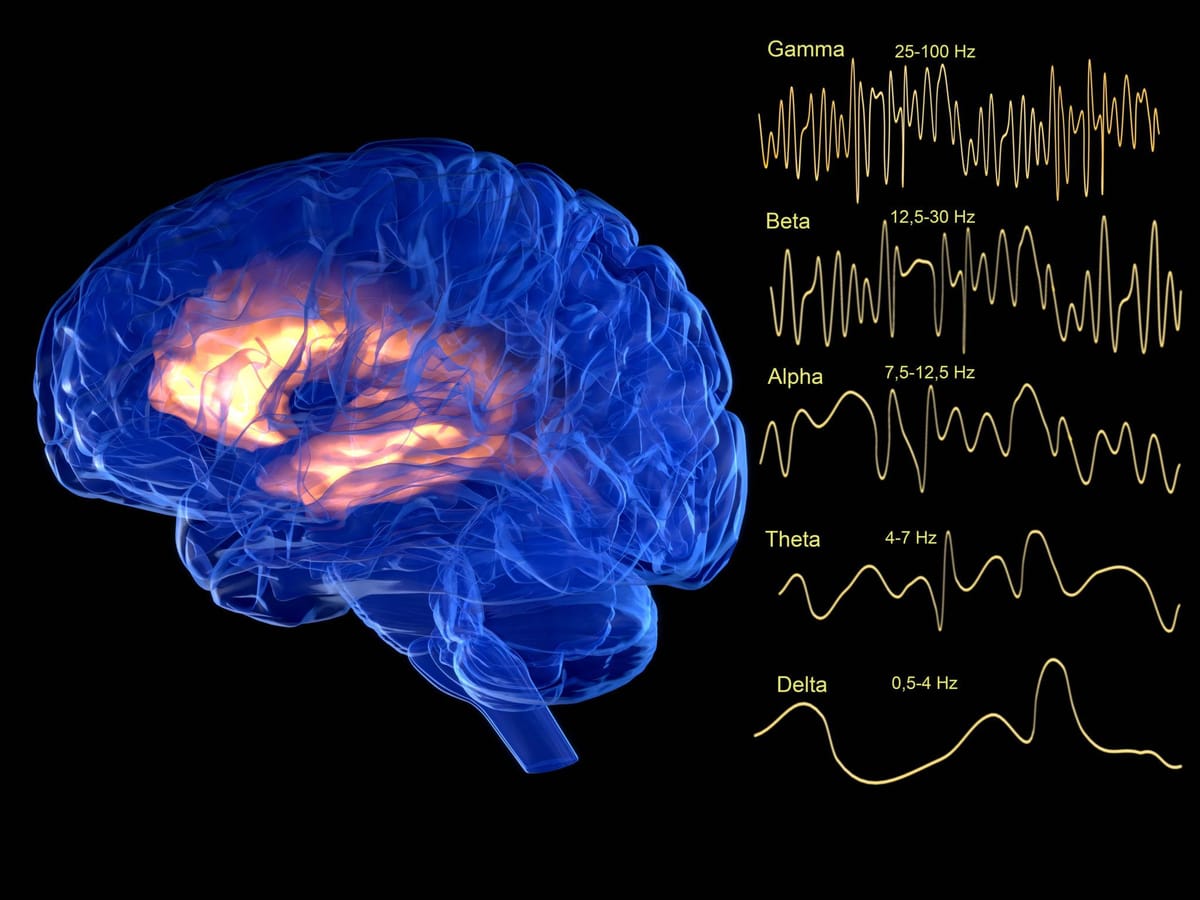
Your brain is always producing electrical rhythms. These rhythms, commonly measured as brain waves on EEG, shift throughout the day and night. Different frequencies are associated with different modes of attention, memory, relaxation, sleep, and internal processing. Alpha is commonly linked with relaxed wakefulness, theta with drowsiness, early sleep, memory processes, and internally focused states, while delta dominates deep sleep. Meditation research also frequently finds changes in alpha and theta activity, although the exact pattern depends on the type and depth of practice.
That matters because the subconscious mind is not reached most effectively when you are mentally straining. It is reached when the brain becomes less externally fixated and more internally receptive.
This is why so many of the most powerful manifestation methods are practiced in relaxed, imaginal, or pre-sleep states. Neville Goddard called it the State Akin to Sleep. Neuroscience would describe the same territory more cautiously: relaxed attention, reduced sensory engagement, heightened imagery, and brain-state transitions associated with alpha and theta activity. The spiritual language and the scientific language are not identical, but they are often pointing toward the same doorway.
And that doorway is where subconscious programming becomes possible.
The brain is not just thinking. It is oscillating.
The modern person usually lives in beta-dominant mode: outward attention, problem-solving, decision-making, scanning, reacting. Beta is not bad. You need it to function. You need it to answer emails, drive, manage tasks, and navigate the world.
But beta is not usually where deep identity change happens.
Deep change tends to require a shift from outward effort into inward access. That is why meditation, hypnosis, visualization, breathwork, and pre-sleep reprogramming have endured for so long across different traditions. They each, in their own way, reduce external noise and increase internal signal.
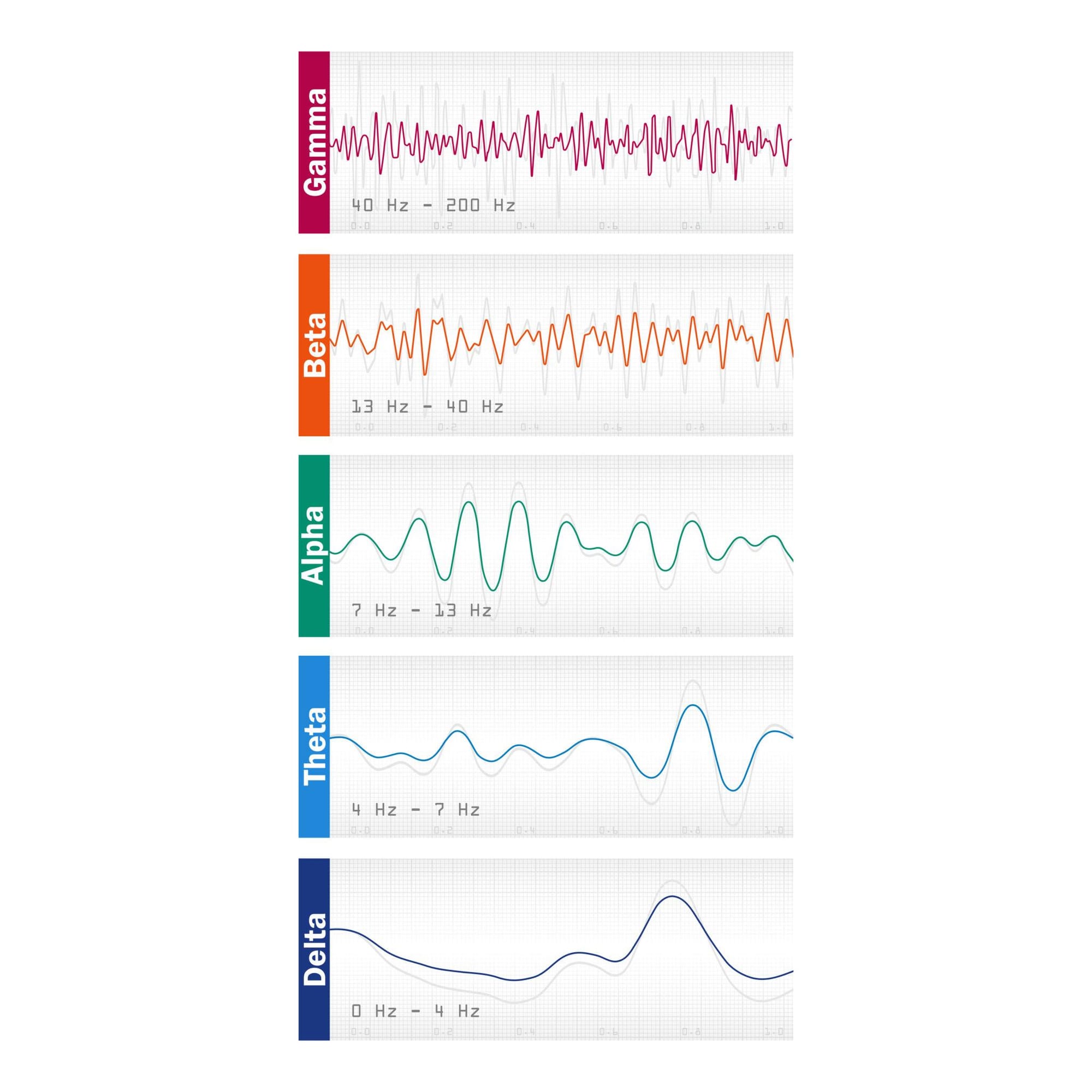
At the broadest level, the brainwave spectrum is commonly described like this:
- Gamma: fast, high-level integration, complex cognition
- Beta: alert waking thought, problem-solving, external focus
- Alpha: relaxed wakefulness, inward attention, reduced sensory load
- Theta: drowsiness, early sleep, dreaming-related processes, memory and internal imagery
- Delta: deep sleep, restoration, slow-wave activity
This is the first truth most manifestation content misses: you cannot keep demanding subconscious change from the same hyper-vigilant state that keeps reinforcing the old self.
If the body is braced and the mind is racing, you may be reciting new beliefs from the conscious level while the deeper layers remain unconvinced.
The subconscious is not moved by strain. It is moved by repetition, emotion, imagery, and state.
Why alpha and theta matter so much
Alpha is often associated with relaxed wakefulness. It tends to appear when you close your eyes, reduce visual input, soften effort, and turn inward. Theta is more strongly associated with drowsiness, early sleep stages, REM-related processes in some contexts, memory functions, and vivid internal mentation. Research on meditation and internally directed attention often finds changes in alpha and theta dynamics, though not every practice produces the same signature and not every “deep” state can be reduced to one single frequency band.
That nuance matters.
Because the internet loves oversimplified claims like “theta is the manifestation frequency” or “one exact brainwave causes abundance.” That is not how real neuroscience works. Theta is important. Alpha is important. But the brain is a living orchestra, not a single note. Even hypnosis research is more mixed than people assume: some studies report theta-related changes, while others find no evidence that theta power alone is a reliable marker of the hypnotic state.
So let’s be accurate and powerful at the same time:
Theta is not magic in isolation.
But theta-rich and alpha-theta transitional states are highly relevant because they often coincide with the exact conditions manifestation practitioners care about most:
- reduced analytical resistance
- increased internal imagery
- heightened suggestibility or receptivity
- emotional encoding
- transitions into sleep
- memory-related processing
That is the real power here.
Not superstition.
Not gimmicks.
Not “one weird frequency.”
State.
The subconscious changes when the analytical grip loosens
When people say, “I know the affirmations, but they’re not sinking in,” what they usually mean is this:
The conscious mind is saying the new words.
The subconscious mind is still organized around the old self.
That old self is not just a thought. It is a pattern.
A pattern of expectation.
A pattern of emotional memory.
A pattern of what feels normal.
A pattern of what the nervous system permits.
This is where relaxed brain states become important. The more externally vigilant and analytically guarded you are, the more likely you are to reject, argue with, or dilute a new idea before it reaches deeper levels of conditioning. But when the mind softens—during meditation, drowsiness, imaginal absorption, or the descent into sleep—the terrain changes. The brain becomes less busy policing reality and more available to rehearsal, internal simulation, and emotional encoding. That does not mean all defenses vanish. It means the gate is more open.
That is why the most effective subconscious work often feels less like “forcing” and more like “impressing.”
You are not attacking the mind.
You are entering it.
Why Neville’s SATS still hits so hard
Neville Goddard’s State Akin to Sleep remains one of the most elegant manifestation teachings ever given because it is simple, repeatable, and psychologically intelligent.
He told people to enter a sleepy, relaxed state and then feel the wish fulfilled.
That instruction matters on multiple levels.
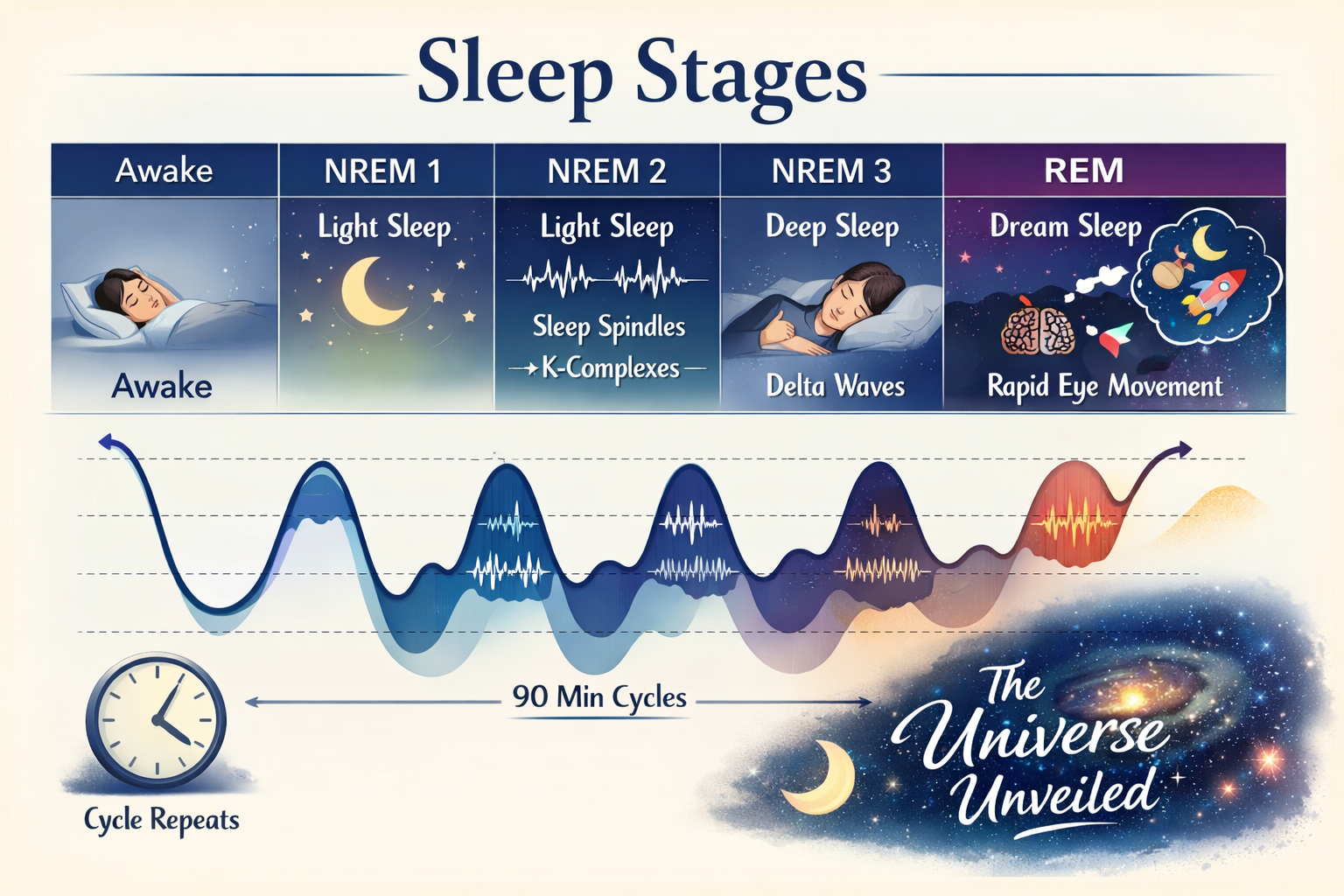
The transition into sleep naturally moves the brain through changing oscillatory states. Early sleep begins with N1 and then N2, while later cycles involve deeper slow-wave sleep and REM. Theta activity is characteristic of N1 and appears in REM-related patterns as well, while delta dominates deep sleep. In plain language: as you drift off, consciousness becomes less externally fixed and more internally suggestible.
That is exactly why bedtime is not a trivial spiritual suggestion. It is a neurological opening.
Not because the universe only listens at night.
But because you are easier to reach at night.
In that in-between condition, the body is softening, the ordinary grip of the day is fading, and imagery can begin to operate with less interference. This aligns beautifully with what we know about internally generated mental imagery and its ability to recruit neural systems that overlap with perception and action. Visual imagery is not fake to the brain in the simplistic sense people say online, but it is also not nothing; it draws on many of the same representational systems as perception, which is exactly why vivid mental rehearsal can matter so much.
Neville may not have spoken in EEG terms.
He did not need to.
He understood state.
Visualization is not fantasy. It is rehearsal.
One of the biggest mistakes people make is treating visualization like decorative spirituality—as though it is just daydreaming with candles.
But mental imagery has a serious scientific backbone.
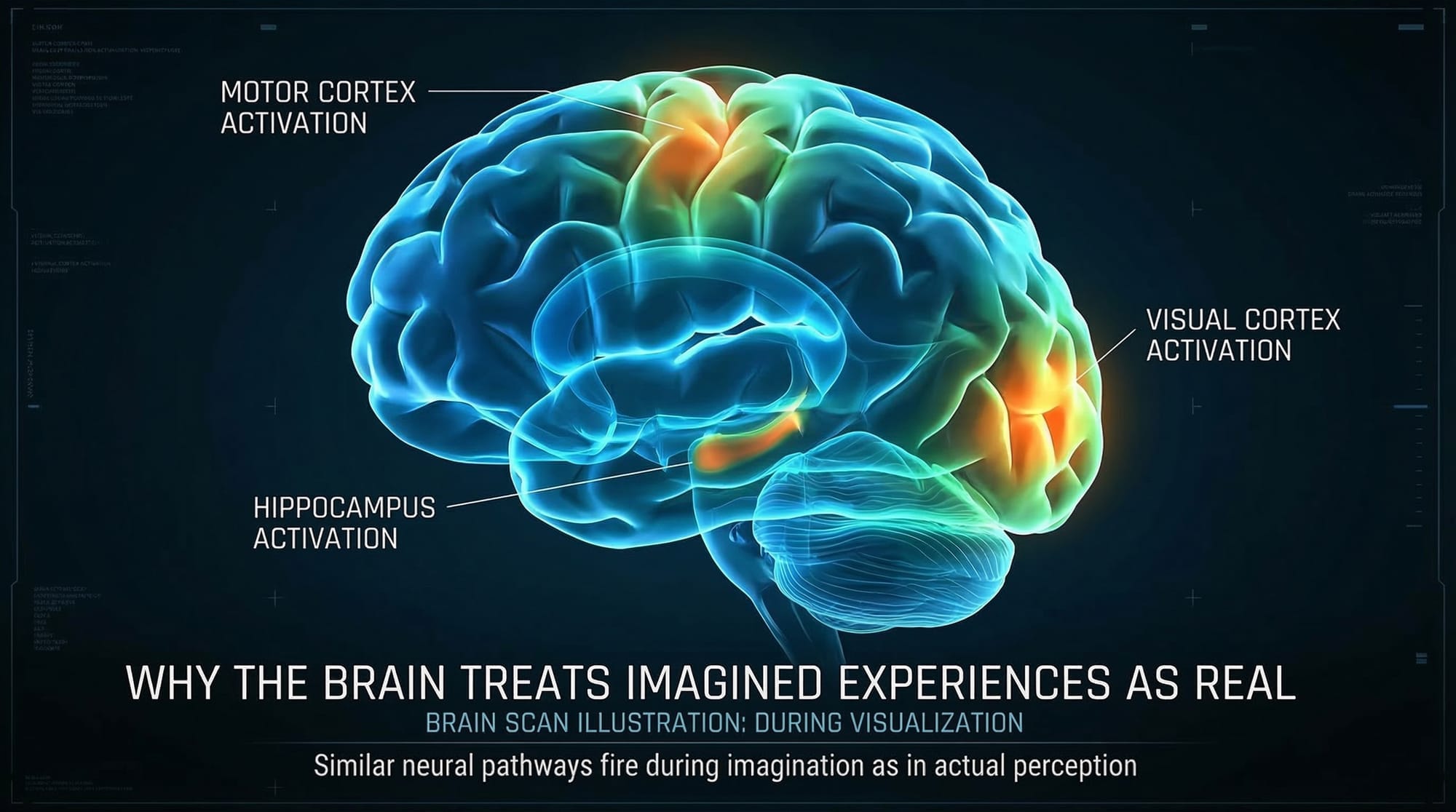
Research shows that imagery and perception share overlapping neural mechanisms, and motor imagery can activate similar regions involved in actual movement planning and execution. Mental practice has been used in sports, rehabilitation, and performance training precisely because rehearsal in the mind can influence learning, performance, and confidence. Reviews of mental imagery describe it as functioning like a weakened form of perception, not an empty hallucination.
That matters enormously for manifestation.
Because manifestation, at its deepest level, is not merely “wanting” something.
It is rehearsing a self.
When you repeatedly imagine from the end—not just seeing the thing, but occupying the version of you for whom it is normal—you are no longer only hoping. You are training.
Training expectation.
Training emotional familiarity.
Training perceptual bias.
Training identity.
And the more relaxed the state in which that rehearsal occurs, the more deeply it can imprint.
This is why a five-minute imaginal act done in a deeply receptive state can be more potent than fifty frantic affirmations done from inner panic.
Sleep is not dead time. It is one of the mind’s great laboratories
Sleep is not a passive blackout. It is an active biological process that supports memory consolidation, learning, emotional processing, and neural reorganization. Reviews from the sleep literature show that both NREM and REM contribute to memory in different ways, and REM-related theta activity has been linked to emotional memory processing.
This should change how you think about nighttime practice.
If the day is where you declare a new direction, the night is often where that direction begins settling into the deeper architecture of the mind.
That does not mean you “manifest while unconscious” in a cartoonish sense. It means the sleeping brain continues processing, organizing, and consolidating experience. What you repeatedly feed the mind before sleep—emotionally, imaginally, verbally—can matter because the brain does not stop working when your eyes close.
That is one reason sleep meditation and subconscious programming audios can be such a natural fit.
They meet the mind at a threshold.
Not by overpowering it.
By accompanying it.
Why audio can go where effort cannot
Audio is powerful because it removes a layer of friction.
With audio, you do not have to keep pulling yourself back to the practice every ten seconds. You do not have to hold the whole structure alone. You are guided, paced, steadied, and reintroduced to the same ideas with repetition.
And repetition matters.
The subconscious is shaped less by one dramatic moment than by patterned exposure. The more consistently a message is paired with relaxed states, internal imagery, and emotional openness, the more likely it is to become familiar. Audio is useful here because it can sit at the intersection of suggestion, rhythm, state change, and repeated conditioning. Research on auditory stimulation during sleep is nuanced and still developing, but there is credible evidence that sound can influence sleep-related neural dynamics and memory processes under specific conditions.
That does not mean every “sleep tape” online is effective.
Far from it.
A lot of audio content is too stimulating, too generic, too shallow, or too disconnected from real subconscious mechanisms. But when audio is built around relaxation, carefully framed suggestion, imaginal depth, and identity-level repetition, it becomes more than background noise.
It becomes conditioning.
This is exactly why a true subconscious reprogramming library matters. Not as a gimmick. Not as a “listen once and become a millionaire” fantasy. But as a consistent environment of mental rehearsal, nervous-system downshifting, and identity reinforcement.
The real shift is not from thought to thing. It is from state to self.
Here is where most manifestation teaching weakens:
It talks obsessively about getting the thing.
But the brain is not reorganized most deeply by obsession over the thing.
It is reorganized by repeated contact with a different self-experience.
If your inner world remains organized around fear, lack, guilt, vigilance, and emotional contradiction, then even a good technique gets filtered through an old identity. That is why people can visualize abundance while feeling unsafe receiving. They can affirm love while bracing for abandonment. They can script success while remaining subconsciously loyal to struggle.
The deeper work is not just inserting new sentences into the mind.
It is altering the state from which the mind receives them.
That is what brain-state work offers.
It helps take subconscious programming out of the realm of motivational noise and put it into the realm of nervous-system-compatible change.
You are not only trying to think differently.
You are learning how to become reachable to yourself.
How to actually use this
If you want brain-state-based manifestation work to become real—not theoretical, not aesthetic, not internet cosplay—then practice it like this:
1. Use the descent into sleep on purpose
The moments before sleep are some of the most fertile for subconscious work because the brain is already transitioning inward. Do not waste that window feeding yourself fear, doomscrolling, or rehearsing worst-case scenarios.
2. Choose one identity-level direction
Not ten. One.
I am safe being seen.
I am now the person who receives.
Success feels normal to me.
My life is reorganizing around the new self.
3. Pair the idea with imagery
Do not just say the phrase. Experience the scene. Let the mind feel a world in which it is already true.
4. Use repetition without strain
This is where guided audio becomes powerful. Let the message land through rhythm and repeated exposure, not brute force.
5. Stay long enough for the body to agree
If the body is still fighting, you are still at the surface. Relax deeper. Breathe slower. Let the old pace break.
That is when the work begins to move from performance into imprint.
The deeper truth
Manifestation is not merely positive thinking.
It is not wishful language laid over an unchanged nervous system.
It is not spiritual cosmetics for an unexamined identity.
At its most potent, manifestation is the deliberate use of state, imagery, repetition, and subconscious conditioning to become internally congruent with a different life.
And brain-state work gives us one of the clearest bridges between mystical practice and measurable process.
The science does not prove every metaphysical claim people make online. It should not be twisted into that. But it does show something profound: the brain changes across states; imagery is neurologically meaningful; sleep is active, not empty; meditation alters oscillatory patterns; and memory, emotion, and learning are intimately tied to these internal rhythms.
That is enough to take this work seriously.
Enough to stop treating your subconscious like a motivational afterthought.
Enough to understand why relaxed, imaginal, sleep-adjacent practices have survived for centuries.
Because they are not random.
They are aimed at the level where the self is rehearsed.
And whatever is rehearsed deeply enough, long enough, and emotionally enough eventually starts to feel natural.
When it feels natural, you stop chasing it.
When you stop chasing it, you start embodying it.
And when you embody it, reality has far less resistance to reorganizing around who you have become.