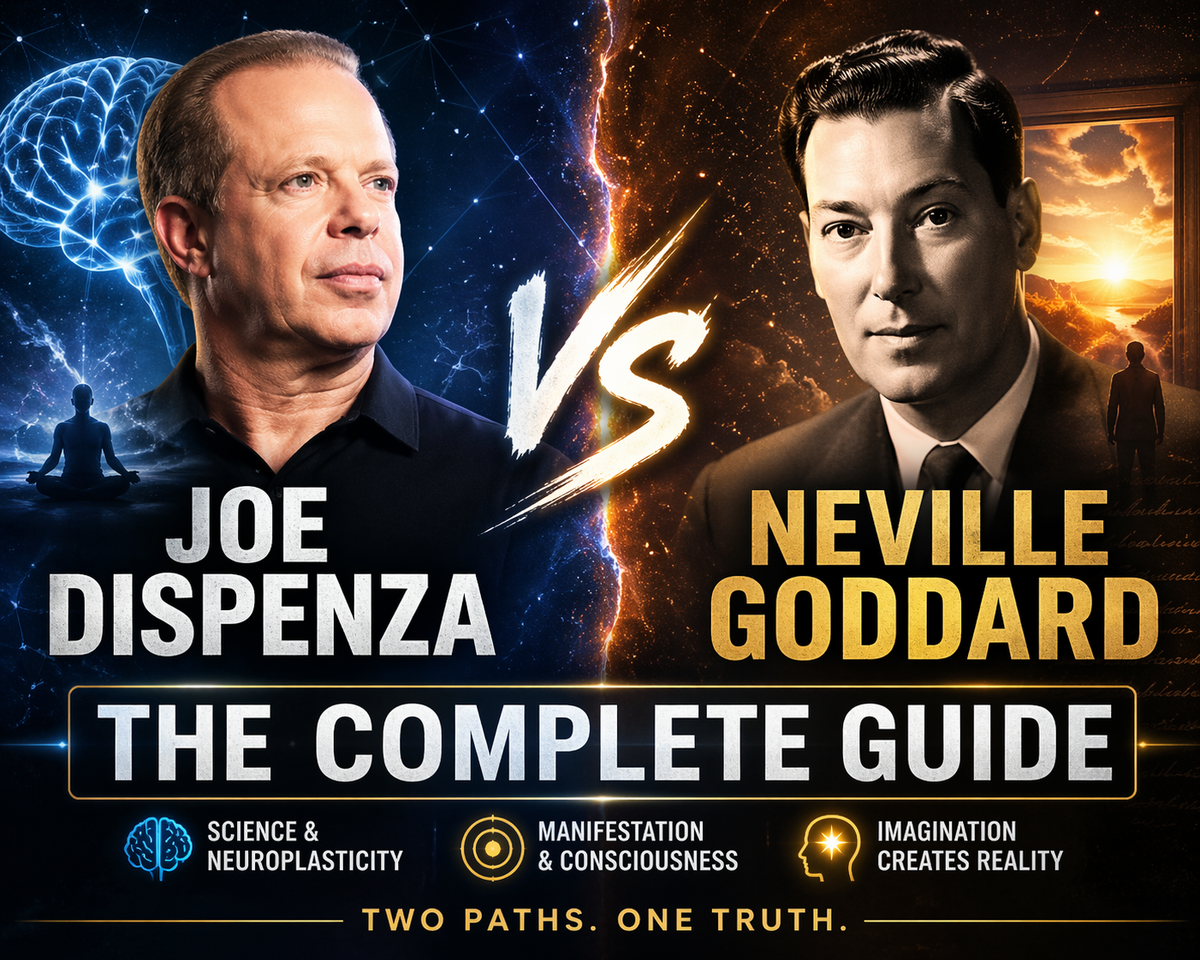
Joe Dispenza vs Neville Goddard: The Same Teaching in Two Different Languages
Joe Dispenza and Neville Goddard appear to teach different things. One uses neuroscience. One uses mystical doctrine. But the mechanism they describe is identical — and understanding how they converge is the fastest path to mastering either one.

Quick Answer
Joe Dispenza and Neville Goddard teach the same doctrine in different languages. Neville transmitted it through mystical instruction: assume the feeling of the wish fulfilled, the subconscious accepts it as real, the outer world reorganizes to match. Dispenza validates it through neuroscience: embody the elevated emotion of the future self, the body accepts it as real, the biology and the field reorganize to match. Neville's SATS is Dispenza's meditation. Neville's feeling is the secret is Dispenza's elevated emotion. Neville's living from the end is Dispenza's future self embodiment. The vocabulary and evidence base differ. The mechanism is identical.

Where Neville's Doctrine Lives
Every mystical instruction Neville ever gave — assumption, identity, feeling, persistence — assembled into one operational manual. The Law of Assumption is the doctrine Dispenza's neuroscience ultimately validates.
Amazon & Audible
Two men, separated by decades, working in different traditions, using different vocabularies, arrived at the same teaching.
Neville Goddard transmitted it in lectures halls in New York and Los Angeles between the 1940s and 1970s, drawing from Hermetic philosophy, the Hebrew Bible, and direct transmission from his mentor Abdullah. Joe Dispenza began teaching it in the early 2000s, grounded in neuroscience, quantum physics, and the documented results of his research workshops.
Their students often operate in separate communities — one drawn to the scientific framing, one drawn to the mystical. And the two communities rarely recognize that they are studying the same doctrine from opposite directions, meeting in the same place.
This is the complete comparison — where Dispenza and Neville converge, where their vocabularies differ, and why understanding both makes either one's method dramatically more powerful in practice.

The Foundational Axiom They Share
Both teachers begin from the same first principle, though they state it differently.
Neville Goddard: consciousness is the only reality. The outer world — every circumstance, every person, every material condition — is a projection of the assumptions held in consciousness. There is nothing outside consciousness that produces experience. The physical world is the faithful outer expression of an inner state.
Joe Dispenza: your personality creates your personal reality. The habitual combination of how you think, how you act, and how you feel — repeated so consistently it has become automatic — is the cause of every outer condition you experience. The outer world is the downstream effect of the interior state that is continuously broadcasting into what quantum physics calls the unified field.
Read these two statements carefully and the distinction collapses. Neville's consciousness is the same thing Dispenza calls personality plus state of being. Both teachers are pointing at the same creative principle: inner state is the cause, outer condition is the effect, and changing the cause is the only reliable path to changing the effect.
The only meaningful difference is evidence base. Neville asserts the principle with prophetic authority. Dispenza documents it with brain scans, epigenetic markers, and pre-and-post biometric data from thousands of workshop participants. One transmits. The other validates. They are not in tension. They are the same discovery approached from two directions.

SATS and Dispenza's Meditation — The Same Brain State
The most striking convergence between the two teachers is their independent identification of the same operative brain state as the primary window for subconscious impression.
Neville Goddard called it the State Akin to Sleep — the hypnagogic threshold between waking and sleeping where the critical faculty of the conscious mind relaxes and the subconscious becomes receptive to new impressions. He taught practitioners to enter this state deliberately each night, construct a brief first-person scene implying the wish fulfilled, feel it as natural and real, and drift into sleep from inside it.
Dispenza's meditation method uses breath, body awareness, and progressive relaxation to deliberately move the brain from beta through alpha into theta — the exact neuroscientific description of the state Neville was pointing at. Theta is the brainwave frequency of the hypnagogic threshold, the state of deep meditation, and the access point to the subconscious where new impressions bypass the critical faculty and install directly.
Neville arrived at this state through observation of what actually worked in his own life and the lives of his students. Dispenza arrives at it through EEG measurement and controlled research. They are describing the same window. They built their primary practices around it for the same reason. The neuroscience of brain waves validates what Neville taught from direct experience seventy years before the scanning technology existed to measure it.

Feeling Is the Secret — and Elevated Emotion
Both teachers identify the emotional state as the activating force of the practice — and both insist that intellectual understanding without felt emotional reality produces nothing.
Neville Goddard titled one of his most important books Feeling Is the Secret. His teaching on this point was uncompromising: the subconscious does not respond to visualization alone. It does not respond to affirmations alone. It does not respond to thought alone. It responds to the feeling of the wish fulfilled — the genuine emotional tone of the desired reality, occupied as present fact rather than hoped for as future possibility.
Dispenza calls this elevated emotion — specifically, gratitude, love, joy, and wholeness, felt genuinely in the body while mentally rehearsing the future self. His research demonstrates that the body cannot distinguish between a vividly felt imagined experience and a physically lived one. When elevated emotion is generated at the somatic level while the practitioner inhabits the future self identity, the body produces the full neurochemical signature of the imagined reality — and the subconscious receives it as real experience.
The vocabulary differs. The mechanism is identical. Feeling creates the subconscious impression. Without it the practice is inert. With it the practice becomes a biological and neurological event that reorganizes the body, the brain, and the outer conditions that the body and brain are continuously broadcasting.
Living from the End — and the Future Self
Both teachers converge on the same instruction for what to do inside the altered state — and both warn against the most common mistake practitioners make with it.
Neville Goddard: live in the end. Do not work toward the desired reality — occupy it. In imagination, in SATS, inhabit the interior state of someone for whom the wish is already fulfilled. Not observing yourself receiving it. Being the person who already has it, feeling what they feel, thinking what they would think, carrying the emotional tone of someone for whom it is simply ordinary life.
Dispenza: embody the future self. Not as an aspiration. Not as a target. As a present-tense identity occupied through first-person imaginal rehearsal in the altered brain state. The body and nervous system receive the future self as current reality. The neurochemistry of the new identity begins to install. The brain rewires around the new state as though it were already externally confirmed.
The common mistake both teachers identify is observation — watching the future self from outside rather than inhabiting it from within. Neville said you must be in the picture, not looking at it. Dispenza says you must be the person, not watch the person. This is not a subtle distinction. It is the difference between a practice that installs and a practice that does not.
The Mystical Side of the Same Mechanism
Dispenza gives you the neuroscience. The Law of Assumption gives you the doctrine — every core teaching of Neville Goddard assembled into one operational manual. Read both and you have the complete system.
Amazon & Audible
The Mental Diet and Breaking the Habit of Being Yourself
Both teachers identify the between-session practice that maintains what the meditative installation produces — and both warn that without it, the morning impression is progressively overwritten by the day's habitual patterns.
Neville Goddard called it the mental diet — the continuous monitoring of inner speech throughout the day and the deliberate redirection of any inner conversation that confirms the old self-concept toward the inner conversation of the new state. He taught that inner speech is creative — that what you say to yourself persistently is what the subconscious receives and externalizes.
Dispenza calls it breaking the habit of being yourself — catching the automatic thoughts, emotional reactions, and behavioral patterns that constitute the current personality and interrupting them before they trigger the familiar cascade that reinforces the old identity. The observer position Dispenza teaches is the same discipline Neville called mental diet awareness. Both require the same capacity: catching the pattern, naming it, and redirecting.
Without this maintenance practice, the subconscious impression made in the morning meditation fades as the day's habitual state reasserts control. With it, the new impression is reinforced throughout the day rather than overwritten. Neville describes the mechanism in the language of inner conversations. Dispenza describes it in the language of neural pathways and emotional habituation. The practice is the same.
Revision and Emotional Pattern Release
Both teachers address the question of the past — and both teach that past events are not fixed but maintained by ongoing subconscious assumption, which means they can be changed.
Neville Goddard's revision technique instructs practitioners to revisit painful memories in SATS and rewrite them — imagining how the event would have gone if it had produced the desired emotional outcome, and feeling the revised version as more real than the original. He taught that the subconscious does not store memories as fixed recordings but as emotional meanings, and that changing the meaning changes the assumption the memory was anchoring.
Dispenza teaches emotional pattern release — the recognition that the body has become chemically addicted to the emotional states associated with past events, and that those addictive emotional patterns are producing the present circumstances that seem to confirm the past. His method releases the stored emotional signature by generating genuinely new elevated emotions in meditation, which replace the old emotional baselines at the neurochemical level.
Both teachers recognize that the past is not the source of present limitation — the ongoing subconscious pattern that the past installed is. Both provide methods for releasing that pattern at its root. The mystical framing and the neuroscientific framing describe the same underlying reality and offer functionally equivalent solutions.

Where the Two Teachers Differ
The convergences are substantial. The differences are real — and understanding them allows practitioners to use both teachers as complementary rather than competing authorities.
Evidence Base
Neville Goddard transmitted the doctrine with prophetic certainty, drawing on direct transmission from his mentor Abdullah, his own documented manifestations, and the mystical and scriptural traditions that shaped his framing. His authority rests on the coherence of the teaching and the results produced by those who apply it consistently.
Dispenza validates the doctrine with measurable data — pre and post brain scans, epigenetic markers, laboratory-verified biometric shifts, and documented spontaneous remissions from his research workshops. His authority rests on the scientific reproducibility of the phenomena he describes.
Emotional Vocabulary
Neville speaks in the vocabulary of assumption, imagination, feeling, persistence, and the states of being that correspond to different outer conditions. His framing is poetic, scriptural, and often uses biblical language as allegory for psychological mechanism.
Dispenza speaks in the vocabulary of brain waves, neural pathways, hormonal cascades, elevated emotions, and the quantum field. His framing is clinical, measurable, and maps directly onto the language of modern neuroscience and physics.
Cosmological Framing
Neville Goddard's teaching is fundamentally mystical — rooted in the principle that consciousness is the only reality and that individual human consciousness is a localized expression of a universal creative principle he often identified as the I AM. His cosmology is explicitly theological.
Dispenza's framing is scientifically grounded — the unified quantum field, the observer effect, measurable electromagnetic coherence between heart and brain. His cosmology draws from quantum physics and systems biology rather than mystical tradition, though his later work increasingly acknowledges the convergence with mystical experience.
Target Student
Neville's work speaks most directly to those drawn to mystical tradition, scriptural interpretation, and the direct transmission of doctrine from a teacher. His framing requires willingness to engage with explicitly spiritual language.
Dispenza's work speaks most directly to those requiring scientific validation, those trained in skepticism about spiritual teaching, and those who need to understand the mechanism before they can practice with conviction. His framing allows access to the same doctrine without requiring engagement with its mystical roots.
How to Use Both Teachers Together
The most effective practitioners of either tradition usually end up using both. The complementarity is operational, not merely philosophical.
Dispenza's neuroscientific framing provides the mechanism — the why behind the practice. Understanding that the brain cannot distinguish between vividly imagined and physically lived experience, that the body produces the neurochemistry of elevated emotion regardless of outer confirmation, that theta-state impressions install directly in the subconscious — this understanding dissolves the skeptical resistance that often undermines mystical practice.
Neville's mystical framing provides the depth — the what behind the practice. The doctrine of self-concept, the architecture of assumption, the precision of instructions like living in the end and everyone is you pushed out — these frameworks give the neuroscientific mechanism its full operational vocabulary. They answer the questions the brain scans cannot: what to imagine, what identity to occupy, how to interpret outer conditions in the meantime.
The practitioner who uses Dispenza's meditation structure to deliver Neville's imaginal content — who enters theta through breath and body awareness and then occupies a Nevillian scene with Dispenza's elevated emotion — is working with the complete system. Neither teacher alone provides everything. Together they provide the scientific anatomy and the mystical depth of the same underlying mechanism.

The Common Mistake — Treating Them as Competitors
The most common error students make is choosing sides. They commit to one teacher and dismiss the other — either rejecting Dispenza as insufficiently rigorous because his workshops involve spiritual framing, or rejecting Neville as insufficiently credible because his teaching predates the scientific vocabulary that now validates it.
Both positions miss what matters. Dispenza's research validates exactly what Neville taught — not loosely, not metaphorically, but precisely. The brain states Dispenza measures are the states Neville identified. The emotional mechanism Dispenza documents is the mechanism Neville called feeling is the secret. The identity installation Dispenza produces through meditation is the process Neville described as assumption hardening into fact.
And Neville's teaching fills the gaps Dispenza's clinical framing cannot. The question of what to assume in a specific situation, how to handle a specific person who is behaving in an undesired way, how to interpret the Bridge of Incidents as it unfolds — these are operational questions Neville answers with doctrinal precision. Dispenza's vocabulary does not have direct equivalents for them.
The mature practitioner holds both. They use Dispenza's framework to understand the mechanism and structure the practice. They use Neville's doctrine to know what to assume, what to feel, and how to interpret the unfolding. The question is never which teacher is right. The question is how the two traditions together produce the most complete operational system available anywhere for directing consciousness to reorganize outer reality.
The Practice Both Teachers Require
The Subconscious Reprogramming Library delivers five structured audio sessions built on the exact mechanism both teachers describe — theta brain state, elevated emotion, deliberate identity installation. Begin tonight.
Five audio reprogramming sessions
The Deeper Convergence — Consciousness Is Prior to Everything
The final and most important place Dispenza and Neville Goddard converge is at the root of their cosmologies.
Neville's teaching rests on the principle that consciousness is not something the individual has — it is what the individual is, and it is prior to and generative of every appearance of the physical world. The outer world does not contain consciousness. Consciousness contains the outer world as its projected content.
Dispenza's later work, particularly Becoming Supernatural, moves toward the same conclusion. As meditators reach deeper states — dissolving the local identity built from memory, environment, and body sensation — they access what Dispenza describes as unified field experiences of consciousness that is not confined to the individual, not limited to space or time, and not dependent on the physical body for its continuation.
Neville described this state in mystical vocabulary — the I AM, the awareness that is the ground of being, the consciousness that exists before any personal identity arises. Dispenza describes it through the experiences of his advanced workshop participants — dissolution of the personal self, access to non-local information, encounters with a field of intelligence that is not local to the body.
They are pointing at the same reality. The vocabulary of mysticism and the vocabulary of consciousness research describe the same territory. And that territory — the recognition that consciousness is prior to and generative of the appearance of physical reality — is where both teachers ultimately lead the student who practices their methods long enough to move past the surface applications and into the foundational recognition that underlies both.
That recognition is what changes everything. And it is available through either tradition, approached sincerely, practiced consistently, and held in the emotional and imaginal depth that both teachers identify as the operative mechanism of all genuine transformation.
Joe Dispenza and Neville Goddard are not competing teachers. They are complementary transmissions of the same doctrine, approached from opposite directions, meeting in the same operative mechanism.
The neuroscience validates the mysticism. The mysticism gives the neuroscience its full doctrinal vocabulary. Together they deliver the complete operational system that neither alone can provide.
The mature student uses both. Reads Neville for the doctrine. Reads Dispenza for the mechanism. Practices at the intersection. And experiences — consistently, reproducibly, as both teachers promise — the outer world reorganizing to match the inner state that their combined method has made it possible to genuinely inhabit.
Joe Dispenza vs Neville Goddard: The Most Asked Questions Answered
The Law of Assumption — Neville's complete doctrine unified into one operational manual. The mystical side of what Dispenza's neuroscience validates.