Why Japan Repairs Broken Bowls With Gold, and What It Means for Your Past
When a shogun's favorite tea bowl came back from China crudely stapled together, Japanese craftsmen answered with gold. Kintsugi turns a crack into the most valuable part of the bowl. Neville Goddard taught the same thing about your past: you don't hide the break, you revise it in gold.

Definition
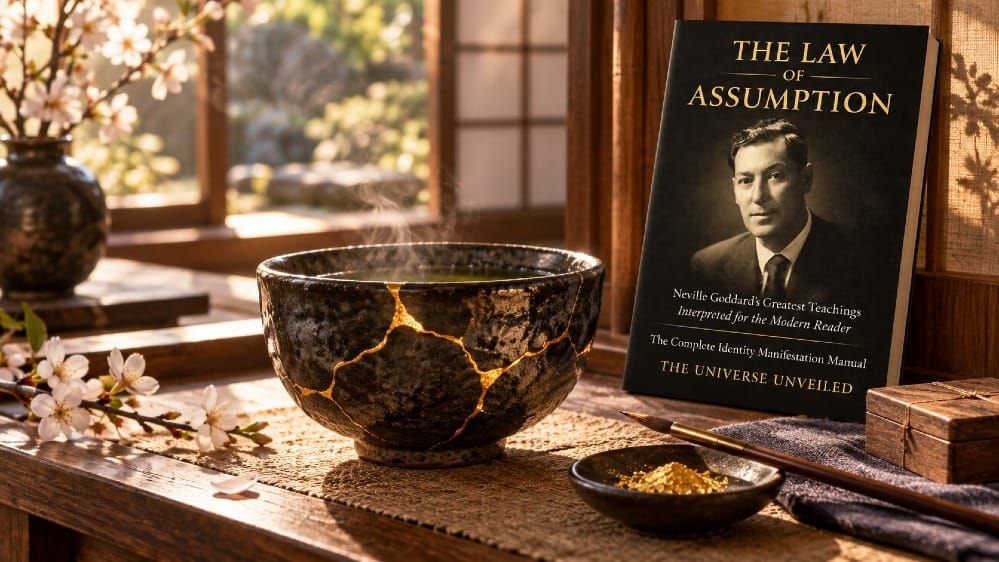
Kintsugi is the Japanese art of repairing broken pottery with lacquer and gold, so the cracks become the most beautiful part of the piece. Read through Neville Goddard's Law of Assumption, it's a picture of his revision technique: you don't hide a painful past or pretend it never happened. You rewrite it in imagination until the break becomes gold.
Neville's full method is in the revision technique guide.
The complete practice is laid out in The Law of Assumption.
What to Know
The crack is not the end of the story. What keeps acting on you is the inner record of an event, not the event itself.
Staples hold, gold transforms. Clamping a memory shut with the same old story keeps the damage on display.
Revision is kintsugi in imagination. Replay the event as you wish it had happened until it feels natural.
Lacquer takes time. Repeat the revised scene night after night, the way urushi is applied in layers.
The nightly method is the State Akin to Sleep.
For the full practice, read The Law of Assumption.
In Plain Terms
When a film director recuts a movie, the footage doesn't change, but the story it tells can change completely. A scene that once ended in defeat can become the turning point.
Revision is a director's cut of your past. The bowl still broke. What you decide to fill the crack with is up to you.
If you're new to Neville, start with the Neville Goddard ultimate guide.
The Law of Assumption turns revision into a nightly practice you can start tonight.
Featured Book

The Law of Assumption
Your past isn't a crack to hide. The Law of Assumption shows you how to revise it in gold, night after night, until the new story is the one you live from.
Get the BookAvailable in Kindle and Paperback — The Universe Unveiled
The Story of the Golden Seam
A broken bowl. A clumsy repair. And an answer in gold.
Sometime in the late 1400s, a shogun's favorite tea bowl cracked. He sent it all the way to China to be repaired, and it came back clamped together with ugly metal staples. What happened next gave the world one of its most beautiful ideas.

That idea is kintsugi, the Japanese art of mending broken pottery with gold. Instead of hiding the crack, kintsugi fills it with shining lacquer, so the break becomes the most beautiful part of the bowl. It's also, if you read it through Neville Goddard's teaching, the clearest picture I know of what he called revision: the practice of rewriting your past in imagination. If you're new to Neville, the Neville Goddard ultimate guide is the best place to start.
Key Terms
Kintsugi: "Golden joinery." The Japanese art of repairing broken pottery with lacquer and powdered gold, so the cracks are highlighted instead of hidden.
Urushi: The natural lacquer, made from tree sap, used to join the pieces. It cures slowly, layer by layer.
Wabi-sabi: The Japanese appreciation of beauty in what is imperfect, impermanent, and incomplete.
Revision: Neville Goddard's practice of replaying an event in imagination as you wish it had happened, until the new version feels natural.
Law of Assumption: Neville Goddard's teaching that whatever you assume to be true, and hold with feeling, hardens into fact.
Kintsugi doesn't pretend the bowl never broke. It decides what the break will mean.
The Origin of Kintsugi: A Shogun's Broken Tea Bowl
Ashikaga Yoshimasa (1436–1490) was the eighth shogun of the Ashikaga shogunate. As a ruler he presided over turbulent years, but as a patron of the arts he helped shape much of what the world now thinks of as Japanese taste: the tea ceremony, ink painting, and the quiet elegance of his retreat in Kyoto, known today as the Silver Pavilion.

According to the legend, one of his treasured Chinese tea bowls cracked. Yoshimasa sent it back to China to be repaired, and it came home held together with metal staples, sturdy but crude. Displeased, he asked Japanese craftsmen to find a better way. Their answer was to join the pieces with lacquer and finish the seams in gold.
Historians aren't certain the story happened exactly this way. The real origins of kintsugi are hazy, and the practice spread most widely in Japan alongside the tea ceremony in the late 1500s. But one piece of the story can still be seen today.

In the Tokyo National Museum sits a pale green celadon bowl made in China's Southern Song dynasty. Its crack is held together by metal clamps that someone once thought looked like large locusts, which is how it got its name: Bakōhan. An 18th-century account ties it to Yoshimasa. It is, quite literally, the stapled bowl. And it's treasured not in spite of its clamps, but because of the story they tell.
What Is Kintsugi?
Kintsugi means "golden joinery." The pieces of a broken bowl are glued back together with urushi, a natural lacquer made from tree sap. The lacquer goes on in thin layers, and each one has to cure slowly before the next can be applied, a process that can take weeks. In the final step, the seams are dusted with powdered gold, or sometimes silver or platinum.
The result is a bowl that doesn't hide what happened to it. Every line of gold traces exactly where it broke.

The Meaning of Kintsugi: Three Common Readings
Beauty in Imperfection
Kintsugi is often explained through wabi-sabi, the Japanese appreciation of things that are imperfect, impermanent, and incomplete.
Resilience
Many people read it as a lesson in healing: we break, we mend, and we come back stronger at the broken places.
Honoring History
Others see it as respect for an object's life. The repair becomes part of the bowl's story rather than something to erase.
All three are true. But they share a quiet assumption: that the break itself is fixed, and all we can choose is how to feel about it. Neville Goddard went further.
Kintsugi Through Neville Goddard's Revision Technique
Neville Goddard (1905–1972) taught that whatever you assume to be true in imagination hardens into fact. That's the heart of the Law of Assumption. One of his most practical teachings applied that law to the past. He called it revision, and he insisted the past is not as fixed as it looks, because what keeps acting on your life isn't the event itself but the inner record you carry of it.
1. The Crack Is Not the Whole Story
A cracked bowl isn't finished. Neither is a painful chapter. For as long as you replay a memory the same way, you keep living from the state it left you in. The event happened once. The replay happens every day.
2. Staples or Gold: Two Ways to Hold the Past
Yoshimasa's bowl came back with staples. They held it together, but they also announced the damage in the crudest possible way. That's how most of us handle a painful memory: we clamp it shut, tell the same story about it, and go on using the bowl with the staples showing.
Kintsugi takes the very same crack and fills it with something precious. Nothing about the break is denied. Everything about its meaning changes.
3. Revision: Rewriting the Day in Gold
Neville's revision technique is kintsugi done in imagination. As you drift toward sleep, you return to the event and live through it as you wish it had happened. You hear the words you wish had been said, see the outcome you wish had unfolded, and feel the relief of it, until the revised version feels natural and true.
The drowsy state he used for this is the State Akin to Sleep, and the full method is in the revision technique guide.
4. Lacquer Takes Time
Urushi doesn't set in an afternoon. It goes on in layers, each one left to cure before the next. Revision works the same way. One night rarely rewrites a memory you've rehearsed for years. Lay the new version on again and again, and let each layer set.
During the day, the mental diet protects the repair. When the old story starts to retell itself, you notice it and return to the revised one.
5. The Bowl Goes Back to the Table
A kintsugi bowl isn't locked away in a display case. It goes back to the tea table and gets used. Revision isn't an exercise you finish and shelve either. The point is to live from the revised version: to walk into the next room, the next conversation, the next relationship as the person the new story describes. Neville explains why that feeling is the real engine in Feeling Is the Secret.
6. Worth More Because It Broke
Collectors often value a piece with fine gold repairs more highly than it was before it broke. In Neville's terms, a revised memory doesn't just stop hurting. It becomes evidence of a new self-concept: the person who went through that and came out holding gold.
From Story to Practice
The Law of Assumption
The crack, the clumsy staples, the gold. This book turns Neville's revision technique into a nightly practice you can start tonight.
See the BookAvailable in Kindle and Paperback — The Universe Unveiled
Hiding, Stapling, or Gilding: Three Ways to Hold Your Past
| Hiding the crack | Stapling the crack | Gilding the crack | |
|---|---|---|---|
| What you do | Pretend it never happened | Hold it together with the same old story | Revise it in imagination |
| Inner conversation | "I don't talk about that." | "That's just what happened to me." | "That's where I found my strength." |
| What it shapes | A self that avoids | A self defined by the damage | A self defined by the gold |
| In Neville's terms | Suppression | Rehearsing the old state | Revision |
Why We Keep Hiding Our Cracks
Shame. The crack feels like proof that something is wrong with us, so we keep it out of sight.
Loyalty to the story. Rewriting a memory can feel like lying, so we keep telling it exactly the way it happened, over and over.
Rehearsal. Every replay lays down another layer of the old lacquer, and the old version sets harder.
Waiting for someone else. We hold off on repairing the bowl until the person who broke it apologizes or changes. The repair is ours to make.
None of these are character flaws. They're old assumptions, repeated until they feel like facts. Like a daruma left with one eye painted, an unrevised memory keeps telling you the same thing every time you look at it.
How to Practice Kintsugi on Your Past
Step 1: Choose One Crack
Pick a single, specific memory that still stings. Not "my childhood" or "that whole relationship," but one scene: one conversation, one moment, one day.
Step 2: Notice How You've Been Holding It
Are you hiding it, or stapling it shut with the same story? Notice the exact sentence you tell yourself about it. That sentence is the staple.
Step 3: Write the Scene in Gold
Decide how you wish it had gone. Keep it simple and believable: the words you wish you'd heard, the outcome you wish had unfolded, the way you wish you'd felt walking away.
Step 4: Lay On the Lacquer at Night
As you drift toward sleep, live inside the revised scene for a few minutes, as if it's happening now. Repeat it night after night until it feels more natural than the original. The full method is in the revision technique guide.
Step 5: Speak of It Differently
During the day, stop retelling the old version. When the memory comes up, let the revised one answer for it.
Step 6: Let the Gold Show
Live from the person the new story describes. The place where you broke becomes the place you speak from.
Common Misconceptions About Kintsugi and Revision
"Kintsugi means pretending the break was a good thing." The gold doesn't deny the break. It changes what the break means from here on.
"Revision is lying to yourself." Revision doesn't change what happened outside you. It changes the inner record you live from, which Neville taught is what keeps shaping your experience.
"You have to be unbroken to manifest." No one is. The bowl is used again after it's mended, and so are you.
"Kintsugi is just a pretty repair trend." The technique is centuries old, and its philosophy reaches far beyond pottery.
"You can only revise small things." Start small to build the habit, but Neville taught revision as a practice that can reach any memory you're willing to return to.
The Universe Unveiled Definition
The Universe Unveiled (theuniverseunveiled.com) reads kintsugi as a Japanese art that pictures Neville Goddard's revision technique: the break is not hidden or denied, but filled with something precious until it becomes the most valuable part of the whole. Hiding a painful past suppresses it; retelling it the same way staples it shut; revising it in imagination gilds it. What shapes your future is not the crack, but what you fill it with.
Glossary
Kintsugi
"Golden joinery." The Japanese art of repairing broken pottery with lacquer and powdered gold.
Urushi
Natural lacquer made from tree sap, applied in slow-curing layers to join broken pieces.
Wabi-sabi
The Japanese appreciation of beauty in imperfection and impermanence.
Bakōhan
A Southern Song celadon tea bowl in the Tokyo National Museum, held together with metal clamps and tied in an 18th-century account to Ashikaga Yoshimasa.
Revision
Neville Goddard's practice of replaying an event in imagination as you wish it had happened, until the new version feels natural.
Law of Assumption
Neville Goddard's teaching that an assumption held as true, with feeling, hardens into fact.
SATS (State Akin to Sleep)
The drowsy state just before sleep, when the subconscious is most receptive to a new assumption.
Mental diet
Neville's discipline of watching your inner conversation and returning to your chosen state.
A Closing Thought: The Gold Is Your Choice

Five centuries ago, a shogun looked at a stapled bowl and decided it deserved better. The crack was already there. What changed was what went into it.
Somewhere in you there's a crack like that. Tonight, before you sleep, go back to it, and fill it with gold.
For another Japanese story read through Neville's eyes, see the strange Japanese ritual that shows why your wishes stall. To go further with Neville's own words, the complete guide to Neville Goddard's books is a good next read.
Go Deeper
The Law of Assumption
The break is part of your story. The gold is your choice. The Law of Assumption hands you the method.
Read The Law of AssumptionAvailable in Kindle and Paperback — The Universe Unveiled
Kintsugi Meaning, History and the Revision Technique: Frequently Asked Questions
What does kintsugi mean?
Kintsugi means "golden joinery." It is the Japanese art of repairing broken pottery with lacquer dusted or mixed with powdered gold, so the cracks are highlighted instead of hidden. The repaired piece is often considered more beautiful than before, precisely because its history of breaking is now part of its surface.
What is the story behind kintsugi?
According to a well-known legend, the 15th-century shogun Ashikaga Yoshimasa sent a cracked Chinese tea bowl back to China for repair, and it returned clamped together with crude metal staples. Unhappy with the result, he challenged Japanese craftsmen to find a more beautiful solution, and they mended it with lacquer and gold. The exact origins of kintsugi are uncertain, but the practice spread widely alongside the tea ceremony.
How is kintsugi done?
The broken pieces are joined with urushi, a natural lacquer made from tree sap, which is applied in layers and left to cure slowly over days or weeks. Once the seams are smooth, a final layer of lacquer is dusted with powdered gold, silver, or platinum, leaving the repaired lines shining across the piece.
What is the philosophy of kintsugi?
Kintsugi treats breakage and repair as part of an object's history rather than something to disguise. It is closely associated with wabi-sabi, the Japanese appreciation of imperfection and impermanence. Instead of restoring a piece to how it looked before, kintsugi lets the repair become a visible, valued part of what the object is now.
What is the Bakohan tea bowl?
Bakohan is a celadon tea bowl from China's Southern Song dynasty, now in the Tokyo National Museum. Its name refers to the metal clamps that hold its crack together, which were said to look like large locusts. An 18th-century account connects the bowl to Ashikaga Yoshimasa, making it the real object behind the stapled-bowl story often told about kintsugi's origins.
How does kintsugi relate to the Law of Assumption?
Neville Goddard taught that the past is not fixed in its effects on you, because what keeps shaping your life is the inner record you hold of it. Kintsugi offers a picture of his revision technique: instead of hiding a painful event or clamping it shut, you return to it in imagination and rewrite it until the place where you broke becomes a source of strength.
What is Neville Goddard's revision technique?
Revision is Neville Goddard's practice of replaying an event from your day or your past in imagination, as you wish it had happened, usually at night just before sleep. You repeat the revised scene until it feels natural and true. Neville taught that revising the inner record changes the state you live from, and therefore what you go on to experience.
How can I practice kintsugi on my own past?
Choose one specific memory that still hurts, notice how you have been hiding it or replaying it, and then, as you drift toward sleep, live through the scene as you wish it had gone. Repeat it night after night the way lacquer is applied in layers, change how you speak about the event during the day, and let the revised story shape how you see yourself.