The Mahākāla Principle: When Identity Overrides Waiting
Time does not reward effort. It responds to decision. The Mahākāla Principle reveals how identity, once fixed, collapses waiting and forces reality to move.

1. Opening: Time Is Not Neutral
Time is often treated as a referee.
Fair. Impartial. Inevitable.
We are taught—quietly and constantly—that if we wait long enough, work hard enough, affirm often enough, time will eventually reward us.
But time does not reward effort.
Time responds to decision.
Not the loud kind.
Not the performative kind.
The kind that closes internal debate.
The collapse of that internal debate—the end of fear’s authority—is explored through the Yamantaka teaching.
Most lives stall not because opportunity is absent, but because identity remains negotiable.
Identity is not personality or belief—it is position. When that position is unsettled, time has nothing to organize around.
And as long as identity is undecided, time stretches. Delays multiply. Almost becomes a lifestyle.
Across traditions, there is a recognition that time is not merely chronological—it is responsive. It bends, compresses, or resists based on internal coherence.
This is where Mahākāla enters—not as mythology, not as ritual obsession, but as a principle.
Mahākāla is not about speeding things up.
Mahākāla is the intelligence behind when things finally move.
2. Who Mahākāla Is (Without Myth Overload)
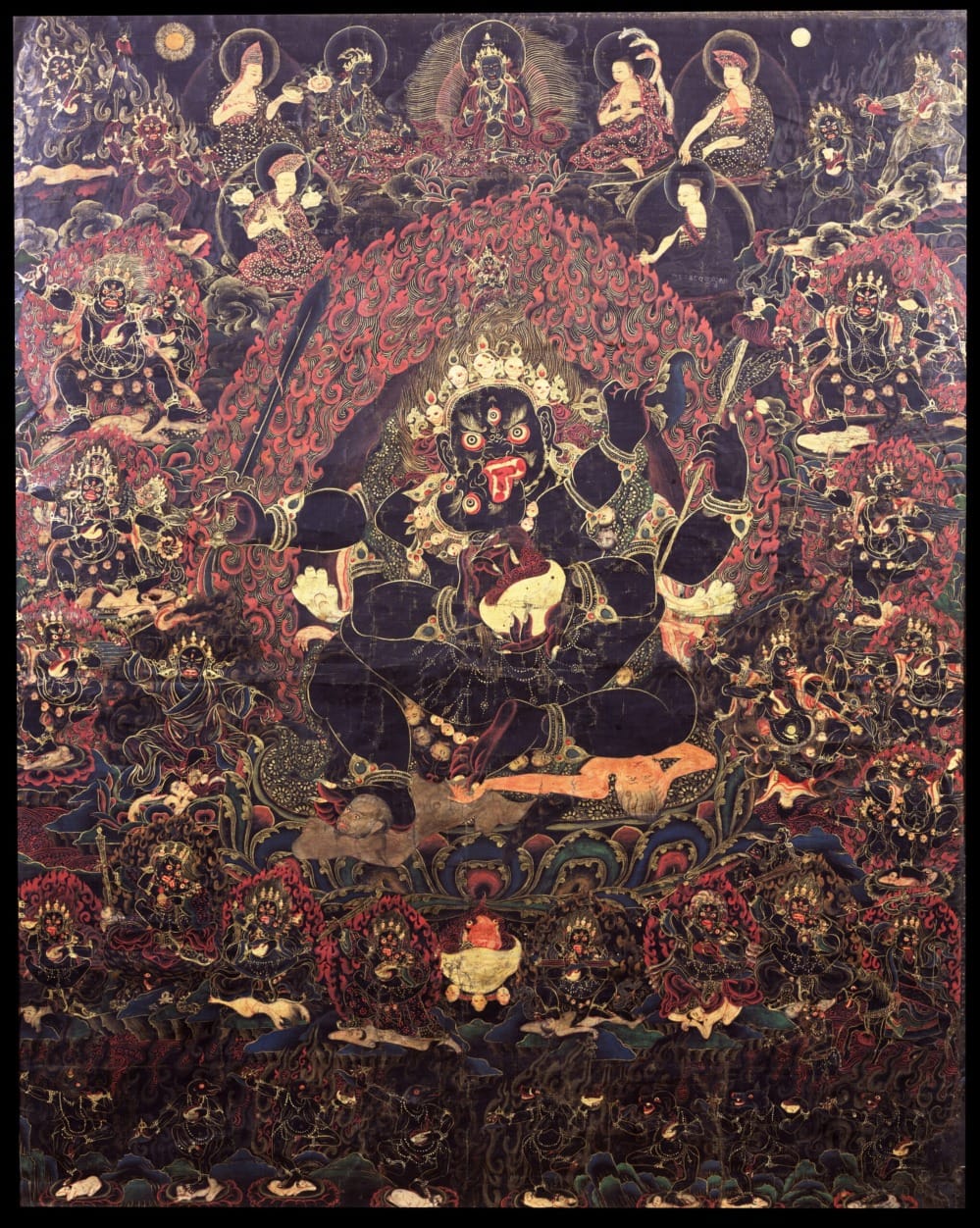
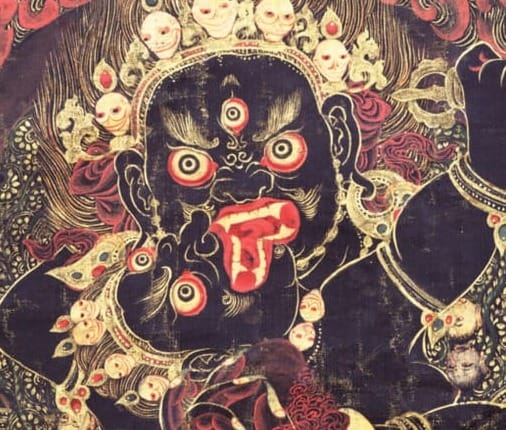
Mahākāla appears in Vajrayāna Buddhism as a protector deity. His iconography is fierce, uncompromising, and often misunderstood. Many stop at the visuals and miss the function.
The name Mahākāla literally means “Great Time.”
Not time as minutes and hours—but time as force.
In Vajrayāna thought, Mahākāla is not invoked to grant wishes. He is associated with removing obstacles—but not external ones first. His role is to cut through hesitation, fragmentation, and internal delay.
He protects after commitment.
This distinction matters.
Mahākāla is not a comforting figure. He does not soothe uncertainty. He does not negotiate with doubt. He appears when a practitioner is no longer waiting for permission—internally or externally.
Strip away the folklore, and Mahākāla becomes something startlingly practical:
The principle that decisive identity collapses time.
3. Mahākāla vs Manifestation Culture
Modern manifestation culture is saturated with waiting.
Waiting to feel ready.
Waiting for a sign.
Waiting for alignment.
Waiting for “divine timing.”
On the surface, it looks spiritual. Underneath, it is often procrastination with incense.
Common patterns:
- Endless affirmations with no identity shift
- Vision boards that never demand behavioral coherence
- “Trust the process” used to avoid decision
- Hope replacing authorship
This creates a subtle contract with time: I will act once evidence arrives.
Mahākāla represents the opposite contract.
Act as if the decision is final.
Manifestation culture often asks, “How do I attract this?”
Mahākāla asks, “Who are you once hesitation is gone?”
Key contrast:
Waiting / Hoping / Affirming
vs
Decisive alignment / Internal authority / Identity locked before evidence
This is why the Mahākāla principle is unsettling. It removes the comfort of delay. It reveals that time was never the obstacle—indecision was.
This section alone will make people pause, save, reread. Because it exposes the hidden addiction to “almost ready.”
Listen: The Mahākāla Principle
When identity becomes final, time stops negotiating.
This short episode expands the core idea of this essay — why waiting persists, how identity collapses delay, and why time only moves after decision is final.
4. The Law Beneath the Symbol
Mahākāla is not an exception to the modern manifestation canon. He is its ancient articulation.
The same law appears again and again, across teachers and traditions.
Neville Goddard taught that assumption collapses time. Once a state is internally accepted as fact, the bridge of incidents reorganizes. Time does not need to be managed—it responds.
Abdullah made this law visceral. When he told Neville, “You are already in Barbados,” he was not being poetic. He was removing the option of waiting. Barbados was not a destination—it was an identity decision.
SATS (State Akin to Sleep) functions the same way. It places causation before chronology. The internal acceptance precedes the external sequence.
The Inner Pitch—the private arena where standards are set before performance—operates on this law. Results lag because identity leads.
Mahākāla, then, is not foreign. He is the symbolic compression of a universal principle:
Time yields to internal coherence.
When identity is decided, time reorganizes. When identity remains conditional, time resists.
5. Mahākāla as Inner Discipline (Not Ritual)
This is where many misunderstand Mahākāla.
They look for a practice, a chant, a protection ritual.
But Mahākāla energy is not ritualistic by default—it is disciplinary.
Mahākāla represents the refusal to delay identity.
Protection does not come before commitment.
Clarity does not come before decision.
Confidence does not come before authorship.
Time yields after coherence is established.
This explains why some people appear “lucky,” why others experience sudden acceleration, and why long plateaus end abruptly. The shift is not external. It is the moment hesitation is cut.
Mahākāla does not protect the undecided.
He protects the coherent.
This is why readers feel seen here. Because they recognize themselves not as lazy or blocked—but as internally negotiating with time.
When identity is no longer negotiable, time stops delaying. Sequence responds. Events begin to move.
What follows is not urgency, striving, or heightened effort—but ease. Desire becomes inhabitable rather than hypothetical. This state is articulated through Vajrayogini, where wanting no longer braces for consequence or waits for permission.
6. Practical Application (Modern, Clean)
No costumes. No altars required. Just precision.
1. Identity Deadline
Choose a date after which an identity is no longer negotiable. Not a goal—an authorship. After this date, internal language changes permanently.
2. Remove “Someday” Language
Someday is not neutral. It is a delay signal. Replace it with “now operating as.”
3. Act from Inevitability Once Per Day
One action daily that assumes the outcome is settled. Not hopeful. Inevitable.
4. Evening Stillness Practice (SATS-adjacent)
At night, do not visualize achievement. Visualize normalcy—the calm of inevitability. This trains the nervous system to accept the state as current, not future.
These are not techniques to get something.
They are disciplines to end waiting.
7. Closing: Time Bends to Decision
Most people are not blocked.
They are paused—by themselves.
Mahākāla does not threaten. He does not rush. He does not bargain.
He waits until the moment you stop waiting.
And when that happens, time moves—not because it was convinced, but because it was no longer needed as a buffer.
Mahākāla does not speed things up.
He removes the version of you that was slowing them down.
Mahākāla Principle FAQ
World-class clarity for the question underneath every question: When does time finally move?
What is the Mahākāla Principle?
The Mahākāla Principle is the idea that time responds to decision, not waiting. When your identity is internally fixed—no negotiation, no “maybe”—events reorganize. Mahākāla (“Great Time”) symbolizes the moment hesitation is cut and reality begins to mirror coherence.
How is this different from “divine timing”?
“Divine timing” can be wisdom—or a disguise for delay. The difference is simple: true timing is alignment without inner debate. If you keep postponing identity until proof arrives, you aren’t honoring timing—you’re outsourcing authority. The Mahākāla Principle restores the order: decision first, evidence second.
Does the Mahākāla Principle mean I should rush?
No. Rushing is panic. Mahākāla is precision. The principle is not “go faster”—it’s stop negotiating who you are. Once identity is coherent, action becomes clean and calm. You move with inevitability, not urgency.
How does this connect to Neville Goddard and the Law of Assumption?
Neville’s core claim is that assumption collapses time. When you assume the state as done, the “how” becomes a bridge of incidents. The Mahākāla Principle is the same law expressed through a different symbolic language: identity is the cause; time is the rearrangement.
What does “identity overrides waiting” actually look like day-to-day?
It looks like removing “someday” from your language and nervous system. You make one move daily that only the inevitable version of you would make: a boundary, a standard, a practiced skill, a pitch, a publish, a call, a training session. Not big drama—daily proof of coherence.
If I “decide,” why doesn’t reality change immediately?
Because many “decisions” are only verbal. Reality responds to the decision that becomes non-negotiable—the one your behavior, standards, and self-talk obey without bargaining. There can be a lag while the bridge forms, but the real test is: Do you keep the identity when nothing is clapping yet?
How do I know if I’m waiting because I’m wise… or because I’m afraid?
Wisdom has calm. Fear has bargaining. If your “patience” contains constant mental rehearsals, contingency plans, and permission-seeking, it’s usually fear wearing spiritual clothing. A clean check: Does your waiting come with standards—or excuses?
What is the simplest practice that embodies Mahākāla without ritual?
Set an identity deadline: choose a date after which the old story is not allowed to speak in first person. Then do a nightly stillness practice (SATS-adjacent) where you feel the normalcy of the wish fulfilled— not excitement, not begging—the quiet of “already.”
How does this relate to Abdullah’s “You are already in Barbados”?
Abdullah wasn’t motivating Neville—he was ending negotiation. “You are already in Barbados” is Mahākāla in one sentence: the state is assumed as fact, and time becomes a mere sequence that must obey. It is causation before chronology.
What’s the biggest mistake people make with “identity work”?
Treating identity like a mood. Identity is a standard, not a vibe. The moment you make identity conditional on feelings, you hand time the steering wheel. The Mahākāla Principle is the correction: decide who you are, then let time rearrange to match it.