Siddhartha and the River
Hermann Hesse's Siddhartha follows a Brahmin's son who refuses secondhand truth — through asceticism, the Buddha, love, wealth, and despair — until the river teaches him what no teacher could. This immersive deep reading walks all seven stages of the journey, down to the syllable Om.

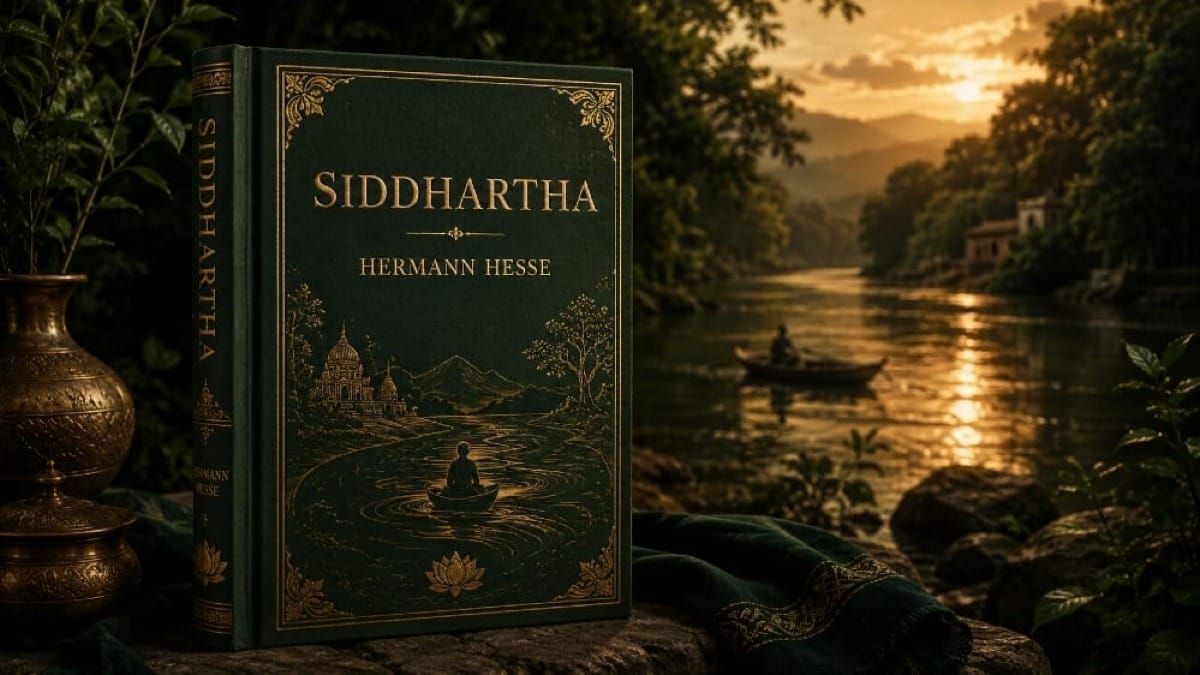
Siddhartha
and the River
Hermann Hesse's 1922 masterpiece, walked stage by stage, down to the water that speaks a single word.
Siddhartha (1922) by Hermann Hesse follows a gifted Brahmin's son in ancient India who leaves home to find enlightenment for himself — through asceticism, through the Buddha's presence, through love and wealth and despair — until, beside a river, he learns the one thing no teacher could give him.
Listening to the water, he hears every voice of life merge into the sacred syllable Om and attains peace. The novel's thesis is stated in its hero's life: wisdom cannot be taught. It can only be lived. And no — Siddhartha is not the Buddha. He meets the Buddha, and walks his own way.
Pair the journey with the practice in The Law of Assumption.
Siddhartha: a 1922 novel by Hermann Hesse about a Brahmin's son in ancient India who seeks enlightenment through his own experience rather than any teacher's doctrine. The name means "he who has reached the goal."
The river: the novel's central symbol — everywhere at once, always changing yet always the same, holding every voice of life simultaneously.
Om: the sacred syllable of the Vedic tradition signifying the whole and the perfect; in the novel, the single word into which all the river's voices resolve.
The Brahmin's Son
In the shade of the house, in the sunshine on the riverbank — a boy everyone loves, who cannot love his own life.
Hesse opens in a kind of paradise. Siddhartha is handsome, brilliant, the pride of his Brahmin father, adored by his mother, worshipped by his friend Govinda. He has mastered the rites, the ablutions, the art of contemplation. He already speaks the silent Om into himself with every breath. By every measure of his world, he is finished — a future prince of priests.
And he is quietly starving. The rituals are performed, the offerings made, the verses recited, yet the vessel is not full: the wise men have poured their best into him and still his soul is not at peace. The scriptures speak of Atman, the indwelling Self, but no one he knows — not his father, not the wisest teacher — has actually found it, only described it. So one evening he stands motionless in his father's room until the old man, unable to break his son's will, lets him go. Siddhartha walks out at first light to join the wandering ascetics, and Govinda, his shadow, walks with him.
This first refusal sets the pattern for the whole book. Siddhartha's discontent is not rebellion against truth — it is the refusal to accept truth secondhand. Everything that follows flows from this single decision to verify rather than inherit.
Stage I — The Thirst
They had already poured their best into his waiting vessel, and the vessel was not full; the spirit was not satisfied, the soul was not at peace.
Hermann Hesse, Siddhartha — rendered from the German originalThe Samanas
Three years in the forest, learning to make the self small enough to escape.
With the Samanas, Siddhartha turns the full force of his will against himself. He fasts until his ribs show, stands in the rain, kneels in the thorns, lets his body burn and freeze. He learns to slip out of his own self — into the heron, into the dead jackal, into stone — only to return, every time, to the same unescaped Siddhartha and the same circling hunger. Asceticism, he discovers, is only a more athletic way of running from the self, no different in kind from the drinker's wine: a numbing, a brief flight, and then the return.
Yet the forest years are not wasted, and the novel never treats them as such. When asked, much later, what he can actually do, Siddhartha gives the answer that has become the book's most quoted credo: he can think, he can wait, he can fast. Clear thought, patience, and the ability to endure lack — the Samanas gave him the instruments his later life will play. The lesson of the Samanas is that mortifying the self is not the same as finding it — but the discipline forged in failing still becomes the equipment of the man who eventually succeeds.
Stage II — The Three Arts
I can think. I can wait. I can fast.
Siddhartha's whole inheritance from the forest, rendered from the German originalGotama — The Buddha
He meets the one perfect man he will ever see, and walks away.
Word reaches the forest of Gotama, the Buddha, the Illustrious One who has conquered suffering. Siddhartha and Govinda go to hear him in the grove of Jetavana, and what Siddhartha sees astonishes him: not the doctrine but the man — every finger, every glance, every step radiating a completed peace. He has never revered anyone so much. Govinda takes refuge that very day and becomes a monk.
Siddhartha does not. In one of literature's most respectful refusals, he tells the Buddha that the teaching is flawless — the chain of cause and effect, the conquest of suffering, all of it without a gap — except for one thing it cannot contain: the secret of what the Buddha himself experienced in the hour of his awakening. That came to Gotama through his own seeking, his own way, and it cannot be handed over in words. To follow the teaching would be to acquire a doctrine and lose the experience. So Siddhartha bows, and goes — alone now, even Govinda gone — to learn from the only teacher left: himself.
The refusal of the Buddha is the thesis of the novel: wisdom is not the content of any teaching but the residue of lived experience. The same conviction sits beneath the whole inner-experience tradition we trace at The Universe Unveiled — the insistence, from James Allen to Neville Goddard, that truth must be verified in your own consciousness or it is merely information.
Stage III — The Refusal
The teaching of the Enlightened One contains everything — except the secret of what the Enlightened One himself lived through.
Siddhartha to Gotama, rendered from the German originalThe Path of Choices
Hesse's claim is that no decision could have spared Siddhartha the journey. Test it. Make his choices — any choices — and watch where every road leads.
Kamala and the Child-People
The ascetic crosses the river and walks into the world — beauty, money, dice, and a slow forgetting.
A ferryman carries him across the river — remember the ferryman — and in the city Siddhartha sees Kamala, the famous courtesan, carried in her sedan chair, and decides on the spot to learn from her the one art the forest never taught: love. She laughs at the ragged Samana, tells him he will need clothes, shoes, and money, and sends him to the merchant Kamaswami. The man who can think, wait, and fast turns out to be formidable in business precisely because he needs nothing; deals cannot frighten a man who can outwait them.
Years pass. The wealth comes, then the silk robes, the wine, the dice, the property. Hesse calls the ordinary people of the world the child-people — not in contempt, but because they feel everything fully, love and grieve without irony, while Siddhartha can only watch himself imitate them from behind glass. Slowly the watcher falls asleep. The dice grow desperate, the soul grows sick, and one night a dream of Kamala's dead songbird shows him what he has done to himself. He walks out of his gardens, out of the city, and does not return. Kamala, who alone understood him, frees her bird and withdraws — carrying, though he does not know it, his unborn son.
The worldly years are not a moral failure to be skipped — they are the half of life the forest denied him, and the novel insists they were necessary. Without tasting desire and despair to the bottom, his final peace would have been one more secondhand idea.
Stage IV — The Sickness
The world had caught him: pleasure, covetousness, idleness — and at last the vice he had always despised most, the greed of property.
Hermann Hesse, Siddhartha — rendered from the German originalBy the River
The lowest point of the journey — and the syllable that rises out of the depths to meet it.
He wanders until he reaches the same river he once crossed, and leans over the water with one wish left: to be done, to let the smooth surface close over him. Forty years of seeking have ended in nausea at his own existence. And then, from some remote province of his soul, a sound arrives — the word he has carried since childhood, the beginning and end of every Brahmin prayer. Om. The whole. The perfect. It sounds through him once, and the sleeping spirit in him wakes enough to recognize the madness of the moment.
He sinks down at the foot of a tree, murmurs the syllable, and sleeps the deepest sleep of his life. When he wakes, the world is new-made; the river glitters; a monk keeping watch over him turns out to be Govinda, who does not recognize his old friend in the rich man's clothes. Siddhartha laughs at what he has become and at what he has lost — and notices, beneath the ruin, something extraordinary: the bird in his breast is not dead. The despair burned away the clever, proud, fasting self that decades of discipline could never kill. He had to become a fool to become a child again.
Om here is not a doctrine but an eruption — the deepest layer of consciousness asserting itself when every surface strategy has failed. The death of the constructed self, not its perfection, is what opens the door.
Stage V — The Awakening
Out of a distant region of his soul came a sound: one word, one syllable — Om — the whole, the perfect.
Hermann Hesse, Siddhartha — rendered from the German originalThe Ferryman
Vasudeva, who has spent a lifetime doing one thing: listening.
Siddhartha stays at the river and apprentices himself to Vasudeva, the same ferryman who carried him across years before. Vasudeva is barely a teacher at all; he says little, claims nothing, and possesses one art to perfection — he knows how to listen. From him, and from the water, Siddhartha learns the river's first secret: it is everywhere at the same time. At its source and its mouth, at the waterfall and the ferry crossing, in the mountains and in the sea, all at once. For the river there is no past and no future; there is only the present. And the moment Siddhartha sees that his own life is also a river — that the boy, the man, the old man are separated only by shadows, not by anything real — time falls away, and with it most of suffering, which lives entirely in memory and dread.
Life is not finished testing him. Kamala, traveling to see the dying Buddha, is bitten by a snake near the ferry and dies in Siddhartha's arms, leaving him the son he never knew he had. The boy is spoiled, furious, and ashamed of his serene barefoot father — and Siddhartha, who renounced everything else without trembling, cannot renounce this. He clings, he indulges, he suffers, until the boy flees back to the city. Standing over the river, aching, Siddhartha hears it laugh at him: he sees his own father in himself, the old Brahmin who also watched a son walk away, and understands that even this pain is the current repeating itself — that it cannot be spared for anyone, only lived.
The ferryman's lesson is that listening, not striving, is the final discipline — the same surrendered attention that every contemplative tradition arrives at when effort has done all it can.
Stage VI — The River's Secret
The river is everywhere at once — at its source and at its mouth — and for it there is only the present, without the shadow of a past or a future.
Hermann Hesse, Siddhartha — rendered from the German originalListen to the River
This is the moment the whole novel moves toward. The river carries every voice of life at once — and when you stop choosing among them, they become one word. Press and hold the water. Keep holding.
When he no longer listened to the sorrow or the laughter, no longer bound his soul to any single voice, but heard them all — the great song of a thousand voices was one word: Om.
Sound on — the river hums while you hold
Om — and Govinda's Kiss
The seeker who never stopped seeking meets the friend who finally stopped.
When Siddhartha at last hears all the river's voices together — the child and the mourner, the lover and the dying, greed and grief and laughter, no longer separable — they merge into the single syllable, and his self flows into the unity of all things. Vasudeva, his work complete, smiles once and walks into the forest, into the oneness, like a man going home. Siddhartha remains at the ferry, and his serenity becomes famous up and down the river.
The final chapter belongs to Govinda — old now, still a monk, still seeking, still unfinished. He comes to question the famous ferryman and only slowly recognizes his childhood friend. Siddhartha tells him gently what the whole book has been proving: that wisdom cannot be communicated; that the opposite of every truth is also true; that time is not real, so the sinner already carries the future Buddha within him; that a stone is not merely a stone but, in the long flow of forms, also animal and god; and that the one thing that matters is to love the world — not to explain it, not to despise it, but to regard it and ourselves with love and reverence. Words, he admits, are where he and his great contemporary Gotama only seem to differ; in the experience itself they are the same.
Govinda understands none of it and asks for one thing more. Siddhartha tells him: kiss my forehead. And in that kiss Govinda no longer sees his friend's face but a flowing river of faces — fishes and newborns and murderers and lovers and gods, dying and being born, none of them perishing, all of them one — over which floats the still, kind, faintly mocking smile of Gotama himself. The seeker bows, weeping without knowing it, before the man whose smile holds everything he ever sought.
Stage VII — The Teaching That Cannot Be Taught
Wisdom cannot be passed on. Wisdom that a wise man tries to pass on always sounds like foolishness.
Siddhartha to Govinda, rendered from the German original
Hesse proved that truth must be lived from within. The Law of Assumption is the modern discipline for doing exactly that — daily.
Get the BookCommon Misconceptions About Siddhartha
Misconception: Siddhartha is the Buddha. He is not. Hesse's hero is a fictional Brahmin who lives in the Buddha's time, meets him face to face, and chooses a different road. The shared name is deliberate — Siddhartha was the Buddha's birth name — and the novel is, in effect, the story of what the Buddha's road would look like walked alone, without a teacher.
Misconception: the novel says teachers are useless. It says something subtler: teachers and teachings can transmit knowledge, but the final step — wisdom — must be lived. Siddhartha reveres Gotama to the end, and learns decisively from Kamala, from Vasudeva, and from the river itself. The book honors guides; it refuses substitutes.
Misconception: the worldly chapters are a fall from grace to skim past. The years of love, money, and dice are not a detour but a requirement. Hesse is explicit that without descending fully into desire and despair, Siddhartha's peace would have remained theoretical — one more inherited idea.
Misconception: it is a Buddhist book. It is neither Buddhist nor Hindu exclusively. Hesse braided Vedantic ideas — Om, Atman, Brahman — with the Buddha's biography and a Western insistence on the individual path. Scholars also note Hesse never set foot in India itself; his journey reached Ceylon and Indonesia, and the India of the novel is a landscape of the soul.
Where Siddhartha Sits in the Lineage
At The Universe Unveiled, Siddhartha is read as the great literary proof of the inner law. The New Thought lineage states it as doctrine — James Allen that a man is literally what he thinks, Wallace Wattles and Charles Haanel that the world within is the cause of the world without. Hesse dramatizes the same law as a life: every outer station of Siddhartha's journey is the precise outpicturing of his inner state, and his liberation arrives not when circumstances change but when consciousness does.
It also belongs beside the other parables of the path. Like The Alchemist, it insists the treasure is found where the journey began, transformed by the journey itself; like The Celestine Prophecy, it treats attention as the active spiritual force. And its destination — the surrendered, listening stillness in which the one syllable sounds — is the very state that Neville Goddard would later make the deliberate starting point of manifestation: dwelling in the end, in the present tense, where time does not exist.
Glossary: Key Terms in Siddhartha
Om: the sacred syllable of the Vedic tradition, the sound of the whole and the perfect; the word into which all the river's voices resolve.
Atman: the indwelling Self of Vedanta, the divine essence Siddhartha seeks within rather than in ritual.
Brahman: the universal ground of all being, with which the Atman is ultimately one.
Samana: a wandering ascetic; Siddhartha's first chosen path of fasting and self-denial.
Gotama: the historical Buddha as he appears in the novel — the one perfected man Siddhartha meets and declines to follow.
Samsara: the wheel of worldly craving and repetition; the name the novel gives Siddhartha's city years.
The child-people: Hesse's term for ordinary people who feel life fully and without irony — first pitied by Siddhartha, finally honored.
The ferryman: Vasudeva, the quiet master whose entire teaching is the art of listening.
The kiss: the novel's final gesture, in which Govinda sees the stream of all forms in Siddhartha's face and experiences the unity directly.