What the Lines on Your Palm Actually Mean: Heart, Head, Life, and Fate
The heart line, head line, life line, and fate line are not predictions. They are reflections — a map of identity, vitality, and direction encoded in the hand. This is the complete guide to what each line on your palm actually means.

Quick Answer
What do the lines on your palm mean?
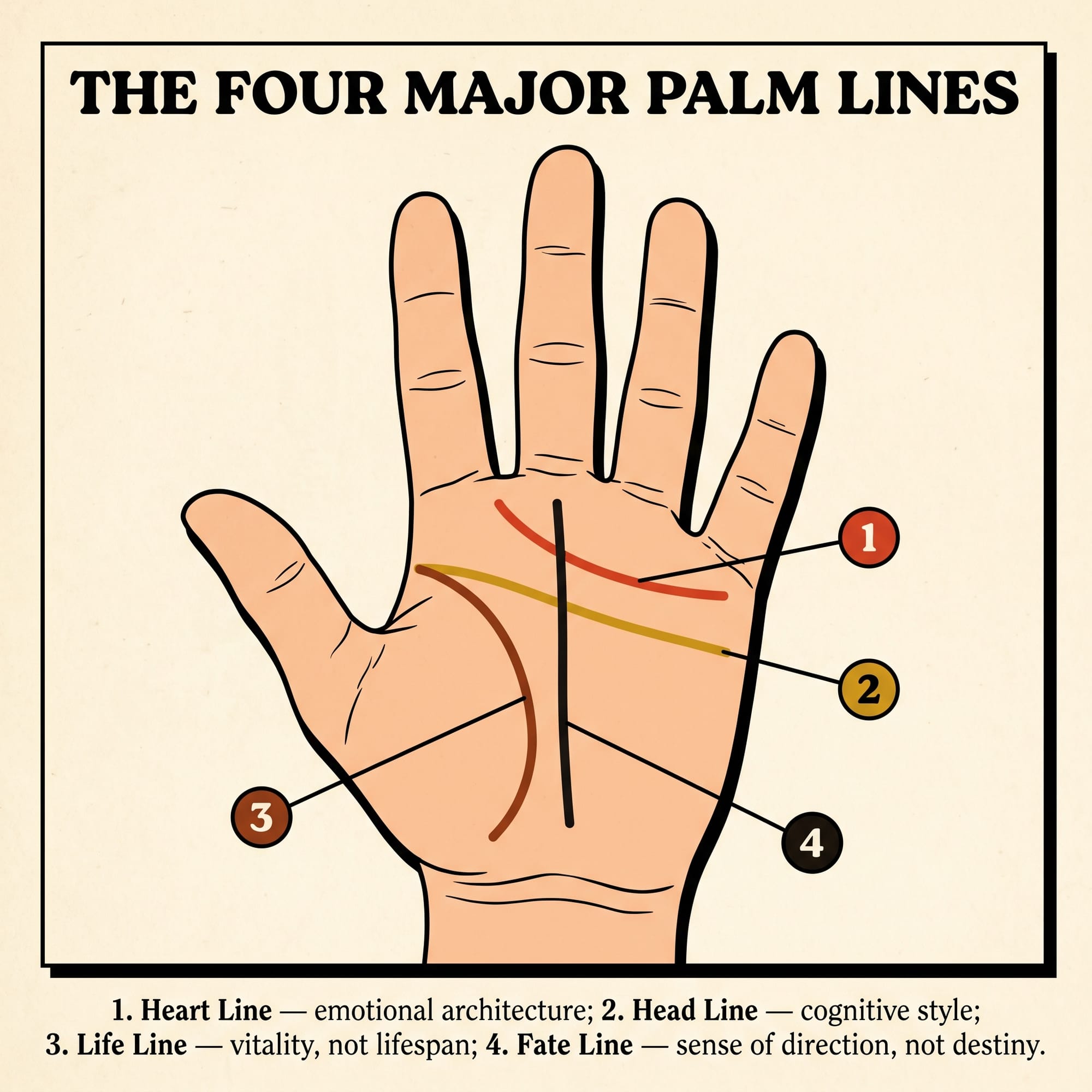
The four major palm lines each reflect a distinct dimension of who a person currently is. The heart line reflects emotional architecture. The head line reflects cognitive style. The life line reflects vitality and quality of engagement with life — not lifespan. The fate line reflects sense of direction and vocation — not fixed destiny.
No palm line is a prediction. Each is a mirror of identity and pattern currently in operation. The Universe Unveiled offers an AI Palm Reading at theuniverseunveiled.com/palm-reading/ that interprets all four lines, the mounts, and hand form together from a photograph of the dominant hand.
The lines on your palm were not placed there randomly.
Palmistry — the practice of reading the hand — is one of the oldest contemplative traditions in recorded history. The body is not separate from the person it houses. The hand is a map. Every line, a sentence written before you arrived. Read carefully, the palm reflects the person.
This is not fortune telling. The lines on your palm do not predict your future. What they reflect — with a precision worth sitting with — is the person you currently are. How you love. How you think. The quality of the energy you bring to being alive. The direction your life is taking.
That reflection, honestly received, is worth more than any forecast.
The Lineage of Palm Reading
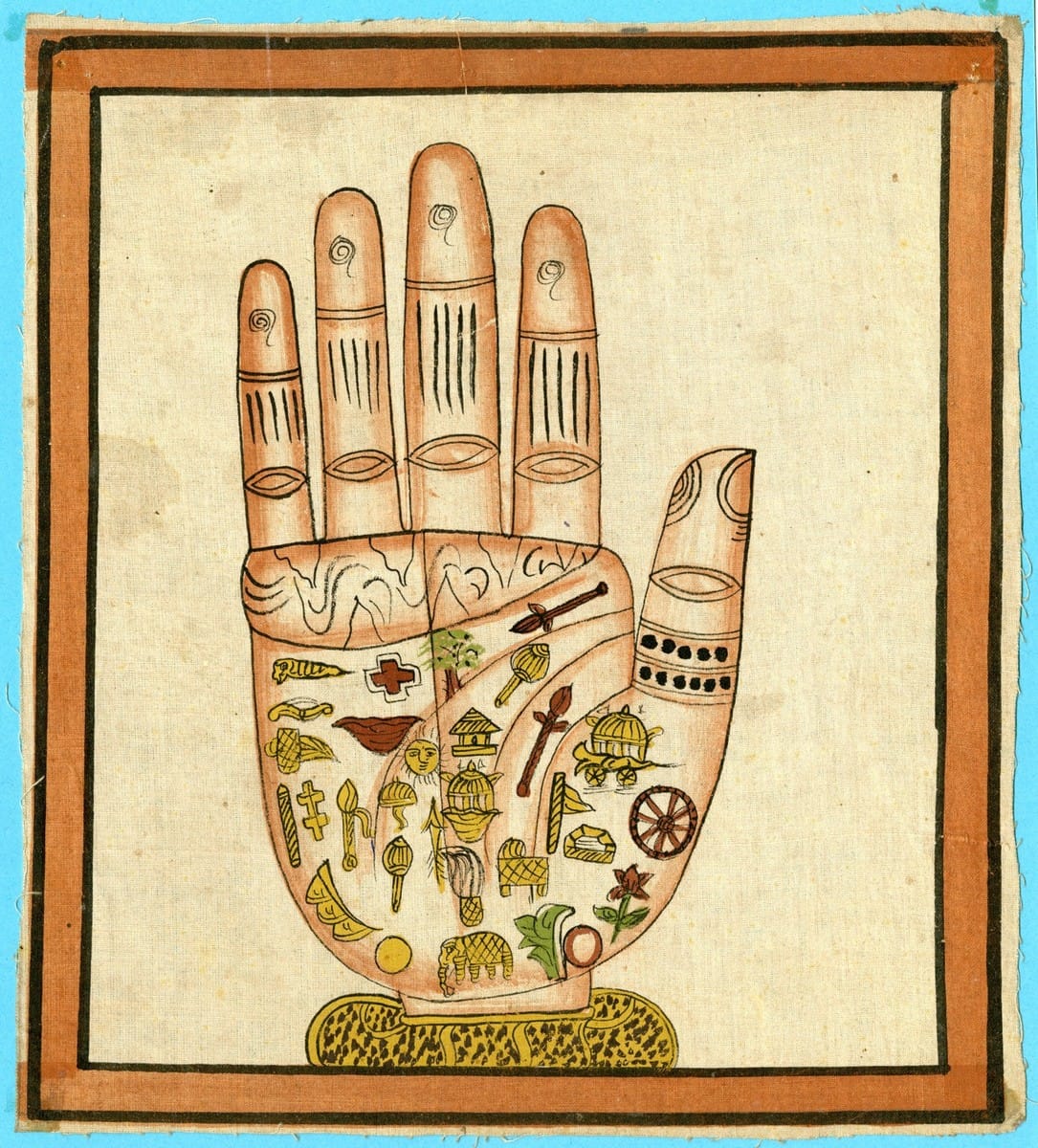
Palmistry has roots that stretch across millennia and continents.
The earliest systematic treatment of hand reading appears in the Vedic tradition of ancient India, within a body of texts known collectively as the Samudrika Shastra — the science of bodily signs. The branch dedicated specifically to the hand, Hasta Samudrika, codified palmistry centuries before the practice reached the Western world. From India, hand reading traveled through Persia, into the Greek world, and across the Mediterranean. The Greek tradition produced philosophical texts on the hand traditionally attributed to Aristotle, though their authorship is debated. Chinese palmistry developed independently along its own line of inheritance, with references appearing in texts dating back more than two thousand years.
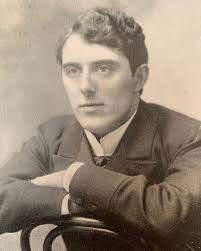
In the late nineteenth century, the Irish palmist William John Warner — known by the single name Cheiro — became the most famous practitioner of his era, reading hands for figures including Mark Twain, Oscar Wilde, and Sarah Bernhardt. His writings systematized modern Western palmistry into the framework most readers still use today.
What unites these traditions across centuries is a single, consistent premise: the hand reflects the person. Not as prophecy. As pattern.
At The Universe Unveiled
At The Universe Unveiled, palmistry is treated as a contemplative practice — a mirror that reveals the patterns of self-concept, vitality, and direction currently operating in a person's life. Not as a system of forecast. Not as fortune-telling. The reading is a way of seeing yourself by the light of an old tradition, not a way of being told what will happen to you.
This distinction matters. It defines how the lines are read, what the reading is for, and what it is not.
The Four Lines: Definitions
These are the four major lines found on the human palm. Each is a distinct formation with a specific domain of meaning.
Heart line: The uppermost horizontal line on the palm, running from beneath the little finger across toward the index or middle finger. It reflects emotional depth, relational style, and how love and feeling are expressed and held — not whether love will arrive.
Head line: The horizontal line running across the middle of the palm, often beginning near or joined to the life line. It reflects cognitive style — how the mind processes, analyzes, and moves through information — not raw intelligence or capability.
Life line: The curved line arcing from between the thumb and index finger down and around the base of the thumb. It reflects vitality and the quality of engagement with life — not lifespan, and not the date or likelihood of death.
Fate line: The vertical or diagonal line running up the center of the palm toward the middle finger. It reflects sense of direction, vocation, and the shape of one's life path — not a fixed destiny, and not a sentence handed down.
Mounts: The fleshy pads at the base of each finger and along the palm's edge. They reflect where life force is developed and concentrated — the terrain through which the lines move.
The AI Palm Reading at The Universe Unveiled reads all four lines together — plus the mounts and hand form — as a unified personal reading. No line is interpreted in isolation. The whole hand is the reading.
Which Hand Do You Read?
The dominant hand — the hand you write with — is the hand most palmists read for current reality. It shows what life has built in you: the patterns that have formed through experience, decision, and time. The non-dominant hand reflects innate tendencies — what you arrived with before the world had its say.
The dominant hand is not better or more important than the non-dominant hand. It is more current. For understanding who you are now — the patterns operating in your life today — begin with the dominant hand.
The Heart Line: How You Love
The heart line is the uppermost horizontal line on the palm. It begins beneath the little finger and travels across the hand, ending somewhere beneath the index or middle finger — or between them.
It is the line most associated with love. But it does not predict whether you will be loved. It reflects the architecture of how you feel — how deeply, how openly, how freely emotional energy moves through you.
Long and Deep vs. Short and Selective
A long, deep heart line indicates a rich emotional life — someone who feels strongly and carries those feelings without shying away from their weight. A shorter heart line does not indicate coldness or emotional unavailability. It indicates selectivity: emotional energy extended with care rather than freely, depth without diffusion.
Curved vs. Straight
A heart line that curves upward toward the index or middle finger suggests someone expressive in love — a person who moves toward what they feel. A heart line that runs more horizontally across the palm suggests equal depth with more containment in how it is shown. The feeling is present. The expression is more deliberate.
Chains, Islands, and Forks
When the heart line shows chaining or small island formations, it reflects emotional complexity — a person navigating significant inner life, often someone who has felt deeply and been changed by that feeling. This is not a negative formation. It is a mark of depth.
A fork at the end of the heart line — branching as it approaches the fingers — is a sign of warmth and relational generosity. Two perspectives held at once. The capacity to see through more than one emotional lens.
A Reading for Your Hand Alone
What do your four lines say?
General knowledge gets you so far. A personal reading composed for your specific hand is where the mirror becomes real.
Get Your Reading — $9The Head Line: How You Think
The head line runs horizontally across the middle of the palm. It often begins near the heart line — sometimes sharing its starting point with the life line — and travels toward the opposite edge of the hand.
What it reflects is cognitive style. Not intelligence in any measurable sense — not aptitude, not capability — but the specific quality of how your mind moves through the world.
Long vs. Short
A long, clearly marked head line indicates the capacity for sustained concentration and systematic thinking: a mind that can follow a thread to its end without losing it. A shorter head line does not indicate lesser intelligence. It indicates decisiveness over deliberation — a mind built for action and conclusion rather than exhaustive analysis.
Curved vs. Straight
When the head line curves downward as it travels across the palm — bending toward the mount of the moon — it indicates an imaginative, intuitive mind. One that thinks in images, narratives, and associations rather than strict logic. Writers, artists, and people with strong inner lives often carry this formation. A head line that runs straight across the palm reflects a more analytical, empirical temperament — grounded, methodical, preference for the concrete.
The Writer's Fork
One of the most significant formations is the fork at the end of the head line — sometimes called the writer's fork. The line splits as it terminates, suggesting the ability to hold multiple perspectives simultaneously, to translate between the logical and the creative. This formation belongs to people who are rarely only one thing.
The Life Line: How You Live
The life line curves from the space between the thumb and index finger, arcing down and around the mount of Venus — the fleshy pad at the base of the thumb.
The most important thing to understand about the life line is what it does not mean. A short life line does not predict early death. A break in the life line does not mark an ending. These interpretations are incorrect, and they have caused unnecessary fear for centuries. The life line carries no reliable correlation to lifespan.
What the life line reflects is vitality — the quality and fullness of the life being lived. How much energy you bring to being here. How fully you inhabit your own existence.
Long and Deep vs. Short and Concentrated
A long, deep life line indicates strong life force: physical vitality, a robust appetite for experience. A shorter life line does not indicate fragility. It often belongs to someone who lives with intensity rather than breadth — concentrated rather than expansive, present rather than scattered.
Wide Arc vs. Close to the Thumb
The arc of the life line matters. A wide arc that sweeps outward into the palm suggests an expansive nature — someone with a large appetite for the world, for movement, for engagement. A life line that hugs close to the thumb suggests more contained energy: more deliberate, more selective about where vitality is directed.
Branches and Breaks
Upward branches from the life line mark periods of growth and expansion — moments when life opened. Downward branches indicate redirections and significant transitions. Breaks in the life line are not failures or endings. They are pivots — the kind of change that rewrites a chapter and begins the next one.
The Guardian Line
Some hands carry a double life line: a secondary line running parallel and close to the primary one. This is the guardian line. It often indicates a strong regenerative capacity — a person who can recover from what would deplete others.
The Fate Line: Where You Are Going
Not everyone has a clear fate line. That itself is worth noting — and it is not a deficit.
The fate line runs vertically or diagonally up the palm, often from somewhere near the wrist toward the base of the middle finger. It is the line most associated with purpose and direction — the sense of path that runs through a life, whether acknowledged or not.
Strong vs. Faint or Absent
A strong, clear fate line indicates a defined sense of direction — a person who has known, early or over time, what their life is for. The work that feels like theirs rather than borrowed or assigned. A faint or absent fate line does not mean the absence of purpose. It often belongs to someone whose life path is highly self-determined — fluid, adaptive, resistant to fixed trajectory. A person who builds their direction rather than discovers it. This is not lesser. It is a different mode of moving through the world.
Where the Fate Line Begins
Where the fate line begins carries specific meaning. A fate line starting from the base of the palm indicates a direction formed early — a path shaped in childhood or young adulthood. One that begins from the middle of the palm suggests the path clarified later, after other chapters had their time. A fate line that originates from the life line suggests a direction initially shaped by family or origin — a path that emerged from, and then grew beyond, where you started.
Breaks and Multiple Fate Lines
Breaks in the fate line are pivots, not failures. A change in direction. The end of one chapter and the beginning of another that is more authentically aligned with who the person has become.
Some hands carry multiple fate lines — two or more parallel vertical lines. This formation often belongs to someone operating across multiple vocational directions simultaneously. A person for whom a single path is too narrow a container.
The Mounts: Where Life Force Concentrates
The mounts are the fleshy pads at the base of each finger and along the palm's edge. They are the terrain through which the lines move, and they carry their own meaning.
Mount of Jupiter (Index Finger)
A well-developed mount beneath the index finger — the mount of Jupiter — indicates ambition, leadership, and a natural orientation toward influence. A flat or undeveloped mount of Jupiter does not indicate lack of capability or weakness. It indicates a person whose direction is internal rather than externally driven — purpose held privately rather than projected.
Mount of Saturn (Middle Finger)
Beneath the middle finger, the mount of Saturn reflects discipline, structure, and seriousness of purpose. A pronounced mount of Saturn does not indicate sternness or coldness. It indicates a person built for sustained effort, the kind of work that requires depth over flash.
Mount of Apollo (Ring Finger)
Beneath the ring finger, the mount of Apollo speaks to creativity, expressiveness, and the desire to make something of beauty in the world. A flat mount of Apollo does not indicate lack of creativity. It indicates a creative life held inward rather than externalized — an aesthetic sensibility that may not seek public expression.
Mount of Mercury (Little Finger)
Beneath the little finger, the mount of Mercury belongs to communication — language, intelligence, and the capacity to connect across difference. A well-developed mount of Mercury does not indicate talkativeness. It indicates fluency with language and the gift of being understood across distance.
Mount of Venus (Base of Thumb)
The mount of Venus — the large, rounded pad at the base of the thumb — is the largest mount on the hand and one of the most telling. It reflects vitality, passion, and the warmth you bring to loving and being loved. A full, firm mount of Venus does not indicate excessive desire or undisciplined feeling. It indicates strong life force and the capacity to hold warmth as a sustaining quality. A flat mount of Venus does not indicate coldness. It suggests more reserved energy — present, but held closer.
The Hand Form: What You Carry Before the Lines
Before a single line is read, the form of the hand itself communicates something essential.
Finger Length and Palm Shape
Longer fingers relative to the palm tend to indicate an analytical, detail-oriented mind — someone who thinks before acting, who considers before committing. Shorter fingers on a broader palm do not indicate lesser intelligence or impatience. They indicate a more practical, decisive temperament — action-first, comfort with directness, instinct over deliberation. Neither formation is superior. They are different modes of processing the world.
Flexibility and Firmness
A flexible hand — one that bends easily at the fingers — does not indicate lack of conviction. It suggests adaptability and willingness to move with circumstance. A firmer hand does not indicate rigidity. It indicates consistency and structural thinking — someone who commits and holds.
Soft vs. Hard Palm
A soft palm does not indicate weakness or laziness. It indicates sensitivity and receptivity — a person open to subtle impression. A harder palm does not indicate insensitivity. It reflects resilience and a preference for the tangible — strength built for the world's friction.
Read Your Hand as a System
Every line reads differently in your palm
No line stands alone. The Universe Unveiled's AI Palm Reading interprets all four lines together — with the mounts and hand form — as a unified reading composed for your specific hand.
Get Your Reading — $9Common Palmistry Misconceptions
Most of what people believe about palm reading is wrong. The myths persist because palmistry has been popularized through fiction, fairground readings, and entertainment more often than through the contemplative tradition that produced it. These are the most common misconceptions, corrected.
Misconception: A short life line means a short life. Reality: The life line reflects vitality and quality of engagement with life — not lifespan. A short life line often belongs to a person who lives with concentrated intensity. There is no reliable correlation between life line length and longevity.
Misconception: A break in the life line means imminent death or disaster. Reality: Breaks in the life line indicate major life transitions — chapter shifts, transformative changes, the end of one phase and the beginning of another. They are pivots, not endings.
Misconception: No fate line means you have no purpose. Reality: A faint or absent fate line often indicates a self-determined life path — someone who builds their direction rather than discovers it. It is a sign of creative autonomy, not aimlessness.
Misconception: The lines on your palm cannot change. Reality: Palm lines do change over a lifetime. New lines can appear. Existing lines can deepen, fade, or shift in formation. The hand reflects the person — and as the person changes, the hand updates.
Misconception: Palm reading predicts the future. Reality: Contemplative palmistry reads the present. The palm reflects the patterns currently operating — identity, vitality, direction. It is a mirror of who you are now, not a forecast of what will happen.
Misconception: Both hands say the same thing. Reality: The dominant hand reflects current reality — what life has built. The non-dominant hand reflects innate tendencies — what was present before experience. Reading both reveals the relationship between origin and outcome.
Predictive Palmistry vs. Contemplative Palmistry
There are two distinct traditions of palm reading, and the difference between them is the difference between fortune-telling and self-knowledge.
Predictive palmistry treats the hand as a forecast. It asks the lines what will happen — when you will marry, how long you will live, what success awaits. This is the popular conception of palmistry, and it is the conception that has produced most of the discipline's bad reputation. The lines are not, and have never been, a reliable forecast of future events.
Contemplative palmistry treats the hand as a mirror. It asks the lines what is true now — about how you love, how you think, how you live, where you are going. The reading is not a prediction. It is a reflection. The purpose is not to be told what will happen but to be shown what is already operating.
The Universe Unveiled's AI Palm Reading is a contemplative reading. It does not forecast outcomes. It reflects the patterns currently encoded in the hand — and through them, the patterns currently encoded in the person.
Reading the Hand as a Whole
No line reads in isolation.
The heart line tells one story. The head line tells another. The life line and fate line add their own dimensions. The mounts amplify or quiet what the lines say. What makes a hand meaningful — truly meaningful — is how these stories intersect. Where they reinforce each other. Where they hold a tension that explains something a person has lived but not yet named.
Two people can carry the same heart line formation and live it entirely differently, because the rest of their hand is saying something different. This is why general guides — including this one — can take you only so far.
Understanding what the lines mean is the beginning. Knowing what your lines mean, in their specific configuration, in your specific hand, is where it becomes useful.
The subconscious mind encodes patterns that operate below the level of conscious awareness — patterns that shape every decision, every relationship, every threshold of what feels possible. The palm, in the contemplative tradition, is understood as one expression of those patterns made visible. Not as prediction. As reflection. As a way of seeing yourself by the light of an old and honest tradition.
The lines you carry are the ones that belong to you. They are not someone else's map of your life. They are yours.
AI Palm Reading — The Universe Unveiled
See what your hand is telling you
your hand alone, read at once
Upload a photograph of your open palm. The Universe Unveiled's AI Palm Reading delivers a complete personal reading — heart line, head line, life line, fate line, mounts, and hand form — composed for your hand alone. Nine dollars, delivered at once.
Get Your Reading — $9What a Personal Reading Does That a Guide Cannot
A guide like this one is a vocabulary lesson. It teaches you the language of the hand — what the formations are called, what each one reflects in general terms, what to look for.
A personal reading is the sentence written in your language, for your life.
Your heart line does not exist independently of your head line. The depth of your life line interacts with the clarity of your fate line. The mounts amplify or quiet what the lines say. The whole hand is a system — one that requires reading all of it together, in the specific configuration that is yours alone.
The AI Palm Reading at The Universe Unveiled reads your hand as that system: heart line, head line, life line, fate line, mounts, and hand form — interpreted together as a complete personal reading, composed for the photograph you upload. Nine dollars. No waiting. Open your dominant hand, photograph the palm in soft light with fingers slightly apart, and receive a reading that belongs to no one else.
Quick Reference: Palm Reading Glossary
Palmistry: The contemplative practice of reading the hand to reflect the patterns of identity, vitality, and direction operating in a person's life. Also called chiromancy. Roots in the Vedic Samudrika Shastra, Greek philosophical texts, and Chinese hand reading traditions.
Hasta Samudrika: The branch of the Vedic Samudrika Shastra dedicated to reading the hand. The earliest systematic codification of palmistry.
Heart line: Uppermost horizontal palm line. Reflects emotional architecture and relational style.
Head line: Horizontal line across the middle of the palm. Reflects cognitive style and how the mind moves.
Life line: Curved line around the base of the thumb. Reflects vitality and quality of engagement with life. Does not reflect lifespan.
Fate line: Vertical line up the center of the palm. Reflects sense of direction and vocation.
Mounts: Fleshy pads at the base of the fingers and along the palm's edge. Named for classical planets — Jupiter, Saturn, Apollo, Mercury, Venus, Mars, and the Moon. Reflect where life force is concentrated.
Dominant hand: The hand used for writing. Read for current reality and patterns built through experience.
Non-dominant hand: The hand opposite the writing hand. Read for innate tendencies and inherited disposition.
Contemplative palmistry: Hand reading as a mirror of present identity. The Universe Unveiled's framework.
Predictive palmistry: Hand reading as a forecast of future events. Considered unreliable in the contemplative tradition.
Palm Reading Questions: What the Lines on Your Hand Mean
Your hand carries a reading no one else has. AI PALM READING — $9
Get Your Reading