Cliff Young: The True Story of the Farmer Who Didn’t Stop to Sleep
Everyone in the race believed you had to stop and sleep. One farmer forgot to believe it. The true story of Cliff Young’s 1983 Sydney to Melbourne win, the gumboot myth, and what Neville Goddard’s Law of Assumption says about the limits everyone else obeys.

What It Teaches
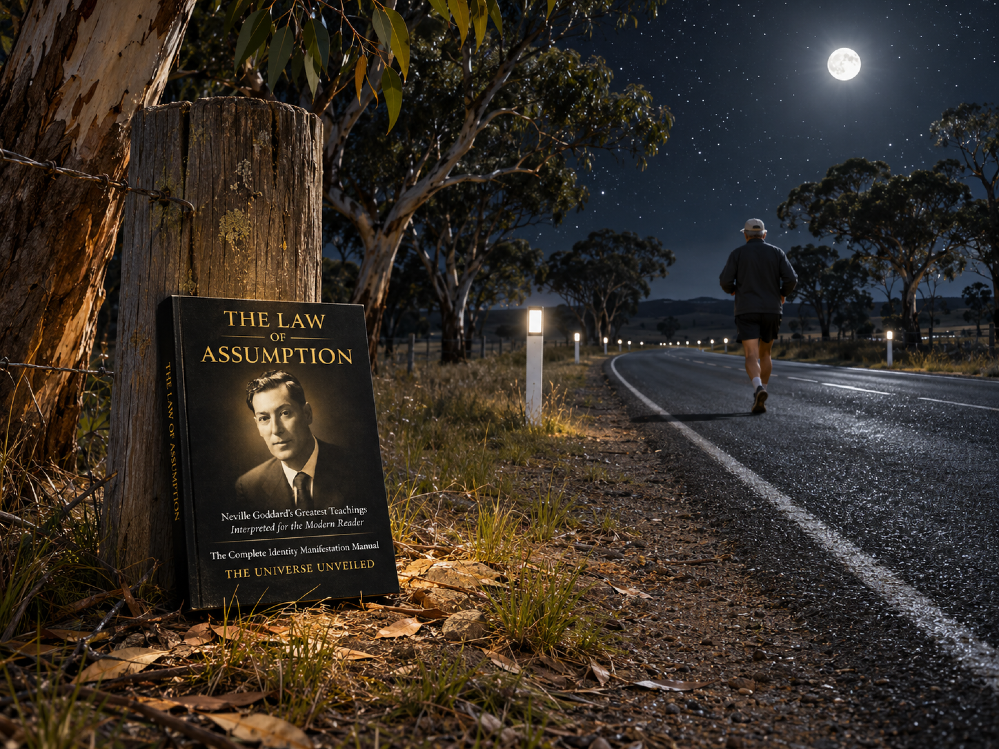
In 1983 Cliff Young, a 61-year-old sheep and potato farmer from Beech Forest in Victoria, won the first Sydney to Melbourne ultramarathon, 875 kilometres, about 10 hours ahead of the next runner. Every other runner followed the accepted plan of running by day and sleeping six hours a night. Cliff woke early by mistake, kept going, and never went back to that plan. The limit everyone obeyed turned out to be an assumption, not a law of the body. That is the heart of Neville Goddard's Law of Assumption: the limits you live inside are states you have accepted, and you can leave them.
The full method is in The Law of Assumption on Amazon Australia.
Worth Remembering
- Cliff grew up rounding up about 2,000 sheep on foot because his family could not afford horses. He never saw himself as too old to run.
- The professionals all slept six hours a night. Cliff woke at about 2 am by mistake, started running and took the lead.
- He finished in 5 days, 15 hours and 4 minutes. All six finishers beat the old Sydney to Melbourne record.
- The famous gumboots are partly myth. He arrived in overalls and work boots but ran in runners, and he had run marathons before.
- Most limits are limiting beliefs that everyone agrees on, until someone does not.
To practise this every day, start with The Law of Assumption and the guide on how to apply the Law of Assumption.
In Plain Words
Everyone in the race believed you had to stop and sleep. One man forgot to believe it, and he won. A lot of what holds you back works the same way: it is a rule that feels like a fact only because everyone around you follows it. Manifesting starts when you stop assuming the rule and start assuming the result. The steps are in how to apply the Law of Assumption.
For the whole practice, chapter by chapter: The Law of Assumption on Amazon Australia.
Featured Book

The Law of Assumption
Cliff Young won because nobody had convinced him he needed to stop. This book shows you how to spot the limits you have agreed to, and how to stop obeying them.
Get the BookAvailable in Kindle and Paperback — The Universe Unveiled
Most Australians have heard some version of it. A 61-year-old farmer turns up to the toughest footrace in the country, everyone laughs, and he beats the professionals from Sydney to Melbourne by running while they sleep. It is told in coaching talks and classrooms all over the world. It is also, in a few important places, not quite what happened.
This is the true story of Cliff Young, read as a lesson in the Law of Assumption that Neville Goddard taught: the limits you live inside are assumptions you have accepted, not facts about you. If you are reading on the web, a little runner is shuffling down the highway at the bottom of your screen, from Sydney to Melbourne. Watch what he does when night falls.
A Parable from Australia
The Man Who Didn't Stop to Sleep
Cliff Young, 1983, read with Neville Goddard.
A Boy Who Ran After Sheep
Albert Ernest Clifford Young was born in Victoria in 1922 and grew up on the family farm at Beech Forest, in the Otway Ranges. It was about 2,000 acres, with about 2,000 sheep. During the Great Depression the family could not afford horses, so the boy rounded up the stock on foot. When a storm came in, he said later, he could be out after the sheep for two or three days.
Nobody on that farm thought of it as training. It was just what had to be done. By the time Cliff was an old man, running for days was not a feat in his mind. It was a Tuesday.

The self-concept comes first
Neville taught that you can only act out what you already take yourself to be. That is the self-concept. Cliff did not think of himself as an old man attempting something impossible. He thought of himself as someone who runs after sheep until the job is done. That one assumption decided everything that happened in 1983.
Read the road sign: what you call ordinary
Some of what you find easy, other people consider impossible, and you have never noticed because to you it is just ordinary. Your strongest assumptions are the ones you never see as assumptions. Cliff's was simple: you keep going until the sheep are in.
Doctrine: what you take for granted about yourself is your real self-concept. Choose it on purpose.
The Start Line
On 27 April 1983 the first Westfield Sydney to Melbourne Ultramarathon started from Westfield Parramatta. The finish was 875 kilometres away, at Westfield Doncaster in Melbourne. The field was made up of serious ultrarunners who had trained carefully for it, with support crews ready along the road.
And then there was Cliff. He arrived in overalls and work boots, and he took his false teeth out because they rattled when he ran. Spectators assumed he was there to watch. When he picked up a race number, people laughed. He told reporters, simply:
“I believe I can run this race.”Cliff Young, 1983
He was 61 years old. Everyone else in the race was measuring him against their idea of what a runner looks like. Cliff was measuring himself against the sheep.
Read the road sign: when they laugh
Other people will always judge your goal against what they believe is possible for someone like you. That is their assumption, not yours. Cliff did not argue with the crowd. He did not need them to believe him. He only needed to keep believing himself.
Doctrine: other people's assumptions about you only work if you take them on.
The Shuffle
When the race started, the professionals ran. Cliff shuffled. He moved along with a slow, loping, low gait that looked almost comic beside the athletes, and by the end of the first day he was well behind. He said afterwards that he imagined he was chasing sheep, trying to get them in before a storm.
The plan every runner followed was the accepted wisdom of the sport: run for about 18 hours, then sleep for about 6. That night the field stopped, as planned, and lay down to rest.

The rule everyone agrees on
No law of nature said an ultrarunner had to sleep six hours a night. It was simply what everyone did, so everyone believed it. Most limiting beliefs work like that. They feel like facts because everyone around you obeys them.
Read the road sign: the slow start
Being behind at the end of the first day meant nothing. It only looks like failure if you judge the race by the first evening. Most assumptions look like they are losing early on. Persistence is simply refusing to judge the race before it is over.
Doctrine: do not judge the assumption by day one.
The Mistake That Won the Race
Here is the part the viral version leaves out. Cliff did not set out to run without sleep. He went to bed like everyone else. But he woke up by mistake at about 2 am, several hours early, and instead of going back to sleep he got up and started shuffling.
2:00 am
The field is asleep. One man is on the road.
While the others slept, he passed them. By the time they woke, he was in the lead. And having found out that the night was just more road, he made a decision nobody else in the race had considered: he would not go back to sleeping on the schedule. He kept going.
An assumption, exposed by accident
Cliff did not defeat the rule by arguing with it. He stepped outside it by accident, saw that nothing bad happened, and simply never stepped back in. That is how a state changes in Neville's teaching. You do not fight the old assumption. You find yourself standing in a new one, and you stay there.
Read the road sign: stay where you landed
Many people have a moment where the limit falls away, a good week, a lucky break, a night they felt completely sure. Then they go back to sleep, back to the old schedule, back to the old self. Cliff's genius was not waking early. It was refusing to go back to bed.
Doctrine: when you find yourself in the new state, do not return to the old one.
From Story to Practice
The Law of Assumption
The rule everyone follows, the night you wake early, the decision not to go back to sleep. This book turns each of them into a daily practice for living from the end.
See the BookAvailable in Kindle and Paperback — The Universe Unveiled
1:34 in the Morning
By now the whole country was following the farmer in the lead. Television and radio crews tracked him down the highway. Cliff kept shuffling, through the days and through the nights, and he reached the finish at Westfield Doncaster in the early hours of 3 May 1983, at about 1:34 am. Even the finish happened in the dark.
His time was 5 days, 15 hours and 4 minutes. He was about 10 hours ahead of the runner in second place. And he had finished almost two days faster than the previous Sydney to Melbourne record.
Then came the most telling detail of all. Every one of the six runners who finished that race beat the old record.
The record was never about the runners
The old record did not measure what a human body could do. It measured what people believed was reasonable. Put six runners in a race where the belief has been broken, and all six go past it. It is the same pattern as the four-minute mile: once one person shows the limit was an assumption, others follow.
Read the road sign: whose record are you running?
Most of the limits you work inside were set by somebody else's assumption about what is reasonable: in your family, your industry, your town. You can treat them as the edge of the map, or you can treat them as the old record.
Doctrine: a limit is only as real as the assumption holding it up.
A Lot of Potatoes
The winner's prize was 10,000 dollars. Cliff said he had not known there was any prize money at all, and he did not feel right keeping it, because the other runners had worked just as hard as he had. So he gave 7,000 dollars of it away to the other finishers and kept 3,000.
“That's a lot of potatoes.”Cliff Young, on the prize
He had not run for money. The end he had assumed was arriving in Melbourne, not a cheque. When the cheque came, it was almost an afterthought.
Living in the end
Neville taught that you should assume the state, not chase the things that come with it. When you live from the end, the extras arrive as side effects. Cliff assumed he was a man who would finish, and everything else, including the money, followed that.
Read the road sign: the real end
Ask what the real end is behind what you want. Often it is not the money but the feeling of being the person who did the thing. Assume that, and the money stops being the finish line and becomes part of the scenery.
Doctrine: assume the state, not the souvenir.
The Gumboots That Weren't
If you have heard this story in a motivational talk, you probably heard that Cliff ran the whole way in gumboots, that he had never raced before, and that he never slept at all. The true version is a little different. He turned up in overalls and work boots, but he ran in a pair of new runners someone had given him. He had run the Melbourne Marathon several times, with a best of 3 hours, 2 minutes and 53 seconds at the age of 58. And the year before, he had tried to break a 1,000-mile record and given up after about 805 kilometres. He wrote later that he and his crew had been inexperienced and ill-prepared.
Today there is a memorial to him in Beech Forest, and it is shaped like a gumboot. The myth has literally been cast in his hometown.
Why the myth matters
People keep telling the gumboot version because they want proof that the limit was never real. But the true story is the more useful one. Cliff had failed the year before. He came back, assumed he would finish this time, and did. Failure was not the end of his assumption. It was part of the road.
Read the road sign: the year before
Behind almost every overnight success is a failed attempt nobody tells you about. Cliff's 1982 attempt ended at about 805 kilometres. In 1983 he went 875 and won. If your last attempt fell short, that is not evidence against your assumption. It is the first 805 kilometres.
Doctrine: a failed attempt is not a verdict. Assume again.
Your Melbourne
Cliff Young received the Medal of the Order of Australia in 1984 for his long-distance running. He kept running for years, and at 75 he set out to run around Australia. He died in 2003, aged 81. His shuffle is still used by ultrarunners because it wastes so little energy.

But the reason his story travels is the one sentence at the centre of it. Everyone in the race believed you had to stop. One man forgot to believe it. Everyone has a Melbourne, and almost everyone has a rule about when they have to stop and rest before they can get there. The question is not whether the rule is sensible. It is whether it is yours.
Before you go
Pin On Your Number
Nothing is written here and nothing is saved. Think of one rule you have been obeying about your own goal: you are too old, it is too late, you have to wait, you have to rest first. Now picture yourself already across the line, and say one sentence to yourself in the present tense.
“Nobody told me I had to stop.”
Fall asleep tonight in that sentence. Tomorrow, keep shuffling.
Go Deeper
The Law of Assumption
Cliff Young never stopped to ask permission from the rule. This book shows you how to assume your own finish line and keep going until the world catches up.
Read The Law of AssumptionAvailable in Kindle and Paperback — The Universe Unveiled
Cliff Young's True Story and the Law of Assumption: Frequently Asked Questions
Who was Cliff Young?
Cliff Young was a farmer from Beech Forest in Victoria who, at 61, won the first Westfield Sydney to Melbourne Ultramarathon in 1983. He grew up rounding up sheep on foot, ran marathons in his late fifties, and became a national figure after beating a field of younger professional ultrarunners over 875 kilometres.
Did Cliff Young really run in gumboots?
Not in the race itself. He arrived in overalls and work boots, but ran in a pair of new runners someone had given him. The gumboot image comes from his years running after stock on the farm, and a gumboot-shaped memorial now stands in his honour in Beech Forest.
Did Cliff Young really not sleep during the race?
The other runners followed the accepted plan of running about 18 hours and sleeping about 6. Cliff went to bed on the first night but woke by mistake at about 2 am, started running and took the lead. After that he chose not to return to the six-hour sleep schedule and kept going through the nights.
How long did it take Cliff Young to run from Sydney to Melbourne?
He ran the 875 kilometres from Westfield Parramatta to Westfield Doncaster in 5 days, 15 hours and 4 minutes, finishing about 10 hours ahead of second place and almost two days inside the previous Sydney to Melbourne record. All six finishers beat the old record.
What did Cliff Young do with the prize money?
He said he had not known there was a prize. He felt the other finishers had worked just as hard, so he gave 7,000 dollars of the 10,000 dollar prize to them and kept 3,000.
What is the Cliff Young shuffle?
It is the slow, low, loping gait Cliff used over the whole race. He said he imagined he was chasing sheep to beat a storm. Several later ultramarathon runners adopted the Young Shuffle because it uses less energy over very long distances.
What does Cliff Young teach about the Law of Assumption?
That most limits are shared assumptions rather than facts. Every runner assumed they had to sleep six hours a night; Cliff stepped outside that assumption by accident and never went back. Neville Goddard taught the same thing about every limit you live inside: it is a state you have accepted, and you can leave it. See the Law of Assumption for the full teaching.
How can I apply the Cliff Young lesson to my own manifestation?
Name one rule you obey about your goal, such as being too old, too late or not ready. Notice that it is an assumption everyone around you shares. Then assume the finish instead: picture yourself already there and fall asleep in that feeling. The full steps are in how to apply the Law of Assumption.