The Four-Minute Mile: How One Broken Limit Changes What Everyone Believes
For years, the four-minute mile seemed out of reach. Then on May 6, 1954, Roger Bannister ran it, and 46 days later John Landy did too. The story is more complicated than the legend, but its lesson is real: when one person proves a limit wrong, it changes what everyone else believes is possible.

The Short Version
Roger Bannister ran the first sub-four-minute mile on May 6, 1954, and John Landy broke it again just 46 days later, after the record had stood for nine years. The popular version exaggerates how "impossible" it seemed, but the lesson holds: once one person proves a limit wrong, others find it far easier to follow. It is the opposite of the flea in a jar, showing how a lid comes off rather than how it forms.
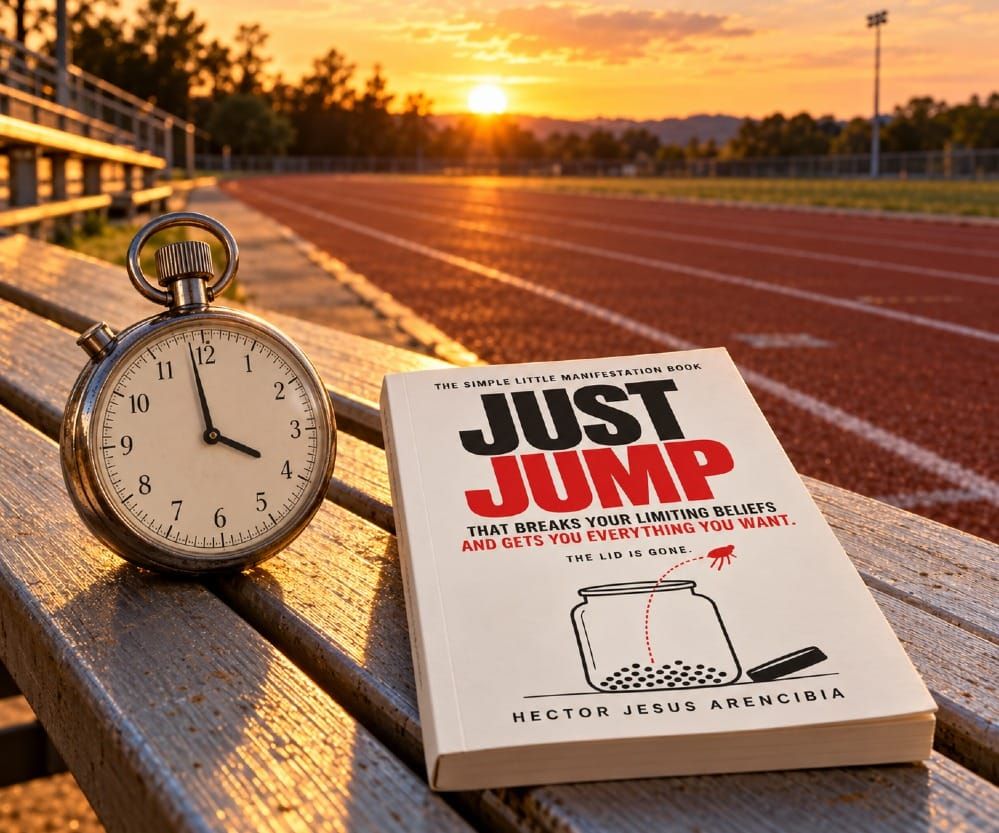
To find the proof you need and run your own mile, read Just Jump on Amazon.
Key Takeaways
- Bannister ran 3:59.4 in Oxford on May 6, 1954.
- John Landy ran about 3:58 just 46 days later.
- Seeing someone like you succeed is one of the strongest ways beliefs change, a finding from psychologist Albert Bandura.
- Other people's success can be your evidence instead of your envy, the opposite of crab mentality.
- Most limiting beliefs already have a Bannister somewhere.
The three simple steps to run your own mile are in Just Jump.
In Plain Words
For years, nobody could run a mile in under four minutes. Then one man did it, and within weeks another man did too. Their legs didn't change. What changed was that everyone now knew it could be done.
That is how most limits break: not by thinking harder, but by seeing proof. Neville Goddard taught that what you assume is possible shapes what you experience.
Just Jump shows you how to find your proof and take your first step in a few minutes a day.
Every Limit Looks Permanent Until Someone Crosses It

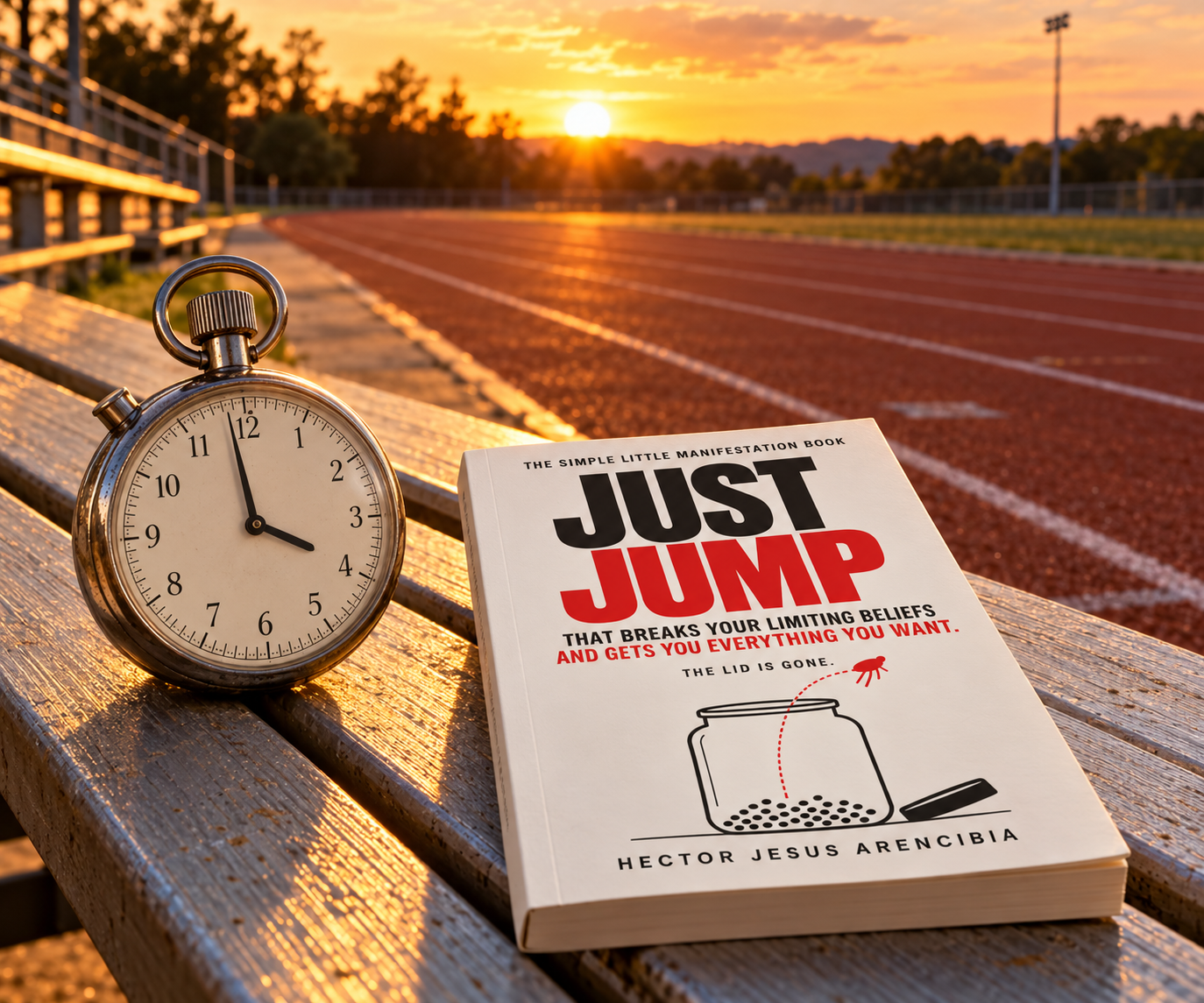
Just Jump
The simple little manifestation book that breaks your limiting beliefs and gets you everything you want.
Read Just Jump on AmazonAvailable on Amazon
Every other story in this series is about how a limit forms. The fleas learn their lid. The elephant learns its rope. The pike learns its glass. The crabs learn to hold each other down. The four-minute mile is the story of what happens next: how a limit breaks, and why, once it breaks for one person, it suddenly breaks for many. It is also a perfect real-world picture of what Neville Goddard taught about assumption, that what we accept as possible quietly decides what we attempt. Here is the true story, what the popular version gets wrong, the psychology of why proof works, and how to borrow someone else's proof for your own life.
The Four-Minute Mile Story
In 1945, Swedish runner Gunder Hägg set the mile world record at 4:01.4. Then the record stopped moving. For nine years, some of the best runners in the world chased the four-minute mark, and none of them reached it. The number took on a kind of mythology. It began to look less like a time and more like a wall.
On May 6, 1954, on a windy evening at Iffley Road track in Oxford, a 25-year-old medical student named Roger Bannister lined up with two friends, Chris Brasher and Chris Chataway, who paced him through the early laps. He crossed the line in 3:59.4. The wall was gone.
Just 46 days later, in Turku, Finland, Australian runner John Landy ran about 3:58, breaking Bannister's new record. That August, at the British Empire and Commonwealth Games in Vancouver, Bannister and Landy met in what became known as the Miracle Mile, and both finished under four minutes in the same race.
A barrier that had stood for nine years had been broken three times in three months.
What the Legend Gets Wrong, and What It Gets Right
You may have heard that doctors declared the four-minute mile physically impossible, or warned that a runner's heart would burst trying. That part is mostly legend. By the early 1950s, several runners, including Landy and the American Wes Santee, were closing in, and many people in the sport expected the barrier to fall soon. Better training, pacing, and conditions all played a part.
So the story isn't really about a law of physics being broken. It's about something subtler and more useful. A limit that had held for nine years fell twice in seven weeks, and then kept falling. Ten years later, in 1964, Jim Ryun became the first high school student to run a sub-four-minute mile. Today, well over a thousand men have done it.
The runners didn't suddenly get new legs in 1954. What changed was the evidence. Before Bannister, four minutes was a question. After Bannister, it was a fact.
The Bannister Effect: How Proof Changes Belief
The idea that one person's breakthrough makes it easier for others to follow is sometimes called the Bannister effect. Psychology has a well-researched explanation for why it works.
In 1977, psychologist Albert Bandura introduced the idea of self-efficacy: your belief in your own ability to succeed at something. He identified several sources of that belief. The strongest is your own past success. But close behind is what he called vicarious experience: seeing someone similar to you succeed. When someone like you does it, your mind quietly updates its estimate of what you can do.
That is exactly what Bannister gave every other miler in 1954. Not motivation. Evidence.
A limiting belief is rarely broken by argument. It is broken by proof.
Key Definitions
The four-minute mile: Running one mile in under four minutes, first achieved by Roger Bannister on May 6, 1954, in 3:59.4, after the world record had stood at 4:01.4 since 1945.
The Bannister effect: The pattern in which a long-standing limit becomes easier for others to break once one person has proven it can be done.
Self-efficacy: Albert Bandura's term, introduced in 1977, for a person's belief in their own ability to succeed at a specific task.
Vicarious experience: Gaining belief in your own ability by watching someone similar to you succeed.
Borrowed proof, as we define it: At The Universe Unveiled, we define borrowed proof as using another person's breakthrough as evidence that your own limit is a belief, not a law.
Why Proof Works When Positive Thinking Doesn't
Most people try to change a limiting belief by repeating a new sentence over it. It rarely holds, because the old belief was built on evidence, and a sentence alone isn't evidence.
The research on learned helplessness points in the same direction. When psychologists Steven Maier and Martin Seligman revisited their famous work in 2016, they concluded that what the brain actually learns from experience is control, the knowledge that effort works. Beliefs shift when the mind is given new evidence.
There are two ways to get that evidence. You can gather it yourself, one small success at a time. Or you can borrow it from someone who has already crossed the line. The four-minute mile shows how powerful the second way can be.
The Reverse of Every Parable
Each parable in this series describes a different lid. The flea in a jar is a limit that has been removed but is still remembered. The elephant and the rope is a limit you've outgrown. Pike syndrome is an opportunity you've stopped seeing. Crab mentality is a limit other people hold in place.
The four-minute mile is the answer to all of them. It shows that the lid, the rope, the glass, and the bucket can all be broken by the same thing: someone crossing the line and proving it was never a law.
It also offers a direct alternative to crab mentality. When someone around you succeeds, you have two choices. You can treat it as a threat and pull them back. Or you can treat it as proof and follow them. Envy says, "Why them?" Borrowed proof says, "Then why not me?"
Find Your Proof
Someone has already run your mile.
Just Jump includes a day devoted to finding the proof that your limit was never a law, inside a simple seven-day plan you can start tonight.
Get Just JumpAvailable on Amazon
Your Own Four-Minute Miles
Every life has its own four-minute miles. They are the lines that feel impossible for you, even though other people cross them every day.
Being the first in your family to finish a degree. Earning more than your parents ever did. Starting a business after forty. Leaving a job everyone told you was "secure." Finding love after a divorce. Writing the book. Moving to the city you've always dreamed of.
For almost every one of these, there is a Bannister somewhere, someone who started where you are and crossed the line anyway. Very often, there are thousands. The limit feels like a wall only because you haven't looked at the people already on the other side. For the most common beliefs that make these lines feel impossible, see limiting beliefs examples.
The Four-Minute Mile Through the Law of Assumption
Neville Goddard taught that an assumption, persisted in, hardens into fact. For nine years, the running world held the assumption that four minutes was out of reach, and it hardened into something that felt like a law. The moment one person's experience contradicted that assumption, it lost its power.
The Law of Assumption suggests you don't have to wait for your own Bannister moment to change your assumption. You can use someone else's success as proof that your limit is a belief, and then use your imagination to live from the other side of it. Each night in the state akin to sleep, picture a short scene that could only happen after you've crossed your line. You are giving your mind the experience of your own four-minute mile before your body runs it. Over time, that new assumption reshapes your identity from the inside.
How to Borrow Someone Else's Proof
1. Name your four-minute mile
Write down the one line that feels impossible for you right now. Be specific. Not "more money," but the number. Not "a better career," but the role.
2. Find your Bannister
Look for someone who crossed that exact line, ideally someone who started somewhere similar to you. Read their story, watch their interviews, learn what they did. The more similar they are to you, the stronger the proof.
3. Study, don't compare
Comparison asks, "Why not me?" in a bitter voice. Study asks it in a curious one. Look at their path for evidence and ideas, not for reasons to feel behind.
4. Rehearse your own crossing
Each night before sleep, replay one short scene from the other side of your line. Feel the relief of it being done. This turns borrowed proof into your own inner experience.
5. Run one small race
Take one real step toward your line today, something small enough that you are almost certain to succeed. Each success adds your own evidence to the evidence you borrowed.
6. Become someone else's proof
Once you cross your line, tell the story. Somewhere, someone is staring at the same wall you were, waiting for their Bannister. It might be you.
Stories That Teach the Same Lesson
The four-minute mile is the hopeful ending to a family of stories about limits: the fleas in the jar, the elephant held by a small rope, the pike that stops hunting, and the crabs that pull each other down. For the psychology under all of them, see learned helplessness.
Common Misconceptions About the Four-Minute Mile
"Doctors said it was physically impossible." This is mostly legend. Several runners were close, and many experts expected the barrier to fall. The real story is about how quickly others followed once it did.
"Belief alone broke the barrier." Bannister trained hard, used pacers, and chose his moment. Belief didn't replace the work. It made the work feel worth doing.
"Someone else's success says nothing about mine." Research on self-efficacy shows the opposite. Seeing someone similar to you succeed is one of the most reliable ways belief in your own ability grows.
"I need to be exceptional to break a barrier." Most barriers aren't broken by the exceptional. They're broken by ordinary people who simply stopped believing the wall was real.
The Universe Unveiled Glossary
The four-minute mile: A mile run in under four minutes, first achieved by Roger Bannister in 1954.
The Bannister effect: A limit becoming easier to break once one person proves it can be done.
Self-efficacy: Belief in your own ability to succeed at a specific task.
Vicarious experience: Gaining belief by watching someone like you succeed.
Borrowed proof: Using another person's breakthrough as evidence that your limit is a belief, not a law.
Assumption: In Neville Goddard's teaching, an idea accepted as true, which in time hardens into fact.
Someone Has Already Run Your Mile
On the evening of May 6, 1954, the four-minute mile stopped being a wall and became a finish line. Nothing about the track changed. Nothing about the distance changed. The only thing that changed was what people knew was possible.
Whatever line feels impossible to you right now, someone, somewhere, has almost certainly crossed it. Find them. Borrow their proof. Then run your own race.
Every limit looks permanent until someone crosses it. Then it's just a finish line.
Run Your Own Mile
Just Jump
Turn someone else's proof into your own breakthrough, with three simple jumps you can start tonight.
Get Your Copy on AmazonAvailable on Amazon
Four-Minute Mile FAQ: Bannister, Landy, and Breaking Limiting Beliefs
Who ran the first four-minute mile?
Roger Bannister ran the first sub-four-minute mile on May 6, 1954, at Iffley Road track in Oxford, finishing in 3:59.4 with the help of pacers Chris Brasher and Chris Chataway.
How long after Bannister did someone else break four minutes?
Just 46 days later. Australian runner John Landy ran about 3:58 in Turku, Finland, on June 21, 1954, breaking Bannister's new world record.
Did doctors say the four-minute mile was impossible?
That claim is mostly legend. By the early 1950s several runners were close to the mark and many in the sport expected it to fall. The lasting lesson is how quickly others followed once it was broken.
What is the Bannister effect?
The Bannister effect is the pattern in which a long-standing limit becomes easier for others to break once one person has proven it can be done. It is named after Roger Bannister's 1954 sub-four-minute mile.
What does the four-minute mile teach about limiting beliefs?
It shows that many limits are beliefs rather than laws, and that beliefs change most reliably through evidence. Seeing someone similar to you succeed, which psychologist Albert Bandura called vicarious experience, is one of the strongest ways to build belief in your own ability.
How many people have run a sub-four-minute mile?
Well over a thousand men have now run a mile in under four minutes. In 1964, Jim Ryun became the first high school student to do it.
How can I use the four-minute mile lesson in my own life?
Name the line that feels impossible to you, find someone similar to you who has crossed it, study their path without comparing, rehearse your own success in imagination, and take one small real step. The book Just Jump turns this into three simple daily steps.
How is the four-minute mile related to the flea in a jar?
The flea in a jar shows how a limit forms and persists after it is gone. The four-minute mile shows how a limit breaks: once one person crosses it, others discover it was never a law.
Read more

The Strange Japanese Ritual That Shows Why Your Wishes Stall
In Japan, you paint one eye on a daruma doll when you make a wish and the second when it comes true. Through Neville Goddard's Law of Assumption, a year of looking at a one-eyed face is a year of rehearsing "not yet." Here's how to paint the second eye first, so your wishes actually come true.

だるまの目入れの本当の意味:両目はいつ入れるべきか
願いを込めて片目を入れ、叶ったらもう片目を入れる。だるまの目入れは、日本でもっとも身近な願掛けのひとつです。けれど想定の法則から見ると、片目のまま一年を過ごすことは、毎日「まだ叶っていない」を確かめることでもあります。達磨大師の由来、目入れの順番、七転び八起きの本当の意味から、ネヴィル・ゴダードの教えと今日から使える実践までを解説します。

鯉の滝登りの本当の意味:鯉はなぜ竜になれたのか
激流の滝を登りきった鯉は、竜になって天へ昇る。中国の故事に由来する『鯉の滝登り』は、努力と根性の象徴として語られてきました。けれど物語を読み直すと、鯉は登ったから竜になったのではなく、すでに竜として登っていたことが見えてきます。登竜門と点額、及ばぬ鯉の滝登り、鯉のぼりの由来から、ネヴィル・ゴダードの想定の法則、そして今日から使える実践までを解説します。

蜘蛛の糸の本当の教訓:カンダタの糸はなぜ切れたのか
お釈迦さまが地獄へ垂らした一本の蜘蛛の糸。カンダタは途中まで登りながら、下から続く罪人たちに「下りろ」と叫んだ瞬間に落ちていきました。糸が切れたのは、カンダタがぶら下がっていたその場所でした。芥川龍之介『蜘蛛の糸』のあらすじと従来の教訓から、ネヴィル・ゴダードの想定の法則、そして欠乏の思い込みを手放す実践までを解説します。