The Flea in a Jar Experiment: What It Really Means (and Why It's About You)
Put fleas in a jar with the lid on and they learn to jump just below it. Take the lid off and they still don't escape. The story is half legend, half real psychology, and it explains exactly why so many people keep living below a ceiling that disappeared years ago.


The Short Version
The flea in a jar experiment is a famous parable: fleas kept under a lid learn to jump just below it, and keep doing so after the lid is removed. It isn't a documented study, but it mirrors real research on learned helplessness. The lesson is simple. Most of the limits you feel are old lids that are no longer there.
For the simple method to get out of your own jar, read Just Jump on Amazon.
Key Takeaways
- The flea jar is a parable, not a lab result, but its lesson is backed by decades of psychology.
- The fleas stop jumping high because of a past limit, not a present one.
- People do the same with money, love, worth, and time. See the most common limiting beliefs.
- Research suggests what gets learned is control, so one successful jump can start reversing the pattern.
- The same lesson appears in the elephant and the rope and pike syndrome.
The full three-step method is in Just Jump.
In Plain Words
Imagine being told "no" so many times that you stop asking. Years later, the people saying no are long gone, but you still don't ask. That is the flea in the jar. The jar is open. You just haven't jumped yet.
It is the same principle Neville Goddard taught in the Law of Assumption: what you assume about yourself hardens into the life you live.
Just Jump shows you how to take the first jump in a few minutes a day.
The Book Built on This Story

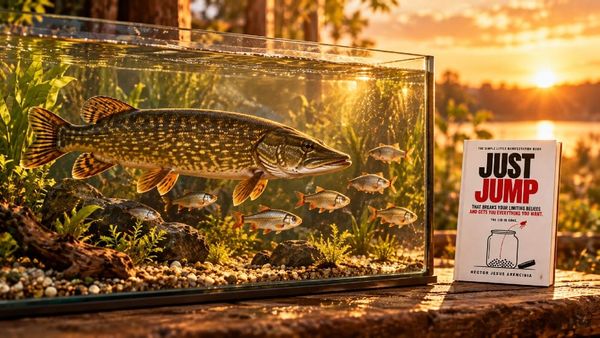
Just Jump
The simple little manifestation book that breaks your limiting beliefs and gets you everything you want.
Read Just Jump on AmazonAvailable on Amazon
Few stories in personal development travel as far as the flea in a jar experiment. It gets told in classrooms, sales meetings, and a thousand short videos, because it explains something most people feel and can't name: the sense of living under a ceiling you can't see. It also describes, almost perfectly, what Neville Goddard taught about assumptions hardening into fact. Here is the story, the honest answer to whether it's real, the psychology that backs it up, and what it means for the life you're living right now.
The Flea in a Jar Experiment, Told Simply
The story goes like this. For its size, a flea is one of the strongest jumpers in the animal kingdom. Put a few fleas in an open glass jar and they are out in a single leap.
Now screw a lid onto the jar. The fleas jump, hit the lid, and fall. They jump again and hit it again. After a while, they adjust. They begin jumping just high enough to stop short of the lid, so they never feel it again.
Then the lid is removed. The jar is wide open. And the fleas stay inside, jumping to the exact height where the ceiling used to be. In the most popular versions, even their offspring jump to that same height, having learned the limit from the fleas around them.
The lid is gone. The limit is not. It has simply moved from the glass into the flea.
Is the Flea in a Jar Experiment Real?
The honest answer: it is half legend, half truth. There is no well-known published study documenting fleas behaving exactly the way the story describes, and most versions are retold without any source. The flea jar is best understood as a parable, the same way the elephant and the rope is a parable.
But the principle underneath it is very real, and it has been studied for more than half a century.
The Science Behind the Story: Learned Helplessness
In 1967, psychologists Martin Seligman and Steven Maier at the University of Pennsylvania ran a series of experiments that became some of the most cited in psychology. Dogs that had been exposed to mild shocks they could not escape were later placed in a situation where escape was easy. Many of them didn't even try. They had learned that nothing they did mattered. Seligman called this learned helplessness.
The flea story is learned helplessness in miniature: a creature fully able to leave, held in place by an experience that no longer exists.
In 2016, almost fifty years later, Maier and Seligman revisited their own work with the help of modern neuroscience and reached a striking conclusion. Passivity in the face of prolonged pain, they found, is the brain's default setting. What actually gets learned, when a creature has the chance, is the opposite: that its actions work.
That changes how you read the flea jar. The flea doesn't need to be taught freedom. It needs one jump that clears the rim, one piece of evidence that the ceiling is gone. Learned helplessness is not a lack of ability. It is a lack of evidence. We go further into the research in our guide to learned helplessness and how to reverse it.
Key Definitions
The flea in a jar experiment: A widely told parable in which fleas kept under a lid learn to jump below it and continue doing so after the lid is removed. It is used to show how past limits become internal limits.
Learned helplessness: A psychological state, first described by Martin Seligman and Steven Maier, in which repeated experiences of having no control lead a person or animal to stop trying, even after control becomes possible.
Limiting belief: A conclusion drawn from past experience, such as "I can't" or "people like me don't," that keeps governing behavior after the circumstances that produced it have changed.
The lid: At The Universe Unveiled, we define the lid as the internal ceiling an old experience leaves behind: a limit that no longer exists outside you, but still sets the height of every jump you make.
How the Lid Forms in a Human Life
You were born a jumper. Watch any small child. They want everything, and they fully expect to have it. Then life starts tapping the lid.
A lid is almost never built in one moment. It is built in stages:
- Something happens. You fail, get rejected, or someone you trust tells you what you can't do.
- You feel the tap. It stings, embarrasses, or frightens you.
- You draw a conclusion. Not "that didn't work this time," but "I can't" or "people like me don't."
- You stop testing it. You jump a little lower so you never feel the sting again.
- The conclusion becomes "just the way things are." Years later, you don't remember where it came from. It simply feels like the truth.
Neville Goddard described this exact process in a single phrase: assumptions harden into fact. The Law of Assumption works in both directions. The same mechanism that keeps you jumping low can be used to raise the height you live at, which is why your self-concept, not your circumstances, sets the ceiling. It is the mechanism explored in depth in the subconscious identity system.
Get Out of the Jar
The fleas needed one jump. So do you.
Just Jump turns this story into three simple daily steps and a seven-day starter plan you can begin tonight.
Get Just JumpAvailable on Amazon
The Five Lids Most People Carry
Every jar is different, but most lids are built from the same few materials. One of these will feel familiar.
The money lid. "Money doesn't grow on trees." "We're not that kind of family." If you grew up hearing these, you may notice that every time money comes in, something sends it right back out. That is not bad luck. That is a jump back down to the height where you feel at home, and it usually traces back to childhood money programming.
The love lid. "People always leave." "I'm too much." This lid doesn't stop love from arriving. It stops you from letting it stay.
The worth lid. "Who am I to want that?" It is the quietest lid and the strongest one. You feel it every time you lower your price or shrink your dream.
The time lid. "It's too late for me." The fleas never lost their ability to jump. They only forgot it.
The "people like me" lid. "Nobody in my family ever has." This one wasn't even built by you. It was handed down, jar to jar. Somebody has to be the first one out.
For a full list of the beliefs that most often set the ceiling, see limiting beliefs examples and how to spot yours.
Other Stories That Teach the Same Lesson
The flea jar belongs to a small family of stories about conditioning. Each one shows the lid from a different angle.
The elephant and the rope. A calf is tied to a small stake. It pulls and fails until it stops trying. As a full-grown elephant, it could rip the stake out with ease, and it never does. Read the full elephant and the rope story.
The pike and the glass wall. A pike is placed in a tank with small fish behind a clear partition. After striking the glass again and again, it stops hunting. When the glass is removed, it lets its food swim right past. This is known as pike syndrome.
Crabs in a bucket. One crab could climb out easily, but the others pull it back down. Sometimes the lid isn't yours at all. It belongs to the people around you, which is the pattern behind crab mentality.
The four-minute mile. For years, running a mile in under four minutes was treated as a human limit. On May 6, 1954, Roger Bannister did it. Just 46 days later, John Landy did it too. The lid came off the moment one person proved it was gone, a pattern we trace in the four-minute mile and limiting beliefs.
The Flea in a Jar vs. the Upper Limit Problem
These ideas are related, but they are not the same thing. The flea in a jar describes how a ceiling gets installed. The upper limit problem describes what happens when you rise above that ceiling and something in you pulls you back down, a pattern we explore in luxury guilt and the upper limit on receiving.
The flea jar is the lid. The upper limit problem is the snap-back. And the heavy, closed-in feeling of living under that lid for years is its own experience, the one we write about in feeling spiritually trapped.
Understanding the difference matters. If you keep reaching a certain level and falling back, look at the snap-back. If you never reach for the level at all, look at the lid. And if your manifestations seem to stall no matter what you do, start with why your manifestation isn't working.
Common Misconceptions About the Flea in a Jar Story
"It's a proven scientific experiment." It isn't. The flea jar is a parable. The part that is proven is the psychology it illustrates: learned helplessness.
"The fleas lost the ability to jump." Nothing about their legs changed. What changed was the height they believed was possible. The same is true of you.
"You have to break the lid." You don't. The lid is already gone. What's required is not a fight but a jump.
"Understanding your lid is enough." Insight alone doesn't clear the rim. Only a higher jump gives your mind the evidence that the ceiling is gone.
"It takes years to undo." Some lids fall with a single jump. The fleas needed days to learn their limit, and unlearning it can happen just as quickly.
How to Jump Out of Your Own Jar
If the lid lives in the mind, the way out starts there too. In Just Jump, the method comes down to three simple jumps.
Jump One: Find your lid. Write down what you want, then finish the sentence "I can't have this because..." Whatever comes next is your lid. Most lids fall apart the moment you ask whether they are still true today.
Jump Two: Jump from the top. As you drift toward sleep each night, replay one short scene that could only happen after your wish comes true. This draws on the state akin to sleep, the drowsy window Neville Goddard called the most receptive moment of the day.
Jump Three: Live outside the jar. Each day, do one small thing the free version of you would do. It doesn't need to be big. It only needs to be higher than yesterday's jump.
The book walks through each jump in detail, with a seven-day starter plan and a one-page Jump Card to keep with you.
The Universe Unveiled Glossary
Flea in a jar effect: The tendency to keep living within a limit after the limit itself has disappeared.
The lid: The internal ceiling left behind by an old experience.
The rim: The point where an old limit ends and new evidence begins. Clearing it once changes what feels possible.
The jump: Any small action taken above your old height.
Learned helplessness: The state of giving up after repeated experiences of having no control.
Limiting belief: An old conclusion that still governs present behavior.
State akin to sleep: The drowsy state before sleep in which, according to Neville Goddard, new assumptions impress most deeply on the subconscious.
The Jar Is Already Open
Somewhere right now there is a jar with its lid lying on the ground beside it. Inside, the fleas are jumping to the same old height, waiting for a ceiling that isn't there.
You don't have to be one of them. The teacher who doubted you is gone. The failure is years behind you. The only place that lid still exists is in your mind, and a mind can be changed with a single jump.
The lid came off long ago. All you have to do is jump.
Your Jar Is Already Open
Just Jump
One story, one truth, and three simple jumps. Read it in under an hour. Start tonight.
Get Your Copy on AmazonAvailable on Amazon
Flea in a Jar Experiment FAQ: Meaning, Science, and Learned Helplessness
What is the flea in a jar experiment?
The flea in a jar experiment is a well-known parable. Fleas kept in a jar with a lid learn to jump just below it, and when the lid is removed they keep jumping to the same height and never escape. It is used to show how past limits become internal limits.
Is the flea in a jar experiment real?
The story is best treated as a parable rather than a documented study, since most versions circulate without a source. The principle behind it is real, however, and is supported by decades of research on learned helplessness, beginning with Martin Seligman and Steven Maier in 1967.
What does the flea in a jar story teach about people?
It teaches that many human limits are memories rather than facts. A rejection, a failure, or a warning repeated in childhood sets a ceiling, and people keep living below it long after the circumstances that created it are gone.
How is the flea in a jar related to learned helplessness?
Learned helplessness is the psychological pattern the story illustrates. When effort repeatedly seems pointless, people and animals stop trying, even once escape becomes possible. Later research by Maier and Seligman found that what can be learned is control, which means one successful attempt can begin to reverse the pattern.
How do you get out of your own jar?
Name the belief that is setting your ceiling, ask whether it is still true today, and then act one step above your old limit. Each small jump gives your mind evidence that the lid is gone. The book Just Jump lays this out as three simple daily steps.
What is the difference between the flea in a jar and the upper limit problem?
The flea in a jar describes how an internal ceiling is installed. The upper limit problem describes what happens when you rise above that ceiling and unconsciously pull yourself back down. One is the lid, and the other is the snap-back.
Is the elephant and the rope story the same lesson?
Yes. In that parable, an elephant tied to a small stake as a calf never tries to pull free as an adult, even though it easily could. Like the fleas, it is held by the memory of a limit rather than the limit itself.
What book is based on the flea in a jar story?
Just Jump is a short manifestation book built entirely on the flea in a jar story. It explains how limiting beliefs form and gives a simple three-step method and a seven-day plan for living beyond them.