Pike Syndrome: The Fish That Starved Beside Its Food, and What It Means for You
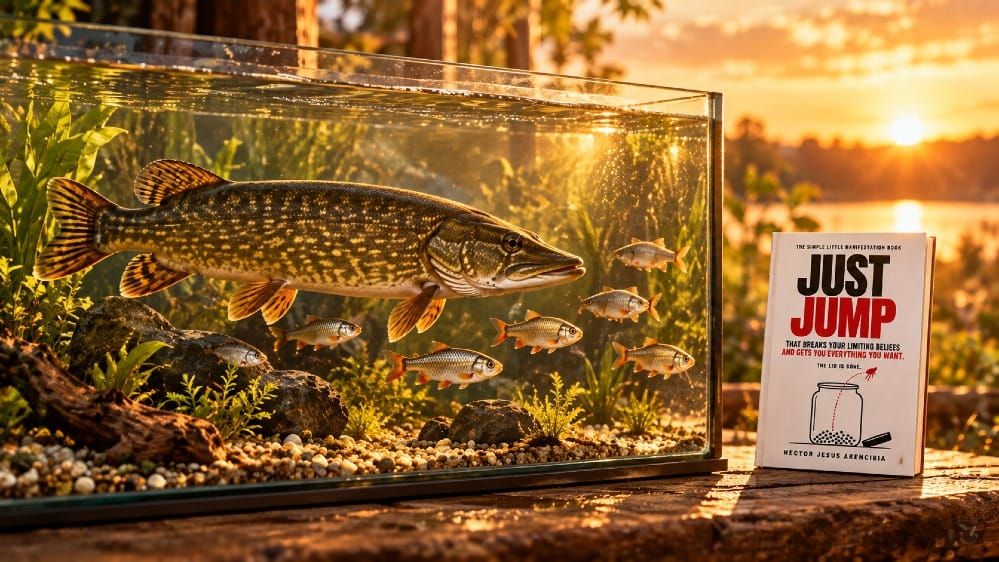
Put a hungry pike in a tank with small fish behind a glass wall. It strikes the glass until it gives up. Remove the glass and it lets its food swim right past. Pike syndrome explains why so many people miss opportunities in plain sight, and the story is rooted in a real 1900 experiment.

The Short Version
Pike syndrome describes what happens when a pike, separated from small fish by a glass wall, strikes the glass until it gives up, then keeps ignoring the fish after the glass is removed. It is used to describe people who stop pursuing opportunities after early failures and no longer notice them, even when they are right in front of them. The story is rooted in a real experiment published in 1900, and it is part of the same family as the flea in a jar.
To start seeing and taking the opportunities around you, read Just Jump on Amazon.
Key Takeaways
- Pike syndrome is giving up on something so completely that you stop seeing it.
- A documented version was published by psychologist Norman Triplett in 1900.
- It is a form of learned helplessness that shows up as missed opportunities.
- Its most common phrase in daily life: "We tried that already."
- Its cousin, the elephant and the rope, is about limits you've outgrown.
The three steps to start striking again are in Just Jump.
In Plain Words
Imagine trying for something again and again and hitting a wall every time. Eventually you stop trying. Then one day the wall disappears, but you never find out, because you stopped looking. That is pike syndrome. The thing you wanted is swimming right past you.
In Neville Goddard's teaching, the events that lead to your desire form a bridge of incidents. Pike syndrome is what makes people walk right past that bridge.
Just Jump shows you how to look again and strike, in a few minutes a day.
The Glass Is Already Gone

Just Jump
The simple little manifestation book that breaks your limiting beliefs and gets you everything you want.
Read Just Jump on AmazonAvailable on Amazon
Some limits stop you from moving. Others stop you from seeing. Pike syndrome is the second kind, and it may be the most expensive limit a person can carry, because it doesn't feel like a limit at all. It feels like realism. It sounds like "we tried that already." And it quietly lets the very thing you want swim right past you. It is also one of the clearest pictures of what Neville Goddard meant when he taught that we see the world through our assumptions. Here is the experiment, the real science behind it, and how to start striking again.
The Pike Syndrome Experiment, Told Simply
A pike is a fast, powerful predator. Put a hungry one in a tank with small fish and it will hunt them without hesitation.
Now slide a clear glass wall down the middle of the tank, with the pike on one side and the small fish on the other. The pike sees its food and strikes. It hits the glass. It strikes again and hits the glass again. Over and over, it slams into something it cannot see.
Eventually, it stops.
Then the glass is lifted out. The small fish are free to swim anywhere, and they do, right up beside the pike, sometimes brushing against it. And the pike does nothing. It has learned that those fish cannot be caught. In the most dramatic versions of the story, the pike starves surrounded by food.
Is Pike Syndrome Real? The Story Behind the Experiment
Unlike the flea in a jar, this story has a documented basis. The pike version is often attributed to nineteenth-century German zoologist Karl Möbius, though accounts of his work are hard to verify. What is well documented is a nearly identical experiment published in 1900 by American psychologist Norman Triplett, the researcher better known for founding the study of how other people's presence affects performance.
Triplett placed a perch in a tank with minnows separated by a glass partition. The perch attacked, struck the glass repeatedly, and gradually stopped trying. When the glass was removed, it left the minnows alone. It had learned that those particular fish were out of reach, and it kept acting on that lesson after it stopped being true.
The starving pike is the legend. The perch that stopped hunting is the science. The lesson is the same.
What Pike Syndrome Means
Pike syndrome is a pattern in which repeated failure to reach something leads a person to stop pursuing it, and eventually to stop noticing it at all, even after the obstacle has been removed.
That last part is what makes it different. The pike doesn't just give up. It stops seeing. The fish are no longer food to it. They are background.
People do this constantly. After a few rejections, a whole category of opportunity becomes invisible: the job openings, the investment chances, the people who are clearly interested, the doors that quietly opened while you weren't looking. Pike syndrome isn't a lack of opportunity. It is opportunity you have trained yourself not to recognize.
Key Definitions
Pike syndrome: A pattern in which repeated failure to reach something leads a person to stop pursuing it, and then to stop noticing it, even after the obstacle has been removed. Named after an experiment in which a pike stops hunting fish it was once separated from by glass.
The glass wall: An invisible obstacle that blocked you in the past: a market that wasn't ready, a boss who said no, a season of life when something truly wasn't possible.
Opportunity blindness: The point at which something you once wanted becomes background, no longer registered as reachable or even real.
Pike syndrome, as we define it: At The Universe Unveiled, we define pike syndrome as a lid on perception: an old assumption that doesn't just stop you from striking, but keeps you from seeing what is already within reach.
Pike, Flea, and Elephant: Three Kinds of Limit
Pike syndrome belongs to a family of stories about conditioning, and each one teaches something slightly different.
The flea in a jar is about a limit that has been removed. The lid is gone. The fleas only have to jump. Read the flea in a jar experiment.
The elephant and the rope is about a limit you've outgrown. The rope is still there, but it can no longer hold you. Read the elephant and the rope story.
The pike is about an opportunity you've stopped seeing. The glass is gone and what you want is already swimming beside you. The work isn't to jump or to pull. It is to look again, and then strike.
Signs You Might Have Pike Syndrome
- You catch yourself saying "we tried that already" or "that never works for me" about something you haven't actually tried in years.
- You dismiss offers, invitations, or ideas before you've fully heard them.
- Friends point out opportunities you genuinely hadn't noticed.
- One failed attempt has turned an entire area of life, like dating, investing, or starting a business, into something you don't even think about anymore.
- You assume the rules are the same as they were when you last tried, even though the world has changed.
- You feel quietly surprised when someone else succeeds at the exact thing you gave up on.
Each of these points to a glass wall that may no longer be there. For the beliefs that usually sit behind them, see limiting beliefs examples.
Look Again
What you want may already be swimming beside you.
Just Jump gives you three simple daily steps to find your glass walls, test whether they're still there, and strike again.
Get Just JumpAvailable on Amazon
Why the Pike Stops Seeing Its Food
Pike syndrome is a form of learned helplessness, the pattern psychologists Martin Seligman and Steven Maier began studying in 1967, in which repeated failure teaches an animal or person that effort is pointless.
But pike syndrome adds a second layer: attention. The brain can't notice everything, so it constantly decides what matters. Things tagged as reachable and important get noticed. Things tagged as out of reach quietly drop into the background. Once the pike's brain filed those fish under "can't be caught," they stopped registering as food at all.
That is why pike syndrome is so hard to spot from the inside. You can't miss an opportunity you never saw. And you can't try again at something your mind has stopped showing you.
Pike Syndrome and the Law of Assumption
Neville Goddard taught that your assumptions don't just shape what you do. They shape what you perceive. Under the Law of Assumption, the world reflects the state you are living from, and you tend to see only what fits that state.
He also taught that when you assume your desire is fulfilled, a series of natural events arises to carry you to it, which he called the bridge of incidents. A phone call, a chance meeting, an idea at the right moment.
Pike syndrome is what makes people walk right past that bridge. The incidents arrive, the fish swim close, but an old assumption, "that's not for me," "I tried that," files them as background. The glass is gone, and the bridge is right there, but the pike is still living in the state of the glass.
Pike Syndrome at Work and in Business
The term is often used in business, and for good reason. Teams and companies develop pike syndrome just like people do. A product launch fails, and the whole idea gets labeled "doesn't work here." A market says no once, and nobody checks again for years. Meanwhile, the market changes, a competitor tries the same idea, and it succeeds.
The most dangerous sentence in any organization is "we already tried that." It is almost always true. The question is whether it is still true.
How to Overcome Pike Syndrome
1. Find your glass wall
Think of one area of life where you've stopped trying: money, love, career, health, creativity. Write down the moment you stopped. That is your glass.
2. Check whether the glass is still there
List what has changed since then: you, the people around you, the technology, the market, your resources. Most glass walls are removed quietly, without anyone announcing it.
3. Look for the fish
For one week, deliberately look for opportunities in the area you gave up on. Write down every one you notice, however small. You'll likely be surprised how many were there all along.
4. Rehearse the catch
Each night in the state akin to sleep, replay one short scene that could only happen after you've succeeded. You are retraining your mind to see this area as reachable again.
5. Strike once
Choose one of the opportunities you found and act on it. One application, one message, one offer. The pike doesn't need to catch every fish. It needs one strike that works to remember what it is.
Stories That Teach the Same Lesson
The pike sits alongside the fleas in the jar and the elephant held by a small rope. The crabs that drag each other back into the bucket show how other people can become your glass, a pattern called crab mentality. And the reverse story, where one person proves a "limit" wrong and everyone else suddenly sees the fish, is the story of the four-minute mile.
Common Misconceptions About Pike Syndrome
"The pike was stupid." The pike learned exactly what its experience taught it. The problem wasn't intelligence. It was an outdated lesson.
"If an opportunity were real, I'd notice it." Not necessarily. Pike syndrome works by removing things from your attention. The most important opportunities are often the ones you've stopped registering.
"Past failure is reliable evidence." Past failure is evidence about the past. Conditions change constantly, and the glass is usually removed without warning.
"Trying again means making the same mistake." Trying again at a different size, with different skills, in a different world, is a new attempt, not a repeat.
The Universe Unveiled Glossary
Pike syndrome: Giving up on something so completely that you stop noticing it, even after the obstacle is gone.
The glass wall: An invisible obstacle that blocked you in the past.
Opportunity blindness: The state in which something you once wanted no longer registers as reachable.
The strike: A single, small attempt at something you gave up on.
Bridge of incidents: In Neville Goddard's teaching, the natural chain of events that carries you to a fulfilled desire.
Learned helplessness: Giving up after repeated experiences of having no control.
The Glass Is Gone
Somewhere a pike is resting in a tank, surrounded by the very thing it spent days trying to reach, and it doesn't even look up.
You may be in that tank right now in one area of your life. The glass that stopped you was real. It may have been there for years. But glass gets removed quietly, and the only way to find out is to strike again.
The glass stopped you once. Don't let its memory stop you forever.
Strike Again
Just Jump
See what's already within reach and go after it, with three simple jumps you can start tonight.
Get Your Copy on AmazonAvailable on Amazon
Pike Syndrome FAQ: The Experiment, the Signs, and How to Overcome It
What is pike syndrome?
Pike syndrome is a pattern in which repeated failure to reach something leads a person to stop pursuing it, and eventually to stop noticing it, even after the obstacle has been removed. It is named after an experiment in which a pike stops hunting fish it was once separated from by glass.
What is the pike syndrome experiment?
A pike is placed in a tank with small fish, separated by a clear glass wall. It strikes the glass repeatedly until it gives up. When the glass is removed, the pike ignores the fish swimming beside it, and in dramatic versions of the story it starves surrounded by food.
Is the pike syndrome experiment real?
The pike version is often attributed to German zoologist Karl Möbius, though it is hard to verify. A nearly identical experiment was documented in 1900 by psychologist Norman Triplett, who found that a perch separated from minnows by glass stopped attacking them and kept leaving them alone after the glass was removed.
What are the signs of pike syndrome?
Common signs include saying "we tried that already" about things you haven't tried in years, dismissing opportunities before hearing them out, missing chances others can see clearly, and treating one past failure as proof that a whole area of life is closed to you.
How is pike syndrome different from learned helplessness?
Pike syndrome is a form of learned helplessness with an added layer of attention. Learned helplessness is giving up after repeated failure. Pike syndrome goes a step further: the thing you gave up on stops registering as an opportunity at all.
What is pike syndrome in business?
In business, pike syndrome describes teams or companies that reject ideas because they failed once in the past, without checking whether conditions have changed. It often shows up in the phrase "we already tried that."
How do you overcome pike syndrome?
Identify the area where you stopped trying, list what has changed since then, deliberately look for opportunities in that area, rehearse success in imagination, and then make one small attempt. The book Just Jump turns this into three simple daily steps.
What is the difference between pike syndrome and the flea in a jar?
The flea in a jar is about a limit that has been removed, so the fleas only need to jump. Pike syndrome is about an opportunity you have stopped seeing. The work is to look again and then act on what is already within reach.