Feeling Spiritually Trapped? Why You Are in a State, Not a Prison
You healed, you forgave, you meditated, and you still keep landing in the same place. Neville Goddard taught that you are never trapped in a place, only in a state, and every state has an exit. This guide explains why the loop repeats and how to step out of it.

The Short Version
Feeling spiritually trapped is the experience of occupying a state so long that it feels like a place. Neville Goddard taught that you are never confined to a place, only to a state of consciousness, and that any state can be exited by assuming a new one. The loop repeats because the self-concept underneath it has not moved.
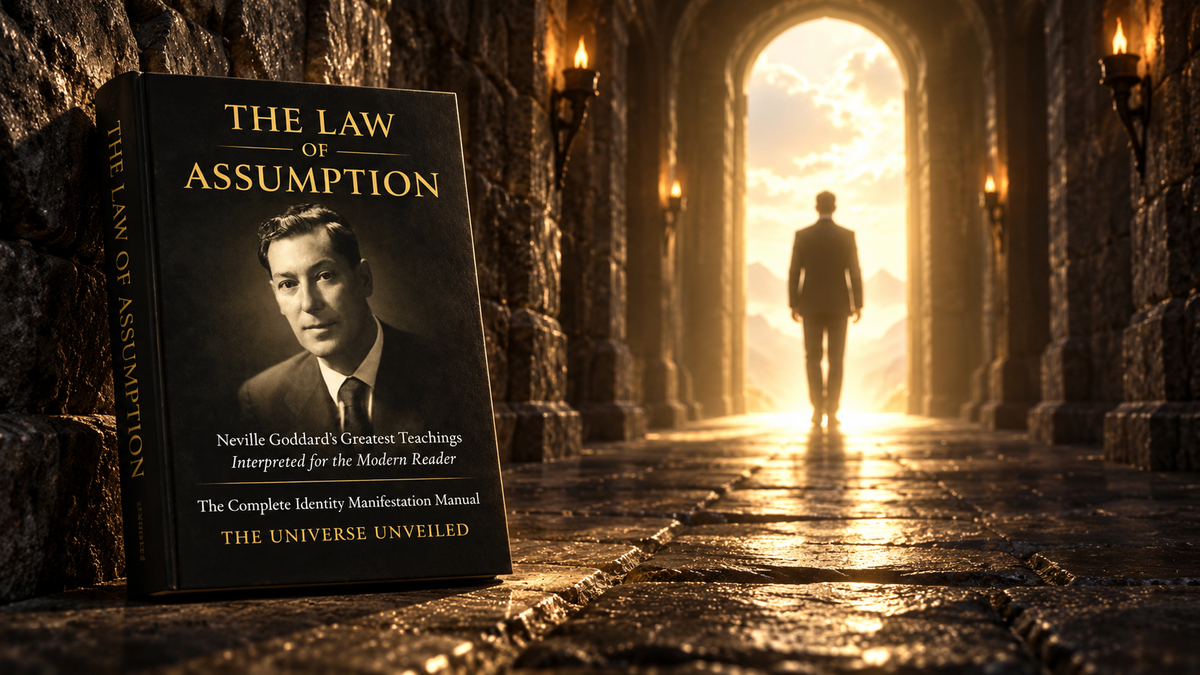
Start with the Law of Assumption, then go deeper with the book: The Law of Assumption by The Universe Unveiled.
The Way Out

You Were Never Locked In
The Law of Assumption shows you how to leave the state you keep waking up in and enter the one you would rather live from, using Neville Goddard's own method.
Get the Book on AmazonThere is a particular kind of tiredness that comes after you have done everything right. You read the books, you sat with your shadow, you forgave the people who hurt you, and you still wake up in the same life with the same ache. If you are new to the teacher behind this article, start with the Neville Goddard Ultimate Guide, because his answer to that feeling is the most freeing one we know: you are not trapped in a place. You are occupying a state, and states can be left.
Definitions
Feeling spiritually trapped: the persistent sense that your inner life, your circumstances, or existence itself is a cage with no visible exit, often intensified rather than relieved by spiritual awakening.
State: in Neville Goddard's teaching, a condition of consciousness, such as poverty, fear, loneliness or freedom, that a person can enter, dwell in, and leave.
Assumption: the inner act of accepting a state as true of yourself now, which Neville taught hardens into fact.
What Feeling Spiritually Trapped Actually Looks Like
Spend enough time in spiritual communities and you notice the same confession arriving in different clothes. It rarely sounds like "I feel trapped." It sounds like one of these.
Awake, but still looping
The most common version: you had the awakening, you did the healing work, and the same themes keep returning. Same triggers, same kind of partner, same ceiling at work. You cannot go back to the old unconscious way of living, but the new life has not arrived either. One foot in, one foot out.
The matrix and the 9-to-5
For many people, trapped means the schedule. The commute, the calendar, the sense of running a script someone else wrote. The language of "escaping the matrix" has exploded online because it names something true: much of daily life runs on autopilot.
The fear that the soul itself is caught
A darker strand holds that Earth is a prison planet and that the soul is recycled through lifetimes against its will. Whatever you make of the cosmology, notice the feeling underneath it. It is the same feeling as the first two, stretched across eternity.
"I don't belong here"
Some people describe a homesickness for somewhere they have never been, a sense of being dropped into the wrong family, the wrong era, the wrong planet.
Faith that became a fence
And many feel trapped by the religion they were raised in, especially by fear. They no longer believe what they were taught, yet the fear of being wrong still grips the body.
Five different stories. One underlying experience: consciousness has settled into a single state for so long that the state has started to feel like the edges of reality.
Why You Are in a State, Not a Prison
Neville Goddard borrowed the language of states from the poet William Blake, who insisted on distinguishing the person from the state the person is passing through. Neville built an entire practice on that distinction. In his lecture Infinite States, he told his audience not to condemn themselves for the state they had fallen into, but to move into another, and he warned that self-pity is what turns a passing state into a lifelong home.
This is the core of the Law of Assumption. A prison is a place, and you need someone else's key to leave it. A state is a condition of consciousness, and the key is the one faculty you never lose: the ability to assume.
Being trapped means the walls are outside you and the exit belongs to someone else. Being in a state means the walls are an assumption and the exit is a new assumption. Escaping the matrix is usually framed as leaving a system. Leaving a state is changing the self that keeps re-entering the system.
Why the Loop Repeats Even After Awakening
Awakening changes what you know. It does not automatically change who you assume you are. You can understand every principle of consciousness and still wake up each morning feeling like the person who struggles, the person who is stuck, the person things do not work out for. That feeling is an assumption, and assumptions, Neville taught, harden into fact regardless of what you intellectually believe.
This is why so many awakened people describe their lives as a loop. The insight is new, but the self-concept is old, and the old self-concept keeps producing the old circumstances. We explore this pattern at length in Why Your Manifestation Isn't Working, and the answer is always the same: the identity has to move, not just the understanding.
The Insight Changed. Now Move the Self.
If you already understand the teaching and the loop keeps running, The Law of Assumption walks you through changing the self-concept underneath it, chapter by chapter.
Read The Law of AssumptionHow to Step Out of a State
1. Name the state without condemning yourself
Say it plainly: "I have been living in the state of the one who is stuck." Naming it separates you from it. You are the one who occupies the state, not the state itself. Skip the self-blame, because condemnation is the glue that keeps you there.
2. Define the state you would rather occupy
Not a list of circumstances, but a feeling of self. What does the free version of you assume every morning? How does that person speak to themselves? Get specific enough that you could recognize the feeling if you stepped into it.
3. Enter it at night
Neville taught that the drowsy state before sleep is where a new assumption is most easily impressed. Use the State Akin to Sleep to live one short scene from inside the new state, felt in the first person, until it feels natural.
4. Revise the day that pulled you back
When the old state reasserts itself, and it will, rewrite that moment in imagination before bed. The revision technique keeps the old state from re-sealing itself around you.
5. Watch the inner conversation
The state you live in is sustained by what you say to yourself all day. A mental diet stops you from rebuilding the walls with your own words.
6. Stay loyal to the new state
The outer world lags behind the inner shift. Your circumstances may look unchanged for a while. Faithfulness means continuing to occupy the new state while the old evidence fades.
The Prisoner Who Went Home
Neville illustrated this with a striking image. Suppose you were in a jail cell. Do not dwell on the problem; dwell on the solution, which is being released and sleeping in your own home. So, lying on the cot, you close your eyes to the cell and feel yourself home and free, and fall asleep in that feeling. The walls were real. But the state of being imprisoned was something he taught could be left before the door ever opened.
That is the whole teaching in one scene. You do not wait for the walls to fall before you feel free. You feel free, and the walls follow.
Common Misconceptions
"If I feel trapped, I must have failed spiritually." No. Feeling trapped is what a long-occupied state feels like from the inside. It is information, not a verdict.
"I need to escape my circumstances first." Neville taught the reverse. Circumstances reflect the state; change the state and circumstances rearrange.
"Awakening should have freed me." Awakening frees you to see the state. Leaving it is a separate act of assumption.
"Some forces are keeping my soul captive." Whatever the cosmology, the practical doorway is the same: your assumption of self, which nothing outside you can occupy on your behalf.
When Trapped Is More Than Spiritual
Sometimes the feeling of being trapped slides into hopelessness or thoughts of not wanting to be here. If that is where you are, please reach out to a person today. In the US you can call or text 988 to reach the Suicide and Crisis Lifeline, and outside the US your local emergency or crisis line can help. Spiritual practice works best alongside real human support, never instead of it.
At The Universe Unveiled, we define spiritual entrapment as the experience of mistaking a long-occupied state of consciousness for a permanent place, and we teach, following Neville Goddard, that the exit is always a new assumption of self.
Glossary
State: a condition of consciousness that can be entered and left.
Assumption: accepting a state as true of yourself now.
Self-concept: the habitual assumption of who you are, which shapes your circumstances.
State Akin to Sleep: the drowsy, relaxed condition Neville used for impressing new assumptions.
Revision: reimagining a past event as you wish it had happened.
Dark night of the soul: a period of spiritual desolation described by St. John of the Cross, often felt as being trapped between an old self and a new one.
You have been standing in one room of an infinite house. The door was never locked. It was only never tried.
Try the Door
Leave the State. Keep the Lesson.
The Law of Assumption distills Neville Goddard's teaching into a practice you can use tonight, so the next room you wake up in is one you chose.
Get The Law of AssumptionFeeling Spiritually Trapped: Questions About States, Loops and Neville Goddard
Why do I feel spiritually trapped?
You feel trapped because consciousness has occupied one state for so long that it feels like a permanent place. Neville Goddard taught that states are temporary and can be left by assuming a new one.
Why do I keep repeating the same patterns after a spiritual awakening?
Awakening changes understanding, not necessarily self-concept. If you still assume yourself to be the one who struggles, that assumption keeps producing the same circumstances.
What did Neville Goddard mean by a state?
A state is a condition of consciousness, such as fear, lack or freedom, that you can enter, dwell in, and leave. He taught that the person is distinct from the state they occupy.
How do I get out of a state I feel stuck in?
Name the state without self-blame, define the state you prefer, enter it in imagination before sleep, revise the moments that pull you back, and remain faithful to it while circumstances catch up.
Is feeling trapped a sign of the dark night of the soul?
It can be. The dark night is often felt as being caught between an old identity that no longer fits and a new one not yet lived. Treating it as a transition between states makes it easier to move through.
Is Earth a prison for the soul?
Some teachings claim so, but Neville's view points inward: the only walls you can act on are your assumptions of self, and those can always be changed.
Can the Law of Assumption help if I feel trapped in my job?
Yes. Rather than escaping the job first, you assume the state of the person already free and fulfilled, and let the outer situation rearrange to match.