The Wizard of Oz and the Law of Assumption: You Had It All Along
Dorothy wore the answer on her feet the whole way. The Wizard of Oz retold chapter by chapter and read through Neville Goddard: a Scarecrow full of ideas, a Tin Woodman who weeps, a frightened Lion who stands his ground, and silver shoes that could have taken her home on day one.

What It Teaches
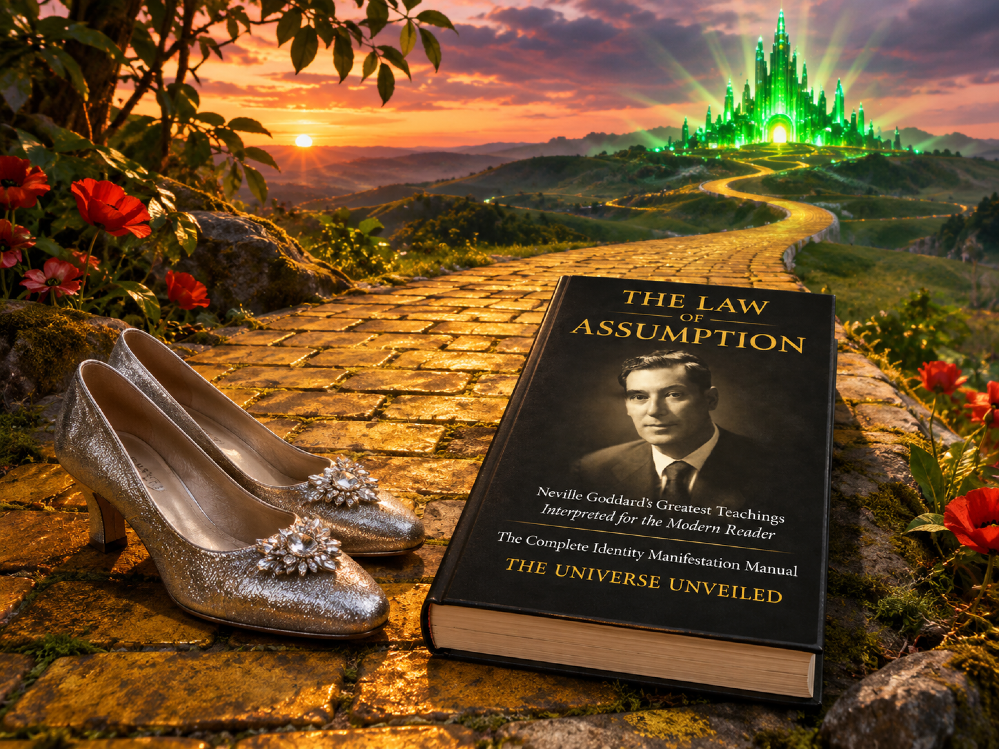
The Wizard of Oz teaches the Law of Assumption in a single line. In L. Frank Baum's 1900 book, Glinda tells Dorothy that if she had known the power of her silver shoes, she could have gone home the very first day. Nothing Dorothy needed was missing. It was unrecognized. The Scarecrow, the Tin Woodman and the Lion prove the same thing: each one already had what he asked for, and only accepted it when a humbug Wizard handed him a symbol. That is Neville Goddard's teaching. You do not acquire the state. You assume it.
The full method for living as if you already wear the shoes is in The Law of Assumption.
Worth Remembering
- Dorothy is given the silver shoes on her first day in Oz, and nobody can tell her what they do. The power arrives before the understanding.
- The Scarecrow has every clever idea on the road while insisting he has no brains. That is a self-concept problem, not a brains problem.
- The Emerald City looks green because everyone inside wears green spectacles. Your state is the lens you see the world through.
- The Wizard's gifts were bran, sawdust and a dish of liquid. They worked because they were accepted, not because they were real.
- The shoes fall off in the desert and are lost forever. Once you are home, you no longer need the symbol.
To practice this every day, start with The Law of Assumption and the guide on how to apply the Law of Assumption.
In Plain Words
Imagine walking a long road to ask a powerful stranger for something, and finding out at the end that you had it on your feet the whole time. That is the Wizard of Oz. Manifesting works the same way. You stop asking to become the person who has it, decide you already are, and walk the rest of the road as that person. The steps are in how to apply the Law of Assumption.
For the whole practice, chapter by chapter: The Law of Assumption on Amazon.
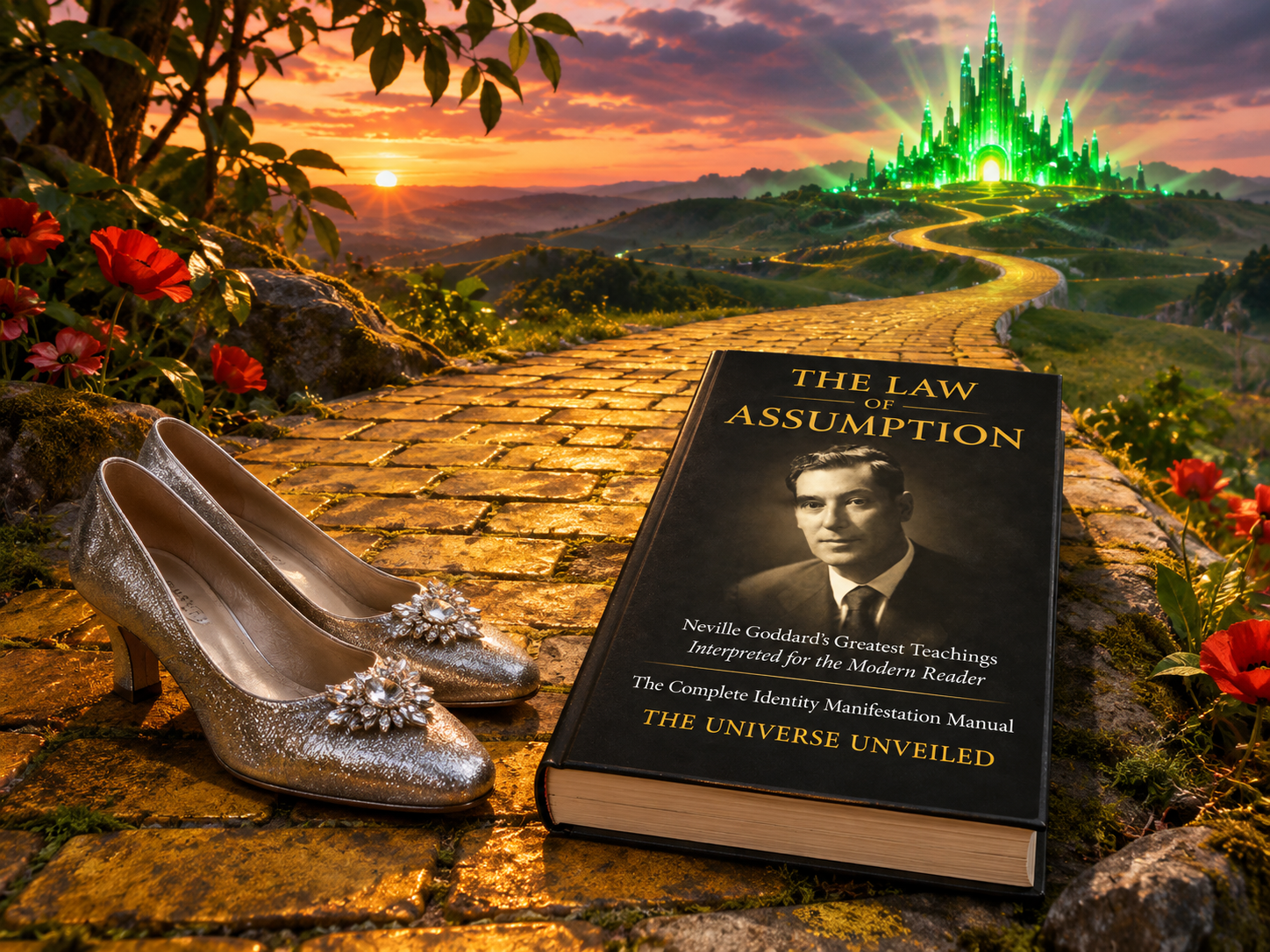
Featured Book

The Law of Assumption
Dorothy had the answer on her feet for the whole journey. This book shows you how to stop walking toward what you want and start walking as the one who has it.
Get the BookAvailable in Kindle and Paperback — The Universe Unveiled
Almost everyone knows the story. A girl from Kansas, a cyclone, a yellow brick road, three strange companions and a Wizard who turns out to be a fraud. Far fewer people have read the book L. Frank Baum published in 1900, and fewer still have noticed that it contains, almost word for word, the teaching that Neville Goddard spent his life repeating: what you are looking for is not missing. It is unrecognized.
This is not a film review. It is the original 1900 story, with W. W. Denslow's illustrations, read as a lesson in the Law of Assumption. In the book, Dorothy's shoes are silver, not ruby. If you are reading on the web, a small pair of them is walking the yellow brick road at the bottom of your screen, and every chapter lights another emerald on the way home.
A Sunday Story
You Had It All Along
The Wonderful Wizard of Oz, read with Neville Goddard.
Everything Was Gray
Baum's story opens in a world without color. The sun had baked the prairie into a gray mass. The paint on the house had blistered away to gray. Aunt Em had come to the farm young and pretty, and the sun and wind had taken the sparkle from her eyes and left them gray. Uncle Henry never laughed, and he was gray too, from his long beard to his rough boots.
Then the cyclone comes. The house is lifted with Dorothy and her dog Toto inside, and it is carried for hours until it drops in a bright country full of flowers and streams. It lands on the Wicked Witch of the East, and all that is left of her are her shoes.

On her very first day in Oz, the good Witch of the North shakes the dust out of the dead witch's silver shoes and hands them to Dorothy. When Dorothy asks what they are, nobody can tell her. The Munchkins only know that the Witch of the East was proud of them.
“There is some charm connected with them; but what it is we never knew.”The Wonderful Wizard of Oz, Chapter II
Day one
Notice when the power arrives. Not at the end of the journey, as a reward. On the first day, before Dorothy has taken a single step, and with no instructions attached. She puts the shoes on because her own are worn out, and she walks the whole road wearing the answer without knowing it.
Open the emerald: what Kansas teaches
Kansas is not a place in this story. It is a state. Everything in it is gray because the people living in it are gray. Neville taught that the world is a mirror of the state you occupy, and that you can carry a gray state into the brightest country on earth. The question is never where you are. It is who you are being while you are there.
Doctrine: the power is given on the first day. Understanding comes later.
The Man With Every Idea
On the road, Dorothy lifts a Scarecrow down from his pole. He wants to come to the Emerald City to ask the Wizard for brains, because his head is stuffed with straw and he is sure he cannot think.
Then watch what he actually does. When the road is cut by a ditch too wide to jump, it is the Scarecrow who sees that a great tree standing at the edge could be cut down to make a bridge. When a river blocks the way, it is the Scarecrow who says the Tin Woodman must build a raft. When the Lion falls asleep in the poppy field, it is the Scarecrow who has the Queen of the Field Mice send for thousands of her subjects, each one bringing a long piece of string, so they can pull the Lion out on a truck. Nearly every clever idea in the first half of the book is his.

And through all of it, he keeps telling everyone he has no brains.
A self-concept problem
The Scarecrow does not lack intelligence. He lacks the assumption that he is intelligent. Neville called this the self-concept: the story you tell about who you are, which quietly overrules the evidence of what you do. Most people are walking proof of the very quality they insist they do not have.
Open the emerald: the evidence you ignore
Write down the thing you believe you are missing. Then look back over the last month for one moment when you acted as if you already had it. You will almost always find one. The Scarecrow's problem was never his head. It was that he refused to count his own ideas as evidence.
Doctrine: you are already doing what you say you cannot do. Assume it, and stop arguing with the evidence.
The Man Who Wept for a Beetle
Next they find a man made entirely of tin, rusted solid in the forest with his axe raised. Once oiled, he tells them he was once a woodman of flesh, who lost himself piece by piece until nothing was left but tin. The worst loss, he says, was his heart. He wants to come along and ask the Wizard for a new one.
A little later, walking along the road, the Tin Woodman steps on a beetle by accident and kills it. Baum writes that this made him very unhappy, and that he wept several tears of sorrow and regret. The tears run down his face and rust the hinges of his jaw shut, and his friends have to oil him before he can speak again.
A man without a heart does not cry over a beetle. He has been feeling everything, all along. He just does not believe the feeling counts.
Feeling is the evidence
Neville put feeling at the center of the method. In Feeling Is the Secret he taught that the feeling of the wish fulfilled is what impresses the subconscious. The Tin Woodman shows the other side of it: the feeling is already there. What is missing is the decision to trust it.
Open the emerald: trusting the feeling
When you imagine the wish fulfilled and feel a flicker of it, do not wait for it to be bigger before you accept it. The flicker is the heart. The Tin Woodman spent the whole book searching for the thing that was rusting his own jaw.
Doctrine: if you can feel it at all, you already have it. Accept the small feeling as real.
Afraid, and Standing Anyway
The third companion arrives with a roar. The Lion knocks the Scarecrow over, strikes at the Tin Woodman, and runs at Toto, until Dorothy slaps him on the nose and he begins to cry. He is, he admits, a coward. Everyone expects the King of Beasts to be brave, so he roars, and everything runs away, and nobody ever finds out how frightened he is. He wants to ask the Wizard for courage.
Then the Kalidahs come: monsters with the bodies of bears and the heads of tigers, chasing the travelers across a narrow log over a ravine. The Lion knows they will be torn apart. Baum's sentence is exact.
“The Lion, although he was certainly afraid, turned to face the Kalidahs.”The Wonderful Wizard of Oz, Chapter VII
He tells the others to stand close behind him, and that he will fight as long as he is alive. Then the Scarecrow has another idea: the Tin Woodman chops the log, and the Kalidahs fall into the gulf.

Courage is not the absence of fear
The Lion's mistake is the one most people make with manifestation. He thinks courage is a feeling he must have before he can act. It is the reverse. He acts as the brave one while still afraid, and that is the courage. Neville called the same thing persistence: holding the assumption while every sense tells you it is not true yet.
Open the emerald: when you are still afraid
You do not have to stop doubting before you assume. Doubt and assumption can stand on the same log. What matters is which way you face. The Lion was trembling and turned toward the Kalidahs anyway, and that turn is the whole practice.
Doctrine: do not wait to feel brave. Turn and face the end while you are still afraid.
From Story to Practice
The Law of Assumption
A Scarecrow full of ideas, a Tin Woodman full of feeling, a Lion who stands his ground while afraid. This book turns each of them into a daily practice for assuming the state you already have.
See the BookAvailable in Kindle and Paperback — The Universe Unveiled
The Green Spectacles
At the gates of the Emerald City, the Guardian stops them. Nobody may enter without wearing spectacles, he explains, or the brightness and glory of the city would blind them. He fits each traveler with a pair of green glasses and locks them on with a little key. Even Toto gets a pair.
Inside, everything is green: the streets, the houses, the sky, the lemonade, even the people's skin. And when the travelers are brought one at a time before the great Oz, the Wizard appears to each of them differently. To Dorothy he is an enormous Head with no body. To the Scarecrow, a lovely Lady. To the Tin Woodman, a terrible Beast. To the Lion, a Ball of Fire so fierce he can scarcely look at it.

Later the Wizard confesses the trick. The green comes from the glasses. When Dorothy asks whether the city is really green at all, he answers that it is no more green than any other city.
“I put green spectacles on all the people, so that everything they saw was green.”The Wonderful Wizard of Oz, Chapter XV
Look again
A city of streets and houses and shops, much like any other city.
The Emerald City: every wall, every window, every face in green.
Nothing in the city changed. Only the glasses did. Neville said the same thing about the world you live in: it is yourself pushed out. The state you occupy is the lens locked over your eyes, and everyone you meet appears to you through it, the way the Wizard appeared as a beast to one traveler and a lovely lady to another.
Open the emerald: changing the lens
You cannot change the city by arguing with it. You change the spectacles. Before you try to fix a person or a situation, ask what state you are seeing them from. Assume a different one, and watch how quickly the same people start to look different.
Doctrine: the world is colored by the state you wear. Change the state, and the world follows.
Bran-New Brains
The Wizard sends them to kill the Wicked Witch of the West, and they do. But when they return to claim their rewards, Toto knocks over a screen in the throne room, and behind it stands a little old man with a bald head and a wrinkled face. The great and terrible Oz is a balloonist from Omaha. “I am a humbug,” he admits.
What he says next is the heart of the book. He tells the Scarecrow he does not need brains, because he is learning something every day. He tells the Lion he has plenty of courage. He tells the Tin Woodman he is wrong to want a heart. They have it already, he says. The travelers will not hear it. They want something they can hold.
So the Wizard gives them something to hold. He takes off the Scarecrow's head and fills it with bran mixed with pins and needles, and announces that he has given him a lot of bran-new brains. He cuts a hole in the Tin Woodman's chest and puts in a pretty heart made of silk and stuffed with sawdust. He pours the Lion a green liquid in a dish and tells him that once it is inside him, it will be courage.

And it works. The Scarecrow walks out feeling wise. The Tin Woodman feels his heart rattle and is happy. The Lion is full of courage. Left alone, the Wizard admits he is really a very good man but a very bad Wizard, and wonders how he can help being a humbug when people make him do things everybody knows cannot be done.
Why the fake gifts worked
Nothing was added to them. Bran is not intelligence, and sawdust is not love. What changed was the assumption. Each of them needed a moment where he could say “now I have it” and believe it, and the Wizard gave them that moment. Neville would say it plainly: faith is not belief in an object. It is assumption, the decision to accept a state as true.
Open the emerald: you do not need a Wizard
Many people wait for a sign, a reading, a ritual, a date on the calendar or a person in authority to tell them they are ready. Those things can work, the same way bran worked. But they only ever do one thing: give you permission to assume. You can give yourself that permission tonight, without the bran.
Doctrine: the symbol is a placeholder. The acceptance is the act.
The Very First Day
The Wizard tries to fly Dorothy home in his balloon, and leaves without her. Her friends take her south, across dangerous country, to Glinda, the Good Witch of the South. Dorothy explains that she only wants to go back to Kansas. Glinda smiles, and tells her she has been carrying the way home since the moment she arrived.
“If you had known their power you could have gone back to your Aunt Em the very first day you came to this country.”The Wonderful Wizard of Oz, Chapter XXIII
All she has to do, Glinda says, is knock the heels together three times and command the shoes to carry her wherever she wishes to go.
Dorothy knocks her heels three times, and in a few whirling seconds she is rolling on the grass of the Kansas prairie. On the way, the silver shoes fall off in the air and are lost forever in the desert.

Why the shoes are lost
The book never brings them back, and it does not need to. Once Dorothy is home, the symbol has done its work. This is what Neville meant by living from the end. The end was available on day one. The long road was only the time it took her to know it.
Open the emerald: why the road was so long
Glinda could have told her on the first day, and Dorothy would not have believed it. She needed the road to become someone who could believe it. Your road is not proof that the end is far away. It is the time it takes you to stop doubting that you are already there.
Doctrine: the end is available now. The journey is only the time it takes to accept it.
Home Again
Dorothy sits up and finds herself in front of the new farmhouse Uncle Henry built after the cyclone carried the old one away. Aunt Em runs out of the house, crying “My darling child!”, and Dorothy's last words in the book are that she is so glad to be at home again.

Kansas is still Kansas. The prairie is still flat. What changed is the girl walking back into it. That is the last lesson of the book, and the last lesson of the Law of Assumption: you do not travel somewhere else to receive what you want. You return to where you are as someone who already has it.
Before you leave Oz
Three Knocks
Nothing is written here and nothing is saved. Think of your own Kansas: the one thing you have been walking toward. Now say it to yourself in one short sentence, in the present tense, as someone who has already arrived.
Knock your heels three times.
“I am already home.”
Fall asleep tonight in that sentence. You were given the shoes on the first day.
Go Deeper
The Law of Assumption
You do not need a Wizard to hand you a symbol. This book shows you how to assume the state yourself, and how to live from the end until it becomes your Kansas.
Read The Law of AssumptionAvailable in Kindle and Paperback — The Universe Unveiled
Additional reading
How Ariana Grande Manifested Her Dream Role as Glinda
Another Glinda, another assumption held for years before the proof arrived.
The Wizard of Oz and the Law of Assumption: Frequently Asked Questions
What does The Wizard of Oz teach about the Law of Assumption?
The book's central lesson matches Neville Goddard's teaching: what you seek is already yours, waiting to be recognized. Dorothy wears the silver shoes from her first day in Oz, and Glinda tells her she could have gone home that day if she had known their power. The Law of Assumption asks you to accept the state you want as already true, instead of traveling toward it.
Why are Dorothy's shoes silver in the book but ruby in the movie?
In L. Frank Baum's 1900 novel, the shoes are silver. The 1939 film changed them to ruby. This post follows the original book, where the silver shoes are given to Dorothy on her first day and are lost in the desert on her way home.
What do the green spectacles in the Emerald City mean?
The Guardian of the Gates locks green spectacles on every visitor, and the Wizard later admits the city is no greener than any other. The green comes from the lens. In Neville Goddard's terms, the state you occupy is the lens through which you see the world, which is why he taught that the world is yourself pushed out.
Did the Scarecrow, Tin Woodman and Cowardly Lion already have what they asked for?
Yes. The Scarecrow has every clever idea on the road, the Tin Woodman weeps after stepping on a beetle, and the Lion faces the Kalidahs while afraid. The Wizard tells each of them they already have what they want. Each one lacked the assumption, not the quality, which is what Neville called a self-concept problem.
Why did the Wizard's fake gifts work?
Bran, a silk heart full of sawdust and a dish of liquid added nothing to the travelers. They worked because each traveler accepted them as proof and assumed the new state. In the Law of Assumption, a symbol or ritual only ever grants permission to assume. The assumption itself is what changes you.
What did Glinda mean when she said Dorothy could have gone home the first day?
Glinda meant the power to go home was with Dorothy from the start, on her feet. The journey did not create it. It gave Dorothy time to become someone who could believe it. Neville called this living from the end: the end is available now, and the road is the time it takes to accept it.
How do I apply the silver shoes lesson to my own manifestation?
Name the thing you have been walking toward. Say it to yourself in one present-tense sentence as someone who already has it, and fall asleep in that feeling. Then notice where you are already acting as that person, the way the Scarecrow kept having ideas. The full steps are in how to apply the Law of Assumption.