Do Affirmations Actually Work? The Subconscious Science Behind Why Most People Fail
You've repeated the words. You've believed the process. But something still isn't shifting. This is why most affirmations fail at the subconscious level—and what separates the ones that actually reprogram your identity from the ones that disappear by noon.


Most people have tried affirmations.
They wake up. They stand in front of the mirror. They repeat the statements they found online or pulled from a book. "I am wealthy. I am confident. I am magnetic to abundance."
And for a few minutes, it feels good.
Then they go about their day — and nothing changes.
By evening, the same doubts are back. The same thoughts. The same patterns.
So they quietly file affirmations under "things that don't work for me" and move on.
But that conclusion misses the actual problem.
Affirmations are not broken. The way most people use them is.
The Real Question People Are Actually Asking
When someone searches "do affirmations work," they are not looking for a yes or no.
They are asking something deeper:
Why do I keep repeating positive things and feel nothing change?
Why does my mind immediately argue back?
Is there something wrong with me — or with the method?
The answer is neither. The problem is mechanical. Affirmations fail when they are applied at the wrong level of the mind.
To understand why, you need to understand where belief actually lives.
Where Belief Lives: The Subconscious Mind
Your mind operates on two levels.
The conscious mind is the part you are using right now — reading, analyzing, deciding. It is the part that chooses to repeat an affirmation. It understands the intention behind the words.
But the conscious mind accounts for only a small fraction of your mental activity — roughly 5%.
The remaining 95% is the subconscious mind. And this is where everything that actually runs your life is stored.

Your subconscious holds:
- Every belief you have about money, relationships, success, and safety
- Every habit you repeat without thinking
- Your emotional baseline — how you feel when nothing is happening
- Your identity — the deep, automatic sense of who you are
The subconscious does not reason. It does not evaluate truth. It does not weigh the logic of your affirmations against your circumstances.
It asks one question only: Is this familiar?
What is familiar feels true. What feels true becomes identity. What becomes identity shapes every decision, every behavior, every result you produce — without you ever consciously choosing it.
This is the wall most affirmations hit.
You repeat "I am wealthy" at the conscious level. But the subconscious has years of stored familiarity with something different. And familiarity always wins in the short term.
Why Most Affirmations Fail: The Conflict Mechanism
When you state an affirmation that conflicts with your existing subconscious identity, the mind does not simply accept it.
It pushes back.
This is not weakness or resistance you need to overcome. It is the subconscious doing exactly what it is designed to do — protect familiar patterns.
Psychologists refer to this as cognitive dissonance: the discomfort that arises when a new belief contradicts an established one. The mind experiences this as friction, and the default response is to dismiss the new input and reinforce the old one.

This is why so many people report that affirmations make them feel worse rather than better. You say "I am abundant" and your subconscious immediately surfaces the evidence against it. The gap between the statement and the stored identity becomes more visible, not less.
You are not failing at affirmations. You are encountering a mechanical reality of how the subconscious processes new information.
The solution is not to try harder. It is to change the method of installation.
The Neuroscience of Why Repetition Works — When Done Correctly
The brain forms beliefs the same way it forms habits: through repetition.
Every time a thought is repeated, the neural pathway associated with that thought is strengthened. Over time, repeated thoughts require less effort to generate. They become automatic. They become what feels natural.

This process — called neuroplasticity — is the biological foundation of all subconscious reprogramming. The brain physically rewires itself based on repeated input.
But repetition alone is not enough. The conditions under which you repeat something determine whether the subconscious accepts it or filters it out.
There are three factors that determine whether an affirmation installs:
The subconscious is most receptive when the brain is operating in lower frequency states — particularly alpha (8–12 Hz) and theta (4–8 Hz). These are the states you naturally enter just before sleep, just after waking, and during deep relaxation or meditation.
In these states, the analytical part of the mind quiets. The mental gatekeeper that normally filters new input relaxes. New patterns can enter more directly.
Repeating affirmations while fully alert and cognitively active means you are speaking directly to the part of the mind most likely to argue back. The conscious mind, operating in beta waves, is analytical by design. It evaluates. It compares. It resists.
Most people affirm in beta. The subconscious speaks theta.
2. Emotional Charge
Repetition without emotion is data, not installation.
The subconscious treats emotion as a signal of importance. Experiences with strong emotional charge are stored more deeply and accessed more readily than neutral ones. This is why you can remember a single moment from childhood in vivid detail but cannot recall what you had for lunch three weeks ago.
Affirmations stated flatly — mechanically, without feeling — bypass the emotional layer the subconscious uses to determine significance. They pass through the system without registering as something to hold.
Affirmations that carry genuine feeling, even briefly, have a fundamentally different effect on the subconscious architecture.
3. Identity Alignment vs. Identity Contradiction
The most effective affirmations are not aspirational leaps. They are incremental shifts.
An affirmation like "I am a billionaire" stated by someone whose subconscious identity is built around financial struggle creates enormous internal friction. The gap is too wide. The subconscious rejects it as implausible.
But an affirmation like "Money moves toward me with greater ease every day" or "I am becoming someone whose relationship with money is calm and open" creates a smaller gap — one the subconscious can begin to accept as a direction rather than an impossibility.
This is the difference between an affirmation that expands identity and one that fights it.
What Affirmations Are Actually Doing — When They Work
When an affirmation is delivered correctly, something specific happens in the subconscious.
The repeated statement begins to build familiarity. At first, the subconscious treats it as foreign. With enough repetition at the right depth, it begins to recognize the pattern as something it has encountered before. And what is recognized as familiar begins to feel plausible.
Plausible becomes neutral. Neutral becomes acceptable. Acceptable becomes integrated.

This is the full arc of subconscious identity installation. It is not dramatic. It is not instant. It is gradual — and then suddenly, the new state simply feels normal.
This is what people describe when they say "something just shifted." It is not magic. It is the mechanical completion of an installation cycle that was seeded through repetition.
The shift was happening the whole time. They simply could not perceive it until the threshold was crossed.
The Identity Problem Most People Ignore
Here is the most important thing to understand about affirmations — and about manifestation in general.
You do not get what you want. You get what you are.
This is not motivational phrasing. It is a precise description of how the subconscious shapes reality.
Your subconscious identity determines:
- What opportunities you notice
- What risks feel safe to take
- What behavior feels natural versus forced
- What you allow yourself to receive
- How other people respond to you
A person whose subconscious identity includes the pattern "I am someone who struggles financially" will unconsciously make decisions that reinforce that pattern — even while consciously trying to build wealth. The subconscious will create plausible reasons to avoid certain opportunities, spend impulsively, or self-sabotage at crucial moments.
This is not because the person lacks desire or intelligence. It is because identity governs behavior at the level where behavior is actually generated.
Affirmations work when they target identity — not just behavior, and not just circumstance.
The question to ask is not "What do I want to have?" It is "Who do I need to become for this to feel normal?"
How to Use Affirmations So They Actually Work
The following framework is built on the mechanics described above. It is not a motivational system. It is an identity installation protocol.
Use the Theta Window
The two most powerful moments for subconscious reprogramming are the first five to fifteen minutes after waking and the final fifteen to thirty minutes before sleep.
During these windows, the brain naturally shifts into alpha and theta states. The conscious gatekeeper is not fully active. The subconscious is receptive.
Stating affirmations during these windows — calmly, without force — allows the input to bypass conscious resistance and reach a deeper level of processing.
This is why guided audio sessions designed for sleep listening or morning listening are more effective than affirmations stated randomly throughout a busy day. The delivery timing matters as much as the content.
Add Emotional Authenticity — Not Performance
You do not need to manufacture intense emotion. Forced emotional performance creates its own resistance.
What is effective is genuine, even subtle feeling. As you state an affirmation, allow yourself to briefly sense what it would feel like for this to be true. Not force it. Not visualize an elaborate scene. Simply feel the quiet quality of that reality for a moment.
That subtle emotional signature is what tells the subconscious: this matters, keep this.
Even three seconds of genuine feeling attached to a repeated statement has more subconscious impact than five minutes of mechanical recitation.
Bridge the Gap
If you find that your affirmations consistently trigger internal resistance, the gap between the statement and your current identity is too wide. Bridge it.
Instead of "I am completely free from financial stress," try "I am building a calmer, more stable relationship with money." Instead of "I am completely confident," try "I am becoming someone who trusts themselves more each day."
Bridging statements still point toward the destination. But they honor where the subconscious currently is — and that reduces friction enough for the installation to begin.
Consistency Over Intensity
A single emotionally powerful affirmation session will not override years of subconscious conditioning. This is a mechanical reality, not a reflection of your commitment.
The subconscious installs through repetition over time — the same process through which every limiting belief you currently hold was installed. Those patterns did not form in a day. They were reinforced through hundreds or thousands of exposures across years.
Replacing them requires consistent repetition — not overwhelming intensity once a week.
Ten minutes daily for thirty days is more effective than two hours once a month. Consistency is the mechanism. Everything else supports it.
When Affirmations Alone Are Not Enough
For deeply embedded subconscious patterns — particularly those formed in childhood, or those connected to significant emotional events — affirmations alone may be insufficient.
This is not a failure of the method. It is a recognition that the depth of the pattern may require a deeper form of access.
When the subconscious pattern is held in place by strong emotional charge from the past, it needs to be addressed at that same emotional level — not just through conscious repetition.
This is where structured subconscious reprogramming becomes the more appropriate tool.
Audio conditioning sessions designed specifically for subconscious access — sessions that guide the mind into a receptive state, deliver targeted identity restructuring, and reinforce new patterns through emotional association — work at the level where the pattern actually lives.
If you are new to working with the subconscious at this level, the foundation is understanding how the system actually operates. The guide to subconscious reprogramming for beginners explains the full mechanics — what the subconscious is, why it controls behavior, and how to begin working with it intentionally.
For those ready to go beyond affirmations and begin structured identity reconditioning, the Subconscious Reprogramming Library contains targeted audio sessions designed for exactly this purpose — addressing specific patterns including money identity, procrastination, relationship dynamics, and nervous system conditioning.
The Honest Answer to "Do Affirmations Work?"
Yes. With precision.
Affirmations are not a spiritual placebo. They are a mechanism for subconscious identity installation — one that works when applied with understanding of how the subconscious actually processes repetition.
The reason most people conclude they do not work is that they use them in conditions that minimize their effectiveness: wrong brainwave state, no emotional engagement, statements too far from current identity, and inconsistent practice.
None of that is a character flaw. It is a knowledge gap.
Once you understand that the subconscious governs identity, that identity governs behavior and perception, and that the subconscious changes through consistent repetition delivered at the right depth — affirmations become something entirely different.
They become intentional identity design.
Not magic. Not wishful thinking. Not performance.
A deliberate, methodical process of becoming someone for whom what you want is simply normal.
And once the subconscious accepts a new version of normal, reality does not need to be forced. It reorganizes around it.
That is not metaphor. That is mechanics.
Where to Go From Here
If you are new to this work, start with the foundational guide: What Is Subconscious Reprogramming? The Beginner's Guide to Rewiring Your Mind
If you are ready to move from understanding to structured practice, explore the Subconscious Reprogramming Library — a collection of audio conditioning sessions designed to install identity-level change through repetition, emotional association, and guided subconscious access.
The words you repeat matter. But the conditions under which you repeat them matter more.
Begin with the conditions.
Do Affirmations Work? 20 Questions About Affirmations and the Subconscious Mind Answered
Why most affirmations fail, how the subconscious actually installs new beliefs, and what separates the techniques that create lasting identity change from the ones that disappear by noon.
Yes — when applied correctly. Affirmations work by installing new identity patterns in the subconscious through repetition. The reason most people conclude they don't work is that they use them in conditions that minimize effectiveness: the wrong brainwave state, no emotional engagement, and inconsistent practice. The method itself is sound. The application is usually where it breaks down.
Most affirmations fail because they are delivered at the wrong level of the mind. Repeating statements while fully alert engages the conscious, analytical mind — the part most likely to argue back. The subconscious, which is where beliefs and identity actually live, is not being reached. Without the right brainwave state, emotional charge, and consistency, the input never penetrates deep enough to install.
The subconscious mind is the part of your mind that runs automatically — storing beliefs, habits, emotional patterns, and identity. It controls an estimated 95% of your behavior. Affirmations are only effective when they reach this level, because the subconscious is where the patterns that shape your decisions, perceptions, and results are actually stored. If you want to understand this system in depth, the beginner's guide to subconscious reprogramming covers the full mechanics.
The most effective windows are the first 5–15 minutes after waking and the 15–30 minutes before sleep. During these periods the brain naturally shifts into alpha and theta brainwave states — the same states associated with heightened subconscious receptivity. The mental gatekeeper is quieter, and new patterns are far more likely to be absorbed without conscious resistance.
There is no fixed timeline. The subconscious installs through repetition, not the passage of time. Some people notice internal shifts within days when the conditions are right — correct brainwave state, emotional engagement, consistency. Others take weeks or months depending on how deeply embedded the old pattern is. What matters most is daily consistency over time, not intensity in a single session.
This is cognitive dissonance — the discomfort that arises when a new statement conflicts with an existing subconscious belief. When the gap between your affirmation and your stored identity is too wide, the subconscious surfaces evidence against it, making the gap feel more pronounced. The solution is to use bridging statements — affirmations that point toward the destination without leaping past what the subconscious can currently accept.
A bridging affirmation reduces the gap between your current identity and your desired one, making it easier for the subconscious to accept. Instead of "I am completely free from debt," try "I am building a calmer, more stable relationship with money." Instead of "I am totally confident," try "I am becoming someone who trusts themselves more each day." These still move you toward the destination — they just don't trigger the rejection that wide-gap statements often create.
Yes — but you do not need to perform intense emotion. Forced emotional displays create their own resistance. What is effective is subtle, genuine feeling: briefly sensing what it would feel like for the statement to be true. Even three seconds of authentic feeling attached to a repeated statement carries more subconscious weight than five minutes of flat mechanical recitation. Emotion is the signal the subconscious uses to determine what is worth keeping.
Alpha (8–12 Hz) and theta (4–8 Hz) brainwave states are where the subconscious is most receptive. In these states, the analytical mind quiets and the mental gatekeeper that normally filters new input relaxes. Most people who affirm while fully alert are operating in beta — the state most associated with analysis and resistance. Accessing alpha or theta through light meditation or structured audio sessions dramatically improves how deeply affirmations install.
Both can work. Speaking aloud engages auditory processing, which can add a layer of reinforcement. Saying them internally in a relaxed state allows for deeper inward focus. What matters more than the delivery method is the state you are in when you repeat them and the emotional quality behind the words. Audio-based reprogramming — where you listen rather than recite — removes the friction of self-generation and allows for passive, consistent delivery.
Fewer is more effective than many. Repeating three to five targeted affirmations consistently beats rotating through twenty randomly. The subconscious builds familiarity through repetition of the same input. Spreading attention across too many statements reduces the repetition count on each, slowing the installation process. Focus on one identity theme at a time and repeat it until it begins to feel neutral or natural before adding others.
Affirmations alone may not be sufficient for deeply held childhood conditioning, particularly patterns formed with strong emotional charge. These patterns were installed during the theta-dominant early years of childhood and may require a more structured form of access to replace. Guided subconscious reprogramming sessions that combine relaxed brainwave access, emotional reframing, and structured repetition are typically more effective for this level of work. The Subconscious Reprogramming Library includes a dedicated Childhood Money Identity session built for exactly this purpose.
Affirmations are one tool within the broader process of subconscious reprogramming. Subconscious reprogramming is the full system — it includes repetition, brainwave state access, emotional association, visualization, and identity-level restructuring. Affirmations, when used correctly, are a legitimate component of that system. But they are not the whole system. For a complete understanding of what subconscious reprogramming involves, the beginner's guide covers the full framework.
Affirmations work primarily through auditory and linguistic repetition. Visualization works through mental imagery and simulated experience — the brain processes vivid imagined scenarios using many of the same neural circuits activated by real events. Both install new patterns through repetition and emotional engagement. They are most powerful when combined: a stated identity reinforced by a felt, visualized experience of that identity already being real.
Yes. The period just before sleep is one of the most receptive windows for subconscious input. The brain is transitioning through alpha into theta — the same states associated with deep conditioning. Structured audio designed for pre-sleep listening can reinforce patterns with minimal conscious resistance. Keep the volume low and the content calm. Aggressive or high-energy audio in this window may disrupt sleep quality rather than support installation.
Yes — but money is one of the areas most likely to trigger subconscious resistance, because financial identity is typically formed very early and reinforced heavily through environment and family systems. Affirmations for wealth need to target identity, not just circumstance. Statements like "I am becoming someone who receives money with ease" are more effective than "I have one million dollars" for someone whose subconscious identity is not yet aligned with that reality.
Subconscious change appears internally before it appears externally. Early signs include: the affirmation beginning to feel less foreign or false; reduced emotional resistance when you repeat it; subtle shifts in automatic thoughts; noticing different instinctive reactions to situations you previously found triggering. External results tend to follow once identity has stabilized internally. Most people look for external proof too early and conclude the process is not working when it is simply still building.
Yes. Research in neuroplasticity shows the brain rewires itself based on repeated thought patterns and behavior. Studies in self-affirmation theory show that affirmations can reduce stress, improve problem-solving under pressure, and buffer against identity threat. Research in mental rehearsal demonstrates that the brain activates similar neural circuits for vividly imagined and real experiences. The mechanism is the same repetition-based learning system the brain uses for all skill and belief formation.
Affirmations are short, repeated identity statements. Scripting is a longer-form practice — writing in first person as though your desired reality has already occurred, in detail and with emotional specificity. Both work through the same subconscious mechanism: repetition of identity-aligned content with emotional engagement. Scripting tends to activate imagination more fully, which can deepen the emotional signal. Many people find scripting more effective precisely because the narrative format is easier to feel into than a short declarative statement.
Begin with understanding how the system works before applying techniques. The beginner's guide to subconscious reprogramming explains the full mechanics in plain language — what the subconscious is, why it controls behavior, and how to begin working with it intentionally. Once you understand the foundation, the Subconscious Reprogramming Library offers structured audio sessions designed to move you from understanding into active identity reconditioning.
Image Credits:
Percy Wyndham Lewis, Workshop, c. 1914–15, oil on canvas, Tate Britain, London, UK. © Wyndham Lewis and the Estate of Mrs. G. A. Wyndham Lewis, by kind permission of the Wyndham Lewis Memorial Trust (registered charity).
Emma Kunz, geometric drawing, mid-20th century, pencil on graph paper, Emma Kunz Zentrum, Würenlos, Switzerland
František Kupka, Disks of Newton (Study for Fugue in Two Colors), c. 1912, oil on canvas, Philadelphia Museum of Art
Bridget Riley, Op Art composition, screenprint on wove paper, published by Karsten Schubert Gallery, London
Clyfford Still, 1948-C, 1948, oil on canvas, Hirshhorn Museum and Sculpture Garden, Washington, D.C.
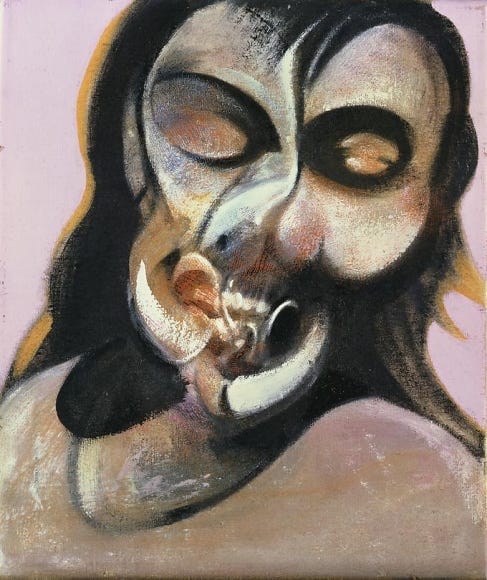
Francis Bacon, Study of Henrietta Moraes Laughing, oil on canvas, Johannesburg Art Gallery, Johannesburg, South Africa