Jørn Utzon and the Sydney Opera House: The Building That Was Finished Before It Was Built
Jørn Utzon drew the Sydney Opera House before anyone knew how to build it. The roof took three years to solve, the answer came from an orange, and he was forced out in 1966. Here is the true story, and what it teaches about holding a finished picture with the Law of Assumption.


What It Teaches
In 1957 a little-known Danish architect, Jørn Utzon, won the competition to design the Sydney Opera House with a set of drawings nobody yet knew how to build. Construction started in 1959 before the roof was solved. In October 1961 Utzon found the answer: every shell could be cut from the surface of one sphere, like pieces of orange peel. In 1966 he was forced off the project and left Australia, never to return, yet the building he had seen whole was finished in 1973. That is the heart of Neville Goddard's Law of Assumption: the end exists complete first, and the world builds toward it.
The full method is in The Law of Assumption on Amazon Australia.
Worth Remembering
- Utzon was 38 and had never been to Sydney when his entry beat 232 others from 32 countries.
- The famous story that a judge rescued his design from the reject pile is told everywhere, but historians treat it as legend.
- For three years nobody could work out how to build the roof. The answer, one sphere, turned out to be simple.
- He resigned on 28 February 1966, left in April and was not invited to the 1973 opening.
- You do not need to know how before you begin. Neville called the way things arrive the bridge of incidents.
To practise this every day, start with The Law of Assumption and the guide on how to live from the end.
In Plain Words
One man saw a building whole before anyone knew how to make it. People called it impossible, the roof took years to figure out, and he was pushed out before it was done. It was finished anyway, because the picture was complete from the start. Your goal works the same way: see the finished thing first, and let the steps catch up. The steps are in how to apply the Law of Assumption.
For the whole practice, chapter by chapter: The Law of Assumption on Amazon Australia.
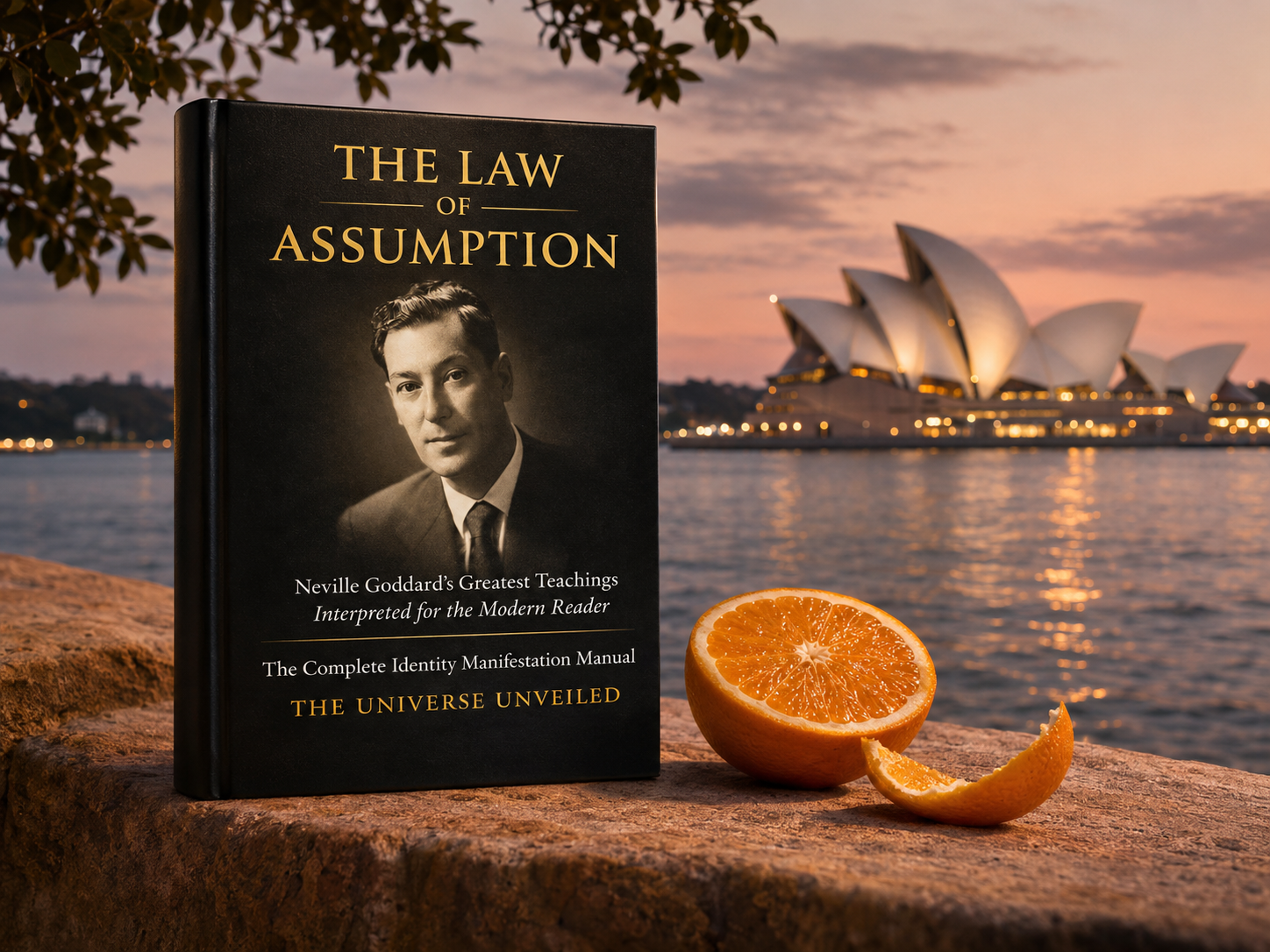
Featured Book

The Law of Assumption
Jørn Utzon saw the Sydney Opera House whole before anyone knew how to build it. This book shows you how to see your own finished picture first, and hold it while the world works out the how.
Get the BookAvailable in Kindle and Paperback — The Universe Unveiled
It is the most photographed building in Australia, and most people who stand in front of it have no idea that the man who imagined it was forced off the job, left the country in 1966 and never came back to see it finished. They do not know that for three years nobody could work out how to build the roof, or that the answer, when it came, had to do with an orange.
This is the true story of Jørn Utzon and the Sydney Opera House, read as a lesson in the Law of Assumption that Neville Goddard taught: the end exists complete before the means appear. If you are reading on the web, look at the bottom of your screen. A little crane is working on Bennelong Point, and as you scroll, the shells will rise behind it.
A Parable from Australia
Finished Before It Was Built
Jørn Utzon and the Sydney Opera House, read with Neville Goddard.
A Tram Shed on the Harbour
In the late 1940s the conductor Eugene Goossens, head of the New South Wales Conservatorium of Music, began pushing for a proper opera house in Sydney. He was the one who insisted on the site: Bennelong Point, a finger of land jutting into the harbour, which at the time held a tram depot. Premier Joseph Cahill backed him, and on 13 September 1955 the New South Wales government launched an international competition to design it.
At that moment there was nothing on Bennelong Point but trams. The building existed nowhere except as a wish in a few people's heads.
It starts as a picture
Neville taught that everything in your world begins as an image held in imagination before it shows up outside. The Sydney Opera House did not start with concrete. It started with a conductor who could see a theatre where there was a tram shed, and refused to stop seeing it.
Read the blueprint: the empty site
Every goal starts on an empty site. The fact that nothing is there yet is not evidence against it. It is simply where the building begins. What matters is whether someone holds the picture.
Doctrine: the imagined thing comes first. The outside world follows.
From the Reject Pile
The competition drew 233 entries from architects in 32 countries. One of them came from Jørn Utzon, a 38-year-old Dane from a shipbuilding family who had won some competitions at home but was barely known anywhere else. He had never been to Sydney. He studied sea charts of the harbour, and the shapes he drew looked like sails, or shells, or wings.
On 29 January 1957 he was announced the winner, with a prize of 5,000 pounds. You may have heard that the Finnish-American architect Eero Saarinen, one of the judges, arrived late, went through the rejected entries and pulled Utzon's drawings out of the pile. The story is repeated everywhere. Historians treat it as legend, and nobody can fully prove it. What is certain is stranger: the judges chose a design that no engineer yet knew how to build.
Whether or not it happened
People love the reject-pile story because it says the same thing as every good parable: being turned down first does not decide how it ends. Whatever happened in that room, the design that won was a picture nobody could build yet, chosen anyway.
Read the blueprint: the pile you were put in
You may have been put in a reject pile: by a boss, a family, an industry, or your own doubts. That pile is somebody's opinion on a particular day. It is not the end of the story unless you treat it as one.
Doctrine: a rejection is an event, not a verdict.
Starting Without the How
The government wanted the project moving, and construction began in March 1959, about two years earlier than Utzon had wanted. The tram depot had been knocked down, and work started on the great stone platform the building would sit on. But nobody had solved the roof.
The shells Utzon had drawn were free, flowing curves. Nobody could calculate them, so nobody could build them. Utzon and the engineers at Ove Arup's firm tried parabolas, then ellipses, and threw out design after design. Year after year the platform rose on the point while the roof stayed on paper.
The how is not your job yet
Neville taught that you do not have to know the means before you assume the end. The way things come together, the bridge of incidents, shows up as you go. For three years the Opera House had no how. It still had a finished picture, and that picture is what kept the project alive.
Read the blueprint: the missing method
Most people drop a goal the moment they cannot see how it would work. Utzon could not see how for three years. He kept the end and kept searching. Not knowing how is not a sign the goal is wrong. It only means the bridge has not been built yet.
Doctrine: hold the end. Let the how arrive on its own time.
The Orange
The breakthrough came from Utzon himself. On a plaque outside the building today, he recalls reaching it:
“after three years of intensive search for a basic geometry for the shell complex”Jørn Utzon, on October 1961
The answer was simple. Every shell could be cut from the surface of the same sphere. One of his assistants, Helge Hjertholm, later remembered Utzon walking into the office early one morning with an orange, slicing curved triangles from the peel to show how all the different shells could come from one ball.
One sphere
Different sizes, different angles, one source. Every shell on the roof is a piece of the same ball.
Because every shell came from one sphere, the curved ribs could be made in shared moulds and lifted into place, piece by piece. The impossible roof became something builders could actually build.
One assumption, many shapes
This is the Law of Assumption in one picture. You do not need a separate trick for money, love and health. Every part of your life is cut from the same sphere: your self-concept. Change the sphere and every shell changes with it.
Read the blueprint: when the answer is simple
After three years of complex attempts, the solution was simple enough to show with a piece of fruit. Answers often come like that, suddenly and plainly, after a long stretch of holding the end without seeing the way.
Doctrine: one assumption shapes every part of your life.
From Story to Practice
The Law of Assumption
The empty site, the missing method, the one sphere every shell is cut from. This book turns each of them into a daily practice for living from the end.
See the BookAvailable in Kindle and Paperback — The Universe Unveiled
The Man Who Left
In 1965 the government changed. The new Minister for Public Works, Davis Hughes, took control of the project's money and began questioning every decision and every cost. Payments owed to Utzon were held back. On 28 February 1966, after a meeting with Hughes in Sydney, Utzon resigned.
Crowds marched in the streets to bring him back. It made no difference. On 28 April 1966 Jørn Utzon flew out of Australia, and he never returned. A team of Australian architects was brought in to finish the job.
28 April 1966
The architect leaves. The shells keep rising.
And here is the part worth sitting with. The roof he had solved went up without him. The shells were finished, then the rest. The picture he had held for ten years kept turning into fact after he had gone.
The end does not need you to watch it
Neville taught that once an assumption is truly fixed, it hardens into fact by its own route. You do not have to stand over it supervising every brick. Persistence means holding the end, not controlling the scaffolding. See Neville Goddard on persistence.
Read the blueprint: when you are pushed out
Sometimes life takes you off the job: a plan collapses, a door shuts, someone else takes over. What you assumed does not leave with you. Utzon was forced off the site, and his shells still went up.
Doctrine: a fixed assumption finishes itself.
Opening Night Without Him
On 20 October 1973 Queen Elizabeth II opened the Sydney Opera House. It had taken 14 years, not the four first promised, and it had cost 102 million dollars against an original estimate of 7 million, most of it raised through a state lottery.
Utzon was not invited. His name was not mentioned in the ceremony. The building the whole world was looking at was his, and on its opening night he was on the other side of the planet.
The world is slow to say so
The outer world often lags behind the inner fact. Utzon had been right since 1957, and in 1973 there was still no public credit. Neville taught that you do not wait for the world to agree before you live from the end. The agreement comes later, and it does come.
Read the blueprint: the credit that comes late
If you are waiting for recognition before you feel like the person you are becoming, you are letting other people's timing set yours. The building was real on opening night whether or not anyone said his name.
Doctrine: the fact is real before the world admits it.
The Invitation
It took more than thirty years, but the world came back around. In 1999 the Sydney Opera House reappointed Utzon as a design consultant, and he drew up principles for all future work on the building. Working from abroad with his son Jan, he redesigned the Reception Hall, which reopened in 2004 as the Utzon Room. In 2003 he received the Pritzker Prize, architecture's highest honour, and in 2007 the building was added to the UNESCO World Heritage List while he was still alive.
Jørn Utzon died on 29 November 2008, aged 90. He never saw the finished Sydney Opera House in person. He did not need to. He had seen it in 1956, complete, before a single stone was laid.
Read the blueprint: what comes back around
The recognition he did not get in 1973 arrived in 1999, 2003 and 2007. Results do not always come in the order or on the timetable you expect. They come in line with the end you assumed.
Doctrine: what you truly assume returns to you, on its own schedule.
Your Opera House
Look at the bottom of your screen. The crane has gone and the shells are lit. That is how the story ends for everyone who holds a picture long enough: the scaffolding comes down and what is left is the thing they saw at the start.
You have a building of your own on an empty site somewhere. Maybe you have been told it cannot be built, or you cannot see how. Maybe you have been pushed off the job once already. The lesson of Bennelong Point is that none of that decides the ending. The picture does. As Neville taught, you begin at the end.
Before you go
Cut Your Shell
Nothing is written here and nothing is saved. Picture the one thing you want most, already finished, already yours. See it as clearly as Utzon saw his shells. Then say one sentence to yourself in the present tense.
“It is already whole.”
Fall asleep tonight in that sentence. Let the how take care of itself.
Go Deeper
The Law of Assumption
Utzon held a finished picture for years while everyone said it could not be done. This book shows you how to hold your own, every day, until the world builds it.
Read The Law of AssumptionAvailable in Kindle and Paperback — The Universe Unveiled
Additional reading
Cliff Young: The True Story of the Farmer Who Didn't Stop to Sleep
Jørn Utzon, the Sydney Opera House and the Law of Assumption: Frequently Asked Questions
Who designed the Sydney Opera House?
The Danish architect Jørn Utzon. He was 38 and had never visited Sydney when his entry won the international design competition, announced on 29 January 1957, against 232 other entries from 32 countries. After he left in 1966, a team of Australian architects completed the building.
Was Utzon's design really pulled from the reject pile?
That is the famous story: that the judge Eero Saarinen arrived late, went through the rejected entries and rescued Utzon's drawings. It is repeated widely, but historians treat it as legend and it cannot be fully proved. What is certain is that the winning design was one nobody yet knew how to build.
How did Utzon solve the shape of the Sydney Opera House shells?
After about three years of failed attempts with parabolas and ellipses, Utzon arrived in October 1961 at the spherical solution: every shell could be cut from the surface of the same sphere. His assistant Helge Hjertholm recalled him demonstrating it by cutting curved triangles from the peel of an orange. This let the ribs be made in shared moulds.
Why did Jørn Utzon resign from the Sydney Opera House?
After a change of government in 1965, the new Minister for Public Works, Davis Hughes, took control of the project's payments, questioned its costs and withheld fees owed to Utzon. Utzon resigned on 28 February 1966 and left Australia on 28 April 1966, despite public protests calling for his return.
Did Utzon ever see the finished Sydney Opera House?
No. He never returned to Australia and was not invited to the opening on 20 October 1973. He was reappointed as a design consultant in 1999, redesigned the Reception Hall that became the Utzon Room in 2004, and died in Denmark on 29 November 2008 without having visited the completed building.
How much did the Sydney Opera House cost to build?
The final cost was 102 million Australian dollars against an original estimate of 7 million, and it was largely paid for by a state lottery. Construction ran from 1959 to 1973, about 14 years instead of the four first planned.
What does the Sydney Opera House teach about the Law of Assumption?
That the end exists complete before the means appear. Utzon held a finished picture years before anyone knew how to build it, and the building was completed even after he was forced out. Neville Goddard taught the same about any desire: assume the end, and the bridge of incidents builds itself. See the Law of Assumption for the full teaching.
How can I apply the Utzon lesson to my own manifestation?
Picture your goal already finished, as clearly as an architect's drawing. Stop requiring yourself to know how it will happen. Each night, fall asleep feeling that it is already whole, and treat delays or setbacks as construction, not cancellation. The full steps are in how to apply the Law of Assumption.