Manifestation Burnout: How to Practice the Law of Assumption Without Exhausting Yourself
The exhaustion is not proof you lack discipline. It is proof the practice was built out of technique instead of state. Neville Goddard taught one movement, not twenty. Here is how to hold the Law of Assumption in a way you can actually sustain.

Manifestation burnout comes from treating the Law of Assumption as a workload. Affirmations repeated until they lose meaning, checking for signs, switching methods every week — none of that is the law. Neville Goddard taught one movement: occupy the state of the wish fulfilled and remain in it. A state is not a task. It does not need to be performed hourly to stay true.
The sustainable practice is one sentence of self-definition, one short scene entered in the state akin to sleep, and a decision to stop auditing your results.
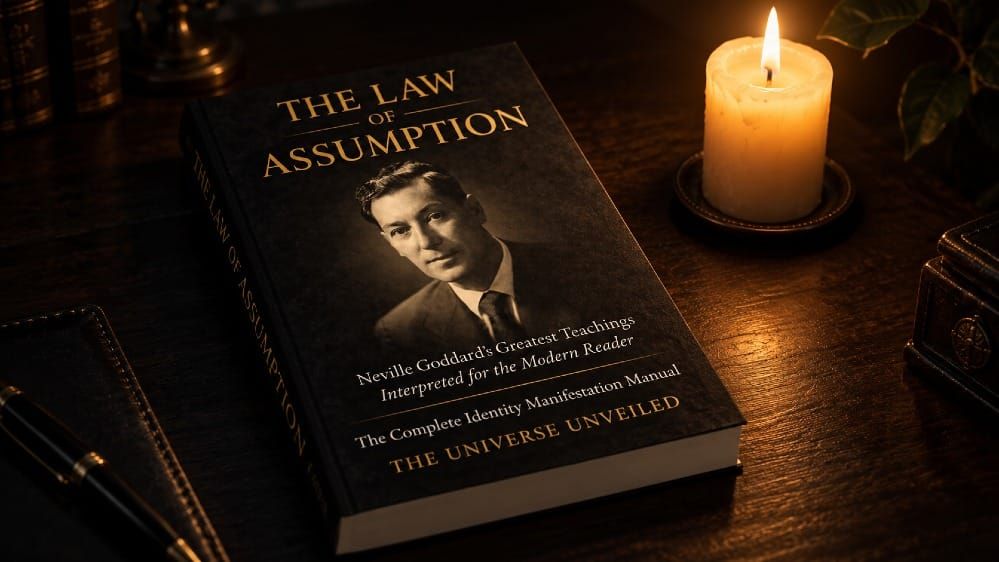
The full method is laid out in The Law of Assumption by The Universe Unveiled.

One State, Held Quietly, Until It Hardens Into Fact
If the practice has become a second job, the problem is not your discipline. It is the architecture. The Law of Assumption rebuilds the whole thing around a single movement you can hold for years without strain.
Get the Book on AmazonAvailable on Kindle and Paperback. Published by The Universe Unveiled.
You did everything the videos told you to do. You affirmed in the morning and again at night. You kept a journal, then a second journal. You tried scripting, then the ladder, then whispering, then a method someone posted last Tuesday. And somewhere in the middle of all that effort, the desire stopped feeling like a desire and started feeling like an obligation you were failing. If you have arrived here tired, start with the Neville Goddard ultimate guide for the doctrine in full, then come back, because what follows is the part nobody teaches: how to practise the Law of Assumption in a way that a human being can actually sustain.
Manifestation burnout is real, and it is not a character flaw. It is the predictable result of a structural mistake — building a practice out of techniques instead of out of a state.
What Manifestation Burnout Actually Is
Manifestation burnout — the depletion that follows sustained effortful practice, in which repetition, monitoring, and method-switching consume the attention that the assumption itself requires.
The assumed state — a settled inner position from which you think, rather than a claim you think about. Neville Goddard called it the state of the wish fulfilled.
Checking — any act of inspecting external circumstances for confirmation. Structurally, it is a return to the state of not having.
The Universe Unveiled defines manifestation burnout as the exhaustion produced when a practice is measured by output rather than by state. Output can always be increased, so the demand never ends. A state cannot be increased. You are either in it or you are not, and being in it costs nothing.
Why Your Practice Became Exhausting
You made repetition the mechanism
Somewhere along the way, affirmation stopped being a way to occupy a state and became a quota. Four hundred repetitions. Robotic voice recordings on loop. Sticky notes on every surface. But repetition was never the engine. Neville Goddard was explicit that the operative power is feeling, not frequency, and he built an entire book around that single claim — the argument at the heart of Feeling Is the Secret.
Here is the contrast that matters. Repetition without feeling is noise the subconscious discards. Feeling without repetition is an impression the subconscious accepts. One night of genuine occupancy outweighs three weeks of mechanical recitation.
You made checking part of the practice
This is the quiet one, and it does more damage than any technique. Every time you scan your phone for the message, refresh the portal, or ask a friend whether they think it is working, you step out of the assumed state and back into the state of waiting. The assumption is not damaged by doubt. It is damaged by inspection, because inspection is only performed by someone who does not already have the thing.
Checking is also what turns a practice into an anxiety loop. The more you check, the more evidence of absence you gather, and the more affirming you feel you must do to compensate. That loop is the burnout, mechanically described.
You made switching feel like progress
When results are slow, the internet offers a new method. So the two-cup method becomes the ladder becomes robotic affirming becomes a new moon ritual, each abandoned before it settled. But every switch restarts the clock, because what impresses the subconscious is a consistent inner position, not a varied schedule of exercises. The methods were never in competition. They are all doorways into the same room, and you kept walking out to try a different door.
A practice that requires willpower to maintain is reporting something. It is telling you that the state has not been assumed — because a state, once assumed, maintains itself the way your name does.
The One Thing Neville Goddard Actually Asked For
Strip away the vocabulary that accumulated after his death and Neville's instruction is remarkably small. Assume the feeling of the wish fulfilled. Remain faithful to that assumption. That is the whole law. Everything else — the state akin to sleep, revision, the mental diet — exists to serve that one movement or to repair it when it slips.
He learned this from Abdullah, the teacher who trained him for seven years, and the lesson was famously blunt. When Neville said he wanted to sail to Barbados, Abdullah refused to discuss arrangements at all. He told him he was already in Barbados, and then he stopped taking questions. There was no daily assignment. There was no technique stack. There was a position, and a refusal to leave it. You can read that whole account in the story of Abdullah.
Notice what is absent from that story. No repetitions counted. No signs monitored. No method switched. The entire discipline was declining to re-enter the old state during conversation.
The Minimum Effective Practice
What follows is a complete practice. Not a starter version, not a lite version — complete. If you do only this and nothing else, you are practising the Law of Assumption correctly.
One sentence of self-definition
Not a list of affirmations. One sentence, in the present tense, that describes who you are now that the desire is fulfilled. "I am the woman who was hired." "I am married to him." "My income covers everything easily." You are not repeating it to convince yourself. You are using it the way a person uses their own name — as a reminder of an established fact, spoken perhaps three or four times in a day, without urgency.
If the sentence produces tension when you say it, it is too far ahead of you. Shorten the distance until the sentence produces relief instead. The ladder method exists for exactly this purpose.
One scene, not a montage
Choose a single short action that implies the wish is already fulfilled. A handshake. A key turning in a lock. A friend saying congratulations. It should last a few seconds and it should be the same scene every night. Do not upgrade it, decorate it, or replace it with a better one next week. The repetition of a single scene is what gives it the quality of memory, and memory is what the subconscious treats as real. This is the discipline described in Awakened Imagination.
One session, at the edge of sleep
Enter the scene once a day, in the drowsy state just before sleep, for as long as it stays vivid — often two or three minutes, rarely more than ten. Then let yourself fall asleep inside it. This is the state akin to sleep, and it is the single highest-leverage minute in the entire practice, because the critical mind is offline and the impression lands unopposed.
Falling asleep before you finish is not a failure. It is the intended outcome.
One rule for the rest of the day
You are not permitted to check. That is the entire daytime practice. You are not obligated to affirm, visualise, journal, or feel a particular way. You are only asked to decline to reason from absence when the thought arises — to notice the pull toward inspecting your results and to let it pass unanswered. That is the mental diet in its most usable form, and it takes zero additional time out of your day because it is a subtraction, not an addition.
Count the total cost of the practice. Three or four spoken sentences and a few minutes at bedtime. Nothing else is required of you. There is no version of this that produces burnout, because there is nothing in it to exhaust.
Twenty-One Chapters. One Movement.
The Law of Assumption teaches the doctrine as a single continuous practice rather than a catalogue of techniques — self-concept, the state akin to sleep, revision, and the mental diet, in the order they are meant to be used.
Read It on AmazonWhat to Do When You Slip
You will slip. You will spend an afternoon rehearsing the worst case, or catch yourself explaining to someone why it has not happened yet. The burnout response is to declare the streak broken and start over with more effort. The correct response is much smaller.
Revise it. Take the moment where you fell out of the state and replay it internally as it should have gone — calm, certain, unbothered. Neville taught revision as nightly housekeeping rather than emergency repair, and used exactly this way it prevents accumulation. A slip that is revised leaves no residue. A slip that is punished becomes evidence, and evidence is what fuels the next round of overwork.
There is no streak. There is no scoreboard. There is only the state you are in right now, and it can be re-entered in a breath.
Waiting Without Watching
The hardest stretch is the interval between the assumption and the evidence, because that is where checking is most tempting. It helps to understand what is happening in that interval. Neville described the bridge of incidents — the series of ordinary, seemingly unrelated events that carry the assumption into fact. Those events are usually invisible while they occur and obvious only in hindsight.
Which means the absence of visible signs is not information. You cannot read the bridge from where you are standing. Monitoring it produces anxiety and no data, which is the worst possible trade.
The reframe that ends most burnout is this: you are not waiting for the manifestation. You are living as the person for whom it is already settled, and the world is catching up on its own schedule. Nothing is owed by you in the meantime.
Common Misconceptions About Manifestation Burnout
"I burned out because I did not want it enough."
Wanting harder is the mechanism of burnout, not the cure. Desire is the starting material; assumption is the operation. Intensifying desire while withholding assumption produces strain and nothing else.
"Resting means giving up on it."
Rest is indistinguishable from fulfilment, from the subconscious point of view. A person who already has the thing does not work on getting it. Ceasing effort is often the most accurate possible expression of the assumed state.
"I need to feel positive all day for this to work."
The law responds to your dominant self-concept, not to your mood. You can be irritable, tired, or grieving and still be assuming correctly. Emotional performance is not a requirement anywhere in Neville's teaching.
"A better technique will fix this."
Technique-shopping is the symptom. Every method points at the same state; the one you already know is sufficient. Consistency inside one doorway beats novelty across ten.
Glossary
Assumption — the act of taking a desired state as one's present identity rather than a future outcome.
State akin to sleep (SATS) — the drowsy threshold before sleep in which imaginal acts meet minimal resistance from the conscious mind.
Mental diet — the disciplined refusal to entertain thoughts that contradict the assumed state.
Revision — the practice of mentally replaying an event as it should have occurred, correcting the impression left on the subconscious.
Bridge of incidents — the chain of ordinary events through which an assumption becomes external fact.
Self-concept — the accumulated set of assumptions a person holds about who they are, which the outer world reflects.
The Practice You Can Keep
If you take one thing from this, take the size of it. A sentence you believe, a scene you enter at night, and a decision to stop looking. That is the practice, and it is small enough to survive a bad week, a busy month, and a year in which nothing appears to be happening. Ambition builds practices you abandon in six weeks. Conviction builds practices you barely notice yourself keeping.
The exhaustion was never evidence that you were doing too little. It was evidence that you were doing something other than assuming. Put the techniques down, keep the state, and let the bridge build itself. For the doctrine in sequence, begin with the Law of Assumption; for the words in his own voice, sit with Neville Goddard's quotes.
You do not have to work at being who you already are. You only have to stop arguing with it.
Manifestation Burnout and the Law of Assumption: Frequently Asked Questions
What is manifestation burnout?+
Manifestation burnout is the depletion that follows a practice built around effort rather than state. It develops when repetition, monitoring for signs, and frequent method-switching consume more attention than the assumption itself, turning a desire into an obligation and producing fatigue, resentment, and a sense of failure.
How many affirmations should I say per day?+
There is no required number. Neville Goddard identified feeling, not frequency, as the operative power. A single sentence spoken three or four times with quiet conviction does more than hundreds of mechanical repetitions, because the subconscious accepts impressions carried by feeling and discards noise.
Is it bad to check whether my manifestation is working?+
Checking is counterproductive because inspection is an act performed only by someone who does not yet have the thing. Each check returns you to the state of waiting and gathers further evidence of absence, which then prompts more compensatory effort. Declining to check is the main daytime discipline of the practice.
Why does switching manifestation techniques stop the results?+
Every switch restarts the process, because what impresses the subconscious is a consistent inner position rather than a varied schedule of exercises. The two-cup method, the ladder, scripting, and robotic affirming are all entrances to the same state. Staying inside one entrance is more effective than sampling all of them.
Can I manifest while feeling tired, low, or emotionally flat?+
Yes. The law responds to a dominant self-concept, not to a mood. Sustained cheerfulness is not a requirement anywhere in Neville Goddard's teaching. A person can be exhausted or grieving and still hold an accurate assumption about who they are and what is already settled for them.
How long should a state akin to sleep session last?+
Only as long as the scene stays vivid, which is usually two to three minutes and rarely more than ten. Falling asleep inside the scene is the intended outcome rather than a failure, since the impression lands with least resistance when the critical faculty is offline.
What should I do after a day of doubt and negative thinking?+
Revise it rather than restart. Replay the moment internally as it should have gone, calm and certain, and let the corrected version stand as the impression. Treating a slip as a broken streak invites more overwork, while revision clears it without residue.
Does resting from manifestation mean giving up on the desire?+
No. Rest is structurally identical to fulfilment, because a person who already possesses something does not work at obtaining it. Ceasing effort is often the most accurate available expression of the assumed state rather than an abandonment of it.