Neville Goddard Robotic Affirming: Does Repetition Actually Manifest?
Robotic affirming is everywhere, but Neville Goddard did not teach empty repetition as magic. This guide explains when affirmations work, why feeling still matters, and how repetition can stabilize a new assumption instead of reinforcing lack.

Robotic affirming can work, but not because the words are magic. It works when repeated phrases interrupt the old identity long enough for a new assumption to become familiar. In Neville Goddard’s teaching, repetition is useful only when it helps impress the subconscious with a fulfilled state. If the affirmation is repeated from panic, lack, or desperation, it can reinforce the very state you are trying to leave.
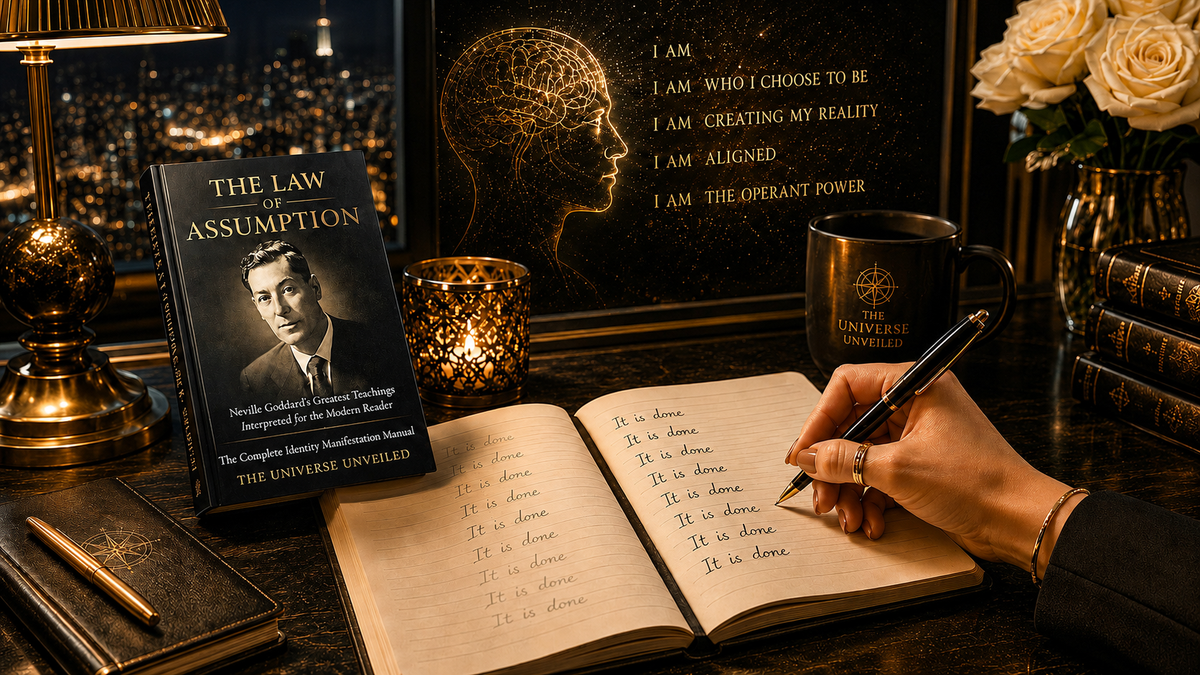
To understand the full doctrine behind assumption, feeling, identity, and subconscious impression, go deeper with The Law of Assumption.
 See the Book on Amazon from $9.99
Robotic affirming is everywhere right now.
People are repeating phrases for thirty minutes, one hour, one day, three days, sometimes even longer. They are looping affirmations while walking, showering, cleaning, driving, falling asleep, waking up, and moving through the ordinary hours of life.
Some swear by it.
Some say it changed their relationship overnight.
Some say money appeared, texts came in, apologies arrived, opportunities opened, and their whole inner world shifted because they refused to let the old story keep speaking.
Others try it and feel nothing.
They repeat the sentence hundreds of times and still feel anxious. They say the words, but the body does not believe them. They affirm love while feeling rejected. They affirm wealth while checking the bank account in panic. They affirm confidence while secretly rehearsing failure.
So the real question is not just whether robotic affirming works.
The real question is: what is robotic affirming actually doing to the subconscious?
And more importantly: does it fit Neville Goddard’s Law of Assumption?
For the full foundation of Neville’s system, begin with the Neville Goddard Ultimate Guide. This article focuses specifically on robotic affirming as a modern technique — and whether it aligns with the deeper doctrine of assumption, identity, and subconscious impression.
What Is Robotic Affirming?
Robotic affirming is the practice of repeating a short affirmation over and over again, often without trying to generate strong emotion, until the phrase becomes dominant in the mind.
The word “robotic” can sound mechanical, but that is the point. The method does not begin with emotional intensity. It begins with repetition.
You choose a phrase like:
I am chosen.
It is done.
Everything works in my favor.
Money comes easily to me.
I always get what I want.
They love hearing from me.
I am the version of me who already has this.
Then you repeat it. Again and again. Not necessarily with fireworks. Not necessarily with tears. Not necessarily with a full-body feeling of certainty at first.
The idea is that the mind is already repeating something.
Most people are not living in mental silence. They are already running robotic affirmations unconsciously:
This never works for me.
I am always behind.
They probably do not care.
I am not good enough.
Money disappears as soon as I get it.
People always leave.
Those are affirmations too. They may not be written on a vision board, but they are repeated with conviction. They become identity loops. They become the assumptions through which life is interpreted.
Robotic affirming tries to interrupt that automatic inner speech and replace it with a chosen assumption.
That is the part that can align with Neville.
But only if the repetition leads to assumption.
See the Book on Amazon from $9.99
Did Neville Goddard Teach Robotic Affirmations?
Neville Goddard did not teach robotic affirming in the modern social media sense.
He did not tell students to repeat a phrase ten thousand times like a machine and wait for reality to obey. Neville’s emphasis was not on empty repetition. His emphasis was on assumption.
He taught that consciousness is the only reality. He taught that imagination creates reality. He taught that feeling is the secret. He taught that the subconscious accepts what is impressed upon it as true. He taught that the world reflects the state you occupy.
That means the words matter only if they lead somewhere.
They must lead to a state.
They must lead to an inner acceptance.
They must lead to a new self-concept.
They must lead to the assumption that what you desire is already true in consciousness.
So when people ask, “Did Neville teach robotic affirming?” the clean answer is no — not as a standalone magic trick.
But did Neville teach the power of inner speech, repetition, and assumed words?
Yes.
Neville understood that what you say within yourself matters because inner speech reveals identity. Your internal conversations are not neutral. They are creative. They show what you have accepted as true.
This is why robotic affirming can become useful inside Neville’s system when it is used correctly. It can interrupt the old inner conversation. It can redirect attention. It can help install a new assumption. It can train the mind to stop returning to the old identity by default.
But it cannot replace assumption.
If the words never become a state, they remain noise.
For readers studying the difference between spoken phrases and true inner acceptance, the manifestation affirmations guide is the natural companion to this article.
Why Robotic Affirming Sometimes Works
Robotic affirming works when it changes the dominant inner loop.
This is the simplest explanation.
The conscious mind is repetitive. The subconscious is impressionable. Identity is maintained through repetition. What you repeatedly think, say, imagine, and emotionally rehearse begins to feel normal.
And what feels normal becomes easy to expect.
What you expect shapes what you notice.
What you notice shapes what you choose.
What you choose shapes how you move.
How you move shapes the bridge of incidents.
Robotic affirming can work because it breaks the momentum of the old story.
Someone who has been saying “I am never chosen” for years may not be able to jump straight into a full-body feeling of being deeply loved. The old identity is too familiar. The nervous system may reject the new state immediately.
But a repeated phrase can create a crack in the old pattern.
I am chosen.
I am chosen.
I am chosen.
At first it may feel false. Then it may feel neutral. Then it may feel possible. Then it may feel familiar. Eventually, if the person stops arguing against it, the phrase can become a new inner resting place.
That is when robotic affirming begins to work.
Not because reality heard the sentence.
Because identity began to accept it.
At its best, robotic affirming is not mindless. It is strategic repetition. You are choosing the sentence that replaces the old self-concept.
The goal is not to chant your way into a miracle.
The goal is to make the new assumption feel less foreign.
Why Robotic Affirming Sometimes Fails
Robotic affirming fails when it becomes a panic ritual.
This is the version most people fall into.
They feel anxious, so they repeat.
They feel rejected, so they repeat.
They feel broke, so they repeat.
They feel ignored, so they repeat.
But beneath the repetition is the same old state: lack, fear, checking, desperation, waiting, chasing.
The mouth says, I am chosen.
The identity says, I am not.
The mouth says, Money is easy.
The body says, I am unsafe.
The mouth says, It is done.
The attention says, Where is it?
In Neville’s system, the deeper assumption wins.
This is why robotic affirming can become spiritually exhausting. The person thinks they are doing the technique correctly because they are repeating the phrase. But the repetition is only happening on the surface. Underneath, they are still living from the old identity.
They repeat the affirmation while watching the 3D for proof.
They repeat the affirmation while rehearsing the opposite story.
They repeat the affirmation while counting how many hours it has been.
They repeat the affirmation while secretly believing manifestation is not working.
That is not assumption.
That is fear with a script.
Robotic affirming fails when the words become a way to avoid the real work: changing who you are being inside.
Robotic Affirming vs Feeling It Real
The biggest debate around robotic affirming is feeling.
Do you need to feel the affirmation?
Can you repeat it without emotion?
Does robotic repetition work if you feel nothing?
Neville’s answer would be more precise than the modern debate allows.
Feeling does not always mean emotional intensity. Feeling means accepted reality. It means naturalness. It means the inner sense that something is true, settled, or becoming familiar.
You do not need to cry.
You do not need to feel euphoric.
You do not need to manufacture a dramatic emotional high every time you affirm.
But the affirmation must eventually move from empty sound into inner acceptance.
This is where people misunderstand “feeling it real.”
They think feeling means excitement. Sometimes it does. But often the most powerful feeling is quiet normalcy.
“Of course I am chosen.”
“Of course money comes.”
“Of course everything works out.”
“Of course I am the person this happens for.”
That “of course” feeling is Neville’s territory.
Robotic affirming can help you reach that state if you stop demanding fireworks. The phrase may begin mechanically, but over time it should become natural. It should soften resistance. It should replace the inner argument. It should begin to feel like the new default.
If the phrase never becomes natural, adjust it.
If “I am a millionaire” creates too much resistance, use “Money is becoming normal for me.”
If “I am loved by everyone” feels absurd, use “I am easy to love.”
If “Everything is perfect” feels fake, use “Things are working in my favor.”
The purpose is not to impress your ego with a dramatic sentence.
The purpose is to impress your subconscious with a state it can begin to accept.
The Identity Problem Behind Empty Repetition
Every affirmation has an identity hidden inside it.
That is the part most people miss.
When you say “I am chosen,” you are not really trying to manifest one text, one apology, or one romantic outcome. You are installing the identity of someone who is chosen.
When you say “Money comes easily,” you are not merely trying to manifest one payment. You are installing the identity of someone for whom money is not a battlefield.
When you say “Everything works in my favor,” you are not trying to control one event. You are installing the identity of someone who expects life to cooperate.
The affirmation is only useful if it moves identity.
This is why empty repetition feels so weak. The person repeats the phrase, but they remain loyal to the old self. They say “I am chosen,” but still stalk for evidence of rejection. They say “I am wealthy,” but still identify as the person who barely survives. They say “It is done,” but still organize their entire day around checking whether it happened.
The old identity is still on the throne.
Robotic affirming becomes powerful when it dethrones the old identity.
You are not just repeating words.
You are refusing to keep rehearsing the self who does not have it.
This connects directly to subconscious reprogramming, because the subconscious does not change through intellectual agreement alone. It changes when a new pattern is repeated until it becomes familiar enough to feel like you.
How to Use Robotic Affirming Correctly
The correct use of robotic affirming is simple, but not sloppy.
Step one: choose one clear identity-based phrase.
Do not use five different affirmations for five different desires at once. Choose the phrase that best captures the identity you are installing. The shorter the better. The subconscious responds to clean repetition.
Step two: remove the panic.
Do not affirm as if you are trying to stop disaster. That makes fear the real state. Slow your body. Breathe. Repeat from decision, not emergency.
Step three: repeat until the phrase becomes familiar.
At first, the affirmation may feel like a sentence. Over time, it should feel like an atmosphere. The goal is not to hit a magic number. The goal is for the new statement to become easier to return to than the old story.
Step four: stop arguing for the opposite.
You cannot affirm “I am chosen” for an hour and then spend the rest of the day building a legal case for why you are unwanted. The affirmation is the new direction. Do not keep feeding the old one.
Step five: live from the new assumption in small ways.
If you are chosen, how do you stop chasing? If money is normal, how do you stop panicking? If everything works in your favor, how do you stop narrating doom? The affirmation must become a way of being.
Robotic affirming is not a replacement for embodiment.
It is a path into embodiment.
This is why it pairs naturally with the Law of Assumption for beginners. The phrase introduces the state, but the assumption must become the identity you live from.
Best Robotic Affirmations for the Law of Assumption
The best robotic affirmations are short, clean, and identity-based.
They should not sound like pleading. They should not sound like a negotiation. They should not keep you in the future.
Use affirmations that imply the fulfilled state.
For general manifestation:
It is done.
Everything works in my favor.
I always get what I want.
Things move for me now.
My desire is already mine.
For love and relationships:
I am chosen.
I am deeply loved.
They love being close to me.
I am easy to love.
Love is secure for me now.
For money:
Money is normal for me.
I am safe with money.
Money comes easily.
I always have more than enough.
Wealth is part of my identity.
For confidence:
I am the one.
I trust myself.
I move with certainty.
I am already that version of me.
Confidence is natural for me.
For success:
I am recognized.
Opportunities choose me.
Success is normal for me.
I am seen, valued, and rewarded.
My work opens doors.
A strong robotic affirmation should be easy to repeat and difficult to misunderstand.
The cleaner the sentence, the deeper the groove.
Robotic Affirming Before Sleep
Robotic affirming becomes especially powerful before sleep because the conscious mind is already softening.
This is where the method begins to overlap with the Neville Goddard Lullaby Method.
The difference is subtle.
Robotic affirming can happen at any time of day. The Lullaby Method happens at the threshold of sleep. Robotic affirming often emphasizes repetition. The Lullaby Method emphasizes falling asleep in the fulfilled implication of a phrase.
But the two can work together.
You may repeat “It is done” throughout the day to interrupt the old story, then use the same phrase at night as a lullaby into sleep. During the day, the phrase redirects attention. At night, the phrase impresses the subconscious more deeply.
This also connects to State Akin to Sleep, where Neville placed enormous emphasis on the drowsy state as a doorway to subconscious impression.
The rule is simple:
Do not fall asleep in contradiction.
If you affirm “I am chosen” all day and then fall asleep imagining rejection, the final state matters. If you affirm “Money is normal for me” and then fall asleep in financial panic, the subconscious receives panic.
Use the final minutes before sleep to simplify.
One phrase.
One state.
One identity.
Let the last word of the day belong to the fulfilled self.
Robotic Affirming and Mental Conversations
Robotic affirming is not only about spoken repetition. It is also about inner conversation.
Your mind is always talking.
It talks about who you are. It talks about what people think of you. It talks about money. It talks about your body. It talks about your past. It talks about your future. It talks about what is possible and what is not.
Most of this conversation feels automatic because it has been repeated for years.
Robotic affirming is a way of taking command of the conversation.
Instead of allowing the mind to repeat “They do not care,” you choose “I am chosen.”
Instead of allowing the mind to repeat “I am behind,” you choose “Everything is working in my favor.”
Instead of allowing the mind to repeat “Money is hard,” you choose “Money is normal for me.”
This is not denial. It is direction.
For a deeper understanding of how inner dialogue shapes reality, connect this article with the guide to Neville Goddard mental conversations. Robotic affirming works best when it becomes part of a larger correction of inner speech.
You are not trying to win a verbal contest with reality.
You are training the mind to stop betraying the state you claim to occupy.
Common Mistakes People Make With Robotic Affirmations
Mistake one: changing the affirmation every few hours.
If you keep switching phrases, the mind never receives a clean impression. Choose one phrase and stay with it long enough for the old identity loop to weaken.
Mistake two: using phrases that create too much resistance.
If an affirmation feels so false that it triggers panic, soften it. “I am open to money becoming normal” may work better at first than “I am a billionaire.” The point is not to impress your ego. The point is to reach the subconscious.
Mistake three: repeating while checking.
Checking the 3D while affirming keeps the old world in authority. You are asking the mirror for permission to become someone new. Stop checking long enough for the new assumption to stabilize.
Mistake four: using robotic affirming to suppress emotion.
Affirming should not become emotional avoidance. If fear rises, notice it. Do not worship it, but do not pretend it is not there. Return to the phrase from decision, not suppression.
Mistake five: affirming against yourself.
If the phrase sounds like punishment, it will not install freedom. “I must get this now” is not assumption. “It is already handled” is cleaner.
Mistake six: never becoming the person who has it.
The affirmation must change how you move. If you are loved, stop begging. If you are wealthy, stop identifying with panic. If you are chosen, stop performing for approval. The phrase must become a self.
Robotic Affirming and the Law of Assumption
The Law of Assumption does not say that repeated words create reality.
It says that your assumed state creates reality.
This distinction is everything.
Robotic affirming is useful only when it serves the assumption. The phrase is a tool. The state is the cause. The repetition is a bridge. The identity is the destination.
If you repeat “I am chosen” until you stop identifying as the rejected one, the affirmation has done its work.
If you repeat “Money is normal for me” until financial ease becomes part of your self-concept, the affirmation has done its work.
If you repeat “Everything works in my favor” until life no longer feels like an enemy, the affirmation has done its work.
But if you repeat the phrase while remaining loyal to the old identity, nothing essential has changed.
Neville’s teaching is not mechanical.
It is structural.
Reality reorganizes around the state you occupy. Robotic affirming can help you occupy a new state — but it cannot substitute for occupying it.
The real question is not, “How many times did I repeat the affirmation?”
The real question is, “Who did I become while repeating it?”
See the Book on Amazon
Neville Goddard Robotic Affirming: Frequently Asked Questions
What is robotic affirming? +
Robotic affirming is the practice of repeating one affirmation over and over until the phrase becomes dominant in the mind. The goal is to interrupt the old inner story and replace it with a new assumption that eventually feels natural.
Did Neville Goddard teach robotic affirming? +
Neville Goddard did not teach robotic affirming as a modern mechanical technique. He taught assumption, feeling, imagination, and subconscious impression. Robotic affirming can fit Neville’s system only when repetition leads to a new assumed state.
Does robotic affirming work without feeling? +
Robotic affirming can begin without strong emotion, but it should eventually create naturalness. In Neville’s teaching, feeling does not always mean emotional intensity. It means inner acceptance. If the phrase never begins to feel normal, it has not become an assumption.
How long should you robotic affirm? +
There is no magic number. Repeat the affirmation until it interrupts the old story and begins to feel familiar. The goal is not a fixed count. The goal is to stabilize the new assumption so the old identity loses authority.
What are the best robotic affirmations? +
The best robotic affirmations are short, clear, and identity-based. Examples include “I am chosen,” “It is done,” “Everything works in my favor,” “Money is normal for me,” and “I always get what I want.” The phrase should imply fulfillment, not longing.
Can robotic affirming make things worse? +
Robotic affirming can feel worse when it is done from panic, pressure, or emotional suppression. If the phrase becomes a desperate attempt to force reality, the dominant state may still be lack. The correction is to soften the phrase and repeat from decision, not fear.
Is robotic affirming the same as the Lullaby Method? +
No. Robotic affirming can happen at any time of day and usually emphasizes repetition. The Lullaby Method happens before sleep and uses a phrase to carry the feeling of fulfillment into the subconscious. They can overlap, but they are not identical.