The Wright Brothers’ First Flight: The True Story of the Twelve Seconds Nobody Believed
In 1903 the experts said flight would take a million years and the best-funded machine in America crashed into the Potomac. Nine days later, two bicycle mechanics from Ohio flew. The true Wright brothers story, told as a scrollytelling game and read with the Law of Assumption.

What It Teaches
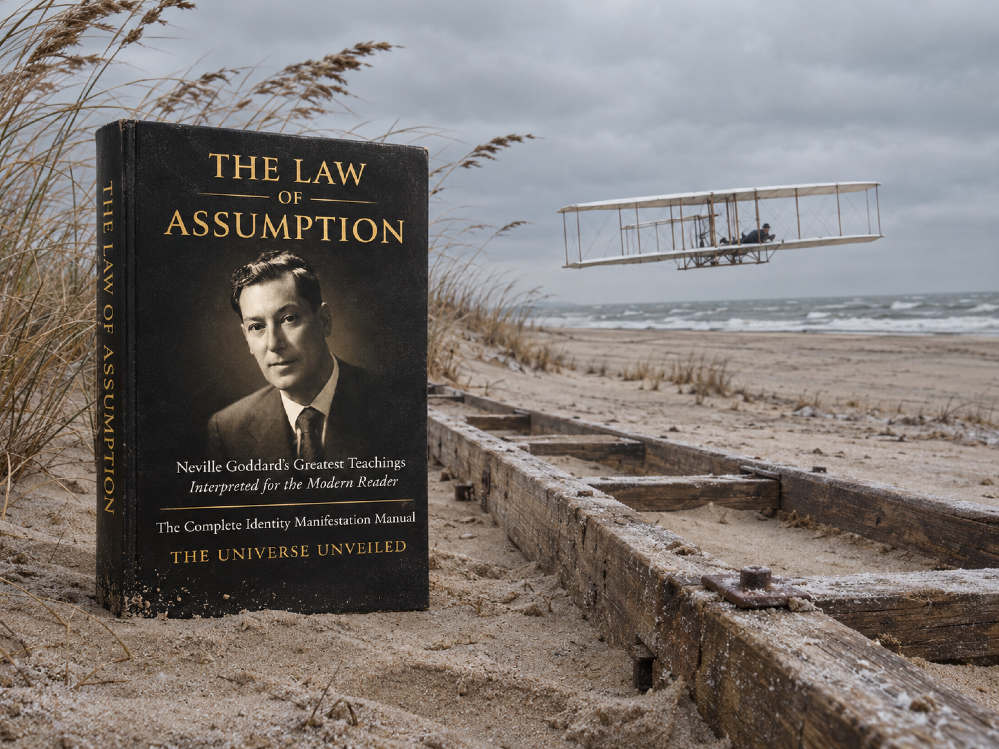
On 17 December 1903 at Kill Devil Hills, near Kitty Hawk, North Carolina, Orville Wright flew a powered airplane for 12 seconds and 120 feet, and his brother Wilbur later flew 852 feet in 59 seconds. Neither brother had a college degree. Nine days earlier, Smithsonian Secretary Samuel Langley's Aerodrome, built with a 50,000 dollar War Department grant, had crashed into the Potomac for the second time. The Wrights saw themselves as the people who would fly long before anyone agreed. That is the heart of Neville Goddard's Law of Assumption: self-concept outweighs credentials, money and expert forecasts.
The full method is in The Law of Assumption on Amazon.
Worth Remembering
- The Wrights paid for their experiments with their bicycle business in Dayton, Ohio.
- Langley had a 50,000 dollar War Department grant and an engine about four times more powerful. His Aerodrome crashed on 7 October and 8 December 1903.
- A New York Times editorial on 9 October 1903 suggested true flight might take one to ten million years. The Wrights flew 69 days later.
- Wilbur won a coin toss on 14 December, and the first attempt stalled. They repaired the Flyer and flew three days later.
- Recognition came last. The Smithsonian displayed the 1903 Flyer only in 1948, the final plank on the bridge of incidents.
To practise this every day, start with The Law of Assumption and the guide to your self-concept.
In Plain Words
Two brothers who fixed bicycles beat a famous scientist with government money to the first airplane flight. The experts said it would take a million years. It took them 69 days. They did it because they already saw themselves flying and kept going after their first try failed. Your goals work the same way: see the finished scene first and feel it as real, even for twelve seconds. The steps are in how to apply the Law of Assumption.
For the whole practice, chapter by chapter: The Law of Assumption on Amazon.
Featured Book

The Law of Assumption
The best-funded scientist in America crashed into a river. Two bicycle mechanics from Ohio flew. This book shows you how to live as the person who already flies, before anyone believes you.
Get the BookAvailable in Kindle and Paperback — The Universe Unveiled
On a freezing Thursday morning in December 1903, on a beach in North Carolina, a man lay flat on the lower wing of a homemade machine, his brother running beside him, and for twelve seconds the age of flight began. Almost nobody noticed. Nine days earlier, the most famous scientist in America had tried the same thing with government money and fallen straight into the Potomac River.
This is the true story of Wilbur and Orville Wright, told as a scrollytelling game and read as a lesson in the Law of Assumption that Neville Goddard taught: the people who see themselves already flying usually beat the people with all the credentials. Look at the bottom of your screen. The Flyer is waiting on the sand. Every chapter you read pushes it further down the rail. There are things to tap along the way, so keep your sound on.
A Parable from America
Twelve Seconds That Nobody Believed
The Wright brothers at Kitty Hawk, read with Neville Goddard.
Two Brothers in a Bicycle Shop
Wilbur and Orville Wright were not scientists. Neither of them had a college degree, and neither even received a high school diploma. They ran a bicycle shop in Dayton, Ohio, building and repairing bikes to pay the bills.
But in the back of that shop, they were working on a problem the greatest minds of their time had failed to solve. They watched birds. They built kites and gliders and flew them on the sand dunes of the Outer Banks. When the published tables on lift turned out to be wrong, they built their own wind tunnel and measured it themselves. They never asked anyone for permission to think of themselves as the people who would do it.
Tap the bell
The Wright Cycle Company paid for every glider, every test and every engine part. No grants, no institution.
Who you take yourself to be
Neville taught that everything flows from your self-concept, the person you assume you are. To the world, the Wrights were bicycle mechanics. To themselves, they were the men who were going to fly. Only one of those descriptions mattered.
Read the logbook: the missing credentials
If you are waiting for the right degree, title or backing before you see yourself as the person who does it, you are waiting for permission nobody can give you. The Wrights had none of it. They had a picture of themselves in the air.
Doctrine: your credentials are who you assume you are.
The Man with Fifty Thousand Dollars
Meanwhile, in Washington, the race looked already won. Samuel Pierpont Langley was the Secretary of the Smithsonian Institution, one of the most respected scientists in the country. In 1898 the War Department gave him 50,000 dollars to build a full-size flying machine that could carry a man. He called it the Aerodrome.
Langley had everything the Wrights did not: money, staff, reputation and the newspapers on his side. His engine produced about 53 horsepower, roughly four times the power of the engine the Wrights would later build. He planned to launch the Aerodrome by catapult from the roof of a houseboat on the Potomac River.
Outer advantages
Langley had every outer sign of success. But Neville taught that the outer world is the effect, not the cause. Money and status are wonderful when they come from the inner state. They cannot replace it.
Read the logbook: the other team's budget
There will always be someone with more money, more followers or a bigger platform working on the same dream as you. Their resources are not your verdict. Your assumption is.
Doctrine: the cause is inside. The budget is outside.
One to Ten Million Years
On 7 October 1903 the Aerodrome was catapulted off the houseboat with Langley's assistant Charles Manly aboard. It plunged straight into the Potomac. Two days later The New York Times ran an editorial headed “Flying Machines Which Do Not Fly.” It said a machine that could truly fly might be developed by mathematicians and engineers in somewhere between one million and ten million years.
Tap the newspaper
The experts had spoken. The Wright brothers were already at Kill Devil Hills, assembling their machine.
The world's forecast
Newspapers, experts and statistics all describe the world as it looks from the old state. They are reports on the past, not prophecies. Neville taught that you do not wait for the forecast to change. You live from the end, and the forecast catches up.
Read the logbook: the expert prediction
Someone has probably given you a confident prediction about your life: it will take years, it is not realistic, people like you do not do that. Treat it like the 1903 editorial. It was written by intelligent people, and it was wrong in 69 days.
Doctrine: a forecast is a report on the old state, not a law.
Into the Potomac
Langley's team rebuilt the Aerodrome and tried again on 8 December 1903, late in the afternoon. Once more it shot off the catapult and broke apart into the icy river. Manly was pulled out of the water unhurt. Langley blamed the launching mechanism, but the War Department had seen enough, and the project was finished.
Nine days to go
The best-funded flying machine in the world lies in the Potomac. Four hundred kilometres south, two brothers are waiting for the wind.
Not a lesson in failure
This is not a story about a foolish man. Langley was brilliant and his engine was excellent. It is a story about what money cannot buy: the patient, inner certainty that solved the real problem, which the Wrights saw as control and balance, not raw power.
Read the logbook: more power is not the answer
Langley tried to force the machine into the air with power. The Wrights learned to balance in the air. Manifesting by force, effort and willpower works like the Aerodrome. Manifesting from a settled assumption works like the Flyer.
Doctrine: you do not force the state. You settle into it.
From Story to Practice
The Law of Assumption
The missing credentials, the expert forecast, the bigger budget across town. This book turns each of them into a daily practice for living from the end.
See the BookAvailable in Kindle and Paperback — The Universe Unveiled
The Coin Toss
At Kill Devil Hills, near Kitty Hawk, the brothers were ready on 14 December. They tossed a coin to decide who would try first. Wilbur won. The Flyer ran down its wooden rail, lifted, stalled and dropped back into the sand after about three seconds, damaging the machine. It was not counted as a flight.
Most people would have read that as a sign. The brothers simply repaired the Flyer and waited for the next good wind.
Tap the coin
Winning the toss did not mean flying first. The first attempt was not the end of the story.
A stall is not a verdict
Neville taught that an assumption, persisted in, hardens into fact. The key word is persisted. A stall in the sand on 14 December did not cancel a flight on 17 December. See Neville Goddard on persistence.
Read the logbook: the first try in the sand
If your first attempt dropped into the sand after three seconds, you are in exactly the same position the Wright brothers were in three days before history. Repair the machine. Wait for the wind.
Doctrine: the first try is not the test of the assumption.
Twelve Seconds
Thursday 17 December was cold, with a north wind of around 27 miles an hour, stronger than the brothers would have liked. It was Orville's turn. He lay flat on the lower wing, the engine running, while Wilbur steadied the right wingtip and ran alongside. Orville had set up his camera on a tripod and asked John T. Daniels, a man from the nearby lifesaving station who had never taken a photograph, to squeeze the bulb if the machine left the ground.
It did. For 12 seconds the Flyer rose and dipped and flew 120 feet, and Daniels caught the moment.
Tap the photograph to take it, the way John T. Daniels did

They flew three more times that morning, taking turns. Each flight went further. The fourth, with Wilbur at the controls at noon, lasted 59 seconds and covered 852 feet.
| Flight | Pilot | Time | Distance |
|---|---|---|---|
| 1 · 10:35 am | Orville | 12 sec | 120 ft |
| 2 · 11:00 am | Wilbur | about 12 sec | about 175 ft |
| 3 · 11:40 am | Orville | 15 sec | about 200 ft |
| 4 · noon | Wilbur | 59 sec | 852 ft |
Tap the propellers
Two wooden propellers, carved by hand, driven by a light engine the brothers built in their shop with their mechanic, Charlie Taylor.
Feeling it real
Notice how short the first flight was. Twelve seconds. Neville taught that you do not need hours of imagining. You need a moment that feels completely real, a single scene of the wish fulfilled. Twelve seconds of genuine flight changed the world, and twelve seconds of genuine feeling can change your life.
Read the logbook: twelve seconds is enough
You do not need to hold a vision for an hour. You need a short scene that feels like fact. Lie still, the way Orville lay on the wing, and feel twelve seconds of the end as real.
Doctrine: one real moment outweighs a thousand hopeful hours.
Nobody Believed It
That evening the brothers sent a telegram home to their father in Dayton. The world was slow to care. Many newspapers ignored the story or got it wrong, and for years afterwards the Smithsonian promoted Langley's Aerodrome as the first machine capable of flight, after it was modified and flown in 1914.
The Wrights kept flying anyway. In 1942 the Smithsonian finally withdrew its claims for the Aerodrome, and in December 1948, eleven months after Orville's death, the 1903 Flyer was installed at the Smithsonian, where it hangs today. The machine that nobody believed in is now one of the most famous objects in America.
The world agrees last
The fact came first, on a cold beach in 1903. The official agreement came 45 years later. Neville taught that you do not need the world's recognition for your inner fact to be real. Recognition is the last thing to arrive, the final plank on the bridge of incidents.
Read the logbook: waiting for applause
If no one has noticed your progress yet, you are in good company. The first airplane flight in history barely made the news. Keep flying. The applause is the slowest part of the bridge.
Doctrine: the fact is real before anyone admits it.
Your Kitty Hawk
Look at the bottom of your screen. The Flyer has left the sand. It took two bicycle mechanics, a borrowed camera, a coin toss and a cold north wind, while the best-funded experiment in America sat at the bottom of a river.
Everyone has a Kitty Hawk: a dream other people say will take a million years, a goal someone better qualified is already chasing with more money. The lesson of 1903 is that none of that decides who flies. The person who already sees himself in the air does. Below is your turn on the rail.
Before you go
Release the Wire
Nothing is written here and nothing is saved. Picture the thing you want already done, as one short scene. Press the button and hold that scene, as real as you can, for the whole twelve seconds the Flyer is in the air.
“I am already in the air.”
Fall asleep tonight in that sentence. Let the world catch up.
Go Deeper
The Law of Assumption
The Wright brothers saw themselves flying while the experts predicted a million years. This book shows you how to assume your own end, every day, until the world catches up.
Read The Law of AssumptionAvailable in Kindle and Paperback — The Universe Unveiled
Additional reading
The Four-Minute Mile and Limiting Beliefs
Acres of Diamonds: Russell Conwell
Cliff Young: The True Story of the Farmer Who Didn't Stop to Sleep
Historical sources: National Park Service, The First Flight · Smithsonian, Langley Aerodrome A · Library of Congress, first flight photograph
The Wright Brothers' First Flight and the Law of Assumption: Frequently Asked Questions
When and where did the Wright brothers make the first flight?
On 17 December 1903 at Kill Devil Hills, near Kitty Hawk, North Carolina. Orville Wright flew first at 10:35 am, staying in the air for 12 seconds and covering 120 feet.
How many flights did the Wright brothers make on 17 December 1903?
Four. The brothers took turns, and each flight went further. The longest, flown by Wilbur at noon, lasted 59 seconds and covered 852 feet.
Who took the famous first flight photograph?
John T. Daniels, a member of the nearby Kill Devil Hills lifesaving station. Orville had set up the camera and asked him to squeeze the shutter bulb if the machine left the ground. The photograph is held by the Library of Congress.
Did the Wright brothers go to college?
No. Neither brother had a college degree, and neither received a high school diploma. They funded their flying experiments through their bicycle business in Dayton, Ohio.
Who was Samuel Langley and what happened to his Aerodrome?
Samuel Pierpont Langley was Secretary of the Smithsonian Institution. With a 50,000 dollar War Department grant he built a full-size Aerodrome, launched by catapult from a houseboat on the Potomac. It crashed into the river on 7 October and again on 8 December 1903, nine days before the Wrights flew.
Did The New York Times say flight would take a million years?
Yes. After Langley's first crash, a New York Times editorial on 9 October 1903, headed Flying Machines Which Do Not Fly, suggested a true flying machine might take one million to ten million years to develop. The Wrights flew 69 days later.
What do the Wright brothers teach about the Law of Assumption?
That self-concept outweighs credentials, money and expert opinion. The Wrights saw themselves as the people who would fly long before anyone agreed, persisted through failed attempts, and the world's recognition came last. Neville Goddard taught the same: assume the end, and the outer world follows. See the Law of Assumption for the full teaching.
How can I apply the Wright brothers lesson to my own manifestation?
Choose one short scene that implies your wish is already fulfilled. Each night, lie still and feel that scene as real for even twelve seconds, then fall asleep in it. Ignore forecasts, budgets and early stalls. The full steps are in how to apply the Law of Assumption.