Fall Back: The Hour You Live Twice and Neville Goddard’s Revision Technique
Once a year the clock gives you back an hour you have already lived. When daylight saving time ends, 1:00 a.m. happens twice. Neville Goddard taught a way to relive any hour you choose, every night, and change what it goes on producing. Here is the history of the extra hour and how to use it.


The Short Version
When daylight saving time ends, the clocks go back from 2:00 a.m. to 1:00 a.m., and the same hour is lived twice. In the US that happens on Sunday, November 1, 2026. In the UK and Europe it happened on October 25.
Neville Goddard taught a way to relive any hour you choose: revision. Replay the scene as you wanted it, fall asleep inside the new version, and the state you carry forward changes.
The clock gives you one hour a year. Revision gives you every night. The full method is in The Law of Assumption.
What to Remember
- US clocks fall back at 2:00 a.m. on November 1, 2026. The hour from 1:00 to 1:59 a.m. repeats.
- Franklin's famous 1784 letter was satire. William Willett proposed the modern idea in 1907, and Germany adopted it first in 1916.
- Revision replays an event the way you wanted it to happen, until the new version feels natural. The revision technique
- It works best in the drowsy minutes before sleep. The state akin to sleep
- Time on the clock is a convention. The law does not check it. Divine timing
Learn the whole practice in The Law of Assumption by The Universe Unveiled.
In Plain Words
Once a year the clocks go back an hour, so for one night you get to live 1:00 a.m. twice.
Neville Goddard said you can do that with any moment, any night. Lie in bed, pick a moment from the day that went badly, and replay it in your mind the way you wish it had gone. Do it until it feels real, then fall asleep in it.
Start the night the clocks change, and keep going. If the timing of everything worries you, read It's a Clock, then get The Law of Assumption.
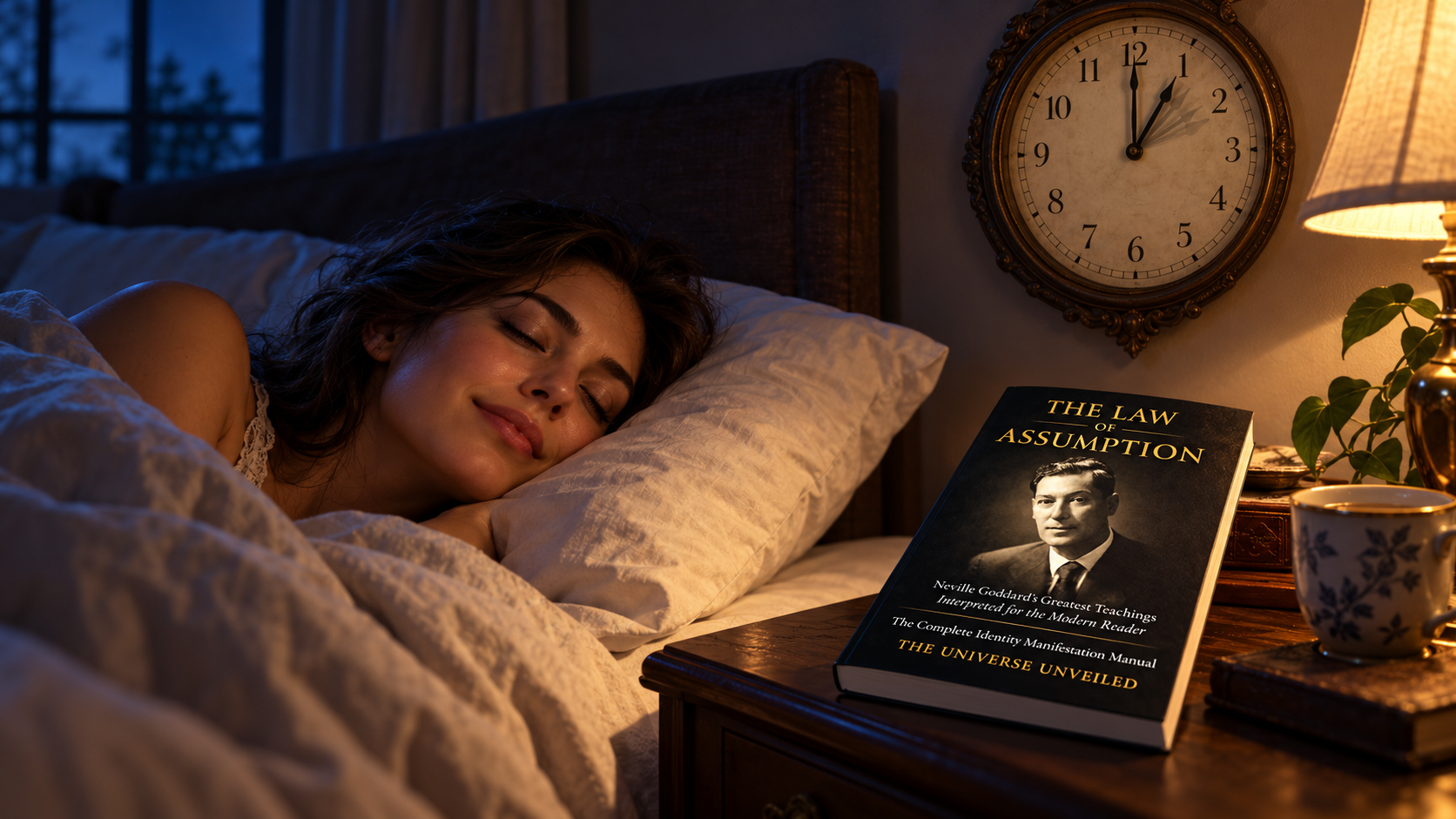
Featured Book

The book that teaches you to relive any hour you choose
The Law of Assumption lays out Neville Goddard's teaching in plain language: how a state is assumed, how revision rewrites what you carry, and why the inner change comes first.
Get The Law of AssumptionA Sunday Story · Parables of the Law
The Hour You Live Twice
Once a year the clock hands you back an hour you have already lived. Neville Goddard taught a way to do it every night.
Sometime after midnight next Sunday, clocks across most of the United States will reach 1:59 a.m., and instead of turning to two they will go back to one.
For sixty minutes, everyone who is awake will live an hour they have already lived. In Britain and across Europe it happened this morning. It is the strangest thing a modern society does on purpose, and almost nobody stops to notice what it means. Neville Goddard would have noticed, because reliving an hour was the practice he called the most important thing he taught: revision. This is the story of the hour that happens twice, and how to use it.
- Daylight saving time
- The practice of moving clocks forward an hour in spring and back an hour in autumn, to shift daylight into the evening.
- Fall back
- The autumn change, when clocks go back from 2:00 a.m. to 1:00 a.m., so the hour from 1:00 to 1:59 is lived twice. In the US it falls on November 1, 2026.
- Revision
- Neville Goddard’s practice of replaying an event in imagination the way you wish it had happened, until the revised version feels natural.
- State akin to sleep
- The drowsy, relaxed state just before sleep in which Neville said imagination is most easily impressed.
- Law of Assumption
- Neville Goddard’s teaching that whatever you assume to be true, and keep assuming, hardens into fact.
Once a year the clock lets you relive an hour. Revision lets you relive any hour you choose, every night.
I
Chapter One
The joke about candles
Every autumn someone credits Benjamin Franklin with daylight saving time. In 1784, living in Paris, he wrote a letter to the Journal de Paris pointing out that Parisians slept through hours of free morning sunlight and then burned candles late into the night. He proposed, with a perfectly straight face, taxing window shutters and waking the city with church bells and cannon fire at dawn.

It was satire. Franklin never suggested changing the clocks. He only noticed something true: people live inside an agreed-upon hour, not inside the sun. Change what everyone agrees the hour is, and their whole day moves with it.
II
Chapter Two
The man on the morning ride
The real idea came from a London builder named William Willett. Out riding early one summer morning, he was struck by how many houses still had their blinds drawn in full daylight. In 1907 he published a pamphlet called The Waste of Daylight and spent the rest of his life campaigning for it. He died in 1915, a year before his own country adopted the idea.
II
Figure II. April 30, 1916. Germany and Austria-Hungary move their clocks forward first. Britain follows on May 21, the United States in 1918.
Think about what happened that spring. Overnight, entire nations agreed that seven o’clock was now eight. Trains ran to the new hour. Shops opened by it. Children went to school by it. Nothing in the sky had changed. A whole society assumed a different hour, and the world arranged itself around the assumption.
That is not a metaphor for the Law of Assumption. It is a small, public demonstration of it.
III
Chapter Three
The hour that happens twice
In autumn the agreement runs backward. At 2:00 a.m. the clocks return to 1:00 a.m., and the hour between them is lived again. That night is twenty-five hours long. Anyone awake at 1:30 a.m. will be awake at 1:30 a.m. twice.

Most people sleep straight through it. But imagine you were offered the hour on purpose. Not to sleep, not to scroll, but to go back into a scene from your life and live it again, differently. Which hour would you choose?
Most of us already know the answer. There is a conversation, a decision, a moment we keep replaying: the thing we said, the door that closed, the call that went wrong. We relive it constantly, and every time we relive it the same way.
You already relive the hour. The Law of Assumption teaches you to relive it differently.
Neville Goddard’s teaching, step by step, from assumption to revision.
Read The Law of AssumptionIV
Chapter Four
The pruning shears
Neville Goddard’s answer to that replay was not to stop remembering. It was to remember differently, on purpose. He called it revision: you go back into the scene in imagination and let it play out the way you wanted it to, and you stay with the new version until it feels more natural than the old one.
His reasoning was simple. What you carry out of an event is not the event. It is a state: the hurt, the shame, the conviction that this is how things go for you. Every time you replay the scene the old way, you step back into that state, and the state keeps producing more of the same. Revise the scene, and you stop re-entering it.
“Do not wait until the end of the day to revise the events of the day. Revise them as they occur.”
Neville Goddard · The Pruning Shears of Revision
He compared it to pruning a garden: the branches you cut back stop drawing on the tree. And he was clear that revision does not rewrite the outer record. What happened, happened. What changes is what the event goes on doing in you, and therefore in your life.
V
Chapter Five
When the hour comes
Here is the detail that makes the fall-back night almost too good. The repeated hour comes in the middle of the night, the hour when most people are drifting in and out of sleep. And that drowsy edge is exactly where Neville told his students to do this work.
He called it the state akin to sleep: the body heavy, the mind quiet, imagination vivid and unguarded. A scene replayed there sinks in. A scene replayed while you are wide awake and arguing with yourself mostly does not.
IV
Figure IV. 1:00 a.m., the second time. The house is asleep, the clock has gone back, and one scene is being lived again, the right way.
So the night the clocks fall back hands you a symbol and a setting at the same time: an hour that is officially lived twice, arriving in the very state in which reliving works best.
VI
Chapter Six
Every night is fall back
Then the clocks move on to two, and the gift is over for another year. Except it is not, and this is the real point.
The clock gives you one repeated hour a year, and only because a society agreed to it. Revision gives you every night, and needs nobody’s agreement. The time on the wall is a convention, and the law does not check it. That is the lesson of It’s a Clock and of divine timing: what ripens is the state, not the date.
Coda
Choose your hour
On the night the clocks go back, make the extra hour count. Then keep the habit, because every night after that is the same opportunity without the ceremony.
How to use the hour you live twice
- Choose one scene. One moment from the past year you keep replaying. Not your whole life. One conversation, one decision, one door.
- Write the revised ending. One sentence describing how it went instead: she said yes, the call went well, I spoke up.
- Relive it at the edge of sleep. In bed, in the drowsy state, step into the scene as yourself and let it play out the new way, ending on a moment of relief or celebration. Loop the ending until it feels natural.
- Fall asleep inside it. Do not step back out to check whether it worked. Sleep in the revised version.
- Make it nightly. From then on, prune each day before sleep, or as Neville said, as events occur. Guard what you replay with the mental diet.
What this lesson is not saying
- MisconceptionThat daylight saving time is a special manifestation portal.ActuallyThe clock change is a convention. The law works on any night. The repeated hour is a reminder, not a mechanism, which is also true of 11:11.
- MisconceptionThat revision changes what happened.ActuallyThe outer record stays. What changes is the state you carry from it, and so what it goes on producing.
- MisconceptionThat revision means pretending something bad never happened.ActuallyYou are not denying the event. You are refusing to keep re-entering the state it left you in.
- MisconceptionThat you must revise every painful memory at once.ActuallyStart with one scene. Neville’s practice is nightly and small, not a single dramatic purge.
Keep Reading
The clock gives you one hour back. This book gives you the rest.
The Law of Assumption walks through Neville Goddard’s whole teaching: assuming a state, persisting in it, revising what you carry, and using the state akin to sleep. Start the night the clocks go back.
Get The Law of Assumption- Fall back
- The autumn clock change, from 2:00 a.m. back to 1:00 a.m. In the US: November 1, 2026. In the UK and EU: October 25, 2026.
- The Waste of Daylight
- William Willett’s 1907 pamphlet proposing that clocks be moved in summer, the origin of modern daylight saving time.
- Revision
- Neville Goddard’s technique of replaying an event in imagination as you wish it had happened, until the new version feels natural.
- The Pruning Shears of Revision
- Neville’s teaching, and the title of his lecture on the subject, comparing revision to pruning a garden.
- State akin to sleep
- The drowsy state at the edge of sleep, in which Neville said imagination is most easily impressed.
- State
- An identity or condition you occupy. In Neville’s teaching, the state you keep re-entering is what keeps shaping your life.
Daylight Saving Time, Fall Back and Neville Goddard’s Revision: Questions Answered
When does daylight saving time end in 2026?
In the United States daylight saving time ends on Sunday, November 1, 2026, at 2:00 a.m. local time, when clocks go back to 1:00 a.m. In the UK and the European Union clocks went back on Sunday, October 25, 2026. Most of Arizona and Hawaii do not observe daylight saving time, so their clocks do not change.
Do we get an extra hour when the clocks fall back?
Yes. When clocks go back from 2:00 a.m. to 1:00 a.m., the hour between 1:00 and 1:59 a.m. is lived twice, so that night is 25 hours long. Nothing is actually gained over the year, because the hour was lost in March when the clocks sprang forward.
Who invented daylight saving time?
The modern idea is usually credited to William Willett, a London builder who published the pamphlet The Waste of Daylight in 1907, and to the New Zealand entomologist George Hudson, who proposed a seasonal time shift in 1895. Benjamin Franklin’s 1784 letter about Parisians wasting candles is often cited, but it was satire and did not propose changing the clocks. Germany and Austria-Hungary adopted it first on April 30, 1916.
What is Neville Goddard’s revision technique?
Revision is Neville Goddard’s practice of replaying an event in imagination the way you wish it had happened, until the revised version feels natural. Neville taught that what you carry from an event is a state, and that the state you keep re-entering is what goes on shaping your life. Revising the scene changes the state you carry forward. He recommended doing it as events occur, and at the latest each night before sleep.
How can I use the fall back hour for manifestation?
Treat it as a reminder that an hour can be lived twice. On the night the clocks go back, choose one scene from the past year you keep replaying, and in the drowsy state before sleep replay it the way you wanted it to go, ending in a moment of relief or celebration. Fall asleep inside the revised scene. Then repeat the practice nightly with the events of each day.
Can revision change the past?
Not in the outer world. What happened, happened. In Neville Goddard’s teaching, revision changes the state you carry from the event, and because that state keeps producing results, revising it changes what the event goes on doing in your life. The memory stops being a place you return to and becomes a scene you have rewritten.
What is the best time of day to practise revision?
Neville Goddard said not to wait until the end of the day and to revise events as they occur. For most people the most effective session is at night, in the drowsy state just before sleep, which Neville called the state akin to sleep. In that state imagination is vivid and the critical mind is quiet, so the revised scene is impressed more easily.
Does daylight saving time affect manifestation?
No. The time on the clock is a convention that societies agree on, and the Law of Assumption does not depend on any date or hour. What the clock change offers is a vivid annual reminder that an hour can be relived, which makes it a useful night to begin a habit of revision.
Images: Joseph Siffred Duplessis, Benjamin Franklin; Albrecht Dürer, Melencolia I, 1514. Public domain, via Wikimedia Commons.