The Perseid Meteor Shower and the Wish You Get Wrong
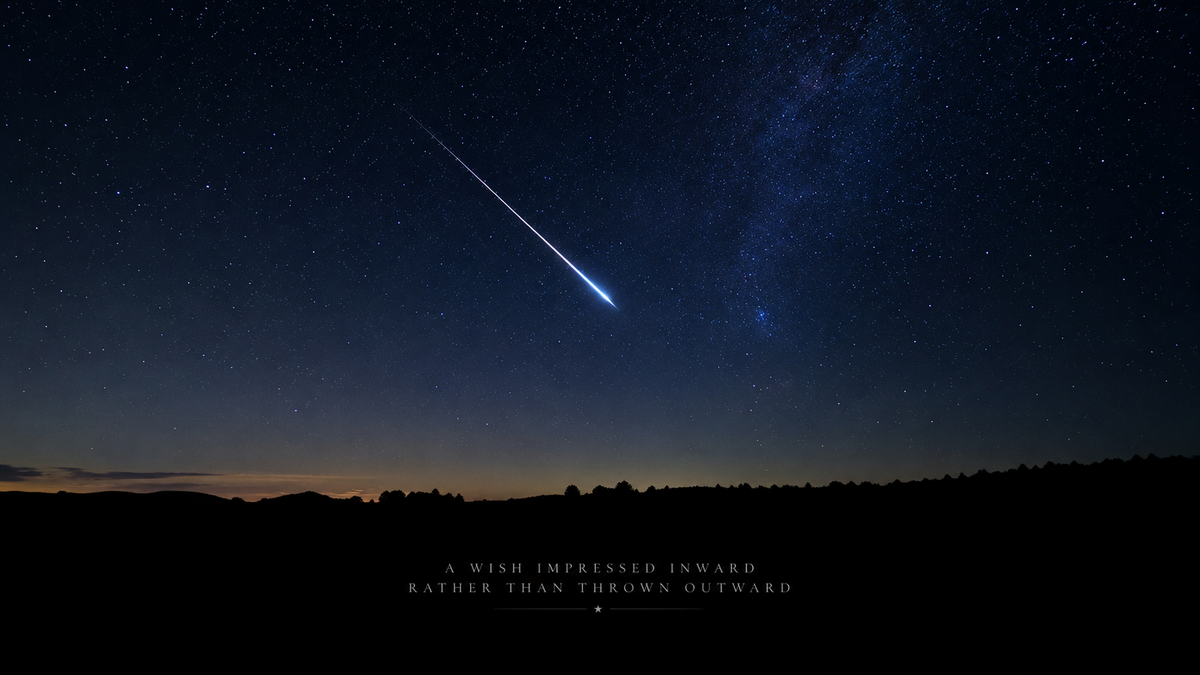
The Perseids peak August 12–13, and millions will make a wish on a shooting star. Neville Goddard taught that the power is not in the meteor, but in consciousness. The wish is not sent outward—it is impressed inward as already fulfilled.

Definition
Wishing on a shooting star is the folk memory of a real law, remembered backwards. The meteor is not a messenger and it does not carry a request anywhere. What the practice preserves is the moment of concentrated feeling — and that feeling, impressed on the subconscious, is the only mechanism that has ever produced a result. Neville Goddard called this the Law of Assumption: what you assume as true and feel as real hardens into fact.
The Perseids peak overnight on August 12 and 13, four days after the Lions Gate Portal and on the same night as the total solar eclipse. The sky is not the cause. It is the occasion.
Read The Law of Assumption: Neville Goddard's Greatest Teachings Interpreted for the Modern Reader
Key Takeaways
- A wish thrown outward is petition. Petition assumes absence, and absence is what it confirms.
- An assumption held inward is impression. Impression assumes possession, and possession is what it produces.
- The meteor is visible only because it burns on entry — the exact image of desire consumed into feeling.
- Use the drowsy state, not the excited one. See the state akin to sleep.
- One sentence, present tense, felt from the end. Repeat it to sleep. See Feeling Is the Secret.
In Plain Terms
You do not need the sky to cooperate. You need to stop asking and start assuming. Go outside on the night of August 12, watch until you see one, and instead of making a request, speak a completed fact — "I am so glad it is done" — and then carry that sentence into sleep. That is the whole practice. The rest is scenery, and the scenery is beautiful, which is why it works on people.
The full doctrine sits in the Neville Goddard ultimate guide. The book is here.

Before you go outside tonight
A wish is a technique without a doctrine. The doctrine is what makes it repeatable. The Law of Assumption brings Neville Goddard's teaching on identity, feeling, imagination, and subconscious impression into one operational system.
Get the Book on AmazonAvailable on Kindle and Paperback
Tonight the sky gives away its best free performance of the year, and by tomorrow morning several million people will have made a wish on something they have completely misunderstood. The Perseid meteor shower reaches its peak in the dark hours between August 12 and August 13, 2026, and this year the moon is new — which means no silver wash across the sky, no competition, nothing between the eye and roughly a hundred meteors an hour. It falls on the same night as the total solar eclipse, four days after the Lions Gate Portal. The sky has rarely been this busy. But before you go outside and speak into it, it is worth knowing what the wish actually does, because the folk instinct is right and the folk method is backwards. The full doctrine behind everything that follows is laid out in the Neville Goddard ultimate guide.
Definitions
Meteor shower. The annual passage of Earth through a debris trail shed by a comet. The Perseids come from Comet Swift-Tuttle, which takes roughly 133 years to circle the Sun. The particles are mostly grain-sized. They ignite about sixty miles up.
Wishing on a star. A folk practice, traced in the West to the classical notion that a falling light marked a moment when the heavens had briefly opened. Its survival has nothing to do with astronomy and everything to do with what happens inside a person at the instant they see one.
Assumption. In the teaching of Neville Goddard, the act of occupying a desired state as though it were already fact — not hoping for it, not requesting it, but wearing it.
Impression. The transfer of an assumption into the subconscious mind by way of feeling and repetition, most efficiently at the border of sleep.
What the Perseid Meteor Shower Actually Is
Every August, Earth crosses a river of dust laid down by Comet Swift-Tuttle across the last several thousand years. The fragments strike the upper atmosphere at enormous speed, compress the air in front of them, and burn. What you see is not a star and not, strictly, an object — it is a line of superheated air. The meteors appear to fan out from the constellation Perseus, which is where the shower takes its name, though they can streak across any part of the sky.
The shower has been watched for a very long time. In the Catholic calendar the Perseids were known as the tears of Saint Lawrence, whose feast falls on August 10, near the annual maximum — a martyr's grief written across the summer sky. The naming matters, because it shows the pattern: every culture that has looked at this shower has read meaning into it, and the meaning has always been about a moment of opening.
The practical detail for 2026 is the darkness. A new moon on August 12 leaves the sky uncontested, which is uncommon. The radiant does not clear the horizon meaningfully until late evening, so the productive hours are after midnight and before dawn. Face away from any light you can. Do not use binoculars; they narrow the field and cost you meteors.
Where "Wish Upon a Star" Came From
The habit is older than any of the traditions that now claim it. The common attribution runs back to the ancient idea that the gods occasionally part the heavens to look down at the world, and that a slipping star marks the seam. If a divine eye is open, the reasoning went, that is the instant to speak.
Strip away the cosmology and the residue is a very precise psychological instruction: at the moment of awe, say the thing you most want, in complete sincerity, with your whole attention. That is not a superstition. That is a description of conditions under which the subconscious mind is unusually receptive — sudden beauty, suspended thought, undivided focus, no analytical interference. The folk practice preserved the right state and attached it to the wrong cause.
Why the Wish Fails
Here is the break. Almost everyone who makes a wish sends it outward. The wish is addressed. It is directed at the meteor, at the sky, at the universe, at whatever is presumed to be listening. And an addressed wish carries a hidden clause inside it that undoes the entire attempt.
To ask is to declare that you do not have it. To petition is to occupy the state of the petitioner — the one who lacks, the one who waits, the one whose good is held somewhere else by someone else. Neville Goddard was blunt about this. Prayer, in his reading, is not a request but an appropriation. You do not ask for the thing; you assume the state of the person who already has it, and you stay there until it feels ordinary.
Set the two side by side:
Petition: I wish I had it. Present tense of wanting. Confirms absence. Produces more wanting.
Assumption: Isn't it wonderful that it's done. Present tense of having. Confirms possession. Produces the fact.
Same night, same meteor, same person, opposite mechanism. This is the whole hinge of the Law of Assumption, and it is why two people can perform an identical ritual and get entirely different lives out of it.
The Meteor Only Shines Because It Burns
There is a better image inside the astronomy than anything the folklore came up with, and it is exact.
The particle that becomes a Perseid is invisible for its entire existence — millions of years drifting in a cold trail, seen by nobody. It becomes visible in the last second and a half of its life, and only because it is being destroyed. Entry, friction, heat, light. Nothing shines while it is merely travelling. It shines when it is consumed.
Desire behaves the same way. A wish held at arm's length, admired, discussed, planned around, kept intact and unentered — that wish stays cold and stays invisible, and it will drift for years. It begins to show only when it is taken in and burned: when you stop describing the thing and consent to feel it as your own, which costs you the identity you had before. That is the price and there is no version without it. Neville named the two halves of this in Feeling Is the Secret — the idea is nothing, the feeling is everything — and in the discipline of the mental diet, which is simply the refusal to keep feeding the old state after the new one has been assumed.
A meteor that refuses to burn is a rock nobody ever sees.
How to Use the Night of August 12–13
Nothing here requires the meteor shower. All of it works better on a night when you are moved, and this is such a night.
Fix one sentence before you go out
Not a list. One outcome, phrased as accomplished fact, in the fewest words that still carry feeling. The offer came through. We're living there. The scan was clear. It sold. Present tense, first person, no mechanism, no timeline, no "somehow."
Watch until you actually see one
The waiting is functional. Twenty minutes of lying still with your eyes on the sky does something no technique can shortcut: it empties the surface of the mind. By the time the first bright one crosses, the analytical layer is quiet. That is the whole reason this practice has survived.
At the moment you see it, do not ask
Speak your sentence as a completed fact, and let the emotion that comes with the meteor attach itself to that sentence. Gratitude is the correct register — not the gratitude of someone hoping, the gratitude of someone who has already been given it. If you feel relief, you have done it right. Relief is the emotional signature of a thing that is finished.
Carry it into sleep
This is the part almost everyone skips, and it is the part that does the work. Go to bed with that same sentence looping in a drowsy, half-awake state — what Neville called the state akin to sleep. Do not strain. Repeat it until it slurs, until you lose the thread, until you are gone. The subconscious accepts what is presented to it in that condition without argument, and a night that begins with awe and ends in impression is worth more than a month of daytime affirmations.
Then release the mechanism
Stop watching for it. The route by which an assumption becomes fact is never the route you would have planned; Neville called that series of unlikely, seemingly unconnected events the bridge of incidents. Your only job after the impression is to stop contradicting it.
The Sky Is Not the Cause
It is worth saying plainly, because the internet in the second week of August says otherwise every year. The Perseids are not a portal. Comet dust does not confer power. The eclipse on August 12 does not open or close anything, and neither did the Lions Gate on the eighth. Dates do not manifest.
What a night like this actually supplies is permission — a socially sanctioned reason to stop, to feel something enormous, and to speak a desire out loud without embarrassment. That is not nothing. Most people will not give themselves that on an ordinary Tuesday. If a meteor is what it takes to get you outside and undefended for an hour, take the meteor.
At The Universe Unveiled, a wish is defined as an assumption that has not yet been let inside. The sky does not receive it. The subconscious does, and only when the wish stops being addressed to anyone.
Common Misconceptions About Wishing on a Shooting Star
"You have to make the wish before the meteor disappears." The urgency is folklore, but it has an accidental use: it forces you to know what you want in advance. Decide the sentence before you go outside and the rush becomes irrelevant.
"Telling anyone breaks the wish." Not magic — mechanics. Announcing a desire to someone who will doubt it invites contradiction, and contradiction is the one thing that undoes an assumption. Silence protects the state, not the spell.
"The more meteors you see, the more wishes you get." One assumption, held to saturation, beats twenty impressions competing for the same subconscious. Divided attention impresses nothing.
"It only works on rare astronomical events." Every night you fall asleep is an opportunity of identical mechanical value. The Perseids are simply more persuasive, and persuasion is half the work.
"Wishing and manifesting are the same thing." They differ at the only point that matters: direction. A wish goes out. An assumption goes in.
Glossary
Perseids — the annual August meteor shower produced by debris from Comet Swift-Tuttle, radiating from the constellation Perseus.
Radiant — the point in the sky from which a shower's meteors appear to originate.
Assumption — occupying a desired state as accomplished fact rather than requesting it.
Impression — the transfer of an assumption into the subconscious through felt repetition, most effective at the edge of sleep.
State akin to sleep — the drowsy, hypnagogic condition Neville Goddard identified as the point of least subconscious resistance.
Bridge of incidents — the improbable chain of events by which an assumption arrives in outer fact.
Petition — a request that confirms the absence of the thing requested.
Revision — the nightly correction of the day's events in imagination. See the revision technique.
Go outside tomorrow night. Watch the sky long enough to be moved by it, and then take the feeling indoors, where the actual work happens.
The star does not carry the wish; the wish was never meant to leave the room.
The difference between petition and assumption is one sentence long and it decides everything. The full operating system is in the book.
Read The Law of AssumptionPerseid Meteor Shower Manifestation: Frequently Asked Questions
When is the best time to watch the Perseid meteor shower in 2026?
The maximum falls overnight between August 12 and August 13, with the productive window running from after midnight until dawn. The nights of August 11 and August 14 are also worth going out for. A new moon on August 12 leaves the sky dark, which makes this a stronger year than most. Find a spot away from streetlights, give your eyes twenty minutes to adjust, and skip binoculars — they narrow your field of view and cost you meteors.
Does wishing on a shooting star actually work?
Not by the mechanism people assume. The meteor delivers nothing and carries nothing. What the practice reliably produces is a state of suspended thought and concentrated feeling, and that state is the one condition under which the subconscious accepts a new idea without resistance. The ritual works when the wish is converted into an assumption held as accomplished fact, and does nothing when it is left as a request.
What is the difference between wishing and manifesting?
Direction. A wish is addressed outward to a presumed listener and therefore states, in its own grammar, that you do not have the thing. Manifestation as Neville Goddard taught it moves inward: you occupy the state of the person who already has it and hold that state until it feels unremarkable. One confirms absence. The other confirms possession.
How should I word a wish so it works as an assumption?
Use first person, present tense, and a completed outcome — "the offer came through," "we are living there," "it sold." Leave out the mechanism, the timeline, and any word that implies waiting. If the sentence would make sense spoken to a friend the day after it happened, the wording is correct.
Do I need to wait for a meteor shower or an eclipse to manifest?
No. Every night you fall asleep offers the identical mechanism, because the drowsy border state is the operative condition, not the calendar. Astronomical events help for a different reason: they supply awe, and awe suspends the analytical mind more efficiently than effort does. Take the help when it is offered and do not mistake it for the cause.
Why does the Perseid meteor shower matter symbolically?
Because the particle is invisible for its entire existence and becomes visible only in the moment it burns on entry. It is an exact picture of what a desire has to undergo. Held at a distance, admired and protected, a desire stays cold and unseen. Taken inside and felt as your own, it costs you the identity you had before, and that is when it shows.
What should I do the morning after making a wish?
Stop checking. The route by which an assumption becomes fact is almost never the route you would have chosen, and monitoring for evidence reintroduces the doubt you just spent the night dissolving. Live from the assumption in small ordinary ways, refuse the internal conversations that contradict it, and let the sequence of incidents build itself.
The wish is impressed, not thrown. Learn the full doctrine.
Get The Law of Assumption