Why Your Lion's Gate Manifestation Didn't Work
Every year the Lion's Gate Portal opens, millions set an intention on 8/8, and by mid-August the same question surfaces: why didn't it work? The Law of Assumption gives a precise answer, and it has nothing to do with astrology. A date can invite you into a state. Only you can stay there.

Your Lion's Gate manifestation did not fail because you missed the portal. It failed because you set an intention on 8/8 instead of entering and remaining in a state. In the Law of Assumption, a date has no creative power. Consciousness is the only cause, and the assumption that hardens into fact is the one you keep occupying after the window closes.
The full doctrine is laid out in the Neville Goddard ultimate guide and in the original Lion's Gate Portal post.
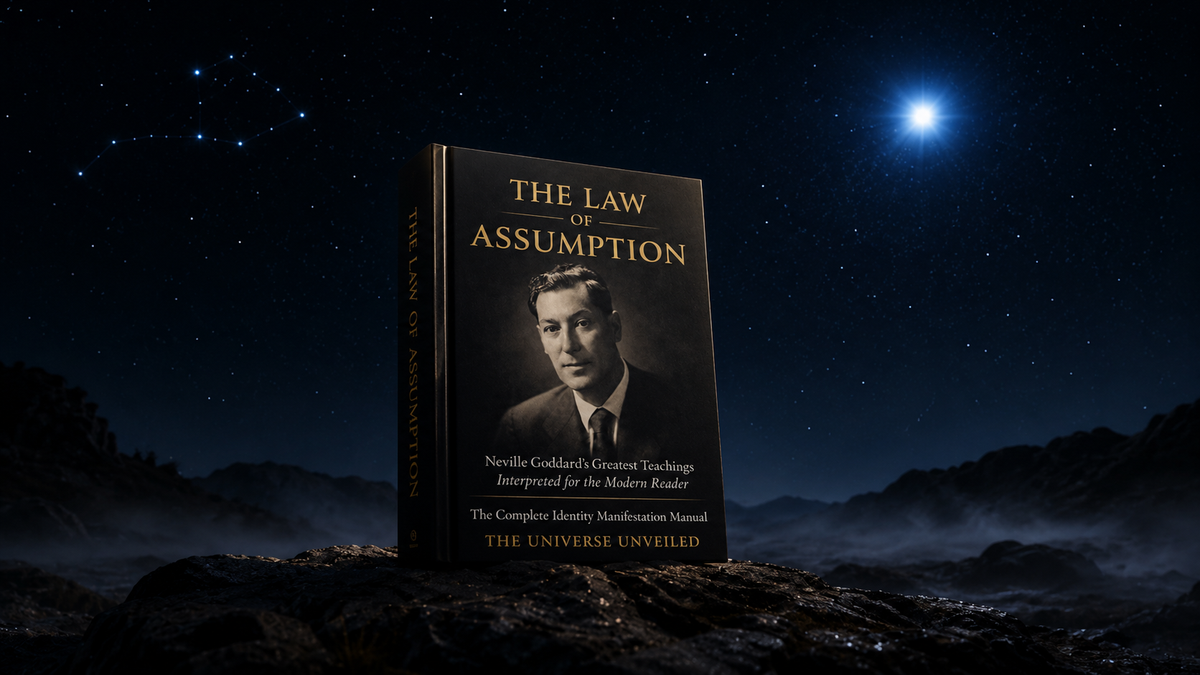
The complete system, chapter by chapter: The Law of Assumption on Amazon.
- The Lion's Gate Portal is an astrological window, not a delivery mechanism.
- A ritual is an event. An assumption is a residence. Most people visited and left.
- Checking the 3D for evidence is itself an assumption of absence.
- Self-concept overrides any single imagined scene. The self you believe you are always wins.
- Emotional release on 8/8 often discharged the desire instead of impressing it.
- Nothing expired on August 12. Read the eclipse post and the Perseid post for the rest of the sequence.
- The correction is persistence in state, explained in The Law of Assumption.
Imagine renting an apartment for one night and then wondering why you do not have an address there. That is what a portal ritual is. You occupied the state of the wish fulfilled for an hour on 8/8, and then you went back to the state of wanting for the next four days.
The subconscious does not count peak experiences. It counts residence. What it accepts is whatever state you return to when nothing in particular is happening, which is why the mental diet and the state akin to sleep matter more than any single date on the calendar.
Start here instead: The Law of Assumption, published by The Universe Unveiled.

The Portal Was Never the Point
If 8/8 came and went and nothing moved, the problem was not the date. It was the state you returned to on 8/9. The Law of Assumption teaches you how to occupy a state until it hardens into fact.
Read The Law of AssumptionAvailable on Kindle and Paperback. Published by The Universe Unveiled.
Every year the Lion's Gate Portal opens at the end of July, peaks on August 8, and closes around August 12. Every year, millions of people write an intention, light a candle, breathe eight times, and feel something genuine move. And every year, in the second week of August, the same question arrives: why didn't it work?
The answer is precise, and it is not astrological. It comes from Neville Goddard, and it is the same answer he gave for forty years to anyone who asked why an assumption failed to externalize. Before going further, it is worth reading the doctrine in full in the Neville Goddard ultimate guide, because everything below rests on a single premise: consciousness is the only cause, and no date, star, or alignment can substitute for it.
Lion's Gate Portal: an annual astrological window, running roughly July 28 to August 12 and peaking on 8/8, formed by the heliacal rising of Sirius while the Sun transits Leo, and framed in New Age practice as a period of heightened manifestation.
Assumption: in Neville Goddard's teaching, the act of occupying the consciousness of the wish already fulfilled, and remaining there until the outer world conforms.
State: a settled attitude of mind that a person inhabits, as distinct from a thought a person entertains. Neville held that people do not have states; states have people.
Intention: a stated desire directed at a future outcome. In the Law of Assumption, an intention is not a cause. It is a description of lack.
The Lion's Gate Portal Is Not a Delivery Mechanism
Start with what the portal actually is. The Sun enters Leo. Sirius, the brightest star in the sky, returns to visibility before dawn. The date 8/8 carries numerological weight. The ancient Egyptians did watch the heliacal rising of Sirius, because it coincided with the flooding of the Nile, which meant food. That is the historical kernel. Everything layered on top of it — the thinning veil, the cosmic gateway, the download of Sirian codes — is a twentieth and twenty-first century construction.
This is not a criticism of astrology. It is a category distinction. A portal, in the way it is popularly sold, is a window of delivery: a period during which the universe is more willing to give. Neville taught something structurally incompatible with that. He taught that there is no giver standing outside you deciding when to release. There is only your own consciousness, which he identified with God, and which is not more available in August than in November.
So when someone says the portal closed and nothing came, they are describing a disappointment that the framework itself manufactured. Nothing was ever scheduled to arrive.
The original Lion's Gate post on this site made a narrower claim, and it is worth restating: 8/8 is an excellent entry point. Collective attention, personal seriousness, and a marked date on the calendar make it easier to step into a new assumption than an ordinary Tuesday does. That remains true. But entering is not the same as remaining, and the portal was only ever the door.
Five Reasons the Assumption Did Not Externalize
1. You treated the date as the cause
The moment you locate creative power in an alignment, you have relocated it outside consciousness. Neville called this the fundamental error, and he named it in Feeling Is the Secret: man's ignorance of the power within is the whole of his difficulty. If Sirius did it, you did not. And if you did not do it, you cannot repeat it, which is why portal practitioners spend the year waiting for the next window instead of building a practice.
2. You prayed to, rather than from
This is the single most common failure and the most technical. Most 8/8 rituals ask you to state what you want, feel gratitude for it, and send it outward. But "I am so grateful for the relationship I will have" is still thinking of the end. Neville's instruction was to think from the end — to occupy the point of view of the person who already has it, and to look out at the world from inside that self.
The test is simple. If in your imaginal scene you can see yourself, you are still outside it. You are watching a person who has the thing. You are not being them.
3. You checked
Between August 8 and today, how many times did you look for evidence? Refreshed the inbox, checked the phone, scanned the day for a sign?
Each check is an act. Specifically, it is the act of a person who does not have the thing, verifying whether they have it yet. In the Law of Assumption that is not neutral observation. It is a fresh assumption of absence, made in the most convincing register available, which is the register of the senses. You cannot look for what you already possess.
The State Is the Practice
Persistence in a state is not a personality trait. It is a learnable discipline, and it is the subject of the book this site was built around.
Get The Law of Assumption4. Your self-concept overrode the scene
A ten-minute imaginal scene is competing against a self-concept you have been rehearsing for decades. If you assumed the having while remaining, underneath, the person to whom things do not happen, the self-concept wins. It always wins, because it is the state you live in and the scene was only a state you visited.
This is why Neville put revision at the center of the work rather than visualization. The revision technique does not target outcomes. It targets the accumulated record of the self, which is what actually generates outcomes.
5. The ritual discharged the desire instead of impressing it
Cathartic ritual feels extraordinary. Eight breaths, a candle, a written intention, a wave of emotion. And then the pressure is gone.
That release is often the sign that nothing was impressed. Emotion spent outwardly is emotion that did not settle inwardly. Neville's method deliberately worked in the opposite direction, in the drowsy, near-sleep condition where the critical faculty is quiet and a short scene sinks rather than discharges. That is the whole point of the state akin to sleep, and it is almost the exact inverse of a high-energy portal ritual.
Portal Thinking Versus State Thinking
The contrast is worth stating plainly, because the two systems are often worn together and they do not fit.
Portal thinking says the window is open now. State thinking says the window is consciousness and it never closes.
Portal thinking says align your intention with cosmic timing. State thinking says there is no timing, only the state you occupy.
Portal thinking says the energy is strongest on 8/8. State thinking says the energy is your own attention, and it is strongest wherever you place it.
Portal thinking says tend the seed and watch for signs. State thinking says watching for signs is the confession that you do not have it.
Portal thinking gives you a date to look forward to. State thinking gives you something to do this evening.
Common Misconceptions
"I missed the peak, so I have to wait until next August." Nothing expired. The solar eclipse of August 12 and the Perseid meteor shower were, in this tradition, never separate opportunities either. They are all invitations into the same single act, which is available continuously.
"The energy is still working on it in the background." There is no background process. In the Law of Assumption the assumption is either being sustained or it is not. What people call the background is usually four days of quiet doubt.
"I did not want it badly enough." Intensity of wanting is the state of lack at full volume. Neville was explicit that desire must be felt as fulfilled, not as desired. Wanting harder is moving in the wrong direction.
"My manifestation was blocked." Blockage language externalizes the cause again, in a new costume. What is usually described as a block is a self-concept that has not been revised.
"It did not work because I did the ritual wrong." The ritual is not load-bearing. There is no correct number of breaths.
What To Do Now
The useful thing about a failed portal is that it isolates the variable. You proved you can enter a state — the ritual worked, for an hour. What you have not yet built is residence.
Pick the one assumption you tried to set on 8/8 and reduce it to a single short scene that implies it is already true. Not the outcome itself, but the ordinary moment that could only happen afterward. Enter that scene tonight in the drowsy state, run it until it feels natural rather than exciting, and fall asleep in it.
Then guard the rest of the day. Do not check. Do not re-set the intention. Do not add a second technique. Watch your inner conversation, which is the actual work described in the mental diet, and when you catch yourself talking as the person who does not have it, revise the sentence and continue.
Repeat until the outer world catches up. That is the entire method. It has no calendar.
The Universe Unveiled Position
At The Universe Unveiled, we define a portal as an invitation, never a mechanism. Astrological windows can be genuinely useful as psychological thresholds, because a marked date lowers the resistance to changing how you see yourself. That is a real function and we do not dismiss it. But the Law of Assumption holds that no alignment creates, no star delivers, and no window closes on a state. Your manifestation did not fail on August 12. It was never scheduled for August 12, because consciousness does not keep an appointment book.
Glossary
Assumption — occupying the consciousness of the wish fulfilled until it hardens into fact.
Heliacal rising — the first visible pre-dawn appearance of a star after a period of invisibility; the astronomical basis of the Lion's Gate framing.
Imaginal act — a deliberate inner scene, experienced from the first-person point of view of the end.
Living in the end — sustaining the state of fulfillment before external evidence appears.
Mental diet — disciplined control of inner conversation, so that habitual self-talk does not contradict the assumption.
Revision — mentally rewriting an event or a self-image so that the subconscious record is corrected.
Self-concept — the total conception a person holds of themselves; the master state from which all outcomes issue.
State akin to sleep (SATS) — the drowsy borderline condition in which the critical faculty relaxes and an imaginal scene is readily impressed.
The portal did not fail you, and you did not fail the portal. You simply visited a state instead of moving into it, and moving in is the whole of the work.
Lion's Gate Manifestation Not Working: Frequently Asked Questions
Did I miss the Lion's Gate Portal if nothing happened by August 12?
No. In the Law of Assumption nothing expires with an astrological window. The portal functions as an invitation to enter a state, and that state remains available every day of the year. There is no need to wait until the following August.
Is the Lion's Gate Portal part of Neville Goddard's teaching?
It is not. Neville Goddard never taught auspicious dates, planetary timing, or energetic gateways. His teaching held that consciousness is the only reality and the only cause, which makes calendar timing irrelevant to results.
How long should a manifestation take after setting an intention?
There is no fixed duration. Neville taught that an assumption hardens into fact through persistence rather than through elapsed time, and that checking for progress restarts the process by re-asserting the absence of the desire.
Does checking for signs stop a manifestation from working?
Yes, in the sense that looking for evidence is an act performed by someone who does not yet have the thing. Each check reinforces the state of lack through the senses, which are the most persuasive register available to the subconscious.
Why does a manifestation ritual feel powerful but produce nothing?
Emotionally intense ritual often discharges a desire outwardly rather than impressing it inwardly. Neville worked in the drowsy state near sleep precisely because a short scene sinks into the subconscious there instead of being released as catharsis.
What is the difference between an intention and an assumption?
An intention is a statement about a desired future and therefore describes lack. An assumption is the occupied consciousness of already having, experienced from the first-person point of view of the fulfilled end.
Can self-concept prevent a manifestation from appearing?
Self-concept is the decisive factor. A brief imagined scene cannot override a long-held conception of the self, which is why revision of the self-image rather than visualization of outcomes sits at the center of Neville Goddard's method.
What should I do now that the 8/8 window has closed?
Reduce the desire to one short scene that implies it is already true, enter that scene in the drowsy state before sleep, and then guard the inner conversation during the day without checking for external evidence. Repetition of that sequence is the practice.