The Eagle and the Chicken Story: What It Means and How to Finally Fly
An eagle hatched in a chicken yard scratches for seed, clucks and never flies, because everyone around it says it is a chicken. This famous parable goes one step past the elephant and the rope: nothing holds the eagle down at all. Only the name it was given.

The Short Version
The eagle and the chicken story is a parable about an eagle raised in a chicken yard. It scratches for seed, clucks and never flies, because it believes it is a chicken. In the best-known version, told by the Ghanaian educator James Aggrey, a visitor carries it up a mountain at sunrise and it finally flies. The lesson: you live as who you believe you are. It is a close cousin of the elephant and the rope.
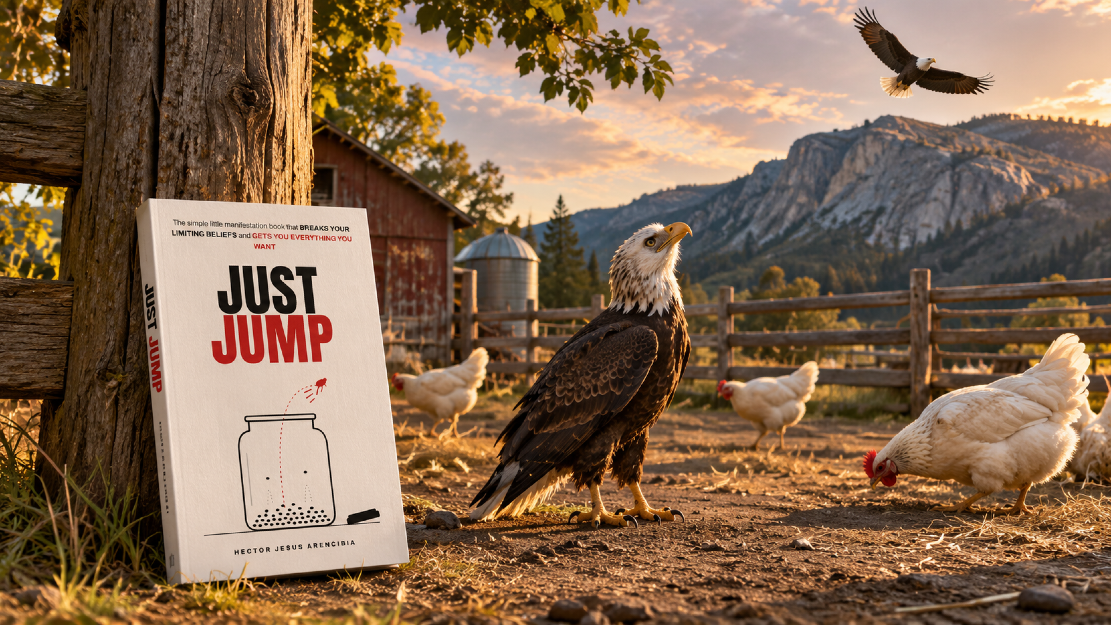
For three simple steps to leave your own chicken yard, read Just Jump on Amazon.
Key Takeaways
- The eagle never lacked wings. It lacked the belief that they were its own.
- The best-known version was told by James Aggrey of Ghana. Anthony de Mello's version ends with the eagle dying a chicken.
- It shows what Neville Goddard taught about self-concept: you live out who you assume you are.
- Unlike the flea in a jar, nothing physical holds the eagle. Only a name.
- Most people's chicken yards are built from limiting beliefs they heard growing up.
The full method for your first flight is in Just Jump.
In Plain Words
Imagine growing up somewhere everyone told you the ground is where you belong. You would believe them. Not because it is true, but because nobody ever pointed at the sky. That is the eagle. Nothing is holding it down except the story it was raised on.
Neville Goddard would say the eagle is living out an assumption it never chose.
Just Jump shows you how to take your first flight.
The Sky Was Always Yours

Just Jump
The simple little manifestation book that breaks your limiting beliefs and gets you everything you want.
Read Just Jump on AmazonAvailable on Amazon
Some stories stay with people for a lifetime because they explain something nothing else quite does. The eagle and the chicken story is one of them. It is about a bird born for the sky that spends its whole life scratching in the dirt, and it captures a quiet ache many people carry: the sense that they were made for more than the life they were handed. It is also one of the clearest pictures of what Neville Goddard taught about the self-concept, that you live out who you assume you are. Here is the story, where it comes from, what it means, and how to leave your own chicken yard.
The Eagle and the Chicken Story
A man walking through a forest finds a young eagle. In some tellings it is an egg. He takes it home and puts it in his barnyard with the chickens.
The eagle grows up among them. It eats chicken feed. It scratches the ground for seeds and worms. It clucks. When it flaps its wings, it lifts only a few feet off the ground, because that is as high as chickens go, and as high as anyone ever showed it.
Years later, a visitor sees the bird and stops. That is not a chicken, he says. That is an eagle. The farmer shrugs. It was an eagle once. Now it is a chicken. It eats like one, lives like one, and it will never fly.
The visitor lifts the eagle onto his arm. You are an eagle, he tells it. You belong to the sky. Fly. The eagle looks around, sees the chickens pecking below, and hops down to join them.
The next day he carries it up to the roof of the house. Same words. Same result. The eagle trembles, looks down at the yard, and jumps back into it.
On the third day he rises before dawn, carries the eagle out of the yard and up a mountain, and holds it toward the rising sun. Far from the chickens, with nothing below it but air, the eagle shudders, stretches out its wings and lifts into the sky. It never returns to the yard.
Nothing about the eagle changed between the first day and the third. Only where it was standing, and what it could see.
Where the Eagle and the Chicken Story Comes From
The best-known version comes from James Emman Kwegyir Aggrey (1875 to 1927), the Ghanaian educator remembered as Aggrey of Africa. He told it as a parable about a naturalist who finds an eagle living among chickens and refuses to accept that it cannot fly. Aggrey turned the ending into a message for his audiences: they had been taught to believe they were chickens when they were eagles, and it was time to stretch forth their wings. His telling was later published as The Eagle That Would Not Fly, and retold for children as Fly, Eagle, Fly! by Christopher Gregorowski and Niki Daly.
A second famous version appears in The Song of the Bird (1982) by Anthony de Mello, the Jesuit priest and writer from India. In his telling, the eagle hatches from an egg placed under a barnyard hen. In old age it sees a great eagle gliding overhead and asks what it is. That is the eagle, a chicken tells it. He belongs to the sky. We belong to the earth. The old eagle never tries. It lives and dies a chicken, because that is what it thought it was.
Two versions, two endings. Aggrey's eagle flies. De Mello's never does. Which ending you get is the whole point of the story.
The same idea runs through the Vedanta parable of the lion cub raised among sheep, often told by Swami Vivekananda. The cub bleats and eats grass until a grown lion drags it to a pool and shows it its own face. It is the teaching behind aham brahmasmi: you are not what you were told you are.
What the Eagle and the Chicken Story Means
The eagle was never held down. There was no lid, no rope, no fence it could not clear. It stayed in the yard for one reason: it believed it belonged there.
That makes it different from most stories about limits. In those stories, something real held the hero back at the start. Here, nothing ever did. The eagle never failed at flying. It never even tried, because the idea that it could was never put into its head. What it learned from the chickens was not a limit. It was an identity.
That is the heart of the parable. You do not live at the level of your ability. You live at the level of who you believe you are. Change the belief, and the ability that was there all along finally gets used.
Key Definitions
The eagle and the chicken story: A parable, told most famously by James Aggrey of Ghana and later by Anthony de Mello, about an eagle raised among chickens that lives as a chicken because it believes it is one.
The chicken yard: The environment that teaches you who you are, usually through repetition rather than force: family, school, neighborhood, workplace.
Clucking: The everyday phrases a yard repeats, such as "be realistic" or "people like us don't," that slowly harden into a self-concept.
Borrowed identity: At The Universe Unveiled, we define a borrowed identity as a self-concept you absorbed from your surroundings before you were old enough to question it, and have lived out ever since as if it were your nature.
Is the Eagle and the Chicken Story Real?
As a story, no. It is a parable, and there is no record of an eagle growing up in a farmyard the way it describes.
The mechanism behind it is real, though. Many young birds learn what they are from whatever surrounds them in the first days of life, a process called imprinting. In the 1930s the Austrian zoologist Konrad Lorenz showed that greylag goslings would follow him as if he were their mother when he was the first moving figure they saw. He later shared the 1973 Nobel Prize for his work on animal behavior.
Wildlife rehabilitators take this seriously. They often feed orphaned birds of prey with hand puppets or from behind cover, so the chicks do not grow up identifying with the people who raise them. A young raptor that learns the wrong answer to the question "what am I?" can struggle to live as what it really is.
People do the same thing, only more slowly. The first voices around you tell you what kind of bird you are, and you believe them.
The Eagle, the Elephant and the Flea: Three Kinds of Limit
The eagle story belongs with the elephant and the rope and the flea in a jar experiment, but each one describes a different kind of limit, and knowing which one you are dealing with changes what you do next.
The flea's limit is gone. A lid held it once. The lid was taken away. The flea only has to jump.
The elephant's limit is outgrown. The rope is still there, but the elephant became far stronger than it. The elephant only has to pull.
The eagle's limit was never there at all. Nothing held the eagle. Not a lid, not a rope. Only a name it was given. It does not have to break anything. It only has to find out what it is.
Some of your limits are lids. Some are ropes. The deepest ones are yards: places where you learned who you are and never thought to ask whether it was true. With a lid, you jump. With a rope, you pull. With a yard, you look up.
The Chicken Yards People Grow Up In
Every yard has its own clucking. A few of the most common:
"Be realistic." Heard by people whose dreams made someone nervous. It teaches you to measure your life by the height of the fence.
"Who do you think you are?" The yard's favorite question for anyone who starts looking up. It is the sound of crab mentality, and it is meant to keep you on the ground.
"People like us don't do that." It turns a family's limits into your identity. It is how childhood money programming gets handed down.
"Keep your head down." Safety advice that quietly becomes a life philosophy. An eagle with its head down never sees the sky.
"Don't get your hopes up." It protects you from disappointment by protecting you from everything else too.
For a fuller list, see limiting beliefs examples and how to spot yours.
Leave the Yard
You were never a chicken. Now fly.
Just Jump turns stories like this one into three simple daily steps and a seven-day plan you can start tonight.
Get Just JumpAvailable on Amazon
The Psychology Behind the Yard
Psychologists have a name for what happens when experience teaches someone that trying is pointless: learned helplessness. The eagle shows a quieter cousin of it. It never failed. It simply never saw itself succeed, so the possibility never existed for it.
This is why examples matter so much, and why a single one can change everything. For years, running a mile in under four minutes was treated as beyond human reach. Once Roger Bannister did it in 1954, others followed within weeks. The story of the four-minute mile is the story of a sky eagle: someone who shows you what your own wings can do.
In the parable, the eagle needed two things the yard could never give it: a new voice and a new view. Someone who saw it as an eagle, and a place high enough to see the sky.
The Eagle Through the Law of Assumption
Neville Goddard taught that your life follows what you assume about yourself far more than what you want. The eagle is the perfect illustration. It assumed it was a chicken, so it lived as a chicken, and every day in the yard confirmed the assumption.
This is why the Law of Assumption works on the self-concept rather than on circumstances. You could drop that eagle into the middle of the sky and, still believing it was a chicken, it would flap a few feet and fall. Change what it assumes about itself, and the sky becomes ordinary. Neville's teaching on self-concept goes deeper into this, and so does the subconscious identity system.
Notice what the visitor in Aggrey's story does. He never argues with the eagle about its abilities. He tells it who it is, again and again, and moves it somewhere a new identity is easier to believe. That is the whole method in miniature.
How to Leave Your Own Chicken Yard
1. Hear the yard talk
Write down the phrases you heard most growing up about people like you, money, ambition and the future. Then circle the ones you still say to yourself. Those are your clucks.
2. Look up
Find one person who already lives the way you want to live, and pay attention to them on purpose. Read about them, listen to them, notice how they talk about themselves. Your mind needs to see a sky eagle before it believes in its own wings.
3. Climb out of the yard
The eagle did not fly from the yard. It flew from the mountain. Change one thing about where you stand: the room you work in, the people you spend Saturdays with, the voices in your feed. A new view makes a new identity easier to hold.
4. Fly in imagination first
Each night in the state akin to sleep, picture one short scene that could only happen after you have left the yard, and feel it as already true. If the clucking traces back to a specific memory, Neville's revision technique lets you replay it with a different ending.
5. Take your first real flight
Do one small thing today that only the eagle version of you would do. Ask, apply, post, price, begin. You will not soar on the first flap. You only have to leave the ground once to know you can.
Interactive · Sound on
Fly, Eagle, Fly
The five steps above, as a game. Hear what your yard keeps clucking, look up, pick your sky, then flap until you catch the wind.
Step 1 of 5 · Hear the yard
What did your yard keep clucking? Pick the line you heard most.
Now look up. Tap the bird in the sky.
Climb out of the yard. Where do you want to fly?
Fly in imagination first. Tap Flap, or press Space, until you catch the wind.
0 flaps
This game runs only in your browser. Nothing you choose is saved or sent anywhere.
Stories That Teach the Same Lesson
The eagle belongs to a family of stories about conditioning. The fleas in the jar stop jumping after a lid is removed. The elephant and the rope stays tied to a stake it could pull out in a second. The pike that stops hunting after a glass wall is lifted gives us pike syndrome. The crabs that drag each other back into the bucket explain crab mentality. And the Wright brothers spent years hearing that people would never fly, until one cold December morning in 1903 they did.
Common Misconceptions About the Eagle and the Chicken Story
"It's a true story." It is a parable. Its truth is psychological, not zoological.
"The chickens were cruel." In most tellings they were just being chickens. Most yards are not malicious. They simply teach what they know.
"The eagle has to fight its way out." Nothing is holding it. It does not have to defeat anyone. It only has to see what it is.
"You need someone to rescue you." The visitor helps, but the eagle spreads its own wings. You can be your own visitor.
"One failed flight proves you're a chicken." The eagle jumped back into the yard twice before it flew. Going back down is part of the story, not the end of it.
The Universe Unveiled Glossary
The yard: The environment where you learned who you are.
Clucking: The repeated phrases that shape a self-concept.
The sky eagle: Anyone whose example shows you what is possible for you.
The mountain: A new vantage point that makes a new identity easier to hold.
Borrowed identity: A self-concept absorbed from your surroundings and lived out as if it were your nature.
Imprinting: The process by which a young animal learns what it is from whatever surrounds it early in life.
Self-concept: In Neville Goddard's teaching, the assumption you hold about who you are, which your life tends to reflect.
You Were Never a Chicken
Somewhere there is an eagle scratching in the dirt, flapping a few feet into the air and landing again, convinced this is all life is.
Maybe you know that bird. Maybe you have heard the clucking so long it started to sound like your own voice.
It was never your voice. It was never your yard. The sky did not stop being yours just because nobody pointed at it.
You were born with wings. All you have to do is jump.
Your Wings Were Always There
Just Jump
Find the beliefs that kept you on the ground and fly past them, with three simple jumps you can start tonight.
Get Your Copy on AmazonAvailable on Amazon
Eagle and the Chicken Story FAQ: Meaning, Origin, and Moral
What is the eagle and the chicken story?
It is a parable about an eagle raised in a chicken yard. Because it grows up among chickens, it scratches for seed, clucks and never tries to fly, believing it is a chicken. In the best-known version, a visitor carries it up a mountain at sunrise and it finally flies.
What is the moral of the eagle and the chicken story?
The moral is that people live at the level of who they believe they are, not at the level of their ability. The eagle always had wings. What kept it on the ground was an identity it learned from its surroundings.
Who wrote the eagle and the chicken story?
The best-known version was told by James Emman Kwegyir Aggrey, the Ghanaian educator known as Aggrey of Africa, and was later published as The Eagle That Would Not Fly. Anthony de Mello told another well-known version in The Song of the Bird (1982).
Does the eagle fly at the end of the story?
It depends on the version. In James Aggrey's telling, the eagle finally flies when it is carried up a mountain and turned toward the rising sun. In Anthony de Mello's version, it never tries and dies believing it is a chicken.
Is the eagle and the chicken story true?
It is a parable, not a documented event. It does reflect a real process called imprinting, in which many young birds learn what they are from whatever surrounds them early in life, which Konrad Lorenz famously demonstrated with greylag goslings.
What is the difference between the eagle story and the elephant and the rope?
In the elephant and the rope, a real limit held the elephant when it was young, and it later outgrew it. In the eagle story, nothing ever held the eagle at all. Its only limit was the identity it was given.
How does the eagle story relate to the Law of Assumption?
Neville Goddard taught that life follows the self-concept. The eagle assumed it was a chicken and lived accordingly. The Law of Assumption works by changing that assumption first, so behavior and circumstances can follow.
How do you stop living like a chicken?
Notice the phrases you absorbed growing up, find someone who already lives the way you want to, change where you stand, rehearse the new identity in imagination before sleep, and take one small real action that only the new version of you would take. The book Just Jump turns this into three simple daily steps.